You notice water staining on your ceiling after a heavy rain. You go into the attic and see daylight through what should be solid decking. Or maybe a neighbor points out that your shingles look wavy from the street. Whatever the entry point, the next decision is the same: find a roofing repair contractor you can actually trust, figure out whether repair or replacement is the right move, and make sure the work holds up long after the crew drives away.
That decision is harder than it looks, and most homeowners don’t realize it until something goes wrong. This guide walks through what separates a qualified contractor from a risky one, how to read warranties before you sign anything, and how to think through the repair-versus-replace question honestly.
Every roofing contractor in business claims to be licensed and insured. Almost none of them explain what that actually means for you as a homeowner, and the gap matters.
Licensing requirements are not uniform across the country. Some states require a specific roofing contractor license. Others require only a general contractor’s license. A few states impose no licensing requirement for roofers at all, which means a contractor in those markets can use “licensed” to refer to a business registration rather than any demonstrated trade competency.
In North Carolina, roofing contractors are required to hold a general contractor’s license issued by the NC Licensing Board for General Contractors. The classification and monetary limit on that license determines the scope of projects they can legally complete. When you’re comparing contractors, here is what to ask for and verify:
Trade association memberships, such as the National Roofing Contractors Association, are meaningful indicators of professional investment, but they are voluntary credentials, not regulatory ones. They complement a valid license; they do not replace it.
At Smithrock Roofing, we are fully licensed and insured, and we’re glad to provide documentation before any work begins. That’s a standard we hold ourselves to, not a checkbox.
Warranties are one of the most misunderstood parts of any roofing contract. Most homeowners assume that a warranty is a warranty. In reality, there are two completely different warranties in play on every roofing job, and they cover different things, with different conditions that can make them worthless.
A manufacturer warranty covers the roofing materials themselves, the shingles, underlayment, and related components, against defects in production. CertainTeed’s limited lifetime warranty on Landmark shingles, for example, covers material failure under normal conditions.
The catch: manufacturer warranties can be voided by improper installation. If the shingles are installed incorrectly, wrong nail pattern, inadequate ventilation, improper flashing technique, the manufacturer can and often will deny a warranty claim on the grounds that the failure was caused by installation error, not a product defect. This means the quality of the contractor’s labor directly determines whether your material warranty is valid.
This is also why manufacturer certifications matter. Smithrock Roofing holds CertainTeed PREMIER ShingleMaster certification, which means our installation practices have been verified to meet CertainTeed’s standards. That certification is what allows us to extend the full scope of CertainTeed’s warranty protections to our customers. You can learn more about the coverage we stand behind on our Warranty page.
A workmanship warranty covers the contractor’s labor, the installation itself. If a repair fails because of how the work was done, a workmanship warranty obligates the contractor to fix it.
Here is what most contractors don’t say out loud: a workmanship warranty is only as strong as the company standing behind it. If a contractor closes operations two years after completing your roof, that warranty is unenforceable. You have a piece of paper and no recourse.
When evaluating workmanship warranties, ask:
Smithrock Roofing backs every job with a 5-year labor warranty, and our more than 350 five-star reviews across the NC Triad reflect a company that has been here, doing this work, for a long time. That kind of track record is the context behind any warranty we offer.
Need a hand with this in Winston-Salem, Greensboro and the Triad? Call (336) 971-0464 or request a free estimate. Honest answers, no pressure.
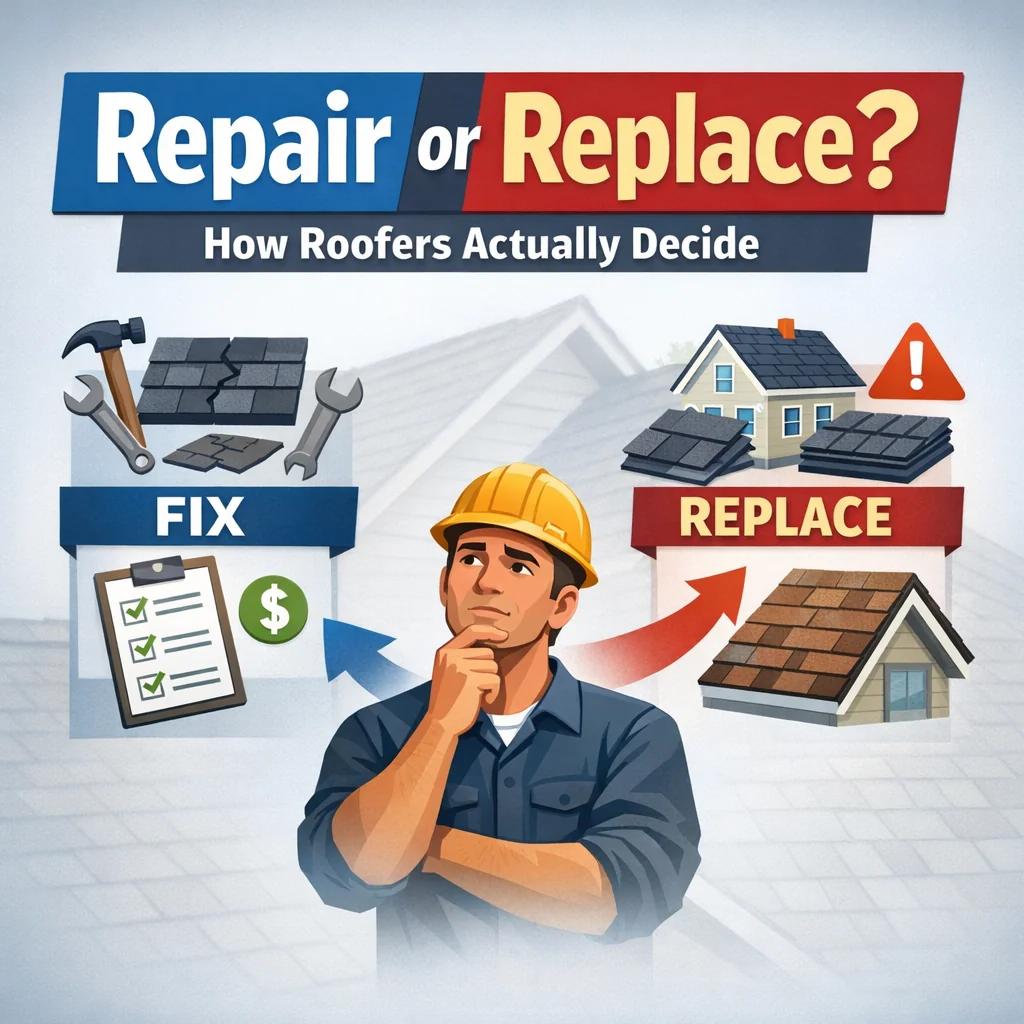
Deciding between repairing and replacing a roof is not a consumer checklist exercise. It is a sequential diagnostic process, and some conditions disqualify the repair option before you even get to age or shingle count. Our roofing service covers the full range of those outcomes, from targeted repairs to complete roof replacements, depending on what the inspection reveals.
Before considering any other factor, a qualified inspector looks for structural problems. Deck rot in multiple locations, sagging between rafters, or compromised structural members mean the underlying system has failed. No surface repair addresses that. A 12-year-old roof with deck rot in two locations fails the repair test on structural grounds, even though its age would otherwise make it a repair candidate.
If no disqualifying structural issues exist, the evaluation moves to the remaining variables.
Two of the most commonly cited repair-versus-replace criteria cannot be accurately assessed by a homeowner:
Granule loss severity. Looking at your shingles from the ground or even from a ladder doesn’t give you a reliable read on how much granule coverage remains. Granules protect the asphalt layer from UV degradation. Significant granule loss dramatically shortens remaining roof life, but quantifying it requires trained eyes and often physical testing.
Percentage of affected decking. The “25% of shingles affected” threshold cited by many contractors assumes damage is distributed evenly. Damage concentrated around a valley or ridge line is disproportionately serious, because those are the highest-stress areas of the roof. The same percentage of affected area means something very different depending on where it is located.
| Indicator | Lean Toward Repair | Lean Toward Replacement |
|---|---|---|
| Roof age | Under 15 years | 20+ years |
| Damage scope | Isolated, single area | Multiple areas or widespread |
| Deck condition | Solid, no rot | Rot present in any location |
| Granule loss | Minimal, localized | Significant, widespread |
| Flashing condition | Intact, sealing well | Failing at multiple points |
| Repair-to-replace ratio | Well under 50% of replacement | Approaching or exceeding 50% |
Use this table as a starting point for the conversation with your contractor, not as a final answer. The variables interact. An older roof with one isolated issue in good condition elsewhere is a different situation from a mid-age roof with moderate problems across several areas. The right contractor will walk you through each variable and explain their reasoning, not just hand you a recommendation.
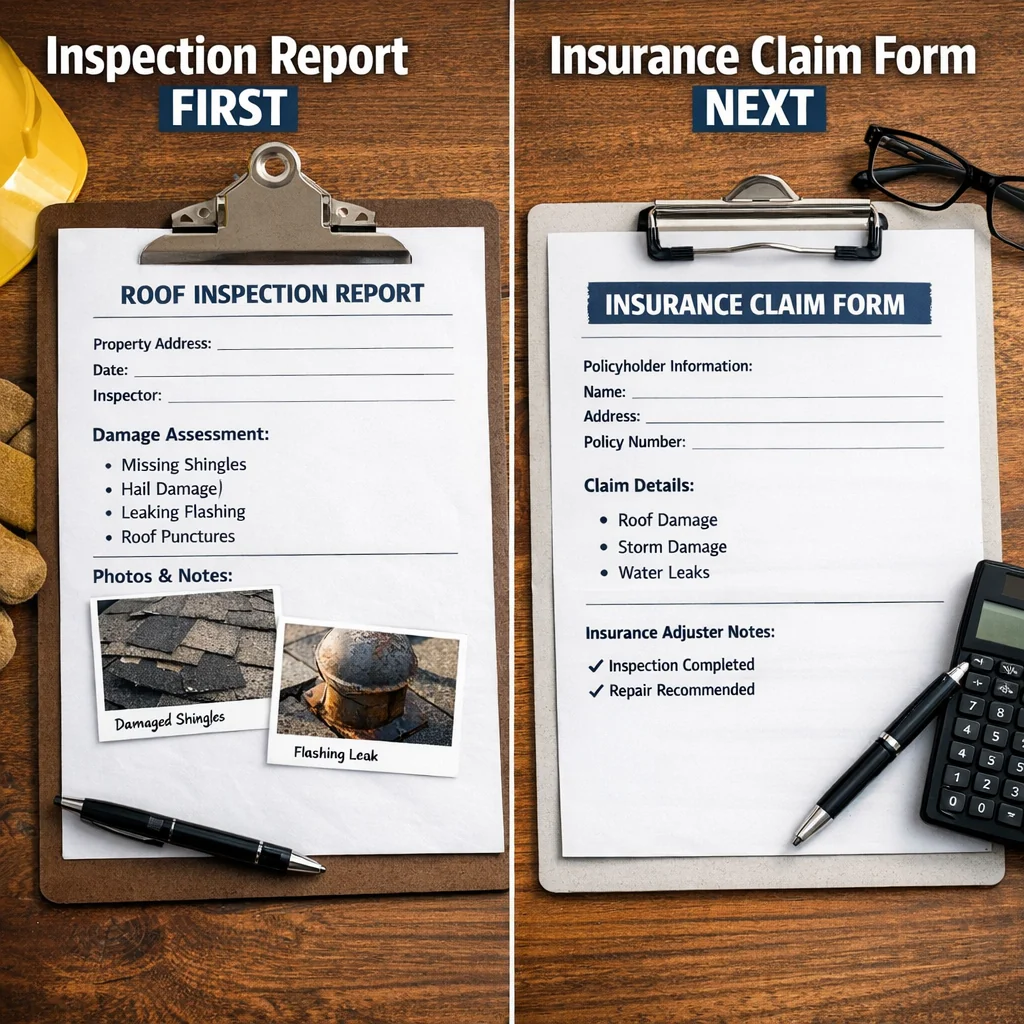
Many roofing repair contractors offer to assist with insurance claims, and that assistance is genuinely valuable when it is done correctly. What most contractors don’t explain is where homeowners get into trouble.
Filing an insurance claim before receiving a contractor’s documented damage report is a common and costly mistake. Here’s why: insurance adjusters conduct their own assessment, and without an independent contractor report in hand, you have no way to verify or dispute their findings in the moment. If the adjuster’s assessment undervalues the damage, you may accept a settlement that doesn’t cover the actual repair scope. For a deeper look at how to handle storm-related damage situations, our article on wind damage repair covers what homeowners should know before and after a weather event.
The correct sequence is:
Smithrock Roofing works with homeowners through this process regularly. We document damage thoroughly before any claim is filed, and we communicate directly with adjusters when needed. Our goal is to make sure the scope of work matches the actual scope of the damage, so nothing gets left out.
The contractors most likely to cut corners are those with no local reputation to protect. Storm-chasing contractors follow severe weather events from region to region, offering quick work at attractive terms, then moving on before any installation issues surface. By the time a problem appears, they are unreachable.
The simplest protection against that scenario is choosing a contractor with a verifiable, established local presence. Look for:
Smithrock Roofing has served homeowners across Winston-Salem, roofing in Greensboro, High Point, Kernersville, Clemmons, Rural Hall, King, and the surrounding NC Triad for years. Our A+ BBB rating and more than 350 five-star Google reviews reflect that track record. We are not going anywhere, which is exactly what makes our warranties meaningful and our commitment to your home real.
When you’re ready to have your roof evaluated, we’ll give you a straight assessment, clear documentation, and honest guidance, whether that leads to a simple repair or a full replacement.
See also: Flat Roof Contractors: Hire Right, Avoid Costly Mistakes
The answer depends on factors like the age of the roof, the extent of the damage, and whether the underlying decking has been compromised. A contractor who inspects the roof in person can tell you whether isolated repairs will hold long-term or whether the damage is widespread enough that replacement makes more financial sense over time. A thorough written inspection report gives you a clear basis for that decision.
Most residential repairs are completed in a single day, though the timeline depends on the size of the damaged area, the materials involved, and weather conditions at the time of scheduling. Larger repairs that involve decking replacement or significant flashing work may require additional time. Your contractor should be able to give you a realistic timeframe after the initial inspection.
Coverage depends on the cause of the damage and the terms of your specific policy. Damage caused by sudden events like storms, hail, or fallen trees is generally covered, while damage attributed to age or lack of maintenance typically is not. Having a qualified contractor document the damage in writing before you file gives your claim the strongest possible foundation.
Stay safe and avoid going onto the roof yourself. Document what you can see from the ground or through windows, including any interior water intrusion. Contact a local, licensed roofing contractor as soon as possible to inspect the damage and provide a written report before any work begins. Avoid signing agreements with contractors who approach you unsolicited after a storm.
Homeowners across Winston-Salem and Kernersville know that roofing problems don’t wait for a convenient moment, and neither do we. Smithrock Roofing brings years of local experience, honest assessments, and documented workmanship to every job, backed by an A+ BBB rating and a community reputation that we stand behind long after the project is complete. If your roof needs attention, reach out today at (336) 971-0464 or Contact Smithrock Roofing to schedule your free estimate.

Smithrock Roofing © Copyright 2026 • All Rights Reserved • Privacy Policy • Maintained by Mongoose Digital Marketing