
When planning a gutter replacement or new installation, gaining a clear understanding of the factors that determine your seamless gutter cost is essential for planning and decision-making. Even though you won’t be doing the fabrication yourself, knowing what drives the final figure helps you ask informed questions, compare estimates fairly, and choose a solution that safeguards your home for the long term.
Seamless gutters are more than simple channels—think of them as a precision-engineered water management system. Their job is to collect and direct rainwater away from your roof, siding, and foundation. By preventing uncontrolled runoff, a well-designed system helps you avoid soil erosion, basement moisture, siding stains, and structural issues that can arise when water repeatedly saturates the soil around your home. Unlike sectional systems, which are assembled from short segments, seamless gutters are custom-formed on-site in long, continuous runs that match your home’s exact dimensions. Fewer joints mean fewer opportunities for leaks, better debris flow, and a cleaner, more cohesive appearance along the roofline.
A thoughtful investment in seamless gutters pays dividends in resilience and reliability. Many homeowners choose seamless systems for their long service life, reduced maintenance needs, and superior performance in heavy rain. Over time, the risk reduction alone—fewer leaks, less fascia damage, minimized foundation and landscaping issues—often outweighs the higher upfront investment compared to basic sectional gutters.
Because every home is unique, your total project cost will vary. Key factors include material type (and its longevity), total linear footage required, the complexity of your roofline and fascia, the number and size of downspouts, the need for structural repairs, and whether you opt for upgrades like gutter guards or oversized profiles. Installation logistics—such as home height, access, and regional labor conditions—also play a role.
This guide explains each variable with clarity and depth. You’ll learn how materials compare in real-world durability, which gutter sizes and styles best suit your rainfall conditions, how installers plan slopes and downspout layouts, and which add-ons truly impact performance. We also outline site preparation, safety, quality assurance, and maintenance practices that extend gutter life. Our goal is to equip you with practical knowledge so you can make confident decisions that align with your home’s needs and your long-term plans.
Seamless gutters represent a significant advancement in home water management technology. At Smithrock Roofing, we prioritize durability, reliable performance, and attractive appearance—seamless gutters deliver on all three.
Unlike traditional sectional gutters that come in pre-cut 10- to 20-foot lengths, seamless gutters are fabricated from a continuous coil of metal on-site. This is accomplished using a specialized portable roll-forming machine, typically mounted in the installer’s truck or trailer. The process is a marvel of precision: the flat metal coil is fed into the machine, which uses a series of rollers to shape it into the desired gutter profile (like K-style or half-round) in one continuous piece. Each run is formed to your home’s exact roofline measurements, with joints existing only at corners, end caps, and downspout connections. This custom-fit construction dramatically reduces the number of potential leak points from dozens down to just a few.
Functionally, all gutters serve the same primary purpose: to collect rainwater from the roof and channel it to downspouts, which then direct the water safely away from your home’s foundation. Without an effective gutter system, uncontrolled water can cause a cascade of expensive problems, including soil erosion around the foundation, unsightly stains on siding, water infiltration into basements and crawlspaces, and even long-term structural issues. The smooth, uninterrupted interior of a seamless trough allows leaves, pine needles, and other debris to flow more freely toward the downspouts, significantly reducing the likelihood of clogs compared to sectional gutters where debris snags on the seams.
Beyond their superior function, seamless gutters offer a notable improvement in curb appeal. Their clean, uniform lines provide a crisp, finished look along the fascia, free from the visual interruption of multiple joints. With a wide array of factory-applied color finishes, you can choose a color that perfectly matches or elegantly accents your home’s exterior trim. For a more distinguished look, premium materials like copper and zinc develop a beautiful, natural patina over time, adding unique character.
A complete seamless gutter system is more than just the trough; it includes engineered hangers for support, properly sized outlets for drainage, strategically placed downspouts, and termination details like splash blocks or underground drain connections. Crucially, it must be integrated with the roof’s drip edge to ensure water flows into the gutter rather than wicking behind it.
The result is a highly stable and reliable system. Fewer mechanical joints mean less vulnerability to expansion and contraction during temperature swings. Hidden hangers, when properly installed, provide immense strength to resist storm forces and support heavy snow loads. This combination of features leads to fewer leaks, lower maintenance requirements, better performance in heavy weather, and an enhanced appearance—a practical and valuable upgrade for any home.
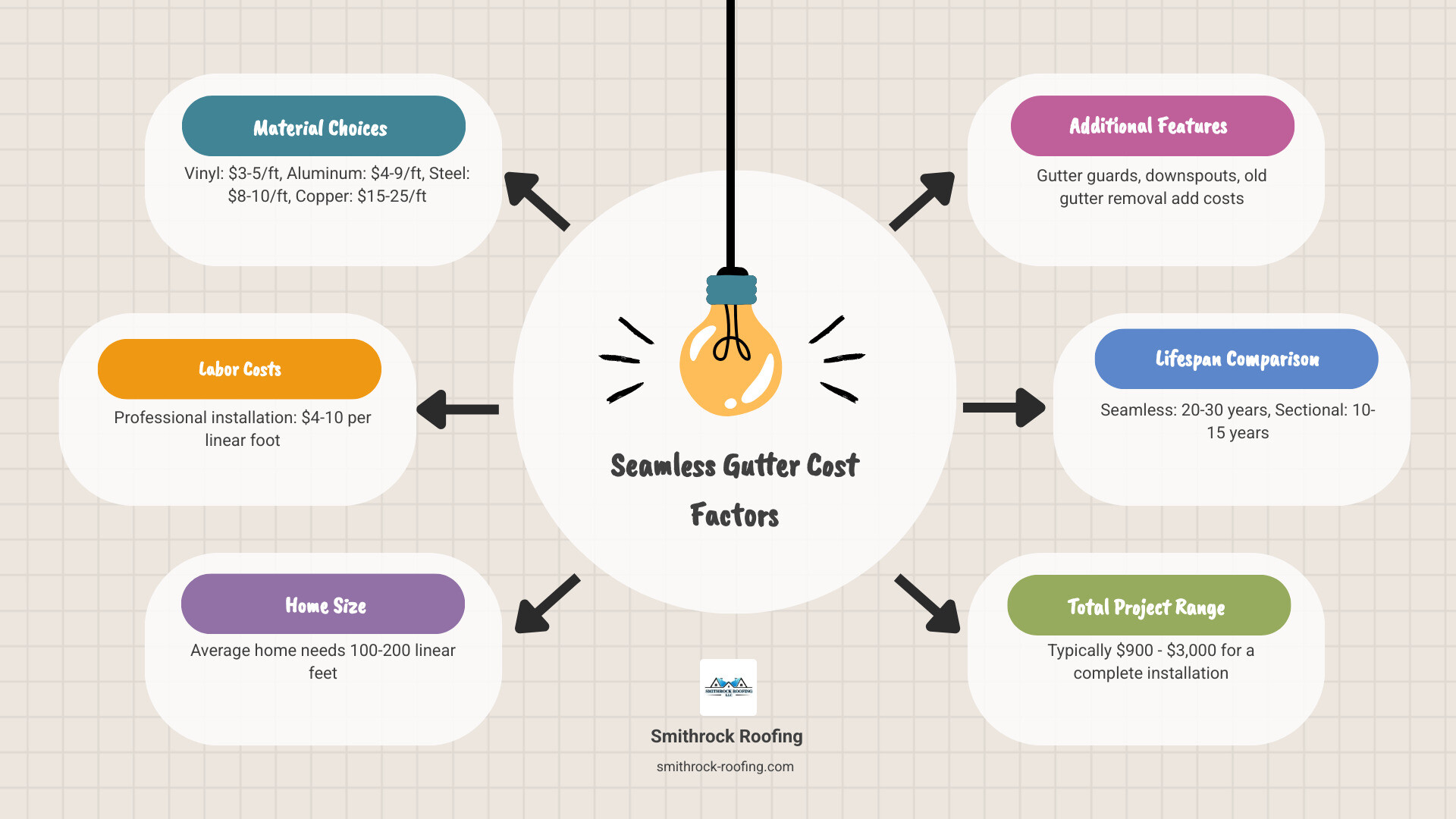
Understanding the variables that shape your seamless gutter cost is the first step toward planning an effective and affordable project. At Smithrock Roofing, we provide transparent, detailed proposals that show exactly how materials, labor, and your home’s specific characteristics contribute to the final investment. For more information, visit our More info about Gutters page.
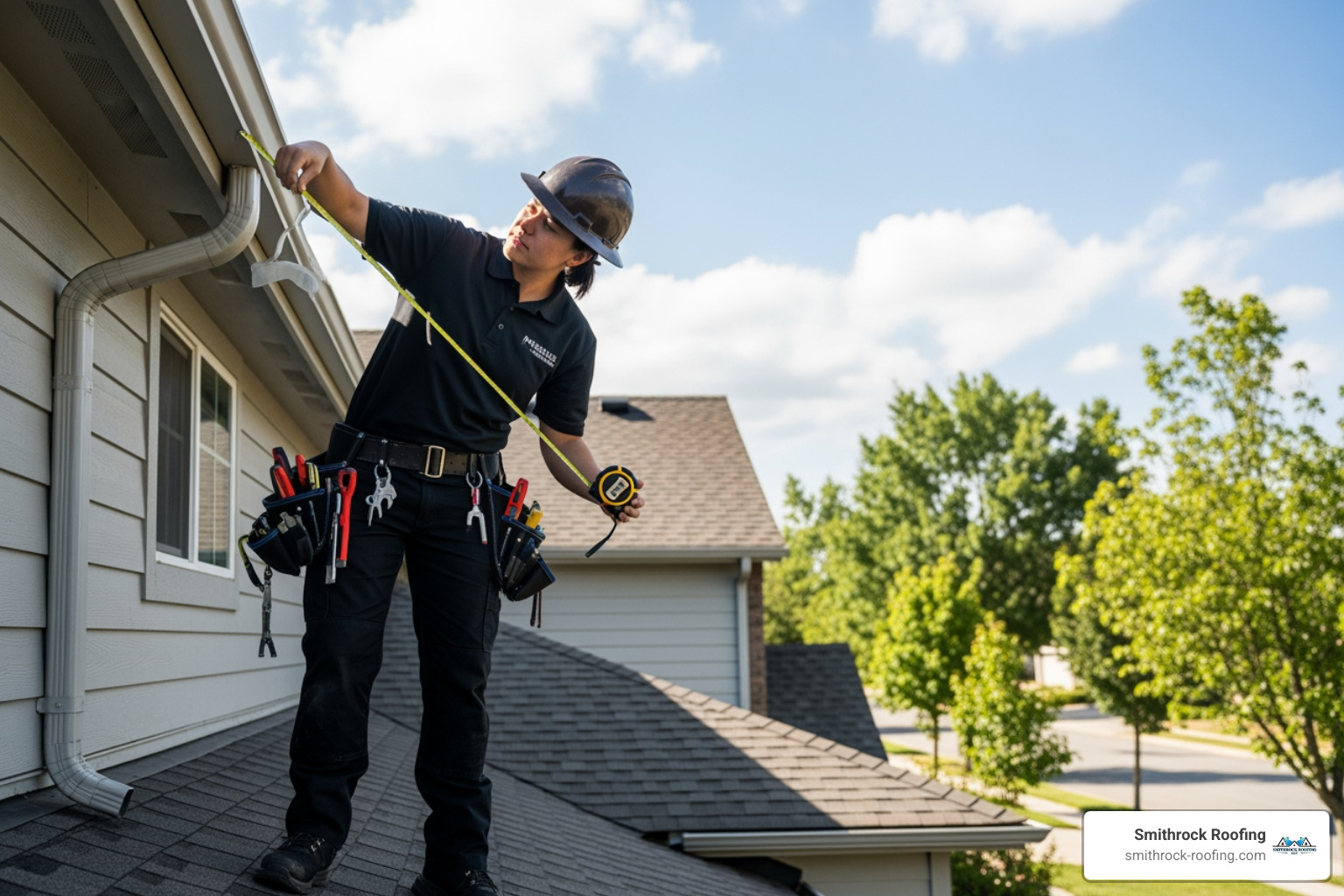
Your choice of material is the single largest factor determining both the initial cost and the long-term durability of your gutter system. According to the National Association of Home Builders, selecting the right material for your climate and budget is crucial for lasting home protection.
Seamless gutters are not a DIY product; they require trained professionals with specialized equipment. The cost of labor reflects this expertise and includes several critical tasks:
The complexity of your home’s architecture heavily influences labor costs. A simple rectangular ranch house is far less expensive than a multi-story home with numerous dormers, gables, and complex roof planes that require more cuts, corners, and setup time.
Beyond the core factors of material and labor, the final cost of your seamless gutter project is influenced by the specific styles, sizes, and accessories you choose. These elements are critical for tailoring the system’s performance to your home’s unique needs.
For the vast majority of homeowners, the answer is a resounding yes. While the upfront seamless gutter cost is higher than for sectional DIY systems, they deliver tangible, long-term benefits in performance, durability, and aesthetics that accumulate over the life of your home.
Seams are the Achilles’ heel of traditional gutter systems. They are the most common failure points, prone to separating, leaking, and snagging debris. By eliminating up to 95% of these joints, seamless gutters inherently reduce the opportunities for failure. This structural integrity translates directly into a longer, more reliable service life, especially when installed with high-quality hangers, corrosion-resistant fasteners, and proper flashing integration.
Material choice further enhances this durability. Modern aluminum resists corrosion and offers an excellent strength-to-weight ratio. Galvanized steel provides robust impact resistance in harsh environments. Premium metals like copper and zinc offer exceptional longevity, often lasting 100 years or more, and age gracefully. Regardless of the metal, sound installation practices—including correct slope for drainage, strong attachment into solid substrate, and expertly sealed corners—are paramount to maximizing the system’s lifespan.
Seamless systems are significantly lower-maintenance than their sectional counterparts. The smooth, continuous trough allows leaves, twigs, and other debris to wash through to the downspouts with less chance of getting caught on a seam. While no gutter is truly “maintenance-free,” the combination of smooth runs, adequate slope, and properly sized downspouts dramatically reduces the frequency of clogs and the need for cleaning. When paired with a high-quality gutter guard system, many homeowners find that their maintenance routine shifts from frequent, messy cleanouts to simple, periodic inspections.
A simple care regimen—visual checks after major storms, spring and fall inspections, and timely resealing of the few corner and end-cap joints every 5-10 years—is all that’s needed to keep the system in top condition. Protecting the system from ladder damage by using a standoff and avoiding harsh chemical cleaners on finished surfaces also preserves its appearance and function.
This is where the true value of a high-performing gutter system becomes clear. Uncontrolled rainwater can cause a chain reaction of costly problems: fascia and soffit rot, stained and damaged siding, damp basements or crawlspaces leading to mold, foundation settlement issues from saturated soils, and erosion of your expensive landscaping. A properly designed seamless system is your home’s first line of defense, mitigating these risks by capturing every drop of roof runoff and directing it to a safe location away from the structure. In heavy rain, larger 6-inch gutters and oversized 3×4-inch downspouts prevent overflow, and strategically placed outlets ensure no single gutter run is overloaded.
Seamless gutters create a cohesive, tailored look that enhances any home’s exterior. Their uniform runs and hidden hangers present a clean, crisp line along the roof edge that looks far more polished than seamed gutters. With a vast selection of colors and premium metals like copper or zinc, you can perfectly match your trim for a subtle look or create a distinctive architectural accent.
This improvement is not just cosmetic; it translates to real value. Prospective buyers often view a well-maintained, robust gutter system as a sign of a carefully cared-for home and a crucial safeguard for the foundation and exterior. A new, high-quality seamless gutter system is a positive feature in a home inspection report and can contribute to a higher resale value and faster sale. The return on investment (ROI) is realized not only in increased property value but also in the thousands of dollars saved by preventing water damage repairs over the years.
The durable metals used in seamless gutters are highly sustainable. Aluminum, steel, and copper are among the most recycled materials on the planet. At the end of their long service life, your old gutters can be fully recycled, reducing landfill waste and supporting a circular economy. Furthermore, by effectively managing rainwater, a seamless gutter system is the perfect starting point for responsible water harvesting. Connecting downspouts to rain barrels or larger cisterns (where permitted) allows you to capture free, naturally soft water for irrigating your garden and landscape, reducing your reliance on municipal water. Finally, by preventing moisture intrusion into your home’s structure, gutters help protect building materials from premature decay and reduce the energy-wasting dampness that can lead to mold and mildew, lowering the long-term environmental impact of home maintenance and repairs.
A successful gutter replacement project is the result of careful planning, smart budgeting, and professional execution. Smithrock Roofing is committed to guiding you through every step, from the initial assessment to the final walkthrough.
To make an informed decision, you should obtain at least two to three detailed, written estimates from reputable, insured contractors. A professional estimate should be a comprehensive document, not just a single number. Insist on a proposal that clearly defines:
Always confirm the contractor’s credentials, including their license, liability insurance, and workers’ compensation coverage. Our Gutter Installation Services page outlines our commitment to transparent communication and thorough documentation.
While DIY sectional gutters are an option from big-box stores, true seamless gutters require professional installation for several non-negotiable reasons:
Seamless gutters are custom-fabricated in continuous lengths on-site to match each specific roof edge. This means they have joints only at corners, end caps, and downspout outlets. Sectional gutters, typically sold at home improvement stores, are assembled from pre-cut 10-foot or 20-foot pieces. This results in numerous seams along every straight run, with each seam being a potential point of failure for leaks, separation, and debris clogs. The minimal seams in a seamless system lead to superior performance, fewer leaks, reduced maintenance, and a much cleaner, more professional appearance.
Service life depends heavily on the material, quality of installation, local climate, and maintenance routine. With proper care, you can expect the following lifespans:
Sizing is a critical calculation based on your roof’s drainage area, its pitch (steepness), the number of roof planes feeding into a single gutter run, and your local rainfall intensity. A 5-inch K-style gutter is generally adequate for smaller roofs with average pitch in moderate climates. However, 6-inch gutters are strongly recommended for homes with large or steep roofs, complex rooflines with multiple valleys concentrating water, or in regions that experience frequent, intense downpours. A 6-inch gutter can handle nearly 40% more water volume, providing a crucial safety margin against overflows that can damage your home’s foundation and siding.
Gutters must be pitched slightly toward the downspout outlets to ensure water drains completely and doesn’t pool. Stagnant water can lead to corrosion, mosquito breeding, and added weight. The industry standard slope is about 1/16 to 1/8 inch of fall for every foot of horizontal run. For a 40-foot gutter run, this translates to a total drop of 2.5 to 5 inches from the high end to the low end. A skilled installer can achieve this functional slope while keeping the gutter line looking aesthetically straight from the ground.
In areas with mature trees, a twice-yearly cleaning schedule (late spring and late fall) is a good baseline. It’s also wise to perform a quick visual inspection after any major storm. If you install an effective, high-quality gutter guard system, you can drastically reduce this chore. However, you should still plan for periodic inspections (at least annually) to ensure the guards are clear of fine debris and that the downspouts are flowing freely.
For many homeowners, yes, high-quality gutter guards are a worthwhile investment that pays for itself in reduced maintenance and improved performance. However, not all guards are created equal. Their effectiveness depends on the type of guard, the specific debris in your area (e.g., large leaves vs. fine pine needles), and the quality of the installation. Here’s a breakdown of common types:
Factory-applied finishes on aluminum and steel gutters are very durable and designed for long-term color stability. If you decide to change the color years later, it is possible to paint them. Proper preparation is key: the surface must be thoroughly cleaned, scuffed, and primed with a bonding primer suitable for metal before applying a high-quality exterior-grade paint. Copper and zinc are almost always left unpainted to allow them to develop their natural, protective patina, which is a primary reason for choosing these materials.
Proper integration is non-negotiable for a water-tight system. A metal drip edge must be installed at the eave of the roof, extending over the gutter so that water is directed into it, not behind it. When a roof plane terminates against a vertical wall, a piece of L-shaped flashing called a “kickout” or “diverter” flashing is essential. It must be installed at the bottom of the roof-wall intersection to direct water out and into the gutter, preventing it from running down the wall and causing extensive water damage.
Not always, but usually. Gutters are strongly recommended on any roof edge where runoff could damage siding, erode landscaping, or saturate the soil near the foundation. In some cases, a small upper roof that sheds water onto a larger lower roof (which has its own gutter) may not need a separate gutter. However, it’s always best to err on the side of caution and control water at every point it leaves the roof.
Building codes vary by location. While many jurisdictions do not have a specific mandate requiring gutters on single-family homes, they are universally recognized as a best practice in building science for managing bulk water and protecting the structure. Furthermore, if you live in an area with expansive clay soils, controlling moisture around the foundation is critical, making gutters an essential component.
In cold climates, ice dams form when heat escaping from the attic melts snow on the roof, which then refreezes at the colder eaves. Gutters do not cause ice dams, but they can be damaged by them and can hold the ice that forms. The primary defense against ice dams is proper attic insulation and ventilation to keep the roof deck cold. In heavy snow regions, installing snow guards on the roof can prevent large, heavy sheets of snow from sliding off and tearing the gutters away.
A common myth is that copper gutters increase lightning risk. This is false. A building’s height, location, and proximity to other tall objects are the determining factors for lightning strikes, not the material of its gutters. If a lightning protection system is installed on a building, all metal components, including gutters, should be properly bonded to it per safety standards.
Absolutely. Seamless gutters are an ideal component for a rainwater harvesting system. Their smooth interior and fewer joints deliver cleaner water to your rain barrels or cisterns. For best results, the system should include leaf screens, a first-flush diverter (to discard the initial, dirtier runoff), and proper filtration to ensure the collected water is suitable for non-potable uses like gardening.
Overflow, or “overshooting,” can happen in heavy rain, especially at the bottom of roof valleys where water is concentrated. Solutions include using larger 6-inch gutters, adding more downspouts to increase drainage capacity, and installing splash guards at inside corners and valley locations to contain the high-velocity flow.
Look for clear signs of failure: visible cracks, holes, or rust spots; peeling paint on or around the gutters (a sign of water damage); water marks or mildew on your fascia boards; sagging or gutters pulling away from the house; frequent seam failures and leaks; and pooling water or erosion around your foundation. If repairs are becoming frequent and costly, a full replacement is the more economical long-term solution.
Yes, and they are often the best choice. Half-round gutters in copper, zinc, or painted aluminum are frequently used to maintain the architectural integrity of historic homes. A skilled installer will pay close attention to period-appropriate details and use care to work with existing fascia and trim. If the home was built before 1978, lead-safe work practices are essential when disturbing old painted surfaces.
A professional crew will take precautions to protect your property. This includes using ladder stabilizers to avoid resting on the roof or gutters, using drop cloths to protect plants and hardscaping below the work area, and performing a thorough cleanup of all job-related debris.
Never lean a ladder directly against the front of a gutter; it will dent or deform it. Always use a ladder standoff or stabilizer that rests on the roof. Don’t use a pressure washer to clean gutters, as the high-pressure stream can force water behind siding and into soffits. Avoid using sharp metal tools to chip ice out of gutters, as this can easily puncture the metal or scrape off the protective finish.
High winds can create uplift forces that stress hangers and fasteners. This is why secure attachment is critical. Using screws instead of nails and ensuring proper hanger spacing provides superior resistance to wind loads. In hurricane-prone coastal regions, contractors may use even closer hanger spacing and reinforced attachment methods.
Most average-sized residential projects can be completed in a single day. Larger, more complex homes or projects that require significant fascia repair may take two days. Your contractor will provide a more precise timeline based on your specific project.
In most cases, a permit is not required for a straightforward gutter replacement. However, requirements vary by municipality. A permit might be needed if the project involves structural repairs to the roof framing or fascia, or if you are installing electrical components like heat cables. Your contractor should be aware of local regulations.
Gutters and solar panels can coexist without issue. When planning a solar installation, consider the layout of downspouts to ensure they don’t interfere with conduit runs or equipment. If adding panels to an existing roof, it’s a good idea to have a gutter professional assess if the panel layout will alter or concentrate water flow in a way that might overwhelm the current gutter system.
High-quality, factory-applied polyester or Kynar finishes on aluminum and steel gutters are engineered to be highly resistant to UV degradation, chalking, and fading. Choosing a reputable manufacturer and material will ensure the color remains vibrant for many years. Light, periodic cleaning with a mild detergent and water can help maintain the finish’s longevity.
Seamless gutters are a proven solution for managing rainfall, defending foundations and exterior finishes, and elevating curb appeal. The final configuration—materials, profile and size, downspout layout, flashing integration, and accessories—should be tailored to your home’s architecture and local climate. For a professional assessment, a detailed, itemized estimate, and expert installation, trust the team at Smithrock Roofing. Learn more about our Seamless Gutter Installation services and explore all of our Gutter solutions. We look forward to helping you design a system that performs beautifully for years to come.

Smithrock Roofing © Copyright 2026 • All Rights Reserved • Privacy Policy • Maintained by Mongoose Digital Marketing