A strong storm rolls through, and by the time it’s over, you’re already scanning your yard for debris. Maybe you see a few shingles on the lawn. Maybe the roof looks untouched from where you’re standing. Either way, the next decision you make, and how quickly you make it, can be the difference between a contained repair and a whole lot more damage than the storm ever caused on its own.
This guide is not your standard checklist. We’re going to walk through how storm damage actually progresses, what your insurance policy language really means, and exactly what a legitimate repair scope should look like, so you can move forward with confidence rather than guessing.
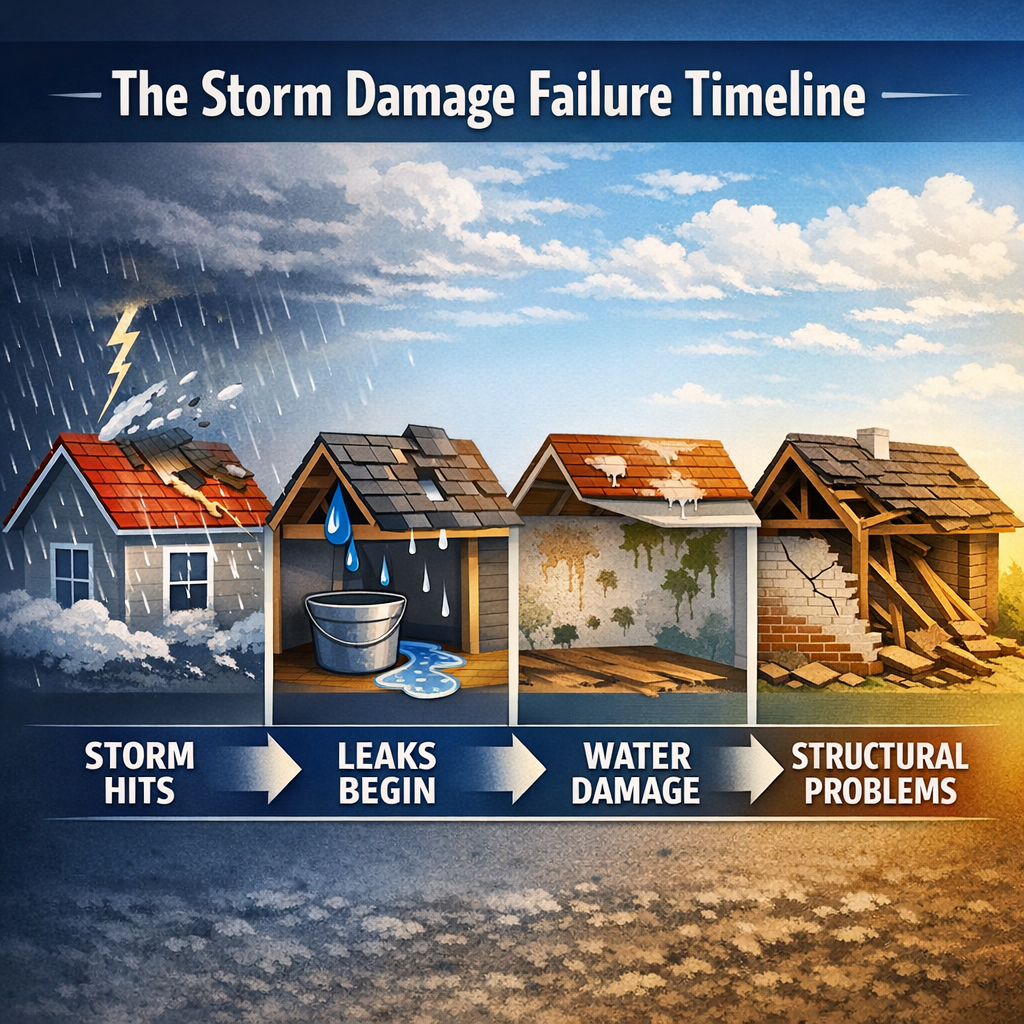
Most homeowners think of storm damage as a fixed event: the storm hit, something broke, now you fix it. That framing is understandable but misleading. Storm damage is a starting point, not a destination. What happens in the days and weeks after the storm often determines how extensive, and how expensive, the problem becomes.
When wind lifts a shingle tab and breaks the factory sealant bond, it doesn’t simply create a gap. It creates a cyclic fatigue point. Every subsequent wind event, even a moderate gust, flexes that tab further, fracturing the asphalt coating incrementally. The shingle may look attached from the ground. It may even look okay from the rooftop. But the bond is gone, and moisture now has a path in.
Here’s where the mechanical reality gets important: water entering a compromised roof does not drip straight down. It wicks laterally through the underlayment felt, traveling 8 to 12 feet horizontally before finding a penetration point or seam. It saturates wood decking from beneath, entirely out of view from any surface inspection. By the time a water stain appears on your ceiling, the structural deck may have been wet for weeks.
This is the failure timeline every homeowner in the Triad should understand:
| Time After Storm | What’s Happening Inside Your Roof |
|---|---|
| 0 – 72 Hours | Sealant failure occurs; water entry begins at the compromise point; underlayment begins absorbing moisture |
| 1 – 2 Weeks | Underlayment saturation spreads laterally; wood decking begins to swell and soften at affected zones |
| 3 – 6 Weeks | Deck delamination starts; mold colonization is possible in warm, humid conditionscommon in NC summers |
| 2 – 3 Months | Structural rafter compromise becomes possible; what began as a shingle issue is now a structural one |
This is why a professional moisture meter reading of the decking is non-negotiable after any significant storm event. A visual inspection, from the ground or even from the roof surface, misses the majority of consequential damage at the stage when it’s still inexpensive to address.
Every article on this topic recommends a post-storm walk around your home to look for obvious signs of damage. That’s reasonable as an orientation exercise. But it creates a false sense of security when it becomes the basis for deciding whether professional assessment is needed.
The damage profile most likely to cause serious long-term structural harm, underlayment compromise without visible surface shingle loss, is completely invisible from the ground. It’s frequently invisible even from the roof surface without physical probing and moisture measurement. If a hail event came through your area and your roof “looks fine,” that assessment is based on incomplete information until a professional has taken readings.
Need a hand with this in Winston-Salem, Greensboro and the NC Triad? Call (336) 971-0464 or request a free estimate. Honest answers, no pressure.
One of the biggest gaps in online content about storm damage is that no one gives homeowners a structured way to think through whether repair is the right call or whether replacement is the smarter long-term move. You’ll find vague statements like “extensive damage may require full replacement”but no actual threshold logic.
Here’s how that decision actually works at the professional level.
Repair is appropriate when damage is genuinely isolated: a specific section of missing or cracked shingles, a single piece of failed flashing, or a localized impact zone where the surrounding roof system is intact and in reasonable condition. The key phrase there is intact and in reasonable condition.
A repair placed over deteriorated underlayment or compromised decking does not restore your roof’s performance. It restores its appearance while the underlying failure continues progressing. This is one of the most common patterns we see, a homeowner had a repair done after a storm two years ago, and now a leak is appearing well away from the original repair site because the underlayment was never addressed.
Repair is the right call when:
Replacement should be a serious conversation, not a sales pitch, when any of the following are true:
The standard insurance guidance in most storm damage articles, “document everything, call your insurer, get a contractor”is correct as far as it goes. What it leaves out is the part where homeowners discover their payout doesn’t match what they expected. That gap almost always comes down to policy structure, not adjuster error.
The single most consequential factor in a storm damage claim is whether your policy pays Actual Cash Value (ACV) or Replacement Cost Value (RCV). Most homeowners don’t know which they have until the check arrives.
Actual Cash Value (ACV):
Depreciation is applied to your roof based on its age relative to its expected lifespan. A 15-year-old shingle roof with a rated 25-year lifespan may be depreciated by 60%, meaning the insurer pays 40% of the replacement cost. On a significant repair or replacement project, this gap is material. ACV policies often leave homeowners with a substantial out-of-pocket balance.
Replacement Cost Value (RCV):
The policy pays the full cost to restore the roof to equivalent condition using current materials and labor rates. Some RCV policies operate in two stages: an initial ACV-equivalent payment, followed by a depreciation holdback that is released only after the work is completed and the final invoice is submitted to the insurer.
The Cosmetic Damage Exclusion:
This is an increasingly common clause in newer homeowner policies, and it’s one of the most frequently misunderstood. A cosmetic damage exclusion limits or eliminates coverage for damage that doesn’t affect the roof’s functionmeaning visible hail denting, granule displacement, and surface bruising may be denied even when those conditions meaningfully shorten the roof’s remaining service life. If you’re in a hail-prone community, this exclusion deserves a close read before the next storm arrives.
Two questions to ask your insurance agent before filing any claim:
These questions take five minutes and can change how you approach the entire claims process.
Another real-world insurance friction point that rarely gets discussed: adjusters are trained to attribute as much damage as possible to pre-existing wear and tear rather than the storm event. This isn’t necessarily bad faith, it’s standard claims protocol. But it means your contractor’s documentation needs to be specific enough to distinguish storm-caused damage from age-related deterioration.
This is where the quality of your inspection report matters enormously. Vague documentation that simply describes “damaged shingles” gives an adjuster significant latitude to reclassify. Specific documentation, including moisture readings by zone, annotated photographs with identifiable reference points, and decking condition assessments by section, creates a defensible, detailed record that supports your claim. For a deeper look at how to navigate this process, the article Don’t Get Ripped Off: The Essential Steps for Your Roof Insurance Claim walks through exactly what documentation insurers need and how to protect your payout.
Here’s the part no other guide will tell you: there is a specific, verifiable standard for what a professional post-storm inspection report should include. Knowing this standard is what separates homeowners who get accurate scopes from those who get either under-documented estimates (designed to win the bid, then upsell) or inflated scopes (designed to push an unnecessary full replacement).
A legitimate storm damage repair scope should include all of the following:
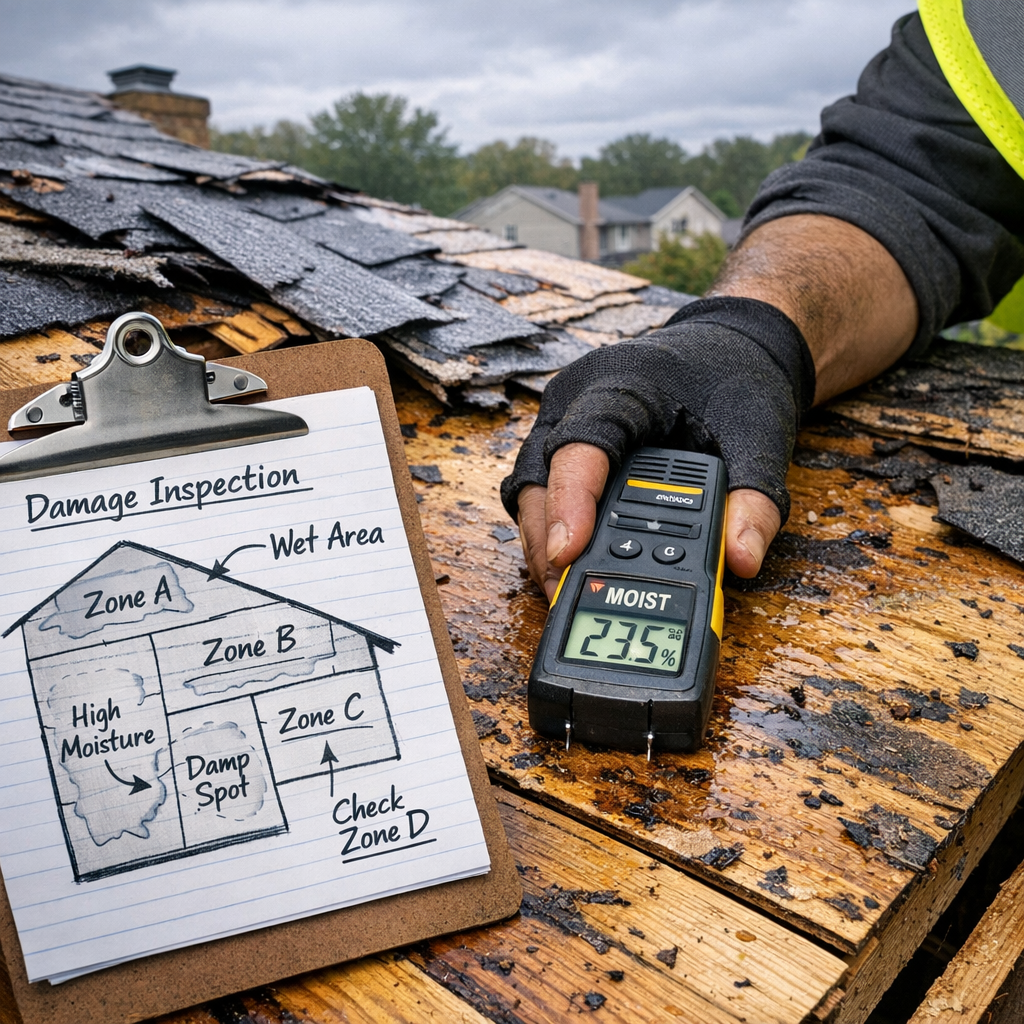
If you receive an estimate that’s missing these components, ask for them in writing before signing anything. A contractor who cannot provide this level of documentation either doesn’t perform inspections at this standard or doesn’t intend to do the work at the level the documentation would imply.
Roofs are covered in most articles as a collection of individual components, shingles, flashing, gutters, underlayment, each addressed in isolation. This framing misrepresents how roofs actually function and why some repairs fail quickly while others hold for decades.
Your roof is an integrated moisture management system. Every component depends on the others performing correctly. When that system is compromised:
The practical implication: a repair scope that addresses only the most visible damage, without evaluating the condition of interconnected components, is a scope that has not fully assessed the problem. It may resolve the immediate symptom while leaving the underlying system failure in place.
This is why working with a contractor who approaches the roof as a complete system, not a list of individual components to be addressed on a line-item basis, matters so much for long-term outcomes.
Our area sees a genuinely varied storm profile. Understanding what different storm types do to roofing systems helps homeowners know what to look for and when an inspection is warranted even when surface damage isn’t obvious.
The area sees hail most frequently in the spring severe weather season, typically March through May, though late-summer convective events bring hail as well. Hail damage to asphalt shingles presents as:
Hail damage is particularly insidious because its effects on service life are cumulative and progressive rather than immediately dramatic. A roof that “looks fine” after a moderate hail event may have lost years of service life due to granule loss and underlying mat damage. The article Hail Damage Roof Repair: What You Can’t See goes deeper on the specific damage patterns that standard inspections miss and why they matter for long-term roof performance.
Straight-line winds and thunderstorm-associated gusts are the most common storm damage cause in our area. Wind damage typically manifests as:
While less frequent than in more northern climates, our area does experience winter ice events that can cause or accelerate roof damage. Ice dam formation, where heat escaping through the attic melts snow that then refreezes at the cold eave overhang, forces water backward under shingles. Homes with inadequate attic insulation or ventilation are the most vulnerable.
After every significant storm event, contractors arrive from out of state to chase the work. Some are legitimate. Many are not. The pattern is consistent: a knock at the door, an offer to inspect for free, pressure to sign an Assignment of Benefits (AOB) agreement, and a request to handle everything so you don’t have to worry.
Here’s what that agreement actually means: you are legally assigning your insurance claim rights to the contractor. They negotiate directly with your insurer, you lose visibility into the process, and disputes between the contractor and the insurer can leave your roof in a disputed state while the legal process plays out.
Protect yourself by following these steps:
Whether you saw shingles come off, had tree limbs make contact with the roof, noticed hail pinging off your windows, or simply aren’t sure whether anything happened, the right first step is the same: have a professional inspection performed before assuming everything is fine or before filing a claim without documentation.
A thorough inspection by an experienced, locally rooted contractor gives you an accurate picture of what the storm actually did to your roof system, not just its surface, and equips you with the documentation you need to navigate the insurance process on solid ground.
Smithrock Roofing has served homeowners across the NC Triad, Winston-Salem, Greensboro, High Point, Kernersville, Clemmons, Rural Hall, King, and the surrounding communities, for decades. Our team carries the CertainTeed PREMIER ShingleMaster certification, meaning our inspections, materials, and installation standards are held to a verified, documented level of quality. With 312+ five-star reviews and an A+ BBB rating, our reputation is local, earned, and something we take seriously on every job.
If a storm has come through your area, don’t wait weeks to find out what it actually did to your roof. Reach out for a professional assessment, and get a clear, honest picture of where things stand.
Interior leaks are often one of the last signs of storm damage to appear, by the time water is getting inside, the damage to your roof system may already be significant. Many serious forms of storm damage, including hail impacts that fracture shingle granules, wind-lifted flashing, and compromised underlayment, are not visible from the ground and produce no immediate interior symptoms. A professional inspection after any major storm is the most reliable way to determine whether damage occurred, regardless of whether you’ve noticed anything inside.
It’s generally better to have a professional inspection completed before filing a claim. Filing a claim without documentation of the damage, or without confirming that damage actually exists, can result in a denied claim, which goes on your insurance record even if no payment is made. An inspection gives you an accurate, documented picture of what the storm did to your roof, which allows you to make an informed decision about whether filing a claim makes sense and gives you supporting evidence when you do.
An Assignment of Benefits (AOB) agreement is a document that transfers your insurance claim rights from you to a third party, typically the contractor presenting it. Once signed, that contractor can negotiate with your insurance company, accept or reject settlement offers, and take legal action against your insurer, all without your direct involvement or consent. Many homeowners who sign AOB agreements discover later that they have lost control of their own claim. You do not need to sign an AOB to work with a contractor. A reputable local contractor will help you navigate the insurance process without requiring you to surrender your rights.
Legitimate local contractors have verifiable roots in your community, a physical business address, a history of local projects, relationships with local suppliers, and a track record that neighbors and review platforms can confirm. Storm chasers typically arrive in force immediately after a major weather event, pressure homeowners to sign quickly, offer unusually broad promises, and are difficult or impossible to reach once the job is done. Before agreeing to any work, verify the contractor’s license with the NC Licensing Board for General Contractors, check their BBB profile, look at the age and location of their reviews, and ask for a local address where they can be reached after the project is complete. For more guidance on evaluating credentials and asking the right questions, see How to Choose the Best Roofing Contractor in Winston-Salem, NC (And What Credentials Actually Matter).
When a storm comes through the NC Triad, the decisions homeowners make in the days that follow, who they call, what they sign, and how quickly they act, have lasting consequences for both their home and their insurance coverage. Smithrock Roofing has spent decades serving Winston-Salem, Greensboro, and the surrounding communities with the kind of honest, accountable workmanship that only comes from a contractor with genuine local roots and a local reputation worth protecting. If your home has been through recent severe weather, don’t leave the outcome to chance, Contact Smithrock Roofing today and get a professional assessment from a team that will still be here long after the storm has passed.

Smithrock Roofing © Copyright 2026 • All Rights Reserved • Privacy Policy • Maintained by Mongoose Digital Marketing