Hail damage siding is one of the most common — and most frequently overlooked — problems homeowners face in the aftermath of a severe weather event. While a battered roof often gets immediate attention because of the obvious threat of a ceiling leak, the vertical surfaces of your home are just as vulnerable to the destructive force of falling ice. Hail damage can range from glaringly obvious structural failures, such as large cracks and missing chunks of material, to incredibly subtle hairline fractures and “bruises” that hide serious moisture problems beneath the surface.
Understanding the nuances of hail impact is essential for maintaining the long-term integrity of your property. When a storm rolls through, it doesn’t just bring rain; it brings kinetic energy. The physics of a hailstorm are actually quite terrifying when you break them down. A hailstone falling from the sky can reach terminal velocities that turn a small piece of ice into a high-velocity projectile. Terminal velocity is reached when the downward force of gravity is balanced by the upward drag force of the air. For a large hailstone, this can exceed 100 miles per hour. When these projectiles strike your siding, they can compromise the “building envelope”—the physical separator between the conditioned and unconditioned environment of a building. Once this envelope is breached, your home is at risk of losing its thermal efficiency and structural stability.
Here’s a comprehensive look at the most common signs of hail damage on siding, categorized by material:
| Siding Type | Common Hail Damage Signs | Technical Implications |
|---|---|---|
| Vinyl | Cracks, splits, chips, buckled panels, “starburst” fractures, and holes. | Loss of water-shedding ability; potential for wind-driven rain to enter wall cavities and rot sheathing. |
| Aluminum | Dents, punctures, chalky oxidation marks, “ping” indentations, and finish scuffs. | Aesthetic degradation; potential for localized corrosion if the protective coating is breached; reduced resale value. |
| Wood | Divots, splintering, chipped paint, moisture stains, grain separation, and cracked shakes. | Exposure of raw wood to UV and moisture, leading to rapid rot, fungal growth, and pest attraction. |
| Fiber Cement | Chipped edges, impact marks, hairline fractures, delamination, and surface crumbling. | Compromised structural rigidity; moisture absorption leading to freeze-thaw damage and board failure. |
Even hailstones that seem relatively small — anything 0.75 inches or larger (roughly the size of a penny) — can cause significant functional damage. When high winds accompany the storm, even smaller stones are propelled horizontally, hitting your siding with enough force to crack, dent, or puncture the material. In the Midwest and the Southeast, where hailstorms are a seasonal reality, the cumulative effect of these impacts can be devastating. The Piedmont Triad region of North Carolina is particularly susceptible to these events due to the collision of warm, moist air from the Gulf and cooler air masses from the north.
The Midwest and regions like the Piedmont Triad see an average of four to six significant hailstorms per year. That represents multiple opportunities annually for damage that, if left unaddressed, can lead to catastrophic water intrusion, toxic mold growth, structural rot, and skyrocketing energy bills. Hail damage is also one of the most frequently filed homeowners’ insurance claims in the United States, yet thousands of claims go unfiled every year simply because the homeowner didn’t realize the damage existed or assumed it was merely a cosmetic nuisance.
The tricky part? A significant portion of hail damage isn’t visible from the ground or under direct midday sun. Some of it doesn’t look like damage at all to the untrained eye — until it manifests as a much bigger, much more expensive problem inside your walls. This guide will walk you through exactly how to identify hail damage on your siding, the scientific factors that influence the severity of a strike, and the professional steps required to restore your home’s protection and aesthetic appeal.
When we discuss Hail in the Piedmont Triad, we aren’t just describing a weather phenomenon; we are describing a mechanical assault on your home. Whether you reside in Winston-Salem, Greensboro, or Kernersville, your siding serves as the primary shield against these icy invaders. However, no shield is invincible, and the way your home reacts to a storm depends entirely on the material it is clad in. Each material has a specific “yield point”—the amount of stress it can take before it permanently deforms or breaks.
The physics of impact vary significantly between materials. For instance, a material with high elasticity might bounce back from a strike, while a brittle material will shatter. Understanding these material-specific vulnerabilities is the first step in a proper home inspection. If you suspect your home has taken a beating, you can find more info about siding repair to understand the technical restoration process required for different substrates. It is not a one-size-fits-all solution; repairing fiber cement requires vastly different tools and techniques than repairing vinyl or aluminum.
Vinyl siding is the most prevalent material in areas like Clemmons and Lewisville due to its cost-effectiveness and low maintenance requirements. However, vinyl is a thermoplastic, meaning its physical properties change with temperature and age. It is designed to expand and contract, but it becomes increasingly brittle as it is exposed to the sun’s ultraviolet rays.
On vinyl panels, hail damage siding often manifests in three distinct ways:
Aluminum siding, while less common in new construction, remains a staple on many homes in High Point and Trinity. Aluminum is a malleable metal, meaning it doesn’t shatter, but it “remembers” every strike. It lacks the “memory” of modern polymers to return to its original shape. After a storm, you should look for:
If you notice these signs, it’s time to act before the next rain cycle. You can read more info about hail damage home repair to see how these issues are addressed professionally to ensure a seamless finish that restores both beauty and function.
Wood siding, including cedar shake and lap siding, offers a timeless aesthetic for homes in places like Mt. Airy and Pilot Mountain. However, wood is an organic material, and hail can be its worst enemy. When hail hits wood, it causes:
Fiber cement, such as James Hardie products, is often touted as the “gold standard” for durability. It is composed of cement, sand, and cellulose fibers, making it incredibly heavy and tough. It is one of the most hail-resistant materials available, but it is not bulletproof. On fiber cement, look for:
Choosing the right material for your next replacement can save you a lot of headaches during the next storm season. For a deeper dive into which material holds up best against the specific climate of the Southeast, check out more info about vinyl vs Hardie board siding.
Not every hailstorm results in a total loss. We’ve seen storms in Bethania and Rural Hall that barely left a mark, and others that looked like a war zone. Several scientific and environmental factors dictate how much damage your siding will actually sustain. Understanding these variables helps explain why your neighbor might need a full replacement while your home appears fine, or vice versa.
One of the biggest hurdles in an insurance claim is distinguishing hail damage from “mechanical damage.” Mechanical damage is a term used by adjusters to describe damage caused by human activity rather than weather. It is a common reason for claim denials if the homeowner cannot prove the damage was storm-related.
Insurance adjusters are trained to look for specific patterns. Hail damage is characterized by its randomness. It will be scattered across an entire elevation, appearing at various heights and intervals. Mechanical damage, conversely, is often localized or follows a linear path. For example:
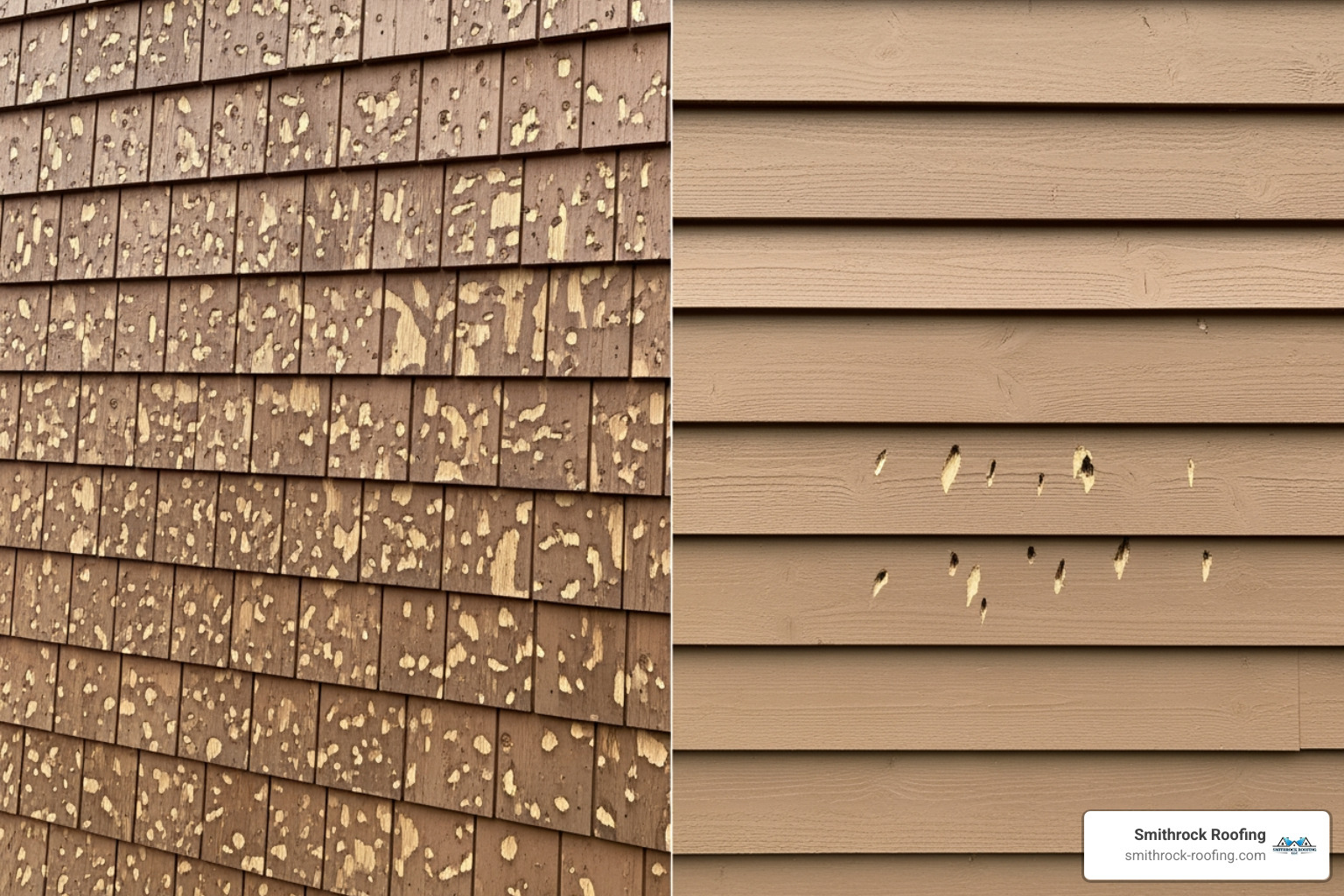
Understanding these differences is vital when preparing for an insurance adjustment. A professional contractor will help you document the widespread nature of the damage to prove it was a weather event rather than a maintenance issue. We look for “collateral damage” on soft metals like downspouts and window wraps to build a bulletproof case for our clients.
It’s tempting to look at a few small dents on your aluminum siding in Tobaccoville and think, “It’s just cosmetic; I’ll deal with it later.” However, this is a dangerous misconception that can lead to long-term financial strain. Hail damage siding is rarely “just” cosmetic because the siding is the first layer of a complex moisture management system designed to protect your home’s skeleton.
When siding is cracked, punctured, or even just loosened, the protective envelope of your home is breached. This leads to several “hidden” problems that can cost tens of thousands of dollars to fix if left for too long:
If you aren’t sure how to proceed after a storm, you can find more info about navigating storm damage repair to help you understand the timeline and the critical steps to take to protect your investment. Delaying action only gives these hidden problems more time to grow.
Filing an insurance claim for hail damage siding can be an intimidating process. Insurance policies are legal contracts filled with complex terminology like “Actual Cash Value” (ACV) and “Replacement Cost Value” (RCV). However, the goal of insurance is to return your home to its “pre-loss condition.” The key to a successful claim is meticulous documentation and a “whole picture” approach that proves the extent of the storm’s impact.
When a professional inspector from Smithrock Roofing visits your home in Advance or Wallburg, they don’t just look at the siding in isolation. They look for “collateral damage” that supports the claim of a significant hail event. If the hail was strong enough to damage the siding, it almost certainly left marks elsewhere. A comprehensive inspection includes:
Should you repair a few panels or replace the entire elevation? This is often the biggest point of contention with insurance companies. They want to minimize costs, while you want your home to look uniform and beautiful.
Lighting is the most critical factor in a DIY inspection. If you try to inspect your siding in the middle of a bright, sunny day in Pinnacle, the direct glare will wash out the shadows, making dents and cracks nearly invisible. The high-noon sun flattens the appearance of the surface.
The Golden Hours: The best time for an inspection is early morning or late afternoon when the sun is low in the sky. This creates “raking light” that casts long shadows into every dent and crease, making them pop out. If it’s an overcast day, that can also be beneficial as the diffused light reduces glare and allows you to see color variations and cracks more clearly.
The Hose Test: If you suspect damage on aluminum or vinyl but can’t see it clearly, try spraying the siding with a garden hose. As the water runs down the panels, it will break around the indentations, highlighting the damage. This is a trick often used by professional adjusters to document damage for the insurance company.
Safety should always be your first priority. Never go outside while it is still hailing or during high winds. Once the storm has passed and it is safe to be outdoors:
You should call a professional if you’ve experienced hail larger than 0.75 inches, if you see any visible cracks, or if you notice your neighbors are having their exteriors inspected. It is important to remember that insurance companies have strict “statutes of limitations” for filing claims. In North Carolina, this window can be anywhere from 6 months to 2 years depending on your specific policy. Waiting too long can result in a denied claim, even if the damage is legitimate. A professional inspection from Smithrock Roofing provides the expert documentation and “proof of loss” needed to ensure your claim is handled fairly and your home is protected. We provide a detailed report that you can hand directly to your adjuster, making their job easier and your claim more likely to be approved.
This is a common fear, but in most states, insurance companies are prohibited from raising your individual rates due to a “catastrophe claim” or an “Act of God.” Hail is a natural event beyond your control. However, rates for an entire zip code may rise after a major storm event regardless of whether you file a claim. Therefore, if your home is damaged, it is in your best interest to file and receive the benefits you’ve been paying premiums for.
Your home is likely your most significant financial investment, and the siding is the primary barrier that keeps that investment safe from the unpredictable elements of the Piedmont Triad. Whether you are in Winston-Salem, Greensboro, or any of the surrounding rural communities like Siloam or Danbury, hail damage siding is a serious threat that requires a proactive and informed response.
Ignoring a few small dents or cracks today can lead to a cascade of structural failures tomorrow, from mold growth to rotted wall studs. At Smithrock Roofing, we pride ourselves on being more than just a roofing company. We are exterior restoration specialists with deep expertise in windows, gutters, and high-performance siding systems. We understand the unique meteorological challenges that North Carolina weather presents, and we know how to navigate the complexities of the insurance industry to ensure our clients get the coverage they deserve.
From the initial inspection to the final piece of trim, we are committed to quality craftsmanship and transparent communication. We offer a wide range of siding solutions, from traditional vinyl to the extreme durability of fiber cement, ensuring your home is better protected than it was before the storm. We don’t just fix the damage; we improve your home’s resilience.
Don’t let a hailstorm compromise your home’s value, its structural integrity, or your family’s comfort. If a storm has recently impacted your area, reach out to us for a comprehensive, no-obligation evaluation. We will provide an honest, detailed assessment and help you navigate the restoration process with confidence. For more details on our full suite of exterior solutions, visit our page for more info about professional siding services. Let us help you turn a stressful storm event into an opportunity to renew and protect your home for decades to come.
Smithrock Roofing © Copyright 2026 • All Rights Reserved • Privacy Policy • Maintained by Mongoose Digital Marketing