Vinyl vs Hardie board siding represents one of the most important decisions you’ll make for your home’s exterior. Your choice affects everything from curb appeal to energy bills to long-term maintenance costs.
Quick Comparison:
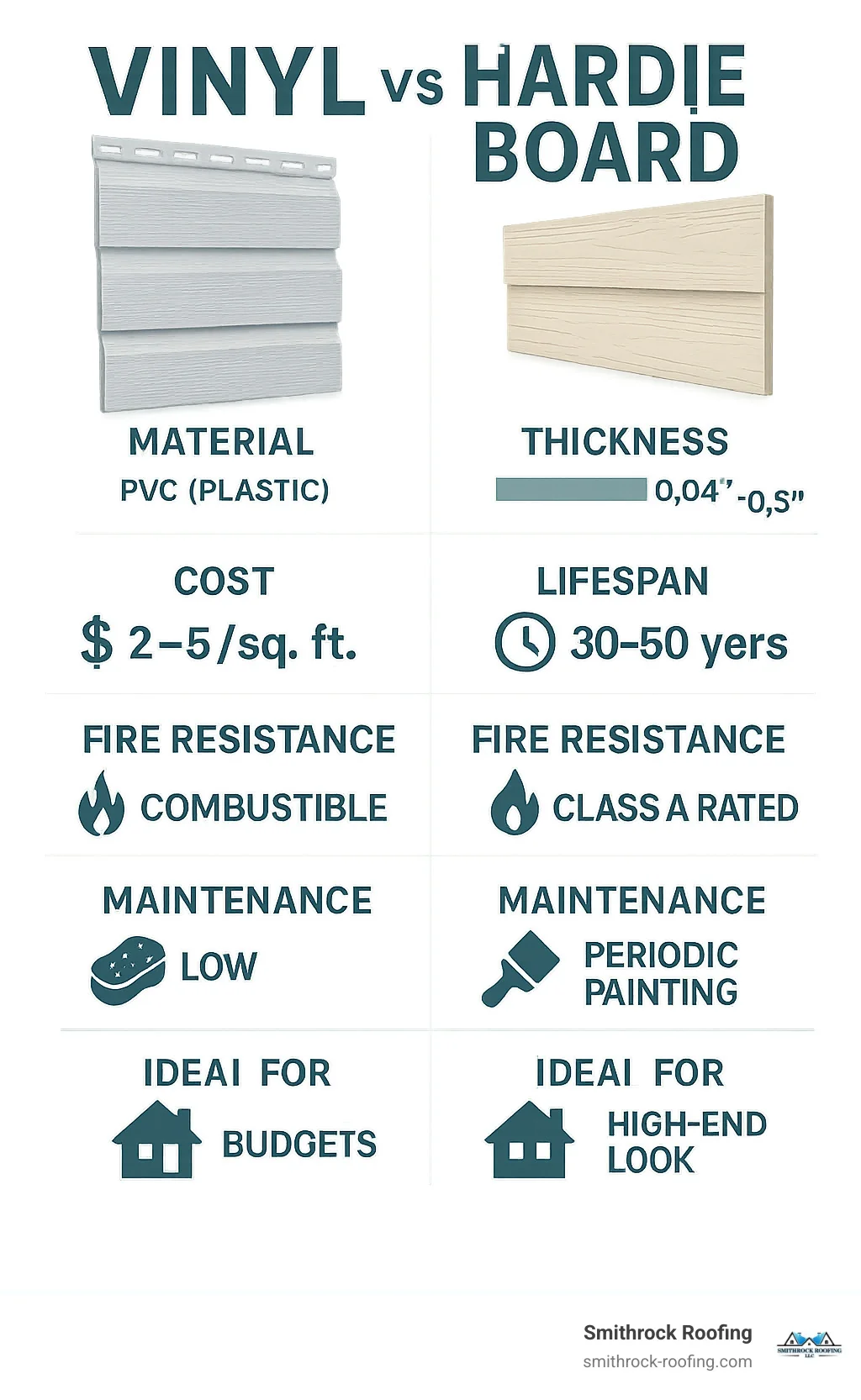
Vinyl siding is made from polyvinyl chloride (PVC) resin — a lightweight plastic material that’s affordable and easy to install. It typically measures just 0.040 to 0.048 inches thick.
Hardie board siding uses fiber cement composition made from Portland cement, sand, and cellulose fibers. This creates a much thicker, denser material — often 5 times thicker than vinyl.
Both materials serve as crucial armor for your home, protecting against weather while boosting curb appeal. But they perform very differently in real-world conditions.
The choice between these materials often comes down to budget versus long-term value. Vinyl offers immediate savings, while Hardie board provides superior durability and fire resistance that can save money over decades.
At Smithrock Roofing, we’ve helped countless homeowners across the NC Triad navigate the vinyl vs Hardie board siding decision based on their specific needs and budgets. Our experience with both materials gives us real-world insight into how each performs across different climates and situations.
Choosing the right siding is a major decision for protecting your home and enhancing its beauty. The choice often comes down to two top contenders: vinyl siding and Hardie Board. Both have unique strengths, so we’re breaking down the key differences across the most important factors for homeowners.
Let’s start with a quick overview of how these two materials stack up against each other across some key metrics:
| Feature | Vinyl Siding | Hardie Board Siding (Fiber Cement) |
|---|---|---|
| Lifespan | 20–40 years | 30–50+ years |
| Cost (per sq ft installed) | $2 – $5 | $4.70 – $8.50 |
| Maintenance | Low (cleaning only, no painting) | Low (cleaning, painting every 10–15 yrs if not ColorPlus) |
| Fire Rating | Combustible (melts/warps) | Class A (non-combustible) |
| Durability | Susceptible to cracking, warping, hail | Highly durable, resistant to impact, rot, pests |
The composition of siding material is fundamental to its performance. Vinyl siding is primarily composed of polyvinyl chloride (PVC) resin. This plastic material is extruded into panels that interlock, creating a protective shell around your home. Its typical thickness ranges from 0.040 to 0.048 inches. While this sounds thin, it’s designed to be flexible and lightweight. For homeowners seeking additional thickness or improved insulation, vinyl siding can be backed with foam sheathing, which can contribute to better energy efficiency.
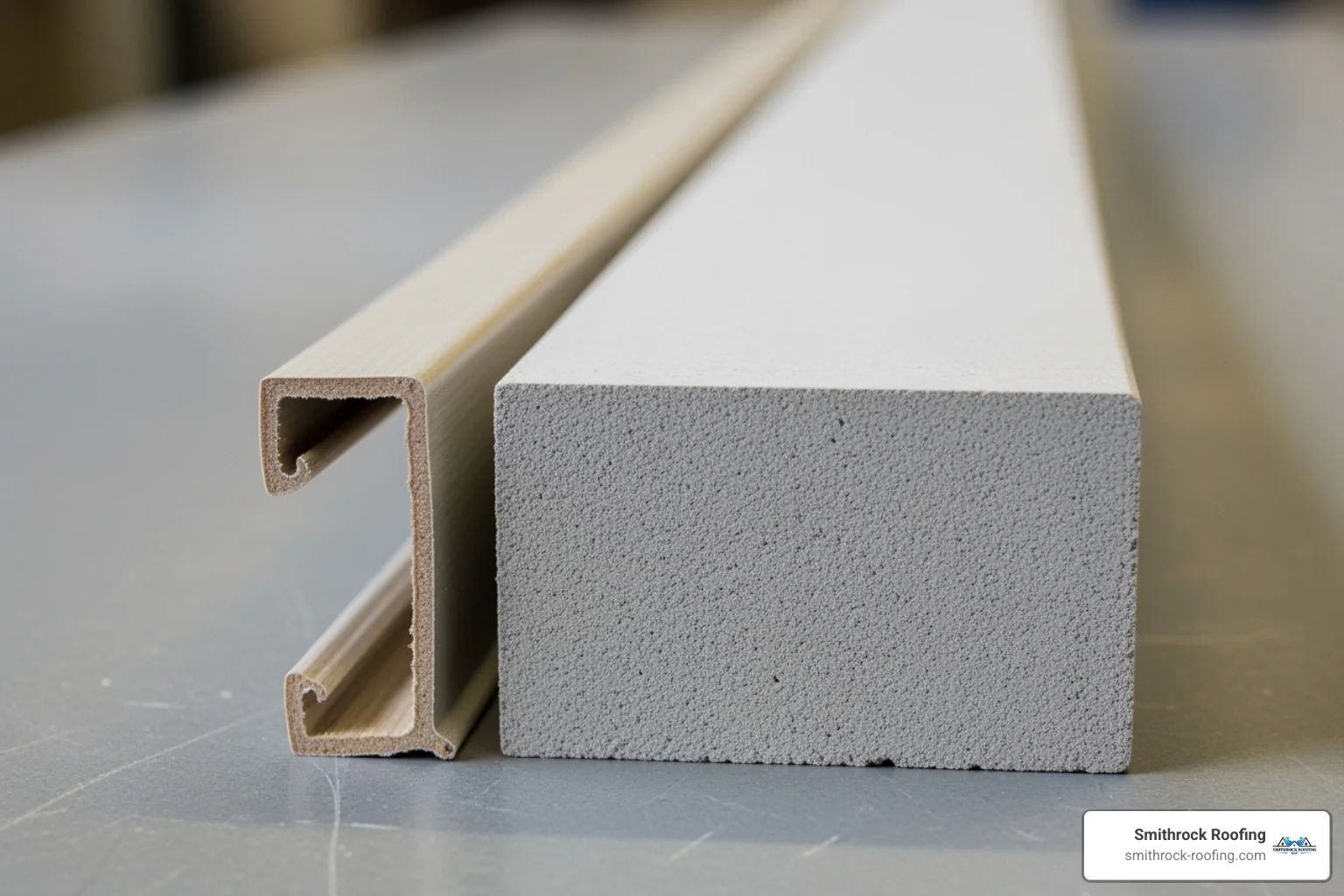
On the other side, Hardie Board is a brand of fiber cement siding, a composite material known for its strength. It’s crafted from a blend of Portland cement, silica sand, cellulose fibers (wood pulp), and water. This combination results in an incredibly dense and rigid material. Hardie Board is significantly thicker than vinyl, often up to 5 times thicker, measuring around 0.25 inches.
This difference in thickness has a profound impact on both durability and appearance. The increased density of Hardie Board contributes to its superior impact resistance. Aesthetically, the greater thickness allows for deeper embossing and more pronounced shadow lines, which helps it more realistically mimic the look of natural wood siding, giving homes a more substantial and premium appearance.
One of the most common questions we hear is: how thick is Hardie board siding? It’s a fair question, because thickness directly influences durability, impact resistance, and that authentic wood-like appearance homeowners love.
Standard Hardie Plank lap siding — the most widely used Hardie Board product — is 5/16 inch (approximately 0.3125 inches) thick. James Hardie also manufactures other products at slightly different thicknesses depending on the profile and application:
To put Hardie board thickness in perspective: at 5/16 inch, it’s roughly 6 to 8 times thicker than a standard vinyl panel, which measures just 0.040 to 0.048 inches. That extra mass is a big reason why Hardie board resists hail, impacts, and pests so effectively — and why it delivers those deep, realistic shadow lines that set it apart from vinyl on the curb.
This thickness also makes professional installation important. Hardie Board weighs approximately 300 pounds per 100 square feet, so it takes the right tools, fasteners, and technique to install it correctly. Improper installation can compromise the product’s long-term performance, which is why working with an experienced contractor matters.
Understanding the standard dimensions of James Hardie products helps homeowners plan projects and compare quotes accurately. Here’s a breakdown of the most common sizes across the product line:
HardiePlank Lap Siding — the most popular residential choice — is available in lengths of 12 feet as standard, with widths (exposures) ranging from 3½ inches up to 9¼ inches depending on the profile selected. Common width options include 5¼”, 6¼”, 7¼”, and 8¼” exposed face widths.
HardiePanel Vertical Siding typically comes in 4 x 8, 4 x 9, and 4 x 10 foot sheet sizes, making it a practical option for gable ends and contemporary-style exteriors where a clean vertical look is preferred.
HardieShingle Siding is sold in panel form rather than individual shingles. Panels are generally 15¼ inches tall and available in 48-inch widths, with staggered or straight-edge profiles to replicate the look of cedar shakes.
HardieTrim Boards are available in 4/4 and 5/4 thickness profiles and come in standard lengths of 12 feet, in widths ranging from 2½ inches to 11¼ inches.
Knowing your panel sizes matters because it affects how your installer calculates material quantities, waste factors, and layout — all of which influence your final project cost. A reputable contractor will account for these details in any written estimate they provide.
Durability is a cornerstone of any good siding material, as it’s your home’s first line of defense against the elements. When comparing the resilience of vinyl vs Hardie board siding, we see some clear distinctions.
Vinyl siding has a typical lifespan of 20 to 40 years, depending on product quality and maintenance. However, it does have vulnerabilities. It can be susceptible to cracking from impacts like hail. In extremely cold climates, vinyl can become brittle, while in very hot conditions or when exposed to reflected heat, it can warp or buckle.
Hardie Board is built for the long haul, with a typical lifespan of 30 to 50+ years. This fiber cement material is highly resistant to hail and high winds, often engineered to withstand winds up to 150 mph. Unlike vinyl, it doesn’t experience the same expansion and contraction issues with temperature fluctuations, meaning it’s less likely to crack or bow over time.
Beyond weather, Hardie Board also boasts impressive pest resistance. Its composition makes it inedible to pests like termites and carpenter ants. Even woodpeckers find it too challenging to damage. Furthermore, it’s highly resistant to rot and moisture damage.
When it comes to warranties, both materials offer substantial coverage. Most vinyl siding manufacturers offer lifetime limited warranties, though coverage may be prorated over time. James Hardie offers a robust 30-year limited warranty on its siding products, along with a 15-year finish warranty for its ColorPlus® products, providing significant peace of mind.
Vinyl siding has a well-earned reputation for longevity given its price point, but the range you’ll read about — 20 to 40 years — deserves some context. That wide gap isn’t arbitrary. A few key factors determine where your vinyl installation lands on that spectrum.
Panel thickness matters most. Entry-level vinyl panels measuring 0.040 inches thick will show their age much sooner than premium panels at 0.046–0.048 inches. Thicker panels hold up better to impact, resist warping more effectively, and tend to retain color longer. If a contractor is quoting you bottom-dollar vinyl, it’s worth asking exactly what product they’re using.
Sun exposure accelerates aging. UV radiation is vinyl’s biggest enemy. South- and west-facing walls take the most sun and will fade faster, sometimes noticeably unevenly compared to shadier elevations. Darker colors are especially prone to fading. Once color fading becomes significant — typically after 15–25 years depending on the product — many homeowners find that the visual decline motivates replacement even if the panels are still structurally sound.
Climate plays a role. Here in North Carolina, the combination of humid summers and occasional winter ice can accelerate wear on lower-grade vinyl. Panels that cycle through repeated heat-expansion and cold-contraction stress will eventually show cracking at the seams or around fasteners. The Triad’s storm seasons also bring hail events that can pit or crack thinner panels.
Installation quality extends or shortens life. Improperly fastened vinyl that can’t expand and contract freely will buckle, warp, and fail prematurely. This is one reason why choosing an experienced installer matters even for a straightforward material like vinyl.
On balance, quality mid-grade vinyl installed by a skilled contractor on a home in a moderate climate can reliably deliver 30-plus years of service with minimal upkeep. That’s genuinely strong performance for the investment — which is why vinyl remains one of the most popular siding materials in the country.
Your home’s siding plays a massive role in its curb appeal. Vinyl siding offers a wide range of aesthetic options, coming in various profiles, colors, and textures, including smooth finishes or embossed textures designed to mimic wood grain. The color is integrated throughout the material, which helps make minor scratches less noticeable. However, vinyl siding can fade over time, especially darker colors exposed to prolonged sunlight.
Hardie Board excels in replicating the natural beauty of wood. Its greater thickness allows for deeper embossing, creating a more realistic wood-grain texture and more pronounced shadow lines that closely mimic traditional wood siding. This gives homes a premium, high-end appearance. One of Hardie Board’s standout features is its paintability. If you choose a primed Hardie Board, you have the freedom to paint it any custom color you desire.
Even better, James Hardie offers a product called Hardie’s ColorPlus Technology. This factory-applied, baked-on finish offers superior fade resistance compared to field-applied paints. It ensures your finish will not chip, crack, or peel, keeping your home looking vibrant for years. The ColorPlus Technology finish comes with a 15-year warranty, guaranteeing long-lasting color retention and reducing the need for frequent repainting.
Low maintenance is a key factor for many homeowners. Vinyl siding is often touted as one of the lowest-maintenance options available. It never needs painting or staining. For most homeowners, maintenance involves little more than an occasional wash with a garden hose and a soft-bristled brush to remove dirt and mildew, typically every 6–12 months. If a panel gets damaged, it can often be replaced individually, though matching older, faded vinyl can be a challenge.
Hardie Board also offers impressive low maintenance, especially with the factory-applied ColorPlus® Technology. With ColorPlus, the baked-on finish is incredibly durable and fade-resistant. For these products, maintenance is similar to vinyl: a simple wash every 6–12 months with a garden hose to remove surface dirt.
However, if you choose primed Hardie Board, which is designed to be painted on-site, it will require repainting every 10 to 15 years. Additionally, Hardie Board may require re-caulking every five to ten years to prevent deterioration, especially around joints and windows. While this is more maintenance than ColorPlus Hardie Board or vinyl, it’s still less intensive than maintaining natural wood siding. We recommend avoiding high-pressure washing on Hardie Board, as it can damage the finish; a gentle soft wash is always best.
Need a hand with this in Winston-Salem, Greensboro and the NC Triad? Call (336) 971-0464 or request a free estimate. Honest answers, no pressure.
Cost is a crucial factor in any siding decision. It’s important to consider not just the upfront price but the long-term value and what you get for your money over the siding’s lifetime.
When comparing the upfront costs of vinyl vs Hardie board siding, vinyl is almost always the more budget-friendly option.
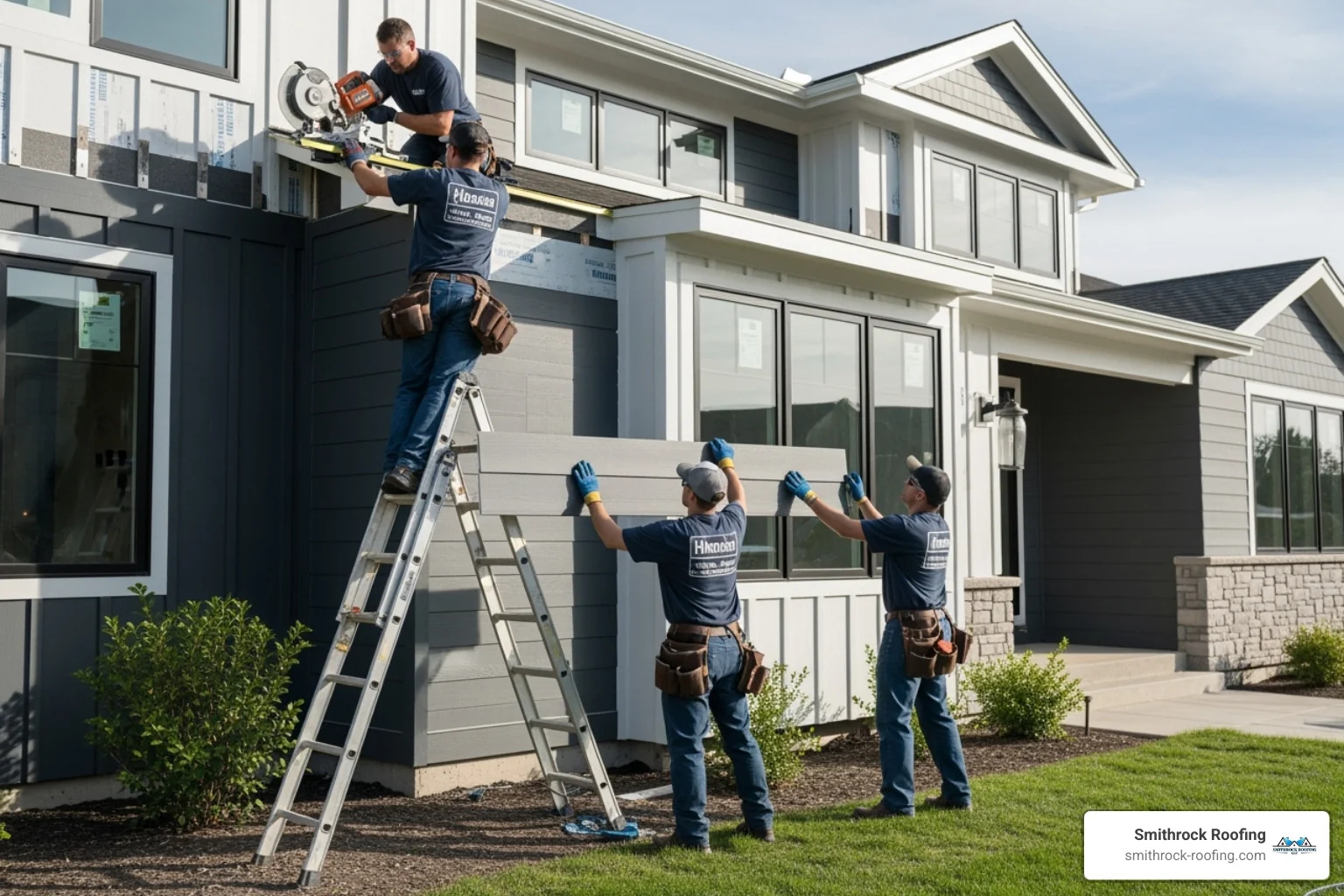
Vinyl siding material costs typically range between $2 and $5 per square foot. Installation costs for vinyl are also generally lower, with total installed costs often falling in the same range. This is largely due to its lightweight nature and ease of handling, which translates to lower labor costs and faster installation times. For a typical home, a full vinyl siding installation project can range from $5,500 to $16,000, making it a significantly more accessible option for many homeowners compared to fiber cement. A single panel from an average vinyl siding supplier might cost around $9 for a board that is 150 inches long and 8 inches wide.
Hardie Board, a premium fiber cement product, comes with a higher price tag. The material cost for Hardie Board siding is generally between $4.70 and $8.50 per square foot. Installation costs are also higher, with the national average for a full Hardie Board installation being around $19,350. This increased cost is due to several factors. Hardie Board is significantly heavier than vinyl; James Hardie fiber cement weighs about 300 pounds per 100 square feet, whereas vinyl siding weighs only 60–70 pounds on average. This heavier material requires more labor and specialized tools for cutting and installation, adding to the overall labor costs. A single board of Hardie Plank, for example, might cost between $10 and $12 for a 12-foot long, 8¼-inch wide, and 5/16-inch thick piece.
If you’ve been researching Hardie board siding cost, you’ve probably noticed that the numbers vary quite a bit depending on where you look. That’s not a coincidence — Hardie board pricing is genuinely project-specific. Understanding what drives the cost helps you evaluate quotes more confidently and plan your budget realistically.
At the broadest level, Hardie board siding costs between $4.70 and $8.50 per square foot installed for most residential projects. For a full home re-side, that typically translates to a total investment in the range of $12,000 to $25,000 or more, depending on the size and complexity of the home.
Here’s what moves the needle on that range:
For homeowners in the NC Triad, local labor rates are generally in line with regional averages, but project-specific factors like driveway access, landscaping around the foundation, and the age of the existing structure can all influence the final number. The only way to get an accurate Hardie board siding cost for your home is an in-person assessment by a qualified contractor — not an online calculator.
One thing worth remembering: when you spread the cost of Hardie board over its 30–50+ year lifespan, the annual cost of ownership is often quite comparable to vinyl — and in many cases, the superior durability means you simply won’t face a second siding replacement project during the time you own the home.
If you’re researching Hardie Plank siding cost specifically, it helps to understand what drives the number — because it’s rarely just the material price on the shelf.
Hardie Plank lap siding is the most popular James Hardie product for residential exteriors, and its installed cost typically falls between $4.70 and $8.50 per square foot, with the total cost for a full home re-side landing in the range of roughly $12,000 to $25,000 or more depending on home size, story count, existing siding removal, and regional labor rates. For homes in the NC Triad, local labor markets and project specifics will influence your final number.
Here’s what’s typically factored into Hardie Plank siding cost:
When you compare Hardie Plank siding cost against the material’s 30–50+ year lifespan, the per-year cost of ownership often comes out quite competitive with vinyl — especially when you factor in fewer replacements and higher resale value.
One of the more specific questions homeowners ask is about the cost to replace vinyl siding with Hardie board. This is a different project than re-siding a new build or replacing older wood siding, and it comes with its own set of considerations.
The process generally involves removing and disposing of the existing vinyl, inspecting and repairing the sheathing underneath if needed, adding a moisture barrier, and then installing the new Hardie Board system. Because fiber cement is heavier and more labor-intensive to work with than vinyl, the installed cost will be higher than a vinyl-to-vinyl replacement. Expect the material and labor cost of the Hardie Board portion alone to fall in the $4.70–$8.50 per square foot range, with removal and prep costs on top of that.
Many homeowners find the upgrade well worth it. If your vinyl siding is aging, fading, or has sustained storm damage, switching to Hardie board at that point is a smart long-term investment rather than replacing one vinyl system with another.
Vinyl siding is the more budget-friendly of the two options, but vinyl siding prices can vary more than most homeowners expect. Not all vinyl is created equal, and the gap between entry-level and premium vinyl products is significant.
Standard vinyl siding materials start as low as $1–$2 per square foot for thinner, basic panels. Mid-grade vinyl — which is what most reputable contractors use for residential projects — runs $2–$4 per square foot in material costs. Premium or insulated vinyl siding, which includes a foam backing for better energy efficiency and a more solid feel, can reach $4–$6 per square foot or more for materials alone.
Factors that influence your total vinyl siding project cost include:
For a typical home, a complete vinyl siding installation runs from $5,500 to $16,000 installed. Because vinyl is lighter and faster to install than fiber cement, labor costs are meaningfully lower — which is one of its biggest advantages for budget-conscious homeowners.
When homeowners research siding cost in general, the range of numbers they find online can be overwhelming. The truth is, the cost of siding depends heavily on three things: the material you choose, the size and complexity of your home, and the quality of the contractor doing the work.
Here’s a straightforward way to think about siding costs across the most common residential materials:
| Siding Material | Typical Installed Cost (per sq ft) | Typical Full-Home Range |
|---|---|---|
| Vinyl (standard) | $2 – $5 | $5,500 – $16,000 |
| Vinyl (insulated) | $4 – $8 | $8,000 – $20,000+ |
| Hardie Board / Fiber Cement | $4.70 – $8.50 | $12,000 – $25,000+ |
These figures are national benchmarks. In the NC Triad — Winston-Salem, Greensboro, High Point, and surrounding communities — your actual cost will depend on your home’s square footage, the condition of what’s underneath your current siding, and the scope of the project. The best way to get an accurate number is to have a qualified contractor assess your home in person.
What the numbers above don’t show is long-term cost of ownership. A vinyl installation may cost less today, but if it needs replacement in 20–25 years while your neighbor’s Hardie Board is still going strong at 40 years, the math shifts considerably. That’s why we encourage homeowners to think about siding cost not just as a day-one expense, but as a decade-by-decade investment in their home.
While vinyl siding wins on initial costs, the long-term value and return on investment (ROI) tell a more nuanced story. This is where the vinyl vs Hardie board siding debate often shifts.
Hardie Board siding typically offers a higher ROI and can significantly increase your home’s resale value. Its premium appearance, superior durability, and longevity are highly valued by homebuyers. A home with Hardie Board siding often stands out due to its improved curb appeal and the perception of a higher-quality exterior. This can lead to faster home sales and a better selling price, with some estimates suggesting homeowners can recoup up to 76% of their investment when selling. For those planning to stay in their home for many years, the long-term benefits can offset the higher initial investment.
Vinyl siding, while more affordable upfront, may not offer the same boost to resale value. While it provides good protection and low maintenance, its aesthetic may not be perceived as premium as Hardie Board. However, for budget-conscious homeowners or those looking for a cost-effective solution for a rental property or a starter home, vinyl can still be an excellent choice.
The durability of both materials acts as a significant selling point. A well-maintained siding, regardless of type, demonstrates that a home has been cared for. To learn more about how different siding options can impact your home, you can explore our professional siding services.
Beyond looks and cost, consider how siding performs under pressure and its environmental impact. These are increasingly important questions for homeowners. Let’s put vinyl vs Hardie board siding to the test in terms of fire resistance, energy efficiency, and environmental impact.
Fire resistance is a critical safety feature, especially in areas prone to wildfires. The differences between vinyl and Hardie Board are stark.
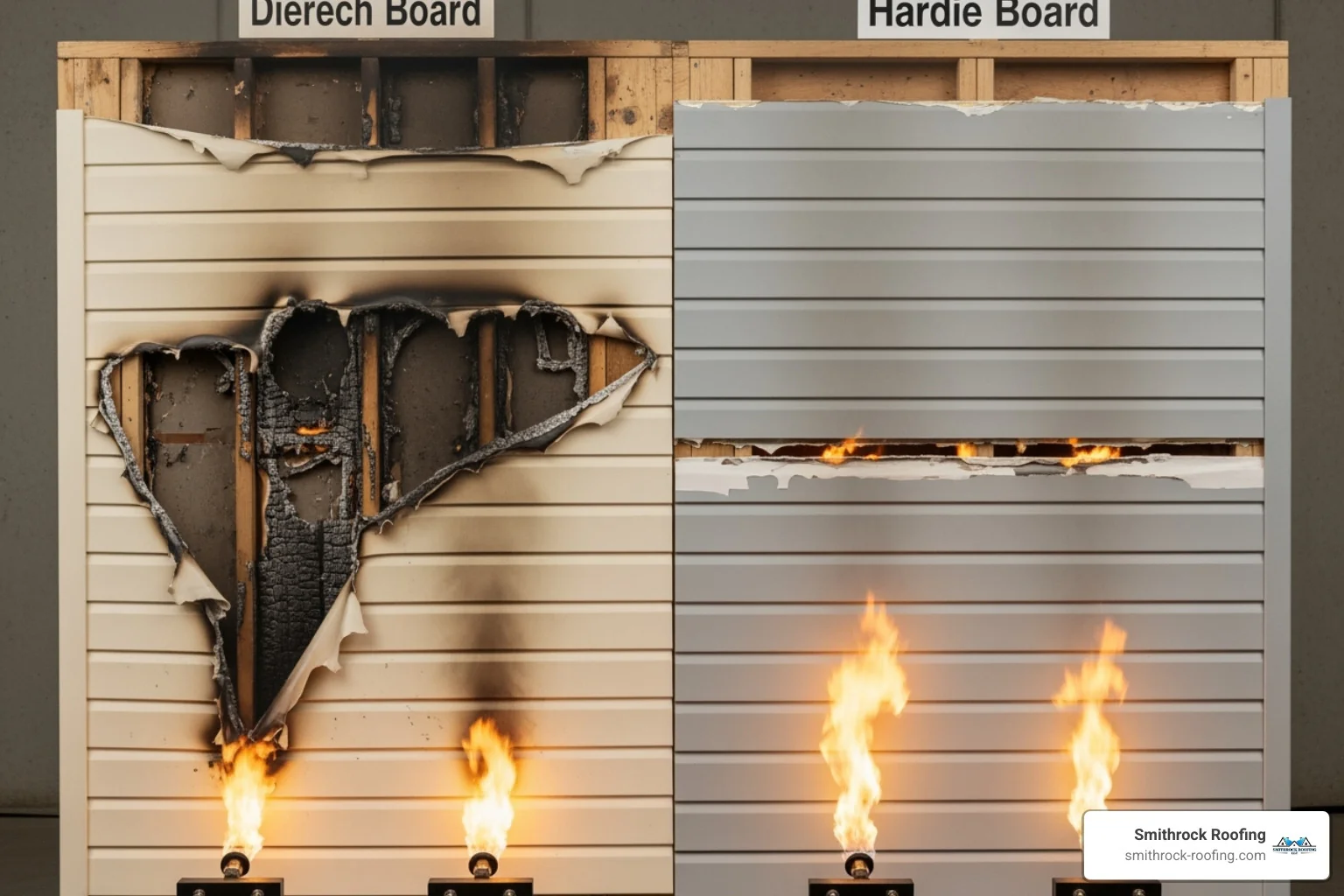
Vinyl siding is combustible. Made from PVC, it can melt, warp, and burn when exposed to high heat or direct flame. This means it offers little protection against fire spread and can deform from a house fire or even from a grill placed too close.
Hardie Board, conversely, is a champion in fire resistance. It is non-combustible and boasts a Class A fire rating, the highest possible rating for building materials. This means it will not ignite when exposed to direct flame and does not contribute to the spread of fire. For homes in wildfire-prone areas, or for any homeowner prioritizing safety, this feature is invaluable. Its excellent fire rating can even qualify you for potential insurance discounts, offering an added financial benefit.
Siding plays a role in your home’s thermal envelope, influencing your heating and cooling bills. Standard vinyl siding on its own offers a minimal R-value (a measure of thermal resistance), typically around R-0.6. However, insulated vinyl siding is a popular choice for energy efficiency. This product includes a layer of rigid foam insulation fused to the back of each panel, which can add an R-value of R-2 to R-4 to your wall system, helping to reduce heat transfer and lower energy bills.
Hardie Board siding, on its own, also has a relatively low inherent R-value, similar to vinyl at about R-0.5. Its primary strength is its density and air-sealing capability, not its insulating properties. However, its rigid and durable nature makes it an excellent substrate for adding continuous exterior insulation. When properly installed with a high-quality house wrap and supplementary insulation (like rigid foam boards installed behind the siding), Hardie Board can be part of a highly energy-efficient exterior wall assembly that significantly boosts your home’s overall thermal performance and reduces air infiltration. For a deeper dive into various siding options and their energy implications, you might find another perspective on siding choices helpful.
In an age of growing environmental consciousness, the sustainability of building materials is an important consideration. Let’s weigh the environmental footprints of vinyl vs Hardie board siding.
Vinyl siding’s sustainability profile is mixed. As a petroleum-based product, its manufacturing process is energy-intensive and can create harmful byproducts. Its recyclability is limited, and a significant portion of old vinyl siding often ends up in landfills.
Hardie Board presents a more environmentally friendly alternative in many respects. It is made from natural, abundant materials: Portland cement, sand, cellulose fibers (often from sustainable sources), and water. While the manufacturing of Portland cement is an energy-intensive process that generates CO2 emissions, the exceptional longevity of the final product helps offset this initial impact. A siding that lasts 50 years or more means less waste in landfills and fewer resources consumed for replacements compared to a material that may need to be replaced every 20–30 years. Furthermore, Hardie Board siding is inert and does not release toxins during its use, making it a stable and eco-friendly choice for your home’s exterior.
To simplify your decision, here’s a summary of the key pros and cons for vinyl vs Hardie board siding. Understanding these trade-offs is crucial for choosing the right fit for your home and lifestyle.
Vinyl siding is a popular choice, especially for homeowners on a budget or those seeking minimal upkeep.
Vinyl Siding Pros:
Vinyl Siding Cons:
Hardie Board siding is a premium fiber cement product known for its exceptional performance and sophisticated aesthetics. It’s often chosen by homeowners looking for long-term value.
Hardie Board Siding Pros:
Hardie Board Siding Cons:
This is the question at the heart of this entire comparison — and the honest answer is: it depends on what matters most to you.
If you’re measuring purely on upfront cost, vinyl wins. If you’re measuring on fire resistance, impact durability, or realistic wood aesthetics, Hardie board wins. If you’re weighing long-term value and total cost of ownership over 30-plus years, Hardie board typically pulls ahead again.
Here’s a simple way to think about it:
Neither material is a bad choice when it’s the right fit for the situation. What matters most is making an informed decision based on your home, your goals, and your budget — not just what sounds impressive on paper. That’s a conversation we’re happy to have with any homeowner in our service area.
When weighing hardie vs vinyl siding side by side, it also helps to think about how each material ages. Vinyl tends to look good for the first 10–15 years with minimal effort, then slowly begins to fade, chalk, or show wear in ways that are difficult to reverse without full replacement. Hardie board, by contrast, can be refreshed with a new coat of paint — giving you real control over how your home looks decades down the road. That flexibility has genuine long-term value for homeowners who care about maintaining curb appeal without replacing the entire siding system.
Homeowners in Winston-Salem, Greensboro, High Point, Kernersville, Clemmons, and the surrounding NC Triad face a climate that’s worth factoring into this decision. North Carolina’s Piedmont region brings humid summers, occasional ice storms in winter, and the periodic severe thunderstorm or hail event that can test any exterior material.
In our experience working across this region, both vinyl and Hardie board perform well under normal conditions. But there are a few local considerations that often tip the scale:
There’s no universal right answer, but there is a right answer for your home. That’s why we always recommend a consultation before committing — so you can make a decision based on your specific house, your street, and your long-term goals.
We often get asked specific questions that highlight key concerns homeowners have when deciding between these two excellent siding options. Let’s tackle some of the most common ones to help clarify the vinyl vs Hardie board siding debate.
For homes in extreme climates, Hardie Board is generally superior. Its robust composition makes it incredibly stable in the face of significant temperature fluctuations, unlike vinyl which can become brittle in extreme cold or warp in high heat. Hardie Board’s exceptional resistance to high winds, hail, and its non-combustible nature also make it ideal for areas prone to severe storms or wildfires. It’s engineered to perform in diverse climates, resisting expansion, contraction, and damage that less resilient materials might succumb to. Vinyl, while durable in moderate conditions, is generally better suited for less volatile climates where temperature swings and severe weather events are less common.
While it is technically possible to paint vinyl siding using specialized paints designed for plastics, it is generally not recommended by manufacturers. The color in vinyl siding is integral to the material, meaning it runs all the way through the panel. Painting can lead to peeling, chipping, and a less durable finish over time, and it will often void your product warranty. If you desire a specific color that isn’t available in standard vinyl options, or if you want the flexibility to change your home’s color in the future, Hardie Board is a far better choice. Hardie Board is designed to be painted, offering unlimited color customization, and with options like ColorPlus Technology, you get a durable, factory-applied finish that maintains its vibrancy for years.
Hardie Board siding typically offers a higher return on investment and increases home value more than vinyl siding. Its premium appearance, realistic wood-grain textures, superior durability, and impressive longevity are highly valued by homebuyers. Hardie Board signals quality and resilience to prospective buyers, significantly boosting curb appeal and perceived value. While vinyl siding is a cost-effective option that can certainly improve a home’s appearance, it generally doesn’t command the same premium in the resale market as Hardie Board. For homeowners looking to maximize their property’s long-term value and appeal to discerning buyers, Hardie Board is often the winning choice.
When it comes to dampening outside noise, Hardie Board generally has the edge over standard vinyl siding. Due to its composition of cement, sand, and cellulose fibers, Hardie Board is significantly denser and thicker than vinyl. This mass helps to absorb sound waves and reduce the amount of noise that penetrates your home’s exterior, from traffic to loud neighbors. While standard, hollow-back vinyl siding offers very little in terms of sound insulation, choosing an insulated vinyl siding option can improve its performance. The foam backing on insulated vinyl provides some sound-dampening benefits, though typically not to the same degree as the dense fiber cement of Hardie Board. For homeowners who live near busy roads or in noisy areas and prioritize a quieter indoor environment, Hardie Board is often the superior choice for sound reduction.
Standard Hardie Plank lap siding — the most commonly installed James Hardie product for residential homes — is 5/16 inch thick, which equals approximately 0.3125 inches. Other Hardie Board products such as HardieShingle siding are slightly thinner at 1/4 inch. For comparison, vinyl siding panels are typically just 0.040 to 0.048 inches thick, making Hardie board roughly 6 to 8 times thicker than vinyl. That added thickness is a primary driver of Hardie board’s superior impact resistance, realistic wood appearance, and long-term durability.
The Hardie Plank vs vinyl siding cost difference is significant upfront. Vinyl siding typically runs $2–$5 per square foot installed, while Hardie Plank siding comes in at roughly $4.70–$8.50 per square foot installed. On a full home re-side, that can mean a difference of $5,000 to $10,000 or more depending on home size and project specifics. However, Hardie board’s longer lifespan (30–50+ years vs. 20–40 for vinyl) means you may never need to replace it again — which can make the total long-term cost comparable or even favorable compared to a less expensive vinyl installation that gets replaced sooner.
For a typical single-story home, Hardie board siding cost — materials and installation combined — generally falls in the range of $12,000 to $25,000 or more depending on square footage, product selection, and whether old siding needs to be removed first. Homes with more architectural complexity (dormers, multiple gables, detailed trim) will be on the higher end. The best way to get an accurate estimate is to have a qualified local contractor assess your home directly, since square footage alone doesn’t tell the whole story.
Vinyl siding typically lasts between 20 and 40 years, with the actual lifespan depending on product quality, installation, climate, and ongoing maintenance. Premium vinyl panels (0.046–0.048 inches thick) installed by an experienced contractor in a moderate climate can reliably perform toward the higher end of that range. Thinner, entry-level panels in more demanding conditions — sustained UV exposure, frequent hail, or significant temperature swings — tend to show wear sooner. In North Carolina’s climate, good-quality vinyl generally delivers solid performance for 25–35 years before replacement becomes a practical consideration. One important note: even when vinyl is structurally sound, homeowners often choose to replace it earlier due to color fading or chalking that can’t be corrected without replacing the panels entirely.
For most homeowners who plan to stay in their home for 10 or more years, yes — Hardie board siding is worth the higher upfront investment. The math becomes clearer when you look at total cost of ownership rather than just day-one price. A vinyl installation that needs replacing in 25 years will cost you again; a Hardie board installation that’s still performing at 40-plus years won’t. Add in better fire protection, stronger hail resistance, superior curb appeal, and a positive impact on resale value, and the premium over vinyl becomes easier to justify. That said, “worth it” depends on your specific situation. If you’re on a tight budget or managing a property where long-term ownership isn’t the goal, quality vinyl is a perfectly reasonable choice.
Choosing the right siding is a big decision — a true commitment to your home’s future. The vinyl vs Hardie board siding comparison isn’t about one being universally “better” than the other; it’s about finding the best fit for your specific needs, budget, and priorities.
Let’s recap the key differences: vinyl is typically more budget-friendly upfront, easier to install, and requires minimal cleaning maintenance. Hardie Board, while a larger initial investment, offers superior durability, a more premium aesthetic, exceptional fire resistance, and a longer lifespan, often leading to a better return on investment.
When making your final decision, consider these factors:
When to choose vinyl:
When to choose Hardie Board:
Regardless of your choice, the importance of professional installation cannot be overstated. Even the highest quality siding material will underperform if not installed correctly. At Smithrock Roofing, we have years of expertise in working with both vinyl and Hardie Board siding, ensuring that every installation is performed with precision and care, maximizing the lifespan and performance of your chosen material. We serve homeowners across Winston-Salem, King, Clemmons, Lewisville, Pilot Mountain, East Bend, Mt. Airy, Kernersville, Siloam, Danbury, High Point, Trinity, Pfafftown, Tobaccoville, Greensboro, Walnut Cove, Belews Creek, Rural Hall, Pinnacle, Bethania, Advance, Wallburg, Horneytown, Union Cross, and Midway, NC.
Ready to transform your home’s exterior? We’re here to guide you through every step of the process. Explore our professional siding services and let us help you make the best decision for your home.
Need a local pro? Learn more about our siding installation and repair in High Point.

Smithrock Roofing © Copyright 2026 • All Rights Reserved • Privacy Policy • Maintained by Mongoose Digital Marketing