
Buried downspout installation is the process of channeling roof runoff away from your home’s foundation by directing water from your gutters through underground pipes to a safe discharge point. Here’s what you need to know:
Essential Installation Steps:
The numbers tell a sobering story. Uncontrolled roof runoff can lead to water damage incidents averaging $11,000. Foundation repairs typically cost between $5,000 and $20,000. Basement flooding repairs run around $10,000. These aren’t just statistics—they’re real costs that homeowners face when water finds its way where it shouldn’t.
Your downspouts are doing important work. Every time it rains, they’re moving hundreds of gallons of water off your roof. But if that water just dumps out at ground level next to your house, you’re inviting trouble. Pooling water, saturated soil, basement dampness, eroded landscaping—these problems start small but grow expensive fast.
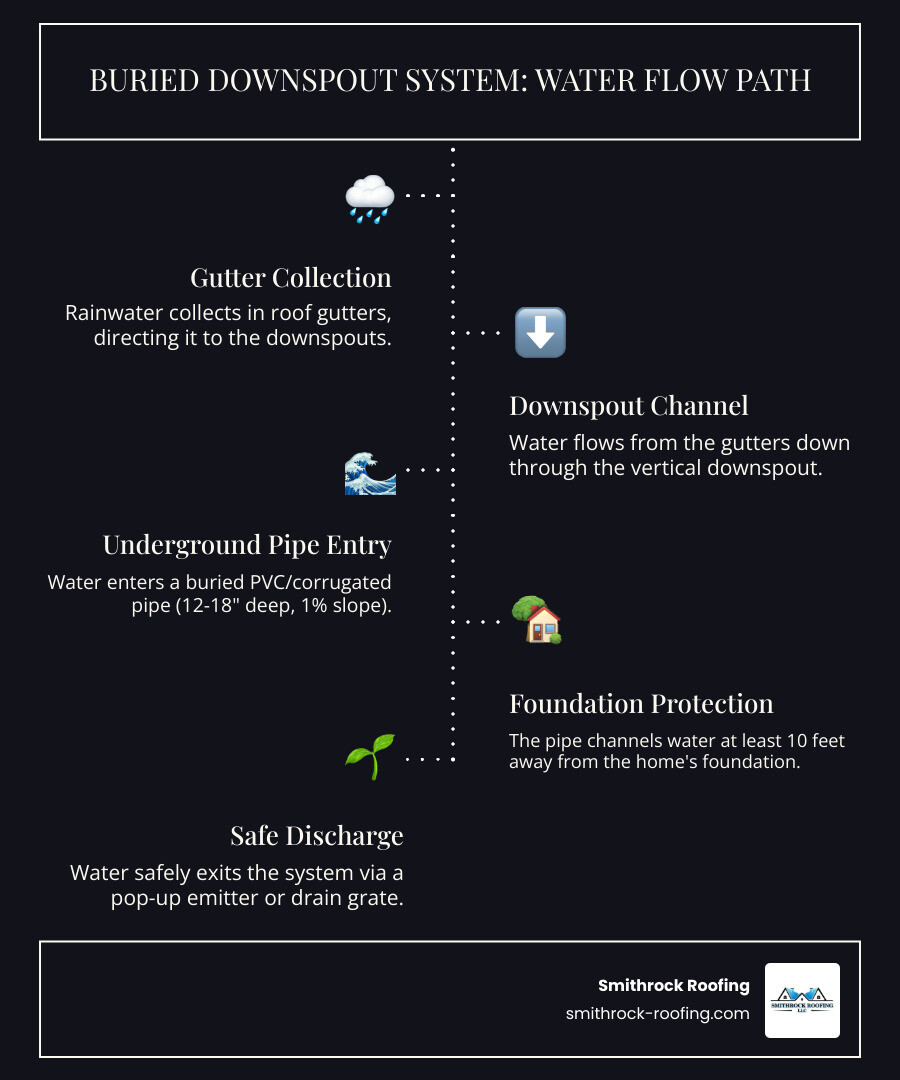
A buried downspout system solves this by taking water underground and moving it far away from your foundation. The water flows from your gutters, down the downspout, into an underground pipe, and out to a discharge point where it can’t cause harm. It’s out of sight, out of the way, and doing its job 24/7.
We’ve all seen unsightly black corrugated hoses snaking across a lawn or a simple splash block next to a foundation. While these might be temporary fixes, they rarely provide the long-term protection your home deserves. That’s where buried downspout installation truly shines.
The benefits of an underground downspout system are numerous, changing not just your home’s protection but also its aesthetic and functionality.
Benefits of Buried Downspouts:
However, buried downspouts also have some considerations:
Potential Drawbacks of Buried Downspouts:
How do you know if buried downspout installation is right for your home? We recommend considering an underground system if you notice any of the following signs:
For more information on ensuring your entire gutter system is performing optimally, check out our guide on More info about Gutter and Downspout Installation.
Here’s a quick comparison of various downspout drainage options:
| Feature | Buried Downspouts | Above-Ground Extensions | Splash Blocks | Rain Barrels |
|---|---|---|---|---|
| Aesthetics | Excellent (invisible) | Poor (unsightly) | Fair (visible but less obtrusive) | Varying (can be decorative) |
| Safety | Excellent (no tripping hazards) | Poor (tripping hazard) | Good (low profile) | Good (if secure) |
| Foundation Protection | Excellent (moves water far away) | Fair (often too short or poorly sloped) | Poor (disperses water too close) | Good (collects water; overflow needs managing) |
| Landscape Protection | Excellent (prevents erosion) | Fair (can cause localized erosion) | Poor (minimal protection) | Good (reduces runoff) |
| Maintenance | Moderate (needs inspection; clogs can be complex to clear) | High (frequent repositioning, easily damaged) | Low (occasional cleaning) | High (regular cleaning and winterization) |
| Installation | Complex (digging, grading, connecting) | Simple (attach to downspout) | Very simple (place under downspout) | Simple (connect to downspout) |
| Cost | Higher upfront | Low | Very Low | Moderate |
| Clog Risk | Moderate (especially corrugated pipes) | Low (visible and easy to clear) | Low (visible and easy to clear) | High (if not filtered) |
| Freezing Risk | Moderate (if not sloped or buried deep enough) | Low (easy to manage) | Low (easy to remove) | High (requires winterization) |
Not all buried downspout systems are created equal. The difference between one that lasts decades and one that backs up after the first major storm usually comes down to three things: the right materials, a properly maintained slope, and a well-chosen discharge point. Before we walk through each installation step, it’s worth understanding what “done right” actually looks like.
Keep these principles in mind as you work through the steps below. They’re the foundation of a system that protects your home quietly and reliably for years.
A buried downspout installation is a rewarding project that protects your home. Understanding the process is key, whether you’re a DIYer or hiring a pro.
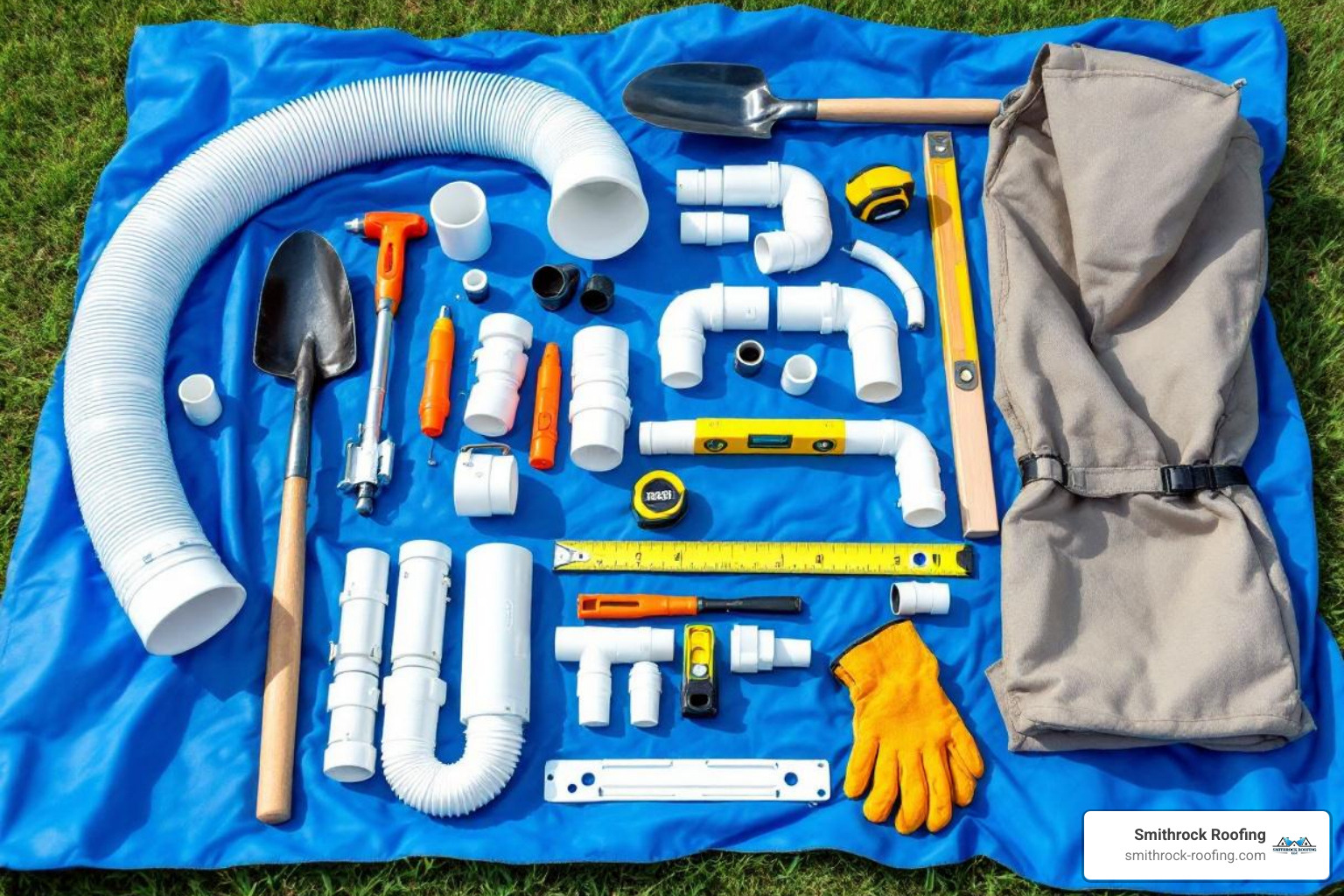
This is a project where safety is paramount. Before digging, wear appropriate personal protective equipment (PPE), including sturdy work gloves and safety glasses.
Success hinges on thorough preparation. First, gather your tools and materials and map out a strategy.
Tools We’ll Need:
Materials We’ll Need:
Planning the Route:
Map a trench path that ensures water flows effectively away from your home.
Your choice of pipe is critical for the system’s longevity and effectiveness.
Choosing the Right Pipe Material:
PVC Pipe (Polyvinyl Chloride):
Corrugated Pipe:
Our Recommendation: For a long-lasting, low-maintenance buried downspout installation, we strongly recommend investing in solid, smooth-wall PVC pipe. It’s a better long-term investment in your home’s health.
Pipe Diameter:
Choose between 3-inch or 4-inch diameter pipes.
For more insights into keeping your entire gutter system in top shape, explore our resources on More info about Exterior Gutters.
With your plan and materials ready, it’s time to dig. This step requires careful attention to the slope.
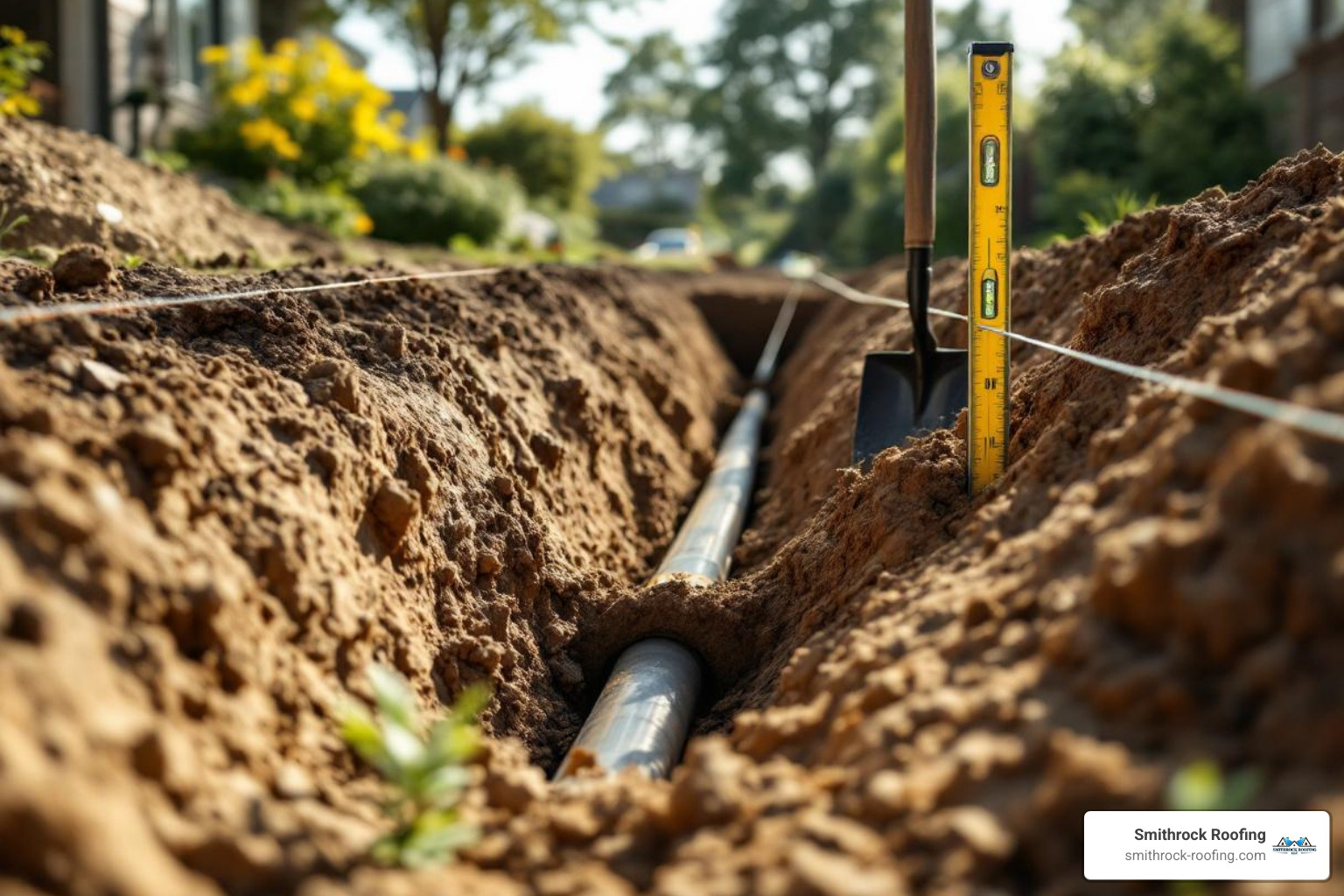
Digging the Trench:
With the trench dug, it’s time to assemble the pipe.
This final stage ensures your system is robust, functional, and invisible.
Best Practices for Backfilling:
Restoring the Landscape: Once the system passes the test, restore the landscape. Smooth the soil, add topsoil, and plant grass seed or lay sod. Ensure any decorative elements don’t impede water flow.
Depth is one of the most common questions homeowners ask when planning underground drainage for downspouts — and for good reason. Bury the pipe too shallow and you risk freezing, crushing from foot traffic, and damage from lawn equipment. Bury it too deep without the right slope and you create a maintenance headache.
Here’s how to think about it practically:
The standard recommendation for burying downspout drain pipe is 12 to 18 inches. For most homes in the NC Triad — Winston-Salem, Greensboro, High Point, Kernersville — this range gives the pipe enough cover to stay protected without requiring excessive excavation. Eighteen inches also puts the pipe below most lawn tool depth and reduces the risk of accidental damage from edging or aeration equipment.
In colder climates or during unusually cold winters, depth matters even more. If water sits in a pipe that freezes, the ice can crack or deform the pipe — especially corrugated plastic. The solution isn’t necessarily to dig deeper (though burying below the local frost line does help); it’s primarily to ensure your pipe has enough slope that it drains completely after every rain event. A pipe that empties itself has nothing left to freeze.
Slope always takes priority over depth. If maintaining an 18-inch depth means you can’t achieve a consistent downward grade, it’s better to sacrifice some depth and keep the slope intact. A pipe at 12 inches that drains completely will outlast and outperform a pipe at 18 inches with a belly in the middle.
As a practical rule: dig to 12 inches minimum, target 18 inches where your soil conditions allow, and confirm your slope at every stage of the trench before the pipe goes in. If you’re uncertain about your yard’s grade, a professional can assess it quickly and save you from having to re-dig later.
It helps to understand the full picture before you start digging — or before you call a contractor. An underground downspout drainage system is really just a connected series of simple components, each playing a specific role in moving water safely away from your home.
When every component in this chain is correctly sized, properly sloped, and securely connected, the result is a system that handles your roof’s runoff invisibly, reliably, and without any intervention from you. That’s the goal of buried downspout drainage done right.
A properly installed buried downspout system is long-lasting, but regular, proactive maintenance is key to preventing costly repairs and protecting your investment.
For any gutter-related concerns, including maintenance and repairs, remember we’re always here to help. You can find more information on More info about Gutter Repair Near Me.
Regular checks are essential to keep your buried system running smoothly.
Knowing how to spot and address common problems can save you stress and expense.
We often hear similar questions from homeowners considering or maintaining a buried downspout system. Let’s tackle some of the most common ones.
A depth of 12 to 18 inches is generally sufficient to protect the pipe. In colder climates, however, you must bury the pipe below the local frost line to prevent freezing and cracking.
Most importantly, regardless of depth, you must maintain a consistent downward slope of at least 1/8 inch per foot. This ensures the pipe drains completely, preventing clogs and ice buildup.
Installation time varies based on the number of downspouts, trench length, and soil conditions. A DIY project for a few downspouts might take a weekend (4-8 hours per downspout).
Professionals, like our team serving Kernersville and Wallburg, can often complete a standard buried downspout installation in a single day due to specialized tools and experience. More complex projects may take longer.
While not strictly required, gutter guards are unequivocally the best way to prevent clogs. They act as a first line of defense, blocking leaves, twigs, and shingle grit from entering the underground pipe. This drastically reduces maintenance and the risk of blockages.
Investing in quality gutter guards is a smart move to protect your entire drainage system. Learn more about the benefits and options for your home’s gutters on our dedicated More info about Gutters page.
Buried downspouts are underground drainage pipes connected directly to your home’s gutter downspouts. Instead of releasing water at ground level next to your foundation — where it can saturate the soil, erode landscaping, and work its way into your basement — buried downspouts carry that water through a subsurface pipe to a discharge point safely away from your home.
Are they worth the investment? For most homeowners, yes. The upfront cost of materials and installation is significantly less than what you’d pay to repair foundation damage, remediate basement moisture, or rebuild eroded landscaping. Beyond the financial math, there’s real peace of mind in knowing that every rainstorm — whether it drops half an inch or three inches — is being managed proactively rather than just hoped away.
Homes with chronic drainage issues, low-lying foundation grades, or heavy tree coverage tend to see the most dramatic improvement. But even homes without obvious problems benefit from the long-term protection that a properly installed buried downspout system provides.
The process of burying a gutter drain pipe breaks down into four essentials: plan the route, dig the trench at the right depth and slope, lay the right pipe with secure connections, and backfill properly. Each step is covered in detail in the installation guide above, but the most critical factor is slope. Without a consistent downward grade — at least 1/8 inch of drop per foot of run — water will stall in the pipe, sediment will accumulate, and you’ll be dealing with clogs or backups before long.
Use solid PVC pipe rather than flexible corrugated pipe whenever possible, seal every connection with PVC cement, and always test the system with a garden hose before you backfill. Those three habits alone will save most homeowners a significant amount of post-installation frustration.
Yes, and it’s a common approach for keeping the yard tidy and minimizing trench work. The key is to use Wye fittings — not T-fittings — at any junction where lines merge. A Wye fitting allows water from two pipes to combine smoothly in the direction of flow. A T-fitting creates turbulence and is more prone to backing up.
When merging multiple downspouts, also make sure your main run pipe is large enough to handle the combined volume. If two or more downspouts are feeding a single line, stepping up to a 4-inch pipe on the main run — even if individual branch lines are 3-inch — is a good safeguard against overwhelming the system during heavy rain.
A pop-up emitter has a spring-loaded cap that stays closed when the pipe is dry. When water pressure builds up behind it, the cap opens and releases flow onto the surface, then closes again when the rain stops. This design keeps animals, insects, and debris from entering the pipe through the discharge end.
A drain grate is an open-face outlet, typically set flush with the ground. It works fine in areas where the discharge point is away from foot traffic and pest intrusion isn’t a major concern, but it requires more frequent clearing of debris and offers no protection against critters exploring the pipe.
For most residential installations in the NC Triad, a pop-up emitter is the practical choice. It requires minimal maintenance and does a better job of protecting the pipe between rain events.
A well-executed buried downspout installation is more than just a home improvement project; it’s a valuable investment in your property’s long-term health and value. By effectively managing rainwater runoff, you’re actively protecting your home against the significant costs and headaches associated with water damage, foundation issues, and basement flooding. Beyond the crucial protection, you’re also enhancing your property’s appearance, eliminating tripping hazards, and preserving your carefully curated landscape.
While a DIY approach can be rewarding, the precision required for correct slope, durable materials, and watertight connections often makes professional installation the most reliable path to long-term performance. Ensuring your system is installed correctly from the start means fewer worries and more peace of mind.
For expert advice, professional buried downspout installation, and comprehensive Gutter Installation Services, trust the team at Smithrock Roofing. We’re dedicated to protecting your home from the top down, ensuring your foundation stays dry and your landscape remains beautiful, serving communities throughout Winston-Salem, Greensboro, High Point, and beyond.

Smithrock Roofing © Copyright 2026 • All Rights Reserved • Privacy Policy • Maintained by Mongoose Digital Marketing