
Exterior gutters are a critical water management system that protects your home’s foundation, walls, and landscaping from thousands of gallons of runoff during every rainstorm.
Quick Answer: What You Need to Know About Exterior Gutters
Just one inch of rainfall on an average-sized roof can produce nearly 2,000 gallons of water. Without a functioning gutter system, that water cascades directly to your foundation, saturating the soil and creating serious problems like cracks, basement flooding, and structural damage. It can also rot fascia boards, destroy landscaping, and lead to mold growth.
Modern gutter systems are more effective than ever. Seamless gutters eliminate most leak points, professional-grade materials resist rust, and proper installation ensures decades of reliable performance. When paired with strategic exterior painting, new gutters don’t just protect your home—they dramatically improve its curb appeal and value.
This guide covers everything you need to know about exterior gutters: how they work, how to choose the right system, what professional installation involves, and how to maintain them for maximum longevity.
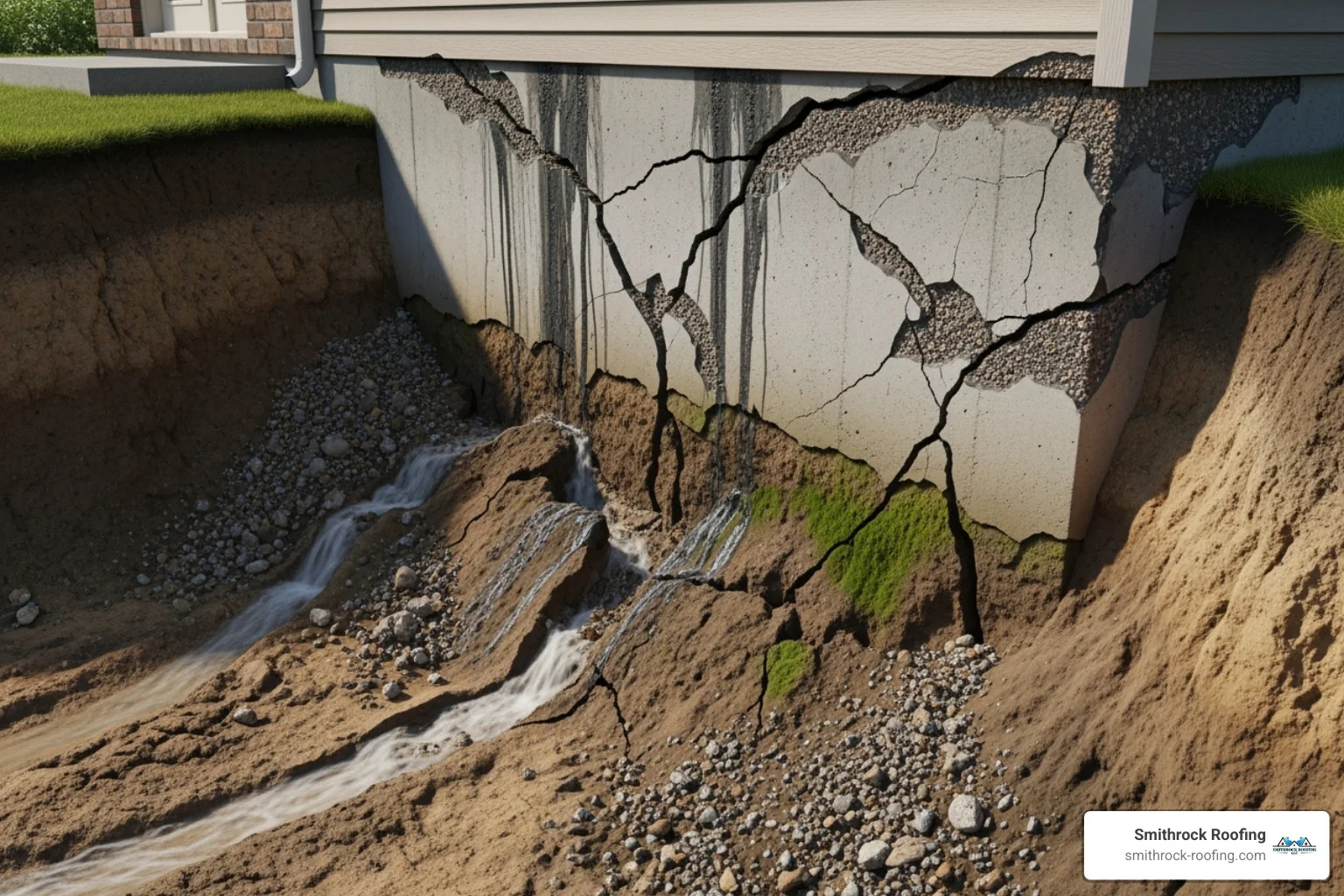
A single thunderstorm can unleash thousands of gallons of water onto your roof. Without a properly functioning system of exterior gutters, this deluge cascades directly down to your home’s foundation. This uncontrolled water flow initiates a destructive domino effect that can compromise your home’s structural integrity and lead to tens of thousands of dollars in repairs.
The first domino to fall is soil saturation. As water pools around your foundation, the ground becomes a dense, heavy sponge. This creates immense hydrostatic pressure—the force exerted by standing water—pushing relentlessly against your basement walls and foundation slab. Over time, this pressure can cause hairline cracks to widen, leading to water intrusion, persistent dampness, and eventually, significant basement flooding. Beyond the immediate water damage, this moisture creates a perfect breeding ground for toxic black mold, which poses serious health risks and requires costly remediation.
Uncontrolled water flow also causes severe damage above ground. It can erode the soil around your home, washing away expensive landscaping and creating unsightly gullies. Siding becomes stained and discolored, and the constant moisture can cause paint to peel and wood to rot, especially at the base of your exterior walls. This is why gutters aren’t an optional accessory; they are an essential defense mechanism for your entire home.
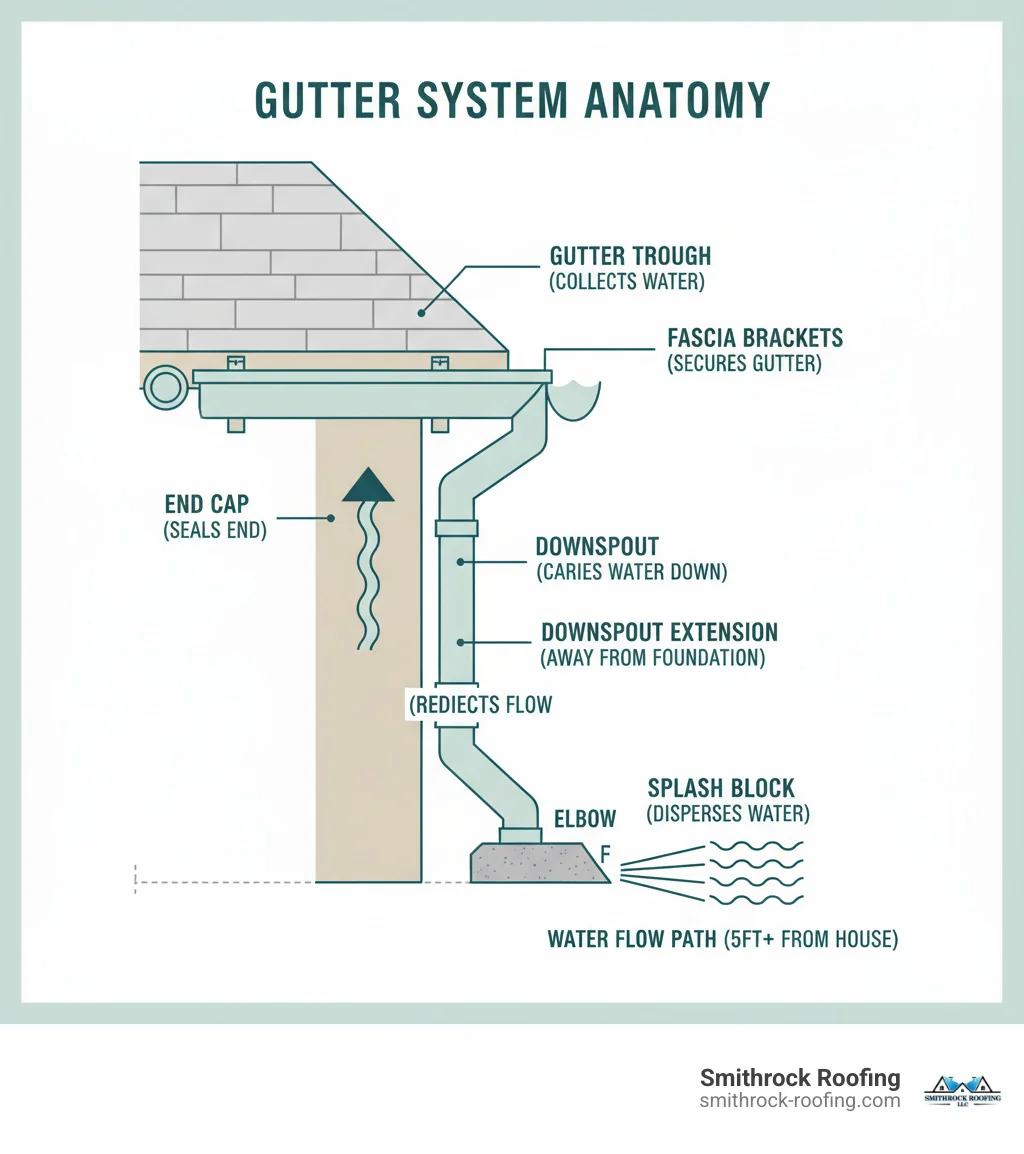
A home gutter system works by intercepting rainwater as it sheds off your roof and routing it safely away from the structure. Here’s the full process, step by step:
Every component in the system plays a role in that chain. If any link breaks — a clogged downspout, a sagging trough, a missing extension — water backs up and finds its own path, which is rarely a path your home can afford.
The function of a gutter system is elegantly simple: collect every drop of rainwater from the roof and transport it to a safe location far from the foundation. To achieve this, gutters are installed along the eaves with a carefully calculated pitch—typically a quarter-inch of slope for every ten feet of length. This subtle angle uses gravity to ensure water flows steadily toward the downspouts without pooling.
The downspouts are the vertical pipes that act as the arteries of the system, carrying the collected water from the gutters down to the ground. A general rule is that one downspout is needed for every 35-40 feet of gutter to handle the water volume effectively. At the bottom, downspout extensions are critical. These extensions should carry water at least five feet away from the foundation before it is released. Splash blocks are then placed under the extensions to disperse the water, preventing it from eroding the soil at the discharge point. This final step is non-negotiable; dumping water directly at the base of your foundation completely defeats the purpose of the gutter system.
A well-functioning system also protects your fascia and soffit—the wooden or composite boards that run along the roofline and support the gutters. By keeping these components dry, you prevent rot, a costly and often hidden repair. Learn more about maintaining these components in our guide on Fascia and Soffit Repair.
Understanding the parts of your gutter system helps you identify problems early and appreciate its design. Below is a breakdown of every key component — from the trough at the roofline to the splash block at grade — and what each one does.
The gutter trough — sometimes called an eavestrough — is the horizontal channel that runs along the eave of your roof. It is the most visible part of the system and does the primary job of catching and holding rainwater as it flows off the roof. Troughs come in two main profiles: K-style (with a flat back and decorative ogee-shaped front) and half-round (a classic semicircular shape). In a seamless system, the trough is a single continuous piece fabricated to match the exact length of your roofline, eliminating the seams that are prone to leaking in sectional systems.
Hidden hangers and fascia brackets are the fasteners that anchor the gutter trough to the fascia board. Modern hidden hangers clip inside the gutter and are secured with long screws driven through the fascia and into the rafter tails for maximum holding strength. They are spaced every 18 to 24 inches — closer together in climates with heavy snow loads — to support the weight of water, ice, and debris without sagging.
End caps are flat, sealed pieces that close off the open ends of a gutter run, containing water within the channel and directing it toward the downspout outlet rather than letting it spill out the sides.
The downspout outlet is the fitting installed in the bottom of the gutter trough where water exits the horizontal channel and enters the vertical downspout. It is sealed with high-grade gutter sealant to create a watertight connection.
Downspouts are the vertical pipes that carry collected water from the gutter trough down the side of your home. They are typically rectangular (2×3 inch or 3×4 inch) and secured to the exterior wall with straps to prevent movement in wind or under load.
Elbows are angled connector pieces used at the top and bottom of downspouts. The top elbow directs water from the gutter outlet back toward the wall, and the bottom elbow redirects flow away from the foundation at ground level. They allow the downspout to navigate the geometry of your home’s exterior without requiring a straight vertical drop.
Downspout extensions attach to the bottom elbow and channel water horizontally away from the house before it is released into the yard. Splash blocks — concrete or plastic trays placed beneath the extension — disperse the water flow and prevent the concentrated discharge from eroding the soil directly below the downspout. Both are essential: without them, even a perfectly functioning gutter system can still deliver damaging water right back to your foundation.
The drip edge is a metal flashing installed at the roof’s edge that directs water off the roof and into the gutter trough rather than letting it run behind the gutter or down the fascia. Proper integration of the drip edge with the gutter during installation is critical to keeping the fascia board dry and preventing rot.
In cold climates, exterior gutters play a crucial role in preventing ice dams. Ice dams form when heat escaping from a poorly insulated attic melts snow on the upper part of the roof. This meltwater flows down to the cold eaves (the roof’s edge), where it refreezes. This process repeats, building a ridge of ice that traps more meltwater behind it. With nowhere to go, the trapped water is forced up and under your shingles, leading to leaks inside your attic and walls.
Clean gutters allow meltwater to drain away freely. However, gutters clogged with autumn leaves and debris trap this water, which then freezes solid, accelerating the formation of a destructive ice dam. The immense weight of the ice can also bend, warp, or even tear the gutters completely off the house. While the root cause of ice dams is often poor attic insulation and ventilation, clogged gutters are a primary accomplice.
Clogged gutters also create a welcoming habitat for pests. The standing water and decomposing organic matter are an ideal breeding ground for mosquitoes, which can carry diseases like West Nile virus. The damp debris attracts carpenter ants and termites to the wood of your fascia and roof structure. Rodents, squirrels, and birds may also build nests in the sheltered, debris-filled troughs, potentially using them as a bridge to enter your attic or walls. Regular cleaning keeps your gutters flowing freely, protecting your home from water, ice, and unwanted pests year-round. For more details, see this comprehensive guide on gutters and downspouts from building science experts.
Need a hand with this in Winston-Salem, Greensboro and the NC Triad? Call (336) 971-0464 or request a free estimate. Honest answers, no pressure.
Of all the things a properly functioning home gutter system does, protecting your foundation may be the most consequential. Foundation repairs are among the most expensive projects a homeowner can face, and a surprising number of them trace back directly to unmanaged roof runoff.
Here’s the chain of events that happens when gutters fail to do their job:
A complete, properly installed gutter system — including troughs, downspouts, and extensions that discharge water at least five feet from the house — interrupts this cycle at the very first step. It keeps the soil around your foundation dry, stable, and bearing only the loads it was designed to handle.
In the NC Triad, where summer storms can drop significant rainfall in a short period, this protection is not theoretical. It is the difference between a dry basement and a very expensive remediation project. If your current gutters are overflowing, sagging, or discharging water too close to the house, your foundation is absorbing the consequences with every storm.
Selecting new exterior gutters is a long-term decision affecting your home’s protection, curb appeal, and value. The right choice requires balancing performance, durability, aesthetics, and budget to suit your home’s architecture and local climate. A home in a rainy region like the Pacific Northwest has different needs than one in a dry, sunny climate, and factors like heavy snowfall, high winds, and extreme temperature swings all influence the best choice.
Today’s market offers more options than ever, from the classic elegance of copper to the practical versatility of aluminum. Let’s explore the materials, styles, and construction methods to help you make an informed decision.

The material you choose is the single most important factor determining your gutters’ longevity, maintenance needs, and overall cost. While vinyl is a common DIY option, we focus on professional-grade metal systems that offer superior durability and long-term value.
| Material | Lifespan | Rust Resistance | Maintenance Needs | Cost (per ft installed) | Key Characteristics |
|---|---|---|---|---|---|
| Vinyl | 10-20 years | Excellent | High | $3 – $7 | Inexpensive and won’t rust, but becomes brittle in cold, sags in heat, and seams are prone to leaks. Not recommended by professionals. |
| Aluminum | 20-30 years | Excellent | Low | $6 – $15 | Lightweight, wide color range, won’t rust, cost-effective. The most popular choice for residential homes. |
| Steel | 20-40 years | Good (if coated) | Moderate | $9 – $25 | Extremely strong and durable against ladders/trees. Ideal for harsh weather. Can rust if the galvanized or enamel coating is deeply scratched. |
| Zinc | 80+ years | Excellent | Very Low | $30 – $50 | Extremely durable, develops a protective blue-gray patina, self-heals scratches. A premium, architectural choice requiring expert installation. |
| Copper | 50-100+ years | Excellent | Very Low | $25 – $50+ | The most durable option. Develops an iconic green patina, won’t rust, naturally antimicrobial. A luxury choice for high-end and historic homes. |
Aluminum gutters are the industry standard for good reason. They are rust-proof, lightweight, and available in a vast array of factory-applied colors that resist fading. They offer an excellent balance of durability and cost-effectiveness, making them a suitable choice for most homes.
Steel gutters are the heavy-duty workhorse, ideal for regions with heavy snow, ice, or high winds. Their superior strength resists damage from falling branches and leaning ladders. Modern steel is galvanized (zinc-coated) or has a baked-on enamel finish to prevent rust, but this protective layer must remain intact.
Copper and Zinc gutters represent the pinnacle of gutter systems. These are lifetime investments that add significant architectural character. Copper develops a distinctive greenish-blue patina over time that protects the metal and is highly sought after for its beauty. Zinc weathers to an elegant matte gray. Both are extremely long-lasting, require virtually no maintenance beyond cleaning, and are installed by specialized craftsmen.
When choosing aluminum or steel gutters, you must consider the gauge, or thickness, of the metal. A lower gauge number means thicker, more durable metal.
Beyond materials, the gutter’s profile affects both function and aesthetics.
K-style gutters are the most common residential style in North America. Their front face has a decorative shape that resembles interior crown molding, while their flat back sits flush against the fascia board. This design is engineered to handle a high volume of water—more than a half-round gutter of the same width—and its structure provides excellent rigidity. Their look complements both modern and traditional homes.
Half-round gutters offer a classic, semicircular look that is historically accurate for many older, colonial, or European-style homes. While they carry less water than K-style gutters, they perform perfectly well when properly sized for the roof. Their smooth, rounded shape can also make them slightly easier to clean. They are often paired with round downspouts for a cohesive, traditional appearance.
Traditional sectional gutters are assembled from 10-foot pieces, creating multiple seams that are sealed with caulk. Over time, this sealant degrades under sun and weather, leading to inevitable leaks.
Seamless gutters eliminate this fundamental flaw. They are custom-fabricated on-site using a specialized roll-forming machine that is brought to your home in a truck. A continuous coil of flat metal is fed into the machine, which shapes it into a perfect, seamless gutter trough cut to the exact dimensions of your roofline. The only joints are at the corners and downspout outlets, dramatically reducing the potential for leaks by over 95%.
This modern construction offers several key advantages:
Because they are custom-made and installed by professionals, you get a system engineered specifically for your home. Our Seamless Gutter Installation service ensures your new gutters are crafted to exacting standards for decades of reliable protection.
Properly installing exterior gutters is a technical craft that demands precision, specialized equipment, and a deep understanding of water management principles. While a DIY approach might seem tempting for saving money, gutter installation is one area where mistakes can have severe and costly consequences for your home. A small miscalculation in slope, improper fastener placement, or poor seam sealing can lead to system failure, water damage, and even foundation problems—the very issues the gutters were meant to prevent.
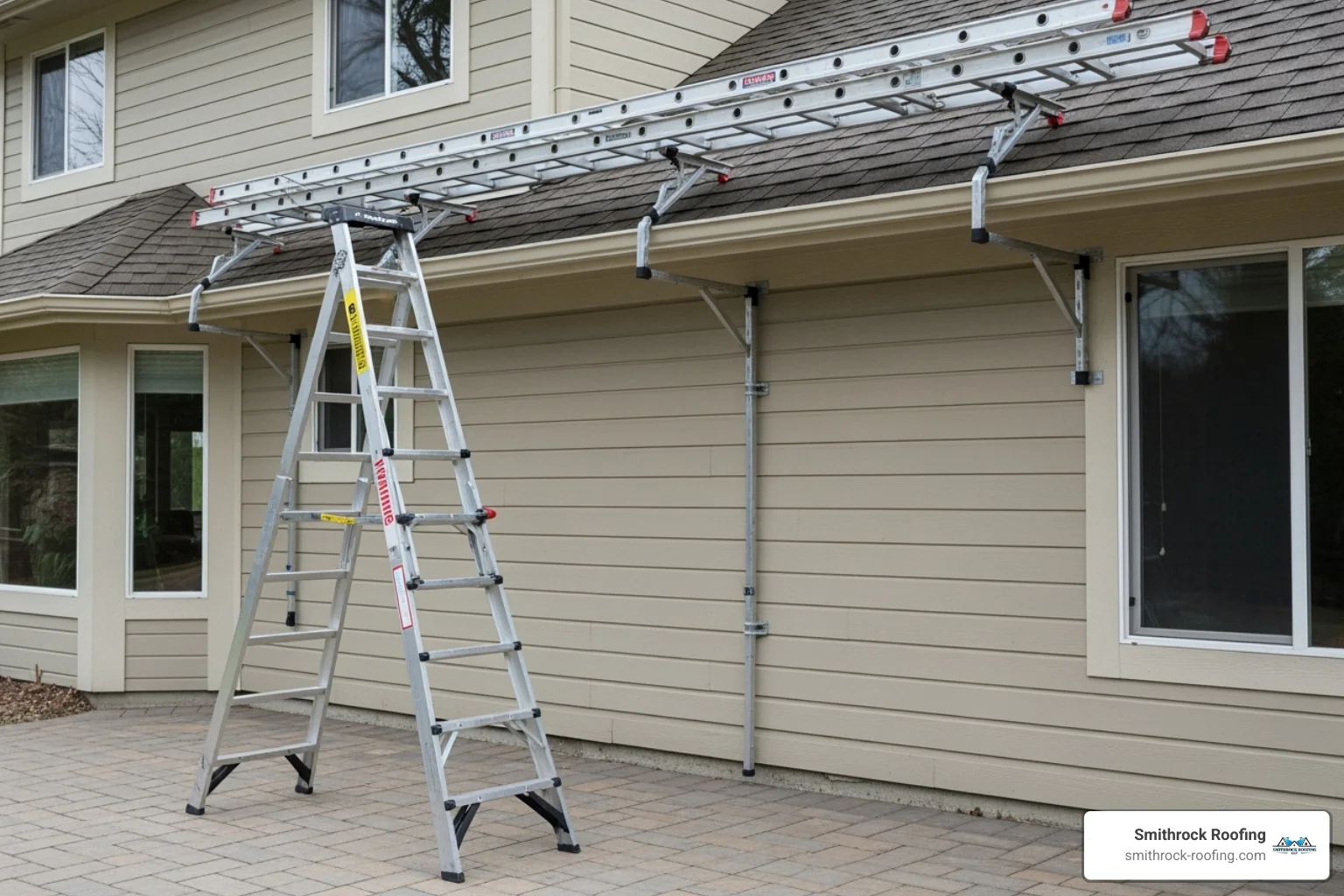
Before attempting a DIY installation, it’s crucial to weigh the risks against the potential savings:
Given the high stakes, professional installation from a team like Smithrock Roofing is a wise investment that guarantees your exterior gutters are installed correctly for optimal, long-term performance.
A professional gutter installation is more than just hanging a trough. Every component below is part of the finished assembly, and each one must be correctly specified, fitted, and secured for the system to perform as designed.
When all of these gutter installation parts are properly selected and assembled, the result is a complete rainwater gutter system that functions reliably for decades without constant intervention.
Successful installation begins with thorough preparation. Key steps include:
Understanding the professional process highlights its complexity and precision.
For more details on professional techniques, see our resource on Gutter and Downspout Installation.
Your exterior gutters are a hardworking component of your home’s exterior, constantly exposed to rain, sun, wind, and debris. To ensure they continue to protect your home for decades, a consistent maintenance routine is not just recommended—it’s essential. A few hours of preventive care each year can save you from thousands of dollars in repairs related to water damage, foundation issues, and pest infestations.
Neglecting your gutters is a gamble against nature that a homeowner will eventually lose. By keeping your gutters clean and in good repair, you are making a direct investment in your home’s structural integrity and long-term value.
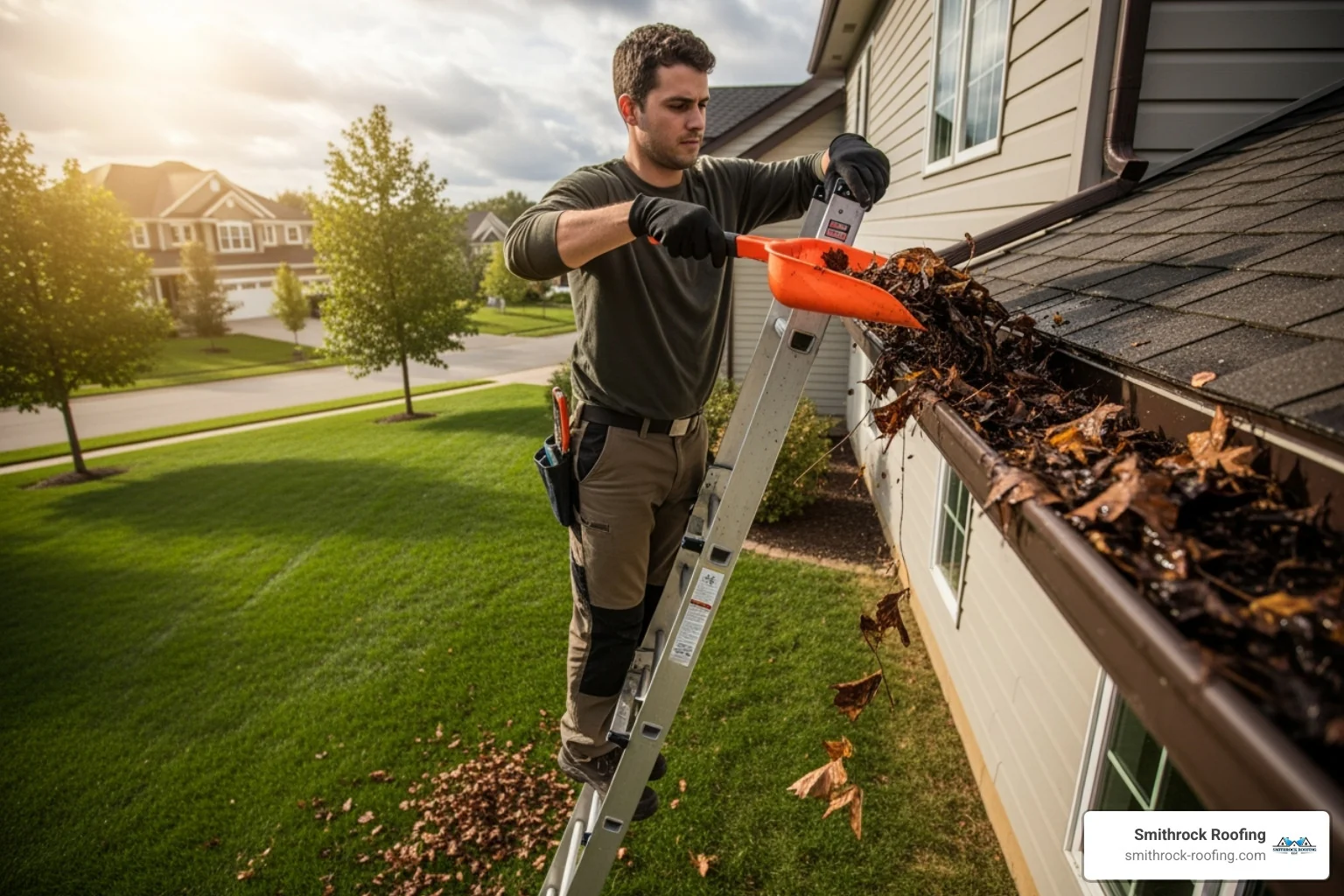
The golden rule of gutter care is to clean your exterior gutters at least twice a year: once in late spring to clear out winter debris and pollen, and again in late fall after all the leaves have dropped. If your home is surrounded by pine trees or other heavy-shedding trees, more frequent cleaning (3-4 times a year) may be necessary.
A thorough cleaning process involves:
Regularly check that downspouts are firmly attached and that extensions are directing water far from the house. For more on maintaining your system, explore our Gutter Installation Services resources.
For widespread damage or persistent issues, it’s time to call a professional. If you need help, Find Gutter Repair Near Me to connect with our team.
To reduce maintenance and enhance protection, consider adding gutter accessories.
Gutter guards are designed to block leaves and debris while allowing water to flow in. While no guard is truly “maintenance-free,” a good system can reduce cleaning frequency from several times a year to once every year or two.
Heated Gutter Systems are a valuable accessory in cold climates prone to ice dams. These systems use electrical heating cables installed in a zigzag pattern along the roof edge and inside gutters and downspouts. They don’t melt all the snow, but they create channels that allow meltwater to drain safely away, preventing ice buildup and damming. They are an effective solution but do add to your electricity bill in the winter.
Over years of installing and repairing exterior gutters, we’ve encountered nearly every question imaginable. Here are clear, detailed answers to the most common inquiries to help you make confident, informed decisions about your home’s water management system.
A complete rain gutter system is made up of several interdependent components. The gutter trough (or eavestrough) is the horizontal channel that catches water at the roofline. Hangers and fascia brackets secure the trough to the house. End caps seal off the open ends of each run. Outlet tubes create the transition from the trough into the vertical downspout. Elbows redirect the downspout at the top (away from the eave and back against the wall) and at the bottom (away from the foundation). Downspout straps anchor the pipe to the wall. Extensions and splash blocks at the base ensure water is discharged safely away from the house. Miters handle inside and outside corners. Every one of these rain gutter parts has to work together for the system to function correctly — a single weak link compromises the whole chain.
Choosing the right size exterior gutters is a critical calculation based on your roof’s water-handling needs. The primary factors are:
For most standard homes in moderate climates, 5-inch K-style gutters are sufficient. However, for homes with large, complex, or steep roofs, or in areas with heavy rainfall, upgrading to 6-inch “oversized” gutters is a wise investment. These wider gutters can handle significantly more water volume, providing a crucial margin of safety against overflow. Downspouts must also be sized appropriately; standard 2×3-inch downspouts are paired with 5-inch gutters, while larger 3×4-inch downspouts are used with 6-inch gutters to drain the higher volume effectively. For more foundational information, Gutter basics from Bob Vila is a great resource.
The lifespan of your gutters depends heavily on material, climate, and maintenance. Aluminum and steel gutters typically last 20-30 years, while copper gutters can last 50 years or even a century. However, it’s more important to look for signs of failure than to rely on age alone. It’s time for a replacement if you observe:
When these problems become widespread, a full replacement is more cost-effective and reliable than a series of temporary repairs.
The cost of new gutters varies widely based on material, home size, and job complexity. Prices are typically quoted per linear foot, including installation.
Gutter gauge refers to the thickness of the metal. Counterintuitively, a lower gauge number means thicker, stronger metal. This is a critical factor in the durability of your gutter system.
Absolutely — and this is one of the most underappreciated functions of a home gutter system. When gutters are missing, clogged, or discharging water too close to the house, the soil around your foundation becomes repeatedly oversaturated. That saturated soil exerts hydrostatic pressure against your foundation walls, which over time causes cracks, water intrusion, and in serious cases, structural movement. A properly functioning gutter system — one that collects water efficiently and discharges it well away from the house — keeps the soil around your foundation consistently drier and far less prone to that damaging pressure cycle. It’s one of the simplest, most cost-effective investments you can make in your foundation’s long-term health.
Yes, exterior gutters can be professionally installed on homes with angled or sloped fascia, but it requires special techniques to ensure proper function. The gutter trough itself must always be hung level from front to back to hold water correctly. Attaching it directly to a sloped board would cause it to tilt, spilling water over the front or back.
The solution is to use wedge inserts. These are precisely angled shims, typically made of wood or composite material, that are placed between the fascia and the back of the gutter. The wedge fills the gap, creating a vertical (plumb) surface for the gutter to hang from. This allows the gutter to sit level while still being securely fastened to the angled fascia. Most importantly, the entire gutter run must still maintain the proper pitch (a 1/4-inch slope per 10 feet) along its length to ensure water flows to the downspouts. This is a prime example of a challenge that requires the expertise of a professional installer.
They are the same thing. Eavestrough is the term most commonly used in Canada and some parts of the UK, while gutter trough — or simply “gutter” — is the standard American terminology. Both refer to the horizontal channel installed along the eave of the roof that collects rainwater and directs it toward the downspouts. You may also hear the term trough gutter used interchangeably. Regardless of what it’s called in your region, the component and its function are identical.
Your home is a major investment, and protecting it starts with a simple yet powerful system: exterior gutters. These hardworking channels perform the essential job of steering thousands of gallons of rainwater safely away from your foundation, walls, and landscaping.
As we’ve covered, gutters are your first line of defense against foundation cracks, basement flooding, rotting fascia, and ice dams. Understanding how a home gutter system works — from the eavestrough at the roofline all the way to the splash block at grade — helps you recognize problems early and make better decisions about materials, sizing, and maintenance. Choosing the right material—whether it’s versatile aluminum, strong steel, or long-lasting copper—and the right style ensures your home is protected. Opting for seamless gutters further reduces leak points and improves curb appeal.
Professional installation is the smart choice, ensuring the precise slope and secure attachment needed for a long-lasting solution. Once installed, regular maintenance like cleaning and inspections will keep your system functioning smoothly for decades.
Neglecting your gutters can turn a minor issue into an expensive nightmare of structural repairs. By making informed choices and maintaining your exterior gutters properly, you are actively preserving your home’s integrity and value.
For a professional, worry-free installation that ensures your home stays protected through every season, trust the experts at Smithrock Roofing. We are committed to delivering high-quality gutter solutions that stand the test of time.

Smithrock Roofing © Copyright 2026 • All Rights Reserved • Privacy Policy • Maintained by Mongoose Digital Marketing