Replacing a roof is one of the largest investments a homeowner makes — and one of the least understood. Most people hire based on a neighbor’s recommendation, a yard sign they spotted after a storm, or whichever company answered the phone first. That’s understandable. Roofing isn’t something you deal with often, and when you do need it, the pressure to just get it handled can override the instinct to slow down and ask hard questions.
The problem is that the roofing industry in Winston-Salem — like most markets — has a wide spread between contractors who do excellent, lasting work and those who cut corners that won’t show up until year four or five when your warranty paperwork has moved three times and the original crew is nowhere to be found.
This guide exists to close that information gap. We’re going to walk through what actually drives roof performance in the Piedmont Triad’s specific climate, what warranty language really means (and what quietly voids it), how to navigate a storm damage claim without getting shortchanged, and exactly what questions to ask any contractor — including us — before you sign anything. If you walk away from this more confident in your ability to make a smart decision, we’ve done our job.
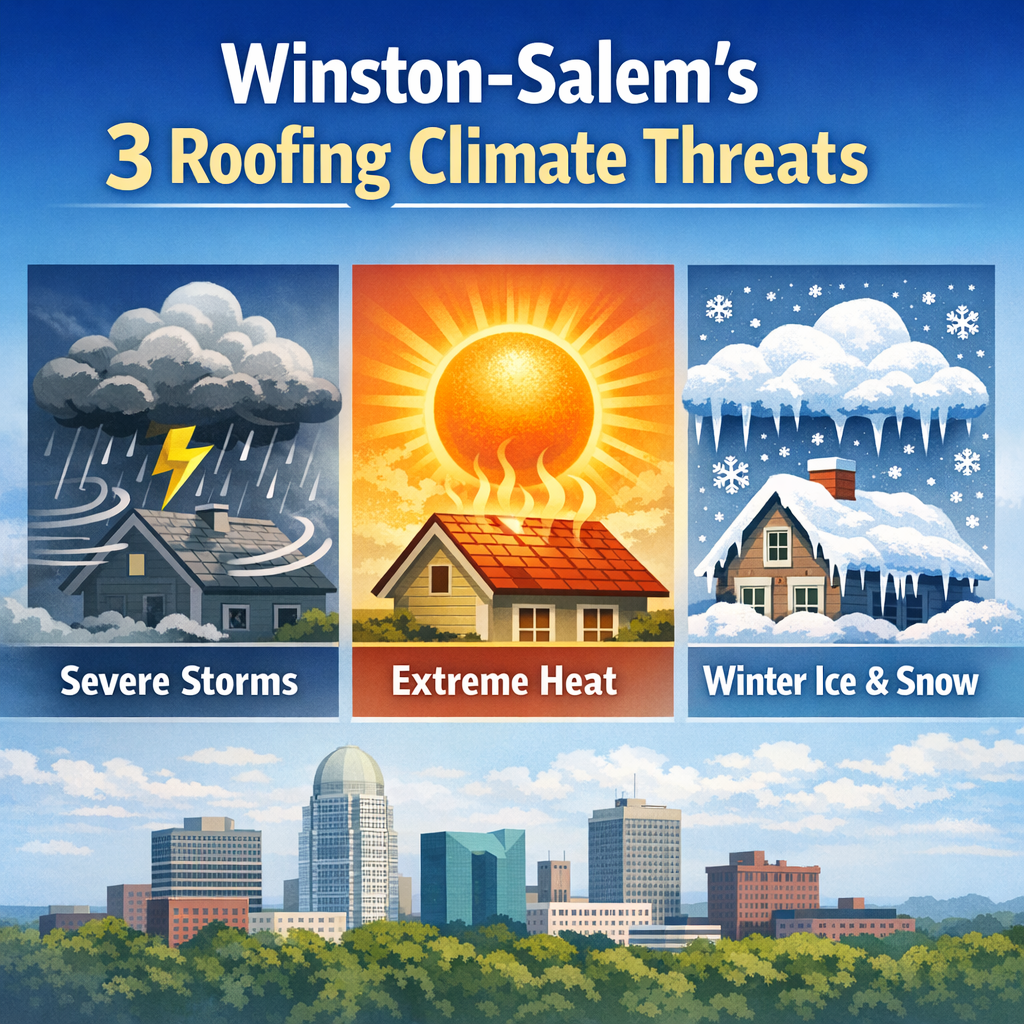
The Piedmont Triad sits in what building scientists call a mixed-humid climate zone — and it’s genuinely one of the more demanding environments for roofing systems in the eastern United States. That’s not hyperbole. Here’s why.
Winston-Salem regularly sees stretches of 90°F-plus days paired with high relative humidity throughout June, July, and August. That combination accelerates two specific failure mechanisms in roofing materials:
Thermal expansion cycling. Shingles expand when they heat up and contract as temperatures drop at night. Lower-grade shingles — particularly 3-tab designs or entry-level architectural shingles — lose structural integrity faster in high thermal-cycling environments. The mat beneath the granules degrades, granules begin shedding into your gutters, and water resistance drops well before the shingle’s rated lifespan.
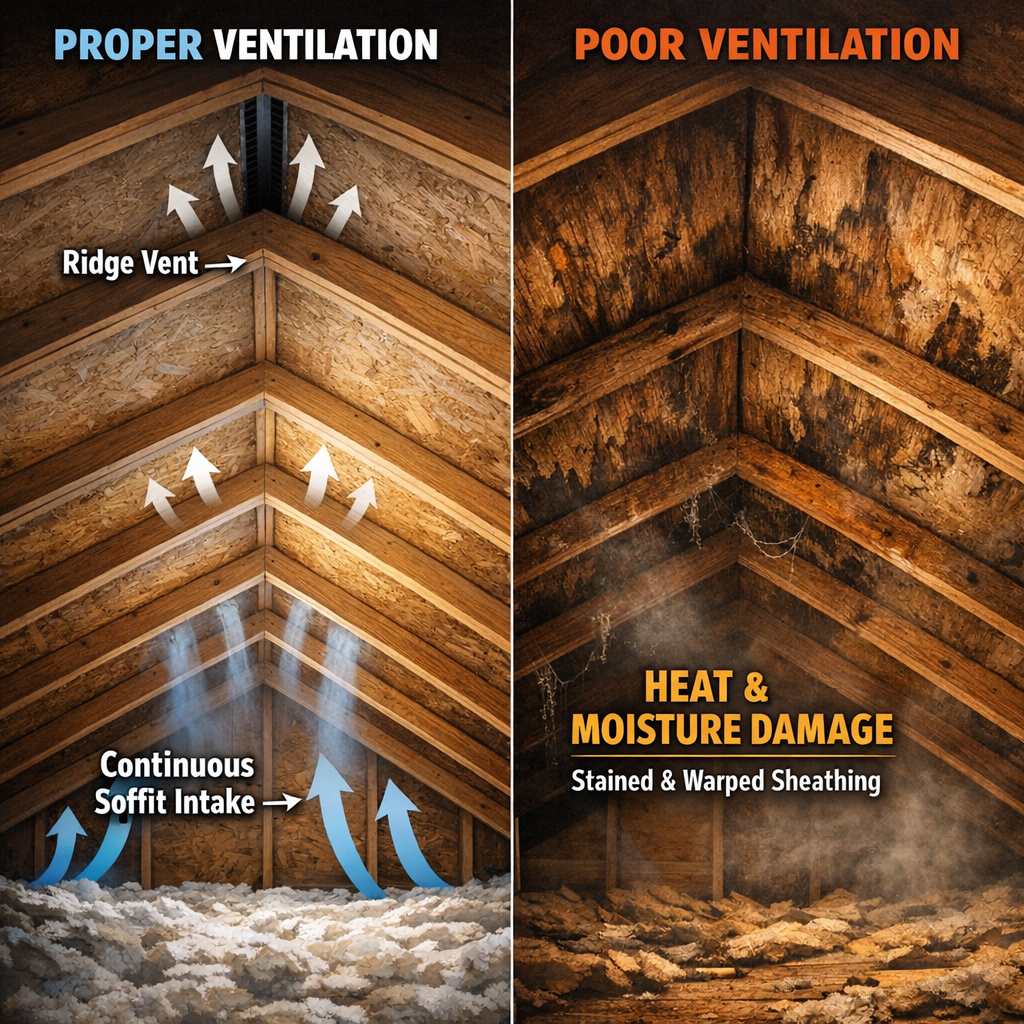
Attic heat loading. An under-ventilated attic in a Winston-Salem summer can reach 150°F or higher. That heat doesn’t just bake your shingles from above — it bakes them from below, cooking the adhesive strip that holds tabs down and dramatically shortening effective lifespan. A roof that might last 25 years on a well-ventilated home in a milder climate may last 14 or 15 years here under poor ventilation conditions.
Winston-Salem doesn’t get the prolonged hard winters of the NC mountains, but that’s actually part of the problem. January and February temperatures in the Triad routinely cross the 32°F threshold multiple times per week — warming above freezing during the day, dropping back below at night. This oscillation is precisely the condition that creates ice dams.
Ice dams form when heat escaping from your living space warms the roof deck, melting snow or frost near the ridge. That water runs down toward the cold eaves, refreezes, and backs up under shingles. The result is water infiltration at the eave line — often showing up as ceiling stains or damaged insulation weeks after the event, making the cause difficult to trace. If you’re dealing with this issue, our guide on how to get rid of ice dams walks through the root causes and solutions in detail.
The protection against ice dams isn’t thicker shingles. It’s a properly installed ice and water shield membrane at the eaves (and in valleys), combined with adequate attic insulation and ventilation that keeps the deck temperature uniform. Any contractor who doesn’t specifically address ice and water shield placement during a Winston-Salem estimate is leaving a gap in your system.
Winston-Salem lies well inland, but the Piedmont Triad sits directly in the path of weakening tropical systems that track northward after making landfall on the Carolina coast. Tropical Storm Fred in 2021, the remnants of Florence, and multiple other systems have delivered hours of sustained heavy rainfall to the Winston-Salem area — not the brief thunderstorm intensity most roofing components handle easily, but prolonged, wind-driven rain that probes every gap in flashing, every underlayment seam, and every valley that wasn’t installed to a higher standard.
This is why flashing quality and underlayment specification matter more in this region than in drier inland climates. A basic felt underlayment that performs fine in the Midwest is a liability in the Triad. Synthetic underlayment — which resists moisture absorption, maintains its dimensional stability, and doesn’t wrinkle or buckle during installation — isn’t a premium upgrade here. It’s the baseline.
Most homeowners think of a “new roof” as new shingles. A roofing system has six interdependent components, and the failure of any one of them compromises the others. Here’s what each layer does and what separates a correctly installed component from a shortcut that will cost you later.
The deck is the structural foundation — typically OSB (oriented strand board) or plywood sheathing nailed to your rafters. Before any other component goes on, the deck needs to be inspected for rot, delamination, and soft spots. This is where the most common hidden cost in any roofing project lives.
Rotted or delaminated decking can’t hold fasteners properly, which means shingles will lift in wind events regardless of shingle quality. A reputable contractor will walk the deck during tear-off and flag damaged sections before the new materials go on. If a contractor’s estimate doesn’t include any language about deck inspection and repair allowances, ask why.
What separates good from adequate: Decking fastened to span ratings, nail pattern followed per manufacturer spec (typically 6″ on center at edges, 12″ in the field for OSB), and any deteriorated sections replaced — not covered.
A self-adhering waterproof membrane applied directly to the deck before underlayment. In Winston-Salem, this should be installed at minimum at all eaves (typically the first 3 to 6 feet up from the fascia depending on roof pitch), in all valleys, and around any penetrations — skylights, chimneys, pipe boots.
In a climate with freeze-thaw cycling and tropical storm exposure, extending ice and water shield up the rakes and around all flashing interfaces is a mark of quality installation, not an upsell.
The layer between the deck and shingles. This is where the synthetic vs. felt distinction matters most. Felt underlayment absorbs moisture during installation, can wrinkle as it dries (creating bumps visible in finished shingles), and degrades faster under thermal cycling. Synthetic underlayment is dimensionally stable, lighter, and significantly more tear-resistant during installation and during the window between tear-off and shingle installation if weather intervenes.
CertainTeed’s Diamond Deck synthetic underlayment, for example, provides a slip-resistant surface for crews working on the roof and a far more reliable water-resistant barrier than traditional #15 or #30 felt. This isn’t marketing — it’s a meaningful spec difference.
A purpose-engineered component installed at the eaves and rakes before field shingles begin. Starter strips carry a factory-applied adhesive strip positioned to seal the first course of field shingles from wind uplift — which is where failures begin in storm events. Using cut-down field shingles as starters (a common shortcut) places adhesive in the wrong position and creates a vulnerable first course.
The visible layer. Material selection here involves more than brand preference. Key variables for a Winston-Salem home:
| Shingle Attribute | Why It Matters Locally | Recommended Specification |
|---|---|---|
| Wind Rating | Hurricane remnants and Triad thunderstorms routinely produce gusts exceeding 60 mph | 130 mph or higher; Class H per ASTM D3161 |
| Impact Rating | Hail events in the Piedmont Triad can damage granule surface and void insurance claims | Class 3 or Class 4 per UL 2218 |
| Algae Resistance | High humidity promotes algae and moss growth, causing staining and granule loss | Look for copper-infused granules (CertainTeed’s Armourshield Technology or equivalent) |
| Thermal Cracking Resistance | Repeated heat/cold cycling degrades lower-weight mats | SBS-modified or heavyweight mat construction (e.g., CertainTeed Landmark series) |
| Weight/Thickness | Heavier shingles resist wind uplift and offer better impact resistance | Architectural (dimensional) shingles minimum; premium series preferred |
Flashing — the metal components sealing joints at chimneys, walls, skylights, and valleys — is where the majority of roof leaks originate. Step flashing at sidewalls, counter flashing at chimneys, and valley metal need to be either replaced or thoroughly inspected and re-sealed during any re-roof. A contractor who “works around” existing flashing on a 20-year-old roof is introducing a known failure point into a new system.
Ventilation is the component most directly tied to both shingle lifespan and warranty validity. More on that in the next section.
Every roofing company in Winston-Salem will mention warranties. Very few will explain them in detail, because the details reveal how many installations are actually positioned to honor them.
A manufacturer’s material warranty (CertainTeed, GAF, Owens Corning) covers defects in the shingle itself — manufacturing failures, premature granule loss, algae staining if the shingle is rated for it. It does not cover improper installation. If your shingles blow off because they were nailed too high on the nail line (a common installation error called “high nailing”), the manufacturer will decline the claim — correctly — because it’s a workmanship issue.
A contractor’s workmanship warranty covers installation errors — the human element. A 5-year workmanship warranty means if something fails due to how the roof was installed (not because the materials failed), the contractor will return and correct it at no charge for five years. This is the warranty that separates contractors who stand behind their crews from those who don’t.
When you’re evaluating any roofing company in Winston-Salem, ask for both warranty documents in writing before the project starts. You can also review our warranty coverage to understand exactly what our installations include before signing anything.
This is the most important thing most homeowners never learn until it’s too late.
CertainTeed, GAF, Owens Corning, and virtually every major shingle manufacturer void their material warranties if attic ventilation doesn’t meet minimum standards — specifically the 1:150 ratio (one square foot of Net Free Ventilation Area per 150 square feet of attic floor space) or 1:300 with a balanced intake/exhaust system.
What this means practically: if a contractor installs $15,000 worth of shingles over an attic that has two small gable vents and no soffit intake — a configuration common in older Winston-Salem homes — your manufacturer warranty is void before the crew’s truck leaves the street. The shingles will bake from below, and when you file a claim at year 10, the manufacturer will send an inspector, identify the ventilation deficiency, and decline coverage.
A reputable contractor assesses your attic ventilation as part of every estimate — not as an add-on to discuss after you’ve signed.
Installing new shingles directly over existing shingles — sometimes called a “re-roof over” or “second layer” — is permitted by some local codes but voids manufacturer warranties entirely on the new shingles. It also adds weight to your structure, makes future tear-offs more expensive, and prevents proper deck inspection. The only reason contractors do it is to reduce labor cost. The homeowner absorbs all the risk.
The tier of warranty available to you depends directly on the certification status of your installer. With CertainTeed, for example:
Smithrock Roofing holds CertainTeed PREMIER ShingleMaster Master Certified status — the top tier of CertainTeed’s certification program. That designation isn’t cosmetic. It’s what allows us to offer homeowners warranty coverage that most roofing companies in this market simply cannot provide, regardless of what shingle they’re installing.
Storm damage is one of the most common triggers for roof replacement in the Winston-Salem area, and the claims process is one of the most misunderstood. Homeowners who don’t know how it works routinely accept settlements that don’t cover the full cost of a proper repair — and they do it legally, because they signed off on a number without knowing what they were agreeing to.
Here’s how the process actually works, and where the leverage points are.
After a hail event or windstorm, take photos of any visible exterior damage — siding dents, window screen tears, gutters, downspouts, and anything on the ground (shingle granules in gutters are significant evidence). Date-stamped photos taken before a contractor or adjuster visits establish a clear baseline. Do not let anyone on your roof before you have documentation of ground-level conditions.
Your insurance company’s adjuster works for the insurance company. That’s not a cynical statement — it’s simply the reality of their role. Initial adjuster estimates routinely:
A qualified contractor should review the adjuster’s scope of work and identify any line items that are missing or undervalued. This is called filing a supplement, and it’s a standard part of working with insurance claims — not a confrontational act. Our article on navigating a roof replacement insurance claim covers the supplementing process in full detail.
North Carolina case law and insurance regulations address the question of whether an insurer must replace non-damaged sections of a roof (or siding) to maintain visual consistency with replaced sections. This matters when, for example, hail damages one slope of a roof but not another — and the original shingle is discontinued or aged to the point where a partial replacement would be visually inconsistent.
Ask your contractor whether a matching issue exists on your project and whether it’s been raised with the adjuster. Many homeowners don’t know to ask, and many adjusters don’t volunteer the information.
After every significant weather event in Winston-Salem, out-of-area contractors arrive in force. Some do acceptable work. Many do not, and more importantly, most will be gone before any warranty claims need to be honored. Red flags that identify storm-chaser operations:
A contractor with 312+ five-star reviews, a local physical address, BBB A+ standing, and 60+ combined years of experience in the Triad doesn’t need to knock on your door at 6pm after a storm. Their reputation does the work.
These questions work regardless of which contractor you’re evaluating. Honest contractors will welcome them. The ones who get evasive or dismissive are telling you something important.
1. Are you licensed with the NC Licensing Board for General Contractors, and can I have your license number?
Verify it at nclbgc.org before the conversation continues. This is non-negotiable.
2. What certification tier do you hold with your primary shingle manufacturer, and what warranty tiers does that make available to me?
The answer reveals both their actual relationship with the manufacturer and the maximum warranty protection they can offer you.
3. How will you assess my attic ventilation before the installation, and what happens if it doesn’t meet manufacturer requirements?
Any vague answer here is a warning sign. Ventilation assessment should be a standard part of the estimate, not a surprise add-on.
4. Will you be doing a full tear-off, and will the crew inspect the deck during tear-off for rot or delamination?
Ask for a written line item for deck repair allowance and understand how it’s priced.
5. What underlayment are you using, and is it synthetic?
A contractor who defaults to felt without discussion in this climate hasn’t thought carefully about material selection.
6. What is your workmanship warranty, and is it in writing?
Get the document. A verbal warranty is not a warranty.
7. Who will be on my roof — your own employees or subcontractors?
This isn’t automatically a disqualifying answer either way, but you should know. If subs are used, ask whether they’re covered under the same insurance policy and whether the same warranty applies.
Choosing the right roofing company in Winston-Salem isn’t about finding the flashiest website or the longest list of services. It’s about finding a contractor who treats your home the way a neighbor with deep expertise would — honestly, carefully, and with the kind of long-term thinking that shows up in every nail pattern, every flashing detail, and every conversation along the way. That’s the standard we hold ourselves to, and it’s the standard you should hold every contractor to before handing over the keys.
Before you sign any contract, these three steps will put you in a stronger position than the majority of homeowners navigating this process.
1. Use the NCLBGC License Verification Portal Before the First Call Ends
The NC Licensing Board for General Contractors maintains a public search tool at nclbgc.org. Spend 90 seconds verifying that the contractor’s license is active, that it covers the correct classification for residential roofing work, and that no disciplinary actions appear on the record. Make this a reflex, not an afterthought. A contractor who hesitates when you ask for their license number has already answered your most important question.
2. Request a Manufacturer’s Warranty Eligibility Letter Before Installation Begins
In 2026, the leading shingle manufacturers — GAF, Owens Corning, and CertainTeed among them — all have contractor certification portals where homeowners can independently verify a roofer’s status and the warranty tiers they’re authorized to issue. Ask your contractor to provide written confirmation of their certification level before work starts. This single document tells you whether the enhanced warranty they’re promising you is actually within their power to deliver. If they can’t produce it, the enhanced warranty isn’t real.
3. Schedule a Post-Installation Inspection with a Third-Party Roofing Inspector
The roof inspection industry has matured considerably, and independent certified inspectors — credentialed through the National Roof Certification and Inspection Association or similar bodies — can conduct a post-installation review for a few hundred dollars that covers nail patterns, flashing integration, ridge cap alignment, and ventilation compliance. In a climate like Winston-Salem’s, where a poorly installed roof will be tested hard by the first major storm, a third-party sign-off is inexpensive insurance. Some manufacturers will also perform a factory inspection to validate enhanced warranty coverage — ask your contractor whether that option is available on your project.
All roofing contractors performing work above a certain project threshold in North Carolina are required to hold a valid license through the NC Licensing Board for General Contractors (NCLBGC). You can verify any contractor’s license status, classification, and disciplinary history at no cost through the public search tool at nclbgc.org. Always confirm that the license is active and covers the correct scope of work before signing a contract. Asking a contractor directly for their license number and cross-referencing it yourself is the single most reliable consumer protection step available to you.
Late spring and early fall are generally considered the optimal windows for roof replacement in Winston-Salem. Temperatures in the 50°F to 80°F range allow asphalt shingles to seal properly and give installation crews ideal working conditions. Summer installations are common and workable, but extreme heat can make shingles more vulnerable to scuffing during handling. Winter installations are possible but require careful attention to manufacturer temperature guidelines for adhesive strips. That said, if your roof has active damage or significant leaks, the right time to replace it is immediately — regardless of season. A quality contractor can install properly in any season with the right techniques and materials.
Most standard residential roof replacements in Winston-Salem are completed within one to two days once work begins. The timeline depends on the size and complexity of the roof, the number of penetrations and valleys, whether significant deck repair is needed, and current crew scheduling. A straightforward single-story home with a simple gable roof may be completed in a single full day. A multi-story home with a complex hip roof, multiple dormers, or extensive deck damage may require two or three days. Permit processing and material delivery scheduling can add time on the front end, so your total project timeline from contract signing to completion is typically one to three weeks depending on contractor workload.
Homeowner’s insurance in North Carolina typically covers roof damage caused by sudden and accidental events such as wind, hail, falling trees, and fire. Whether your policy pays for a full replacement or only the actual cash value depends on your specific coverage terms and the age of your roof. Policies with replacement cost value (RCV) coverage will pay to replace a damaged roof with a comparable new one, while actual cash value (ACV) policies depreciate the payout based on roof age. Normal wear and tear, aging, and maintenance neglect are generally excluded. After a storm event, contact your insurer to initiate a claim and have a reputable local roofing contractor — not a storm chaser — conduct an independent assessment before any adjuster visit.
Winston-Salem experiences a humid subtropical climate with hot summers, moderate winters, and significant seasonal storm activity including occasional ice events. Architectural (dimensional) asphalt shingles rated for high wind and impact resistance perform well here and represent the best value for most homeowners. For enhanced durability, Class 4 impact-resistant shingles can reduce insurance premiums and provide meaningful protection during hail events. Metal roofing — standing seam in particular — is an increasingly popular premium choice that handles temperature cycling, moisture, and wind load exceptionally well and carries a lifespan of 40 to 70 years. The Piedmont Triad’s freeze-thaw cycles in late winter make quality underlayment and properly integrated ice and water shield at vulnerable areas a critical component of any installation regardless of the primary roofing material selected.
A complete and trustworthy roofing estimate should itemize every material by product name, manufacturer, and quantity — including shingles, underlayment, ice and water shield, ridge cap, starter course, flashing, and any required ventilation components. It should specify whether the project includes a full tear-off of existing layers or an overlay, include a deck inspection provision and per-sheet pricing for any deck repair discovered during tear-off, state the disposal method for old materials, identify the warranty terms for both materials and workmanship, and confirm that the contractor carries current general liability and workers’ compensation insurance. Vague estimates that quote only a total price without material detail are a red flag. Line-item transparency is a mark of a contractor who is confident in their pricing and their process.
Most asphalt shingle manufacturers offer two distinct warranty tiers. Standard warranties cover the shingles themselves against manufacturing defects for a defined period — typically 25 to 30 years — but do not cover installation labor or other components of the roofing system. Enhanced or system warranties, offered by manufacturers such as GAF (Golden Pledge), Owens Corning (Platinum Protection), and CertainTeed (SureStart Plus), cover the entire roofing system including labor, and are only available when the installation is performed by a contractor who has achieved a specific certification tier with that manufacturer. The coverage duration, wind speed ratings, and transferability terms differ significantly between tiers. To access the highest warranty tier, verify that your contractor holds the required certification level directly through the manufacturer’s contractor locator tool before work begins.
Your roof is not a commodity purchase, and the company you trust with it will shape the performance, safety, and resale value of your home for the next two to four decades. Winston-Salem’s climate demands materials and installation practices that account for heat, humidity, ice, and storm wind — and that level of regional specificity only comes from contractors who have spent years working in this market and standing behind their work when the weather tests it.
The questions in this guide, the verification steps, and the standards described throughout this article exist to help you cut through the noise and find a contractor who earns your confidence before the first nail goes in. Hold every company you speak with to that standard — including us.
When you’re ready to move forward, we’re ready to listen. Contact Us
Smithrock Roofing © Copyright 2026 • All Rights Reserved • Privacy Policy • Maintained by Mongoose Digital Marketing