Why Buried Gutter Downspouts Are a Game-Changer for Your Home
Imagine a heavy downpour. Now, picture where all that water from your roof is going. Is it gushing out of a downspout right next to your foundation, creating a muddy pool? Are there clumsy, plastic extensions snaking across your lawn, waiting to be tripped over or crushed by the lawnmower? For many homeowners, this is a constant, frustrating reality. Buried gutter downspouts offer a permanent, elegant, and vastly superior alternative. These are professionally designed underground drainage systems that capture rainwater at the downspout and channel it safely away from your home’s foundation through concealed pipes. The result is a powerful water management solution that protects your most valuable asset while maintaining a clean, uncluttered, and professional landscape.
This system is more than just a convenience; it’s a fundamental upgrade to your home’s protective shell. It addresses the root cause of many serious and expensive home maintenance issues, moving from a reactive to a proactive approach to water management. The advantages over traditional, flimsy above-ground extensions are significant and impact everything from your home’s structural integrity to its daily usability and curb appeal.
Key Benefits of Buried Downspouts:
- Ultimate Foundation Protection: By discharging water 10, 20, or even more feet away from your home, you eliminate the primary cause of foundation damage: water saturation. This prevents the soil from expanding and contracting, which can cause cracks and settling over time.
- Proactive Basement Waterproofing: A buried system is your first line of defense against a wet basement or crawl space. It drastically reduces hydrostatic pressure—the force of water pushing against your foundation walls—preventing infiltration, chronic dampness, mold growth, and catastrophic flooding.
- Enhanced Curb Appeal: Say goodbye to unsightly, often damaged, plastic or metal extensions. An underground system is completely hidden, allowing for pristine landscaping, clean lines, and an immediate boost to your home’s visual appeal.
- Vast Safety Improvement: Above-ground extensions are notorious tripping hazards for children, guests, and even yourself. Buried systems remove these obstacles from walkways, patios, and lawns, creating a safer environment for everyone.
- Improved Lawn and Garden Health: Concentrated water discharge from traditional downspouts erodes soil, washes away mulch, and creates waterlogged patches where grass and plants can’t thrive. A buried system disperses water gently and away from delicate landscaping.
Installation Overview:
- Plan the pipe route and call 811 to have utility lines marked.
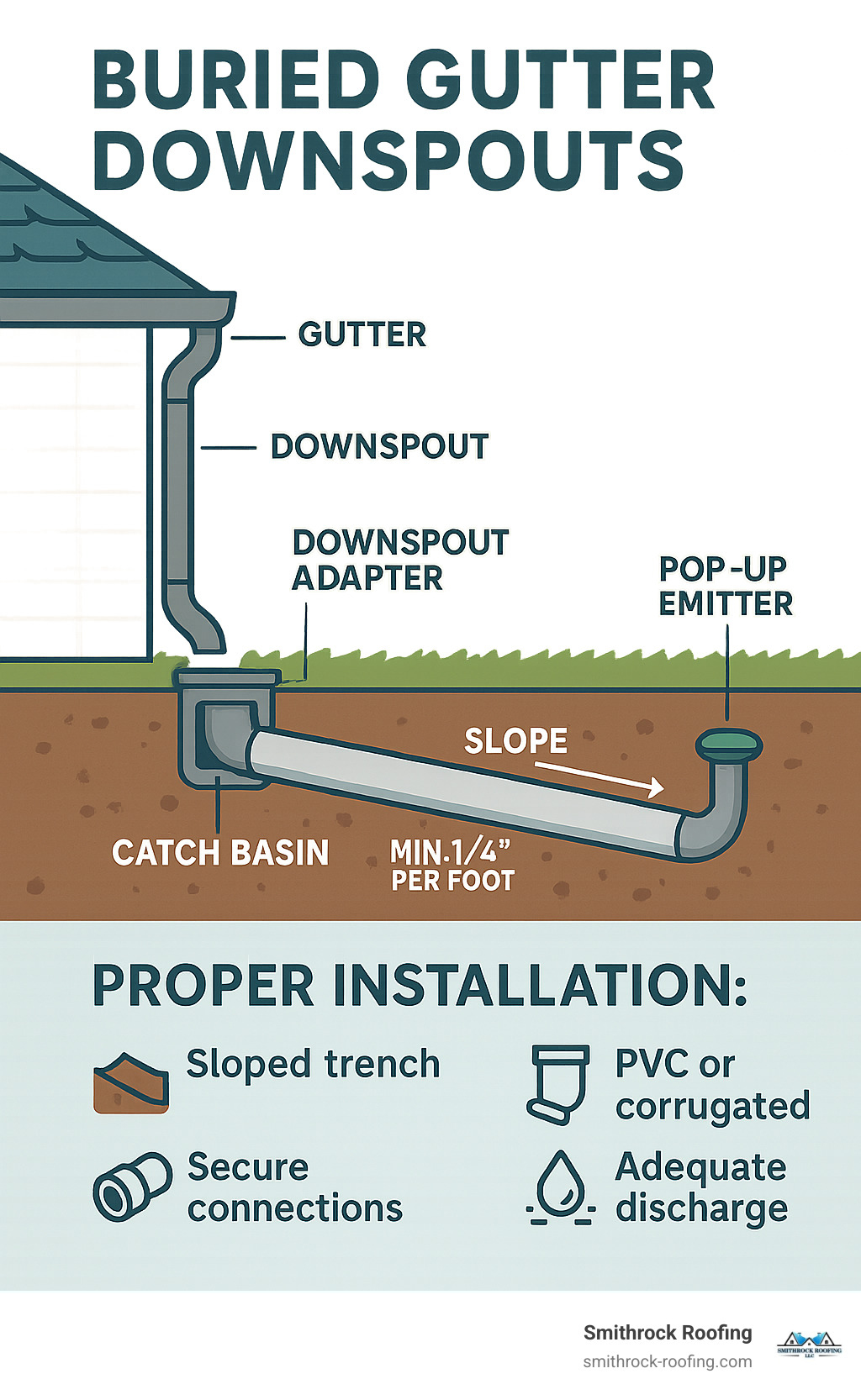
- Dig a trench that maintains a consistent, proper slope (a minimum grade of 1/4″ per foot).
- Install a durable pipe system, typically smooth-wall PVC or dual-wall corrugated pipe.
- Connect the pipes to your existing downspouts using watertight adapters and cleanouts for maintenance.
- Install a discharge mechanism, such as a pop-up emitter or a catch basin, at the termination point.
- Test the system thoroughly before backfilling the trench and restoring your landscape.
While a DIY installation can be cost-effective, with materials typically ranging from $250-$500, the project demands meticulous planning and physical labor. Ensuring proper slope, avoiding utilities, and preventing future issues like freezing or clogging are critical. For a guaranteed, long-lasting solution, professional installation starts around $2,000 and includes invaluable expertise in drainage design, specialized equipment, and compliance with local building codes.
I’m Jordan Smith, and in my 15 years of exterior construction experience, I’ve seen firsthand how a properly installed buried gutter downspout system can permanently solve water management headaches. At Smithrock Roofing, we don’t just install pipes; we design comprehensive drainage solutions that protect our clients’ homes for decades to come.

Why Bury Your Downspouts? A Deep Dive into the Pros and Cons
After a heavy rainstorm, a yard with buried gutter downspouts looks remarkably serene. There are no gushing waterfalls next to the house, no muddy trenches carved through the lawn, and no plastic extensions to navigate. These underground systems are the unsung heroes of home water management, working silently and effectively beneath the surface. As someone who’s dedicated my career to protecting homes from the elements, I can tell you that a deep understanding of both the incredible benefits and the potential challenges of these systems is essential before you pick up a shovel.
The Overwhelming Benefits of an Underground System
When it comes to safeguarding your home’s structure and value, buried gutter downspouts deliver a host of powerful advantages. The single most crucial benefit is unparalleled foundation protection.
Water is the number one enemy of a foundation. When rainwater is deposited directly at the base of your home, it super-saturates the soil. In regions with clay soil, like many parts of North Carolina, this saturated soil expands with immense force, pushing against your foundation walls. In the dry season, it contracts and pulls away. This constant cycle of expansion and contraction leads to cracks, bowing walls, and eventual structural failure. By channeling water at least 10 feet away, a buried system keeps the soil around your foundation stable, mitigating this risk and preventing costly repairs. This directly contributes to effective basement waterproofing. It keeps your basement or crawl space significantly drier, which is key to preventing musty odors, toxic mold growth, and the kind of water intrusion that can ruin stored belongings and finished living spaces. For homeowners in areas like Winston-Salem or Greensboro, where intense seasonal storms are a given, this protection provides invaluable peace of mind.
Other key benefits include:
- Elevated Aesthetics and Curb Appeal: Let’s be honest: the standard-issue, flimsy plastic extensions are an eyesore. They get crushed, discolored, and are often out of place. A buried system is completely invisible, creating a cleaner, more professional, and meticulously landscaped appearance that can increase your property value.
- Enhanced Safety and Usability: Removing downspout extensions from lawns, driveways, and walkways eliminates a significant tripping hazard. This makes your yard safer for children playing, guests visiting, and for you while doing yard work. It also frees up that space for gardens, patios, or simply open lawn.
- Lawn, Garden, and Soil Preservation: A powerful stream of water from a downspout can blast away topsoil, wash away expensive mulch from flower beds, and carve out ugly, muddy channels in your lawn. A buried system releases water gently at a safe distance, preventing this erosion and protecting your landscaping investment.
- Effective Mosquito and Pest Prevention: Standing water is a prime breeding ground for mosquitoes and other pests. By eliminating the pools of water that often form at the base of traditional downspouts, you make your yard a less hospitable place for these insects.
To learn more about how we can help optimize your home’s entire water management system, check out our comprehensive Gutter and Downspout Installation services.
Critical Considerations and Potential Challenges
While buried gutter downspouts offer tremendous benefits, they are an engineered system and require proper planning to avoid potential pitfalls. Every homeowner should understand these considerations.
- Potential for Clogging: This is the most common concern. Leaves, pine needles, twigs, shingle grit, and even animal nests can wash down from the gutters and create blockages in the underground pipes. Unlike above-ground extensions that can be easily cleared, these clogs are hidden from view and can disable the entire system.
- Maintenance and Access: Clearing an underground blockage is more complex than clearing a surface pipe. It may require specialized tools like a long plumber’s snake, a high-pressure water jetter, or a sewer camera inspection scope to locate and remove the obstruction. Proper installation with accessible cleanout ports is essential.
- Risk of Freezing and Cracking: In colder climates, this is a serious threat. If the pipe is not installed with a consistent, adequate downward slope, water can pool inside. When this water freezes, it expands with enough force to crack or shatter the pipe, leading to hidden leaks and expensive underground repairs.
- Long-Term Pipe Durability: The pipe you choose must be strong enough to withstand the weight of the soil above it, as well as foot traffic or even vehicles if it runs under a driveway. It must also resist degradation from soil chemicals and temperature fluctuations for many years.
- Threat of Root Intrusion: Tree roots are naturally drawn to sources of moisture. If a pipe has even a tiny leak at a joint, or if it’s a type of pipe that can be penetrated, tree roots can invade the system, causing severe blockages and damage that is difficult to repair.
- Installation Complexity and Precision: A successful, long-lasting installation is not as simple as just digging a trench. It requires careful planning of the route, precise digging to maintain a constant slope, and accurate calculations to ensure the system can handle your roof’s water volume. A mistake in any of these areas can lead to system failure.
- The Upfront Investment: A DIY project requires an investment in materials, which typically run $250-$500, plus the cost of tool rentals and your own significant time and labor. Professional installation often starts around $2,000, but this cost reflects the expertise, specialized equipment, and warranty that ensure the job is done right.
Understanding these challenges is not meant to discourage you, but to empower you to insist on a proper installation and perform the correct maintenance. For detailed solutions to common issues, visit our Common Issues with Buried Downspouts and Solutions resource page.
The Comprehensive Step-by-Step Guide to Installing Buried Gutter Downspouts
Installing buried gutter downspouts is a highly rewarding project that permanently solves drainage issues, protects your foundation, and dramatically improves your yard’s appearance. With meticulous planning and a methodical approach, you can create a hidden, efficient system that works tirelessly to manage rainwater. This comprehensive guide will walk you through the entire process, from initial concept to final landscaping.
Step 1: Planning and Preparation – The Blueprint for Success
Proper planning is not just the first step; it’s the most critical phase that determines the success and longevity of your entire system. Rushing this stage will lead to problems later.
- Map Your Property and Observe Water Flow: Start by sketching a map of your property. Mark the locations of all downspouts, walkways, patios, driveways, and significant trees or landscaping features. During the next heavy rain, go outside and observe how water naturally flows across your property. This will help you identify the best routes and discharge locations.
- Choose a Strategic Discharge Location: The golden rule is to discharge water at least 10 feet away from your foundation. However, farther is always better. If your lot is flat or has dense clay soil, aim for 15-20 feet or more. Ideal discharge points include a natural downward slope, a street curb (if local regulations permit), a rain garden, or a French drain system. Never discharge water onto a neighbor’s property, over a septic tank or leach field, or in an area where it will simply create a new swamp.
- Verify Local Codes and Permits: Before you dig, make a quick call to your local municipal building department. Ask about any regulations, permits, or inspection requirements for residential drainage work or discharging water near the street.
- Call 811 – The Most Important Phone Call You’ll Make: This is a non-negotiable safety step. Call 811 or visit the 811 website at least a few business days before you plan to dig. This free national service will arrange for all public utility companies to come to your property and mark the approximate locations of their underground lines (gas, electric, water, cable). Digging without this step is illegal, extremely dangerous, and could leave you liable for thousands of dollars in repairs.

Assemble everything you need before you start to avoid interruptions and work efficiently.
- Tools: Trenching shovel or spade (a rented power trencher is highly recommended for long runs or hard soil), measuring tape, 4-foot level, string line and stakes, line level, permanent marker, utility knife or PVC pipe cutter, PVC deburring tool, safety gloves, and safety glasses.
- Materials: Downspout adapters (to transition from your rectangular downspout to round pipe), your chosen pipe (4-inch diameter is standard), fittings (Wye fittings, 45-degree elbows, couplings), cleanout adapters and plugs, PVC primer and cement (if using PVC), a pop-up emitter or other discharge grate, optional catch basin(s), all-purpose gravel or drainage rock, and heavy-duty landscape fabric.
Step 3: Choosing Your Pipe: PVC vs. Corrugated vs. Dual-Wall
This decision is crucial and directly impacts your system’s longevity, maintenance needs, and overall cost.
| Pipe Type | Pros | Cons | Best For |
|---|
| Rigid PVC Pipe (Schedule 40 or SDR 35) | Extremely durable and crush-resistant. Perfectly smooth interior offers the best flow and clog resistance. Lasts 50+ years. | More expensive. Rigid, requires precise measurements and angled fittings for turns. | Homeowners seeking the most durable, lowest-maintenance, long-term solution. Our standard recommendation at Smithrock Roofing. |
| Corrugated Pipe (Single-Wall) | Inexpensive and highly flexible, making it easy for DIYers to bend around obstacles. | Ridged interior traps debris, leading to clogs. Prone to crushing and root intrusion. Shorter lifespan (15-25 years). | Budget-conscious projects, short and straight runs, or temporary solutions. Not recommended for a permanent system. |
| Dual-Wall Corrugated Pipe (N-12) | The best of both worlds: smooth interior for excellent flow and clog resistance, with a corrugated exterior for high structural strength. | More expensive than single-wall corrugated. Less flexible than single-wall. | An excellent alternative to PVC, offering similar performance with slightly more installation flexibility. |
Step 4: Digging the Trench – Precision is Paramount
With your route marked, it’s time to dig. The quality of your trench determines the function of your system.
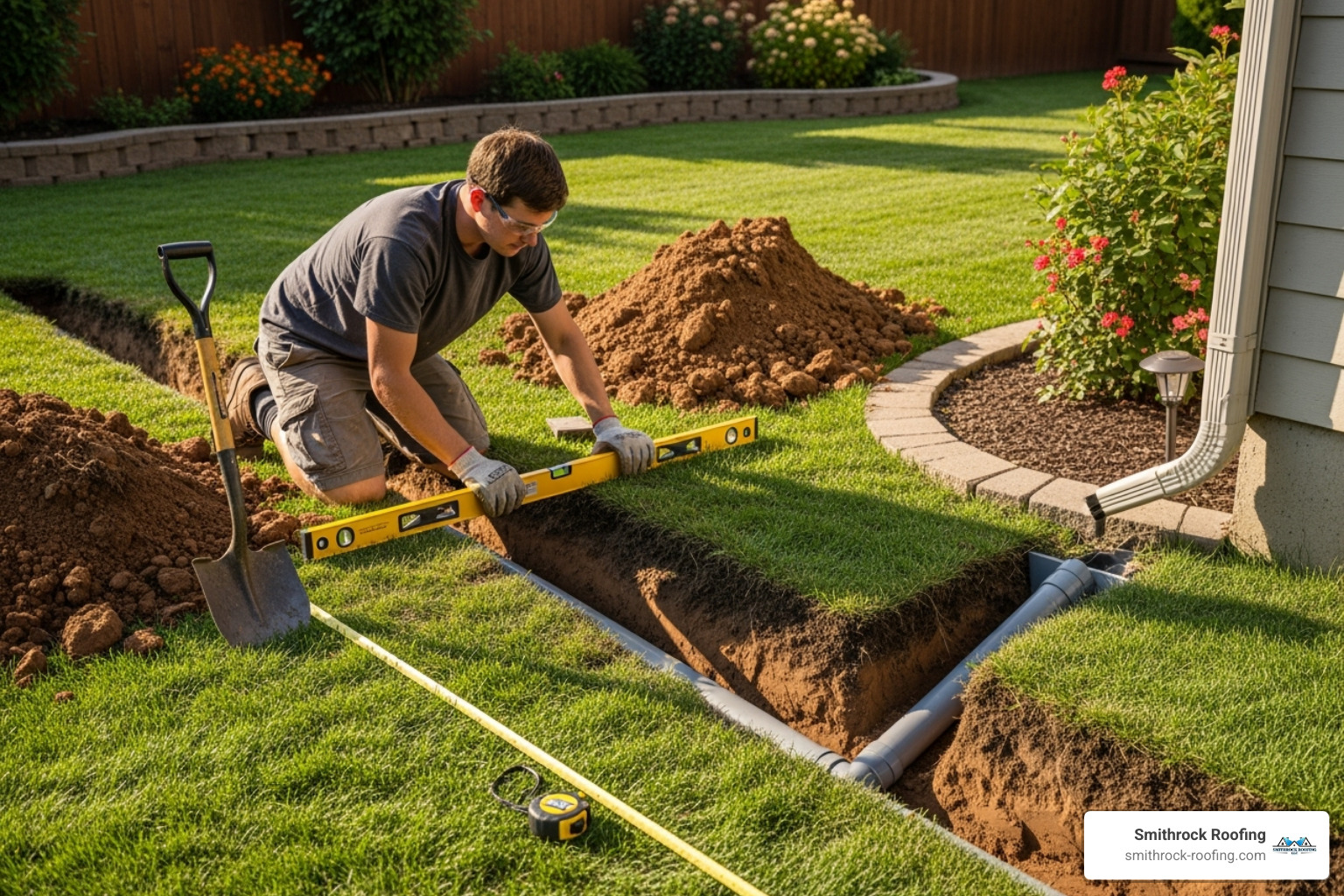
- Trench Dimensions: Dig the trench at least 12-18 inches deep to protect the pipe from frost heave and surface weight. The width should be about 8-10 inches to give you room to work and bed the pipe in gravel.
- Achieving Proper Slope: This is the most critical part of the entire installation. Your trench must have a consistent, uninterrupted downward grade of at least 1/4 inch per foot (a ~2% grade). A 1/2 inch per foot slope is even better. How to ensure slope: Drive a stake at the beginning (high point) and end (low point) of your trench. Run a string line between them, making it perfectly level using a line level. Then, measure down from the string to the bottom of the trench. For a 1/4″ per foot slope, the trench bottom should be 2.5 inches lower every 10 feet you move along the string.
- Avoid ‘Bellies’: Use a 4-foot level constantly as you dig to ensure there are no low spots or ‘bellies’ in the trench. Any dip will cause water to pool, collecting sediment and creating a prime location for freezing and blockages.
Step 5: Assembling and Laying the Pipe System
Now, you’ll bring the system together in the trench.
- Start with a Gravel Bed: Before laying any pipe, add a 1-2 inch layer of gravel to the bottom of the trench. This creates a stable, level base for the pipe.
- Install Cleanouts: This is a pro tip that saves major headaches later. Install a threaded cleanout adapter and plug right after the downspout adapter and at any major bend. This gives you easy access to the system for future flushing or snaking.
- Connect the Adapter: Securely attach the downspout adapter to your existing downspout. Use gutter sealant and screws for a watertight, durable connection.
- Join Pipe Sections: Dry-fit all your pipes and fittings first. Once you’re satisfied, join them permanently. For PVC, apply purple primer to both the pipe end and the inside of the fitting, followed immediately by a liberal coat of PVC cement. Push them together firmly with a quarter-turn and hold for 30 seconds.
- Use Wye Fittings, Not Tees: When connecting two lines, always use a 45-degree Wye fitting. A 90-degree Tee fitting causes extreme turbulence, slowing water flow and creating a major clog point. A Wye fitting allows the water streams to merge smoothly.
For more guidance on gutter work, see our Gutter Installation page.
Step 6: Installing Catch Basins and Pop-Up Emitters
These components are the entry and exit points of your system and are key to its function and maintenance.
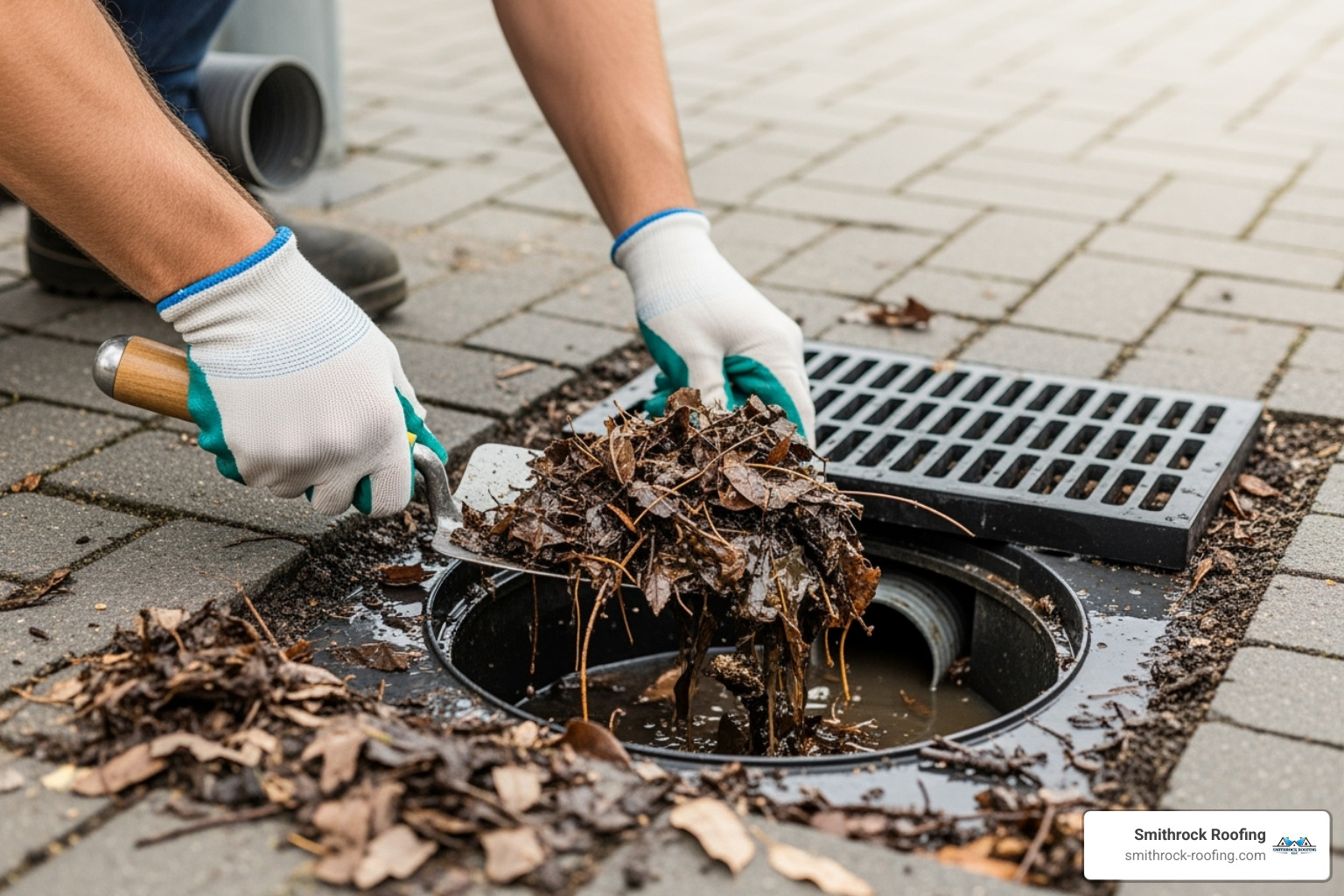
- Catch Basin (Optional but Recommended): Install a catch basin (a small box with a grate) near the house where water enters the underground pipe. It acts as a pre-filter, trapping leaves, shingle grit, and other large debris before it can enter and clog the main line. Simply lift the grate and clean it out a few times a year.
- Pop-Up Emitter (Discharge Point): This is the most common discharge device. It sits flush with your lawn. When water flows through the pipe, the pressure causes the lid to pop up and release the water. When the flow stops, the lid closes to prevent debris and animals from entering the pipe.
- Create a Gravel Pit (Dry Well): For improved drainage at the discharge point, dig a hole about 2x2x2 feet under your pop-up emitter. Line the hole with landscape fabric (to prevent soil from mixing in), fill it with gravel, and place the emitter on top. This allows the discharged water to soak into a larger area, preventing pooling.
Step 7: Backfilling and Final Touches
Before you bury your hard work, you must test it.
- Test the System Thoroughly: With the entire pipe system assembled in the trench, run a garden hose at full volume through each downspout opening for several minutes. Watch the discharge point to ensure a strong, steady flow. Check that the pop-up emitter functions correctly. Look carefully at all joints for any leaks. It is infinitely easier to fix a slope or a leaky joint now than after it’s buried.
- Backfill Strategically: Once tested, carefully surround the pipe with gravel, filling the trench about halfway. This is called “bedding” and it protects the pipe from sharp rocks and soil pressure. You can then cover the gravel with a strip of landscape fabric to keep soil from filtering down into it over time. Fill the rest of the trench with the original soil.
- Compact the Soil in Lifts: As you backfill with soil, only add 6 inches at a time, then compact it down firmly by walking on it or using a hand tamper. This prevents the soil from settling later and creating a sunken line in your yard.
- Restore Your Landscape: Rake the area smooth, and either re-lay the sod you saved or spread topsoil and grass seed. Water the area, and in a few weeks, the evidence of your work will have vanished, leaving only a perfectly functioning system behind.
Long-Term Care: A Guide to Maintenance, Troubleshooting, and Winterization
Congratulations on installing your buried gutter downspout system! You’ve made a significant investment in your home’s health and curb appeal. However, like any critical home system, it requires a small amount of preventative care to ensure it functions flawlessly for decades. Since the system is underground and out of sight, a proactive maintenance schedule is the best way to catch small issues before they evolve into major, costly problems.
Essential Maintenance for Your Buried Gutter Downspouts
Regular check-ups are your best defense against the primary enemies of a buried drain: clogs and damage. We recommend a simple seasonal schedule.
Seasonal Maintenance Checklist:
- Early Spring: After the last frost, inspect your pop-up emitters. Ensure they haven’t been damaged by snowplows or heaved up by frost. Test the system by running a hose down the line to confirm everything is flowing freely after the winter.
- Late Spring/Early Summer: Clean your gutters thoroughly after trees have dropped their seeds and pollen. If you have catch basins, lift the grates and scoop out any accumulated debris. This is the most important cleaning of the year to prepare for summer thunderstorms.
- Late Fall: This is the most critical maintenance period. After the majority of leaves have fallen, perform a complete cleaning of your gutters and downspouts. Clean out your catch basins again. Flush the entire underground system by running a garden hose at high pressure down each cleanout or downspout opening for 5-10 minutes. This will push any remaining sediment or shingle grit out through the emitter.
Troubleshooting Common Issues:
- Sign of Trouble: Slow Drainage or Water Backing Up: If you notice water pooling at the downspout opening during rain, you likely have a clog. First, check the downspout elbow itself for blockages. If it’s clear, the clog is underground. Use a plumber’s drain auger (snake) through your cleanout port to break it up. For tougher clogs, a drain bladder (an inflatable nozzle for your hose) can use water pressure to force it out. If that fails, it’s time to call a professional with a camera scope and hydro-jetter.
- Sign of Trouble: Pop-Up Emitter Not Closing: The emitter lid may be getting stuck on grass or debris. Clear the area around it and clean any dirt from the hinge mechanism. A small amount of silicone spray on the pivot points can also help.
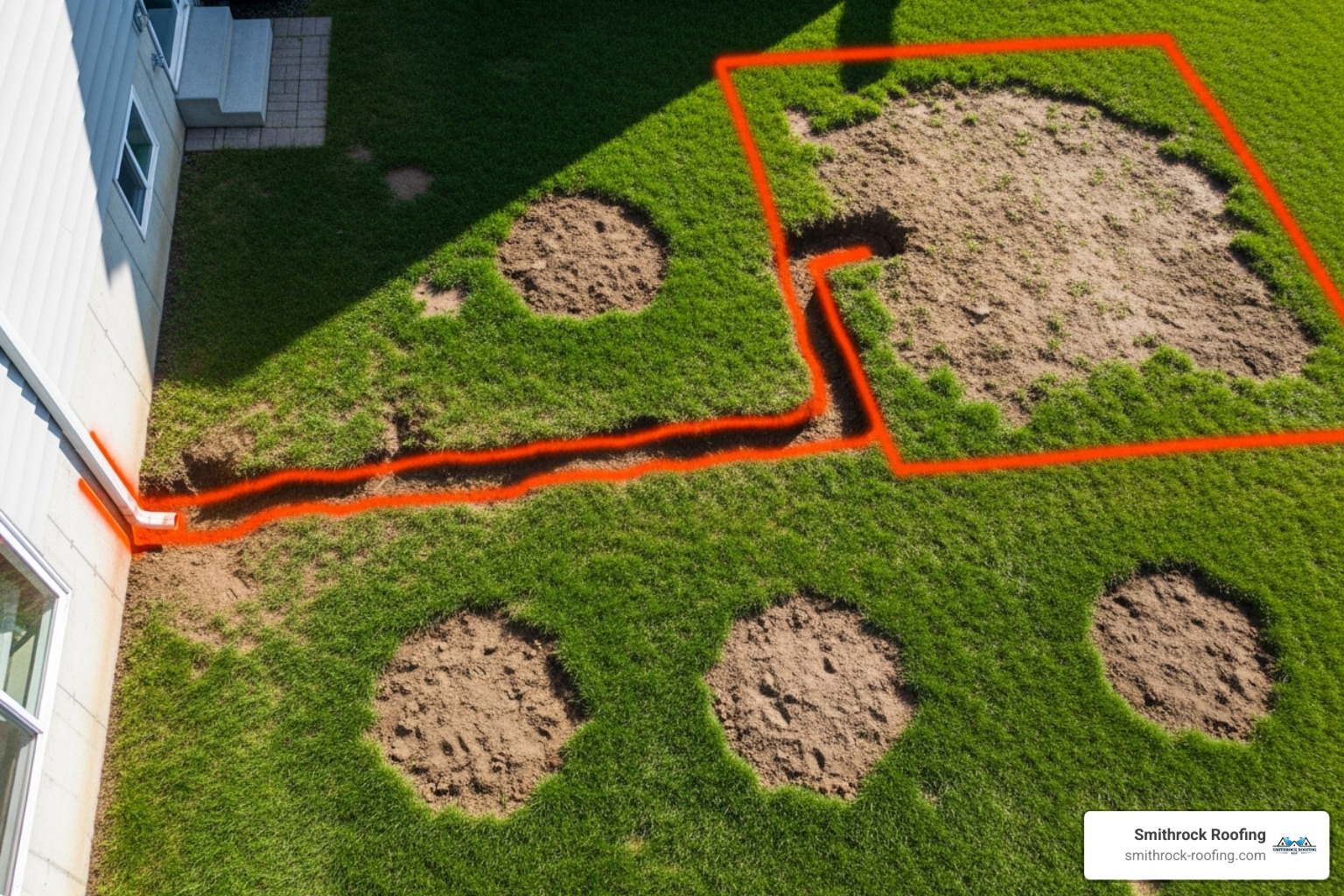
- Sign of Trouble: Soggy Ground Along the Pipe Route: This is a red flag for a crack, break, or separated joint in the underground pipe. This requires digging up the affected section to repair or replace it. This is often caused by freezing or driving over the pipe if it wasn’t buried deep enough.
A Deep Dive into Winterization and Freeze Prevention
Winter poses the biggest threat to buried pipes. Water left inside a pipe can freeze, expand, and crack it. Prevention is key.
- Proper Slope is Your Best Defense: This cannot be overstated. If your system was installed with a proper, continuous slope, all the water will drain out after a storm. If there’s no water left in the pipe, there is nothing to freeze. This is the number one factor in freeze prevention.
- Bury Below the Frost Line: In regions with harsh winters and deep frost lines, burying pipes below this depth is the ultimate protection. However, this can involve very deep trenching and may not be practical for a DIY project.
- Install Gutter Guards and Filters: The best way to prevent clogs that can lead to freezing is to stop debris from entering the system in the first place. High-quality gutter guards or simple downspout strainers are highly effective at keeping leaves and twigs out of your underground pipes.
Winterization Strategies for Cold Climates:
- Method 1: Disconnect and Extend (Most Reliable): For areas with consistent, deep freezes, the safest method is to temporarily disconnect the underground system. Many installers use a flexible adapter at the downspout. In late fall, you can disconnect this adapter from the underground pipe’s cleanout port and attach a standard, above-ground corrugated extension for the winter months. In the spring, simply reconnect the underground system.
- Method 2: Heat Tape (For Problem Areas): If you have a section of pipe that is prone to freezing (perhaps a section with a slight dip or one that is not buried deeply), you can install self-regulating heat tape. This electrical cable is run inside the pipe and automatically turns on when temperatures approach freezing, preventing ice from forming. This requires a nearby GFCI-protected outdoor outlet and must be installed according to the manufacturer’s safety instructions.
- Method 3: Perforated Pipe End: A more advanced design uses solid, smooth-wall pipe for the first 10-20 feet away from the house, then transitions to perforated pipe for the final section of the run. This allows any residual water that doesn’t make it to the emitter to slowly seep into the surrounding gravel bed, leaving the pipe empty before a freeze.
If you encounter drainage issues you can’t solve, or if you suspect a frozen or broken line, don’t hesitate to call for professional help. Our team at Smithrock Roofing has the diagnostic tools, like camera scopes and hydro-jetters, to find and fix problems quickly and efficiently. Learn more at our Gutter Repair Near Me page.
Alternatives and When to Seek Professional Help
Buried gutter downspouts are a premier solution for water management, but they may not be the perfect fit for every home, property, or budget. It’s wise to explore all your options to make an informed decision. It’s also crucial to recognize when a project’s complexity warrants calling in a professional to ensure it’s done safely and correctly.
Exploring Alternatives to Buried Downspouts
If a fully buried system isn’t right for you, consider these other effective water management strategies:
- Above-Ground Extensions: This is the most common and cheapest alternative. Modern, high-quality extensions can be effective at moving water away from the foundation. Look for roll-out extenders that automatically deploy with water pressure or sturdy, wide-mouth extensions that are less likely to be crushed. While functional, they remain a tripping hazard and can detract from landscaping.
- Splash Blocks: These simple concrete or plastic pads are placed under the downspout to prevent erosion at the point of discharge. However, they only disperse water a foot or two from the foundation, making them insufficient as a standalone solution for foundation protection.
- Rain Barrels or Cisterns: An excellent, eco-friendly option for collecting and conserving rainwater for your garden and potted plants. A single storm can fill a barrel quickly, so they must be equipped with an overflow hose that directs excess water safely away from the foundation—often connecting to one of the other solutions on this list.
- Rain Chains: A beautiful, decorative alternative to a traditional downspout. They guide water visually down a chain into a decorative basin or gravel pit. They are most effective in light to moderate rain; in a heavy downpour, they can be overwhelmed and cause significant splashing against your home’s siding.
- French Drains: A French drain is a gravel-filled trench containing a perforated pipe designed to collect and redirect subsurface water across a large area. They are perfect for solving general yard sogginess and can serve as an excellent discharge point for a buried downspout system, allowing the water to be dispersed over a wide area.
- Rain Gardens: These are specially designed, shallow depressions in your landscape filled with water-loving native plants and absorbent soils. A buried downspout can be routed to discharge directly into a rain garden, creating a beautiful, low-maintenance landscaping feature that also helps filter stormwater runoff and support local pollinators.
| Solution | Cost | Effectiveness | Maintenance | Aesthetics |
|---|
| Buried Downspouts | High | Very High | Low (if installed correctly) | Excellent (Invisible) |
| Above-Ground Extensions | Very Low | Moderate | Low | Poor |
| Rain Barrels | Low-Moderate | Good (for water collection) | Moderate | Good |
| Rain Chains | Moderate-High | Low-Moderate | Low | Excellent |
| French Drains | High | Very High | Very Low | Excellent (Invisible) |
| Rain Gardens | Moderate | High | Moderate | Excellent |
DIY vs. Professional Installation: Making the Right Choice
The decision between a DIY project and hiring a professional crew comes down to a realistic assessment of your budget, timeline, skill level, and the complexity of your property.
- DIY Installation: This is the most budget-friendly route, with material costs typically ranging from $250-$500. It gives you complete control over the project and can be a source of great satisfaction. However, it requires a significant investment of time and hard physical labor. Digging trenches, especially in heavy clay or rocky soil, can be an exhausting, multi-weekend job. It also places the responsibility for all planning, slope calculations, and potential mistakes squarely on your shoulders.
- Professional Installation: While the cost is significantly higher (often starting at $2,000 and increasing with complexity), you are paying for much more than just labor. You are buying expertise, efficiency, and peace of mind. A professional crew uses specialized equipment like power trenchers, has deep knowledge of drainage design, and can typically complete the job in a day or two. They are also licensed, insured, and should provide a warranty on their work.
When to Hire a Professional:
Even for a skilled DIYer, some situations strongly favor hiring an expert. Consider calling a pro if:
- Your property has heavy clay or extremely rocky soil.
- You have a complex layout with multiple downspouts requiring a networked system.
- Your property has a steep slope or complex grading that requires careful water velocity management.
- The pipe route needs to go under a concrete walkway, driveway, or retaining wall.
- You have a high water table or persistent yard flooding issues that may require a more complex solution like a French drain or sump pump integration.
- You simply lack the time or physical ability for a demanding, labor-intensive project.
At Smithrock Roofing, our Professional Gutter and Downspout Installation Services ensure your drainage system is designed and built to the highest standards, protecting your home for decades.
Frequently Asked Questions about Buried Gutter Downspouts
It’s natural to have questions about a system that does its important work hidden underground. Here at Smithrock Roofing, we believe an informed homeowner is a happy homeowner. Here are detailed answers to some of the most common questions we receive about buried gutter downspouts.
How far from the house should buried downspouts discharge water?
To effectively protect your foundation from water damage, the system must discharge water a minimum of 10 feet away from your home’s foundation. This is the absolute minimum. For properties with poor drainage (like heavy clay soil) or a relatively flat grade where water doesn’t run off easily, extending the discharge point to 15, 20, or even 30 feet is highly recommended. The ultimate goal is to release the water in a location where it will naturally flow away from the house and can safely soak into the ground without any chance of flowing back toward your foundation.
Can you connect multiple downspouts into one underground pipe?
Yes, connecting multiple downspouts into a single trunk line is a very common and efficient design, especially for the side of a house with two or more downspouts. However, it is critical to follow two rules. First, you must use “Wye” fittings where the lines merge, not “Tee” fittings. A Wye fitting creates a smooth, 45-degree junction that allows water to merge seamlessly. A 90-degree Tee fitting causes the two water flows to collide, creating turbulence that slows the water and causes debris to settle, leading to inevitable clogs. Second, you must ensure the main drainage pipe is sized appropriately to handle the combined water volume from all connected downspouts during a torrential downpour. For most residential applications, a 4-inch diameter pipe is sufficient, but for very large roof areas, a 6-inch pipe may be necessary.
What is the absolute best pipe to use for buried downspouts?
While several types of pipe can be used, solid-wall, smooth-interior PVC pipe (such as Schedule 40 or SDR 35) is generally considered the superior choice for long-term performance and durability.
- PVC Pipe: Its perfectly smooth interior walls are highly resistant to clogs, as sediment and debris slide through easily. It is also extremely durable, crush-resistant, and has chemically welded, watertight joints. It is the best option for a low-maintenance system you can install and essentially forget about.
- Dual-Wall Corrugated Pipe: This is an excellent alternative. It has a smooth interior like PVC for great flow, but a corrugated exterior for structural strength. It’s slightly more flexible than PVC, which can help with installation.
- Single-Wall Corrugated Pipe: This pipe is inexpensive and very flexible, which can simplify a DIY installation. However, its ridged interior is notorious for trapping debris, and it is far more susceptible to being crushed or damaged by roots. We only recommend it for short, straight runs where budget is the primary concern.
What happens if a tree root gets into the pipe?
Tree roots that invade a drainage pipe can cause complete blockages and can even crush or split the pipe over time. If you suspect root intrusion (indicated by slow drainage near a large tree), the first step is a professional camera inspection to confirm the problem and locate it. For minor root intrusion, a mechanical auger with a root-cutting head can clear the pipe. For severe infestations, the section of pipe may need to be excavated and replaced. Using PVC with properly sealed joints is the best defense against root intrusion, as roots typically invade at loose-fitting joints.
Can I connect my sump pump discharge line to the buried downspout system?
This is a common question, but in most cases, it is not recommended and may be against local plumbing codes. The primary reason is that in winter, your downspout line could freeze solid. If your sump pump tries to discharge into a frozen line, the water will have nowhere to go, potentially backing up and causing your pump to burn out and your basement to flood—the very disaster you’re trying to prevent. Sump pumps should always have their own dedicated, separate discharge line.
What is the ideal pipe diameter for a buried downspout?
For the vast majority of residential homes, a 4-inch diameter pipe is the ideal size. A 3-inch pipe is often too small and clogs easily. A 4-inch pipe can handle a large volume of water from a typical roof and is large enough that small debris can be flushed through. For very large commercial buildings or homes with enormous roof surfaces feeding into a single line, upgrading to a 6-inch pipe may be warranted, but this is rare for residential applications.
How do I prevent animals from getting into the end of the pipe?
Small animals like chipmunks, mice, and frogs often seek shelter in open pipes. A pop-up emitter is an excellent solution, as its lid remains closed when water isn’t flowing. If you are using a simple discharge grate, choose one with openings that are small enough to prevent animal entry. You can also purchase specialized screens or guards designed to fit over the end of a 4-inch pipe.
Conclusion: A Lasting Investment in Your Home’s Health
Buried gutter downspouts represent a fundamental shift from temporary fixes to a permanent, integrated solution for rainwater management. They are a superior method for protecting your home’s foundation, preventing the host of problems caused by water saturation, from structural cracks to basement waterproofing failures and mold growth. By channeling water far from your house through a hidden, durable system, you also reclaim your landscape, enhancing curb appeal and eliminating the tripping hazards and unsightly appearance of flimsy, above-ground extensions.
As we’ve detailed, a successful DIY installation is an achievable project for a dedicated homeowner, but it is one that demands meticulous planning and a significant commitment to physical labor. The success of the entire system hinges on details like achieving a consistent, proper slope and choosing the right materials. A well-installed system, whether you build it yourself or entrust it to a professional, is a crucial, long-term investment in protecting your home investment.
The installation complexity can be significant, and there is no shame in recognizing when a project is best left to those with the experience and equipment to guarantee success. If you’re facing a challenging property layout, difficult soil conditions, or simply prefer the peace of mind that comes with a professional warranty, the experts at Smithrock Roofing are ready to assist. We specialize in designing and installing robust gutter and downspout systems that are custom-tailored to your home’s specific needs. We’ve helped countless homeowners across North Carolina—from Winston-Salem to Greensboro and everywhere in between—achieve effective, elegant, and lasting drainage solutions that will keep their foundations dry and their properties beautiful for years to come.