
A note on the numbers: the figures in this guide are national industry averages compiled for research — they are not Smithrock Roofing quotes. Every home and project is different, which is why our in-home assessments and written quotes are always free.
Cost to install gutters typically ranges from $1,600 to $5,200 for most homes, with the national average falling around $2,300 to $3,900. Here’s what you can expect to pay when planning a complete, professional system that performs well and lasts:
Quick Cost Breakdown:
Gutters aren’t just an aesthetic choice—they’re critical protection for your home’s foundation, siding, landscaping, and structural integrity. Without proper gutters, uncontrolled runoff can erode soil, flood basements, stain or rot siding, and even undermine footings. Repairs from water damage often exceed the price of a properly designed gutter system many times over.
Every year, homeowners face sticker shock when getting gutter quotes. Some pay as little as $800 for basic vinyl systems, while others invest $8,000+ in premium copper gutters. The wide price range depends on your home’s size, chosen materials, roof complexity, and local labor market. Understanding these cost drivers up front helps you set a realistic budget, compare quotes apples-to-apples, and avoid both overpaying and underbuying.
Understanding these costs upfront helps you budget properly and avoid surprises. You’ll also learn when DIY makes sense (spoiler: rarely), which materials offer the best value for your climate and roof, and which “extras” are worth the money. A good gutter job looks simple from the ground, but getting slope, supports, outlet placement, and leak management right requires planning and skill.
As Jordan Smith with over 15 years in exterior construction, I’ve helped countless homeowners navigate the cost to install gutters and choose systems that protect their investment. My experience has shown that understanding these costs upfront prevents both overpaying and the costly mistakes that come from choosing the cheapest option.
What actually goes into a professional gutter quote:
Hidden costs to watch for (and why they matter):
How many feet of gutter does a typical house need?
Material and size matter more than you think:
Why seamless gutters are worth consideration:
When DIY does and doesn’t make sense:
How to compare quotes fairly:
Climate-specific considerations that affect cost and performance:
Maintenance and lifetime cost view:
Return on investment: A tuned gutter system prevents foundation erosion, basement leaks, wood rot, and landscaping damage. Foundation repairs commonly range from $4,000-$12,000; siding rot repairs can exceed $2,000; and basement water mitigation often costs thousands. Relative to these, a properly sized and installed gutter system is a modest, preventative expense.
Common red flags in low bids:
Scheduling and savings tips:
How to get ready for installation day:
Permits and code considerations:
Bottom line: A well-designed, professionally installed gutter system is an essential, high-ROI building component. Price varies with material, size, roof complexity, and local labor, but by understanding the pieces of the bid and how they influence performance, you can choose the right system for your home with confidence.
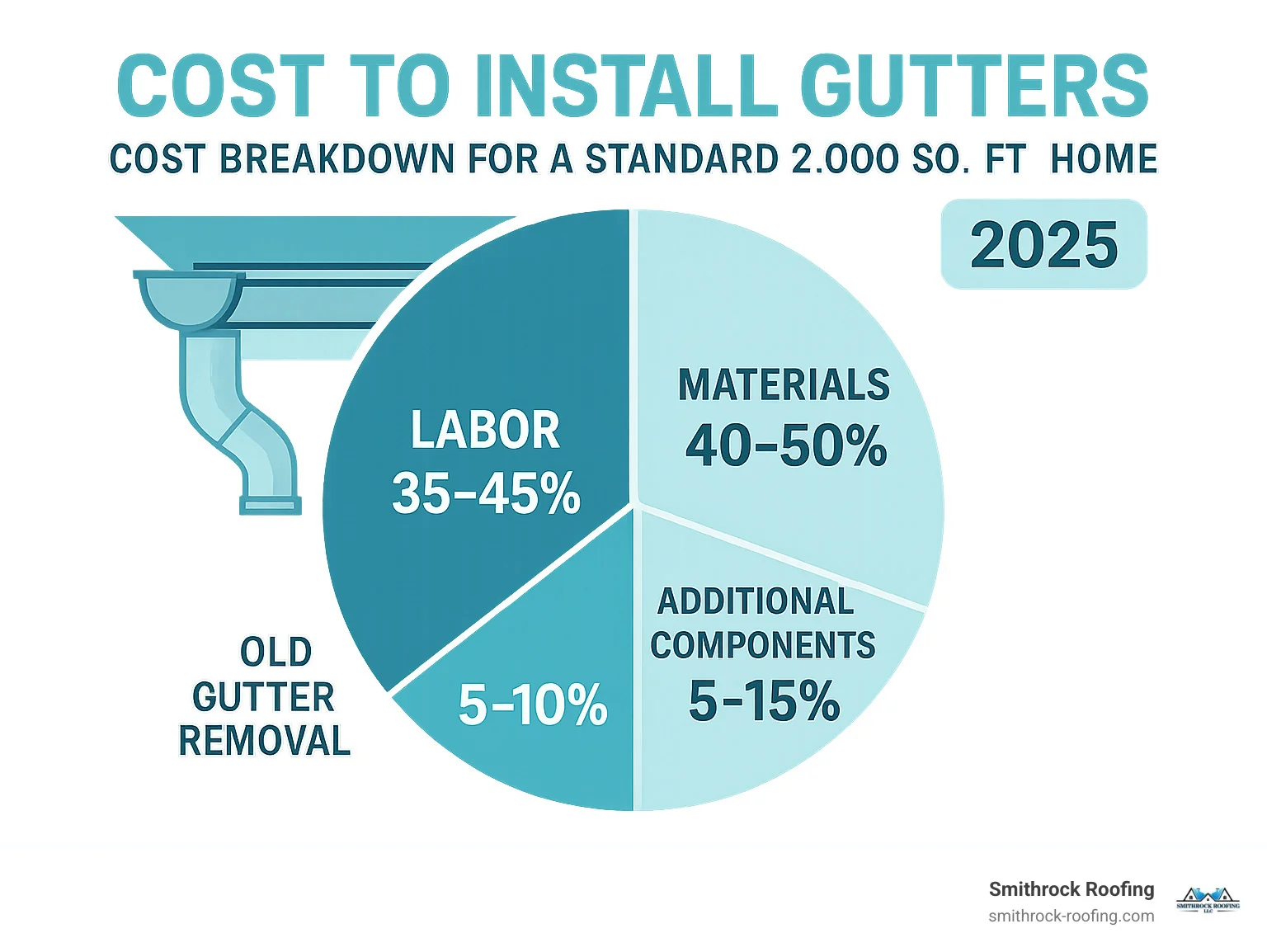
Let’s get straight to the numbers you’re looking for. The cost to install gutters isn’t just one magic number—it’s a range that depends on your home’s unique situation, local market, and the performance level you expect from the system.
Right now, you’re looking at roughly $9 to $25 per linear foot for complete gutter installation. That includes both materials and professional installation for the most common system types. For most homeowners, the total project falls somewhere between $1,600 and $5,200.
The national average sits around $2,800 to $4,000 for a typical home. But “typical” covers a lot of ground. Your neighbor with a single-story ranch might pay $1,900, while a two-story colonial with complex gables could come in at $5,500-$6,000, or more if premium materials are selected.
Your home’s size and roof complexity are the biggest factors in determining your final cost. It’s straightforward math—more house perimeter means more gutters and downspouts—and more roof details mean more labor for corners, miters, and custom fabrication. Add in regional labor rates, and two similar homes in different cities can vary by 10-30% in installed cost.
Typical budgets by home size:
How many feet of gutter will you need? Measure the eave runs where water must be collected—often along the long sides of the house, plus dormers, bays, and porches. Many homes land between 120 and 220 linear feet total. Each downspout serves a section of gutter; expect one downspout for roughly every 30-40 feet of run.
What’s included in $9-$25 per linear foot installed:
What might be extra:
Regional and seasonal price factors affect your final cost. Labor rates in coastal metros and high-cost-of-living areas can push per-foot rates up 10-30%. Material availability and market volatility in metal pricing can shift quotes seasonally. Busy seasons (spring/fall) can raise prices and extend scheduling; winter or midsummer gaps may offer discounts.
More info about gutter installation: https://smithrock-roofing.com/gutter-installation-services/
Material selection defines both your upfront price and lifetime cost. The right choice depends on budget, climate, architectural style, and how long you plan to stay in your home.
Vinyl gutters are the budget-friendly starter option at $3 to $6 per linear foot. They’re lightweight and easy to cut/assemble, which makes them appealing to DIYers. For mild climates and quick fixes—especially on outbuildings—they can be adequate. Downsides: They can crack in extreme cold, fade or become brittle under strong UV, and joints can leak if not sealed carefully. Typical lifespan is 10-20 years when maintained.
Aluminum gutters hit the sweet spot for most homeowners at $4 to $14 per linear foot. Aluminum is rust-proof, lightweight, and widely available. It can be installed as seamless (preferred) or sectional. With proper hangers and slope, aluminum systems routinely last 20+ years. The main vulnerability is denting—hail or ladder mishaps can leave marks—but performance is usually unaffected if the slope and seams remain intact.
Steel gutters offer serious strength at $6 to $14 per linear foot. This is a great choice for climates with heavy snow, ice, or hail. There are a few types of steel to consider: Galvanized Steel is the most common, coated with a layer of zinc to prevent rust. It’s very strong but can corrode quickly if the coating is scratched. Galvalume Steel is coated with an aluminum-zinc alloy, offering better long-term corrosion resistance than standard galvanized steel. Stainless Steel is a premium option that won’t rust, but it comes at a significantly higher cost and is less common in residential applications. With proper maintenance to address any scratches in the coating, a quality steel system can last 20+ years.
Zinc and Copper gutters are the luxury benchmarks, chosen for their incredible durability and architectural beauty. Zinc gutters ($15 to $40 per linear foot) are a favorite on modern and European-style homes. They start with a matte gray finish and develop a beautiful, dark gray patina over time that protects the metal and self-heals minor scratches. Copper gutters ($25 to $40+ per linear foot) are the ultimate high-end choice, often seen on historic restorations and custom homes. They start with a brilliant shine and gradually transition through shades of brown before settling into the classic, elegant green patina. Both zinc and copper require expert installation, as the seams must be meticulously welded or soldered by a craftsman with experience in these materials. Properly installed, these systems can easily last 50-100 years or more, often outliving the roof itself. According to the National Association of Home Builders, copper gutters can last over a century with proper maintenance.
| Material | Average Cost Per Linear Foot | Lifespan | Pros | Cons |
|---|---|---|---|---|
| Vinyl Gutters | $3 – $6 | 10-20 years | Low cost, DIY-friendly | Prone to cracking, fades in sun |
| Aluminum Gutters | $4 – $14 | 20+ years | Lightweight, rust-proof, popular | Dents easily |
| Steel Gutters | $6 – $14 | 20+ years | Very durable, weather-resistant | Can rust if not maintained, heavy |
| Zinc Gutters | $15 – $40 | 50-80 years | Long-lasting, develops patina | Expensive, complex installation |
| Copper Gutters | $25 – $40 | 50-100+ years | Extremely durable, high-end look | Highest cost, requires pro install |
Beyond material, profile, size, and thickness matter. K-style holds more water for the same width than half-round and is generally less expensive. 5-inch is standard; 6-inch increases capacity for large roofs or intense rainfall and reduces overflow but adds cost. For aluminum, 0.027″ is common; 0.032″ is thicker and more resistant to deformation.
Profile and system type influence both labor and material cost.
K-style gutters are the most popular modern choice, with a decorative front that mimics crown molding. They strike an excellent balance of capacity, cost, and appearance. K-style is widely available in seamless form and pairs well with most architectural styles.
Half-round gutters deliver a traditional look that shines on historic or high-end homes. They typically require specialized, visible brackets and careful alignment. Expect a cost premium over K-style due to hardware and installation time, particularly in copper or zinc.
Box Gutters (Built-in Gutters): Less common today, box gutters are built directly into the bottom of the roof structure, often hidden behind a cornice or fascia. They are typically found on older, historic homes. While they offer a clean, integrated look, they are very expensive to install or repair. Repairing a leaking box gutter often involves significant carpentry and roofing work, as the liner (typically metal like copper or stainless steel) must be replaced within the wooden trough. The cost for this type of work is highly specialized and quoted on a case-by-case basis, often exceeding the cost of standard gutters by a wide margin.
Sectional gutters come in pre-cut lengths connected with joints and brackets. They are the most DIY-friendly but have more potential leak points at the seams. Sectional systems are usually found in vinyl or thinner aluminum from home centers.
Seamless gutters are custom-fabricated on-site to the exact lengths needed for your eaves. This minimizes joints, reduces leak risk, and creates a cleaner look with better long-term performance. While seamless systems cost more upfront due to the equipment and skill required, they often deliver lower lifetime maintenance.
Seamless Gutter Installation: https://smithrock-roofing.com/seamless-gutter-installation/
Linear footage is only the start. Roof shape, height, and detailing can swing bids up or down.
Linear footage calculation starts by measuring the eaves where gutters will be installed, including porches, additions, dormers, and bays. Note gable ends: While you don’t place gutters on the sloped gable edge, both adjacent eaves typically need coverage. Identify logical downspout locations at the ends or midpoints of long runs.
Multi-story homes increase labor. Anything above a single-story often requires taller ladders, roof jacks, or scaffolding, which increases setup time and risk. Two-story sections commonly add 10%-30% to labor on those runs.
Roof pitch and complexity create concentrated drainage areas. Steep slopes and multiple roof planes require careful planning. Valleys can dump large volumes into a short section of gutter, requiring upsized capacity and extra downspouts. More corners and angles mean more miters and careful sealing—each corner adds parts and time.
Accessibility challenges like tight lot lines, mature landscaping, fences, and decks can restrict setup and extend installation time. Limited driveway space can complicate staging for seamless machines and material handling.
Downspout design matters. Proper downspout count, size, and routing are as important as the gutters themselves. A standard 2×3-inch rectangular downspout is common, but for larger roofs or high-rainfall areas, upgrading to 3×4-inch rectangular or 4-inch round downspouts can dramatically improve water flow and reduce clogging. The downspouts must effectively route water away from your home’s foundation. The minimum recommendation is to discharge water 4-6 feet away using splash blocks or simple extensions. For a more permanent and aesthetically pleasing solution, consider an underground drainage system. This involves trenching and laying solid PVC pipe to carry water far away from the house, either to a “daylight” exit on a sloped yard, a dry well (an underground pit filled with gravel), or a pop-up emitter that sits flush with the lawn.
Common accessories and their costs:
Gutter guards reduce maintenance, but it’s important to choose the right type for your debris load. No guard is truly “no maintenance.” Screen/Mesh Guards ($3-$6 per foot installed): These are simple metal or plastic screens that sit on top of or inside the gutter. They are effective against large leaves but can allow smaller debris like pine needles and seeds to pass through. They may also need to be brushed off periodically as wet leaves can mat on top of them. Micro-Mesh Guards ($7-$12+ per foot installed): These feature a very fine stainless steel mesh that blocks almost all debris, including shingle grit and pine needles. They are highly effective but are a more significant investment. Reverse-Curve Guards (Surface Tension): These solid covers allow water to flow around the curved edge into the gutter while debris slides off the front. They work well for leaves but can be overwhelmed in torrential downpours, causing water to overshoot the gutter. Brush or Foam Inserts: These are DIY-friendly options that sit inside the gutter. Brush guards look like giant pipe cleaners and block leaves, while foam inserts fill the gutter completely, allowing water to filter through. Both types can be effective but require removal and cleaning every few years as fine sediment can build up within them.
Structural prep and repairs are often necessary. Fascia must be sound for fasteners to hold. If rot is present, replacing fascia before gutter installation is critical. This may involve priming/painting to match existing finishes. In older homes, upgrading soffit ventilation during fascia/soffit repair can improve attic health and reduce ice dam risk.
Design tips to improve performance without overspending:
Cost examples to illustrate the range:
DIY vs. professional considerations are important. DIY materials (sectional vinyl/aluminum) cost $3-$8 per foot. Common DIY pitfalls include insufficient slope, poorly sealed joints, too few hangers, and downspouts in the wrong locations. Working at height with long, unwieldy sections is hazardous.
Warranties protect your investment. You will typically receive two types of warranties. Material Warranty: This comes from the manufacturer and covers defects in the product itself, such as paint peeling or cracking on aluminum gutters (often 20 years or more). Workmanship Warranty: This comes from the installer and is arguably more important. It covers issues related to the quality of the installation, such as leaking seams, improper slope causing standing water, or gutters pulling away from the fascia. A typical workmanship warranty is 1-5 years, but some top-tier companies offer longer terms. Be sure to get the warranty in writing and understand what it covers and, more importantly, what it excludes (e.g., damage from ice dams, ladders, or lack of cleaning).
Insurance and storm events may help with costs. If your gutters were damaged by a covered peril (hail, wind, falling branches), homeowners insurance may cover repair or replacement.
The key to a durable, low-maintenance system is matching material, size, and layout to your roof’s drainage demands and your climate. The cost to install gutters isn’t just about square footage. Roof complexity, chosen materials, and local labor rates all play major roles in your final quote.
Need a local pro? Learn more about our gutter installation and repair in King.

Smithrock Roofing © Copyright 2026 • All Rights Reserved • Privacy Policy • Maintained by Mongoose Digital Marketing