If you’ve ever had water dripping into your firebox after a storm, noticed white staining creeping down your chimney’s exterior, or discovered mysterious debris collecting in your flue, you already understand the problem — you just may not have identified the source yet. An unprotected or improperly capped chimney is one of the most quietly destructive vulnerabilities on a home’s exterior, and in Winston-Salem’s specific climate, the damage compounds faster than most homeowners expect.
Here’s what the generic information out there won’t tell you: not every chimney cap works equally well everywhere. What’s appropriate for a coastal Carolina home is a different calculation than what a Forsyth County home needs, sitting at Piedmont elevation with ice storms, humid summers, and a housing stock that spans pre-war masonry to post-1980 prefab construction. Getting this right requires understanding your specific chimney system, your local environment, and the standards that govern safe, compliant installation — none of which fit neatly into a one-size-fits-all product description.
This guide covers the technical realities most sources skip. By the end, you’ll know what type of cap your chimney actually needs, what materials hold up in this region, and what questions to ask before anyone climbs onto your roof.
This is one of the most common sources of confusion homeowners encounter, and clearing it up saves a significant amount of trouble down the road.
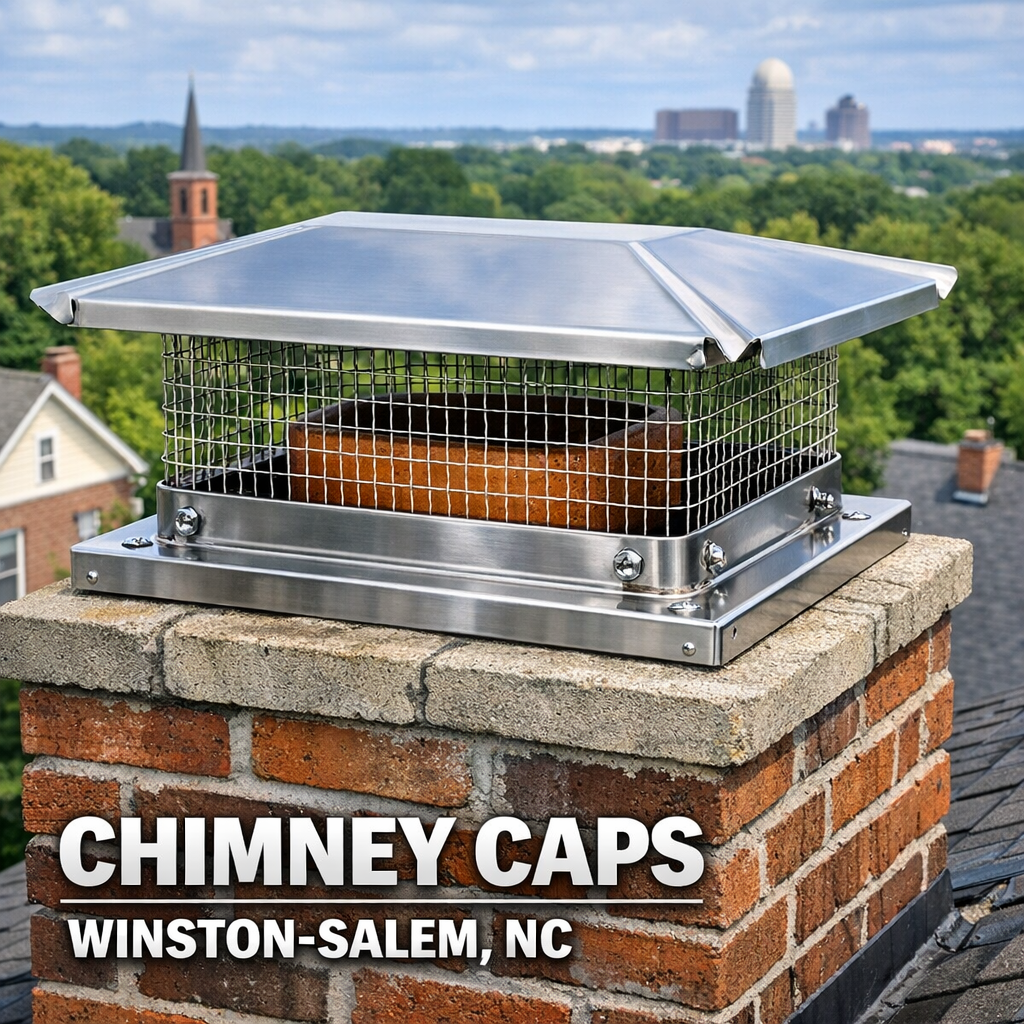
A masonry chimney is what most people picture: brick or stone construction built from the firebox all the way up through the roof. At the top, one or more clay tile flue liners protrude above a poured concrete or mortar chimney crown. A chimney cap mounts directly over the flue tile opening — it’s sized to the flue, anchored to the crown or tile, and its job is to cover that specific opening while still allowing combustion gases to exhaust freely.
Winston-Salem has a substantial inventory of masonry chimneys, particularly in older neighborhoods. The Ardmore and West End historic districts, mid-century neighborhoods throughout Forsyth County, and much of the established housing stock in High Point and Kernersville fall into this category. If your home was built before 1970 and has an exterior brick chimney, there’s a strong chance you’re working with masonry.
Starting in the mid-1970s and accelerating through the 1980s and 1990s, most new construction shifted to factory-built (prefab) fireplaces — engineered metal fireplace units installed inside a framed wood chase, then sided over with vinyl, hardboard, or stucco to look like a masonry chimney from the outside. Neighborhoods built during Winston-Salem’s suburban expansion — areas like Lewisville, Clemmons, Sherwood Forest, and large portions of newer development in Kernersville and Rural Hall — are heavily populated with this construction type.
A prefab chimney chase requires a chase cover: a flat or sloped sheet metal pan that fits over the entire top of the framed chase, with a hole for the metal flue pipe and a cap sitting over that pipe. The chase cover itself is a structural component, not just an accessory. Without a properly fitted, watertight chase cover, the wood framing inside that sided exterior is exposed to rainfall at the top — and that’s exactly where we see some of the worst hidden rot damage in homes built between 1975 and 2000. For a deeper look at what’s involved, the Ultimate Guide to Chimney Chase Cover Replacement covers the full scope of what this repair typically entails.
The critical mistake: Installing only a single-flue cap on a prefab chimney chase addresses the flue pipe but leaves the surrounding chase cover seams unprotected. Water finds every gap. If your home has a prefab system and someone is quoting you only a standard chimney cap without evaluating your chase cover condition, that’s an incomplete solution.
| Feature | Masonry Chimney | Prefab Chimney Chase |
|---|---|---|
| Exterior material | Brick or stone visible all the way up | Siding, stucco, or hardboard cladding on the upper chimney |
| At the top | Clay tile flue liner(s) extending above concrete crown | Metal flue pipe extending above a flat or sloped metal pan |
| Fireplace interior | Brick firebox, damper visible above fire grate | Metal firebox insert, often with a visible brand logo or model tag |
| Home age (general) | Pre-1975 more likely | Post-1975 more common |
| What it needs | Chimney cap sized to flue tile | Chase cover + cap for the flue pipe |
When there’s any doubt, a qualified inspector can make this determination before anything is ordered or installed. Getting this identification right is step one — everything downstream depends on it.
This is where generic national content falls completely short. Winston-Salem sits at roughly 970 feet elevation in the Piedmont region, and that geography creates a climate profile that puts real stress on exterior building components in ways that lower-elevation or coastal NC homeowners don’t experience to the same degree.
The Piedmont elevation means Winston-Salem sees ice storms and hard freezes that coastal areas largely avoid. When an uncapped or poorly capped chimney allows moisture into the flue system, that water doesn’t just sit there — it soaks into porous brick, mortar joints, and clay flue tile. When temperatures drop below freezing, that absorbed moisture expands. When it warms back up, it contracts. Repeat that cycle across an entire winter season and you’re looking at progressive spalling (brick face cracking and flaking), mortar joint erosion, and in severe cases, cracked flue tiles that compromise the safety of the entire system.
A properly fitted chimney cap with adequate overhang significantly reduces water entry at the flue opening, which is the primary point of moisture intrusion. But the cap itself also needs to withstand repeated thermal expansion and contraction without losing its seal or fastener integrity.
Winston-Salem’s average relative humidity regularly exceeds 70%, particularly through spring and summer. This sustained moisture exposure accelerates efflorescence — the white, chalky mineral salt deposits you see migrating through brick faces on older chimneys. Efflorescence is a visible indicator of water moving through masonry, and while the staining itself is cosmetic, the underlying process is erosive. A cap that keeps rain out of the flue helps, but it doesn’t eliminate humidity-driven moisture migration; that’s why chimney crown condition and masonry waterproofing matter alongside cap installation.
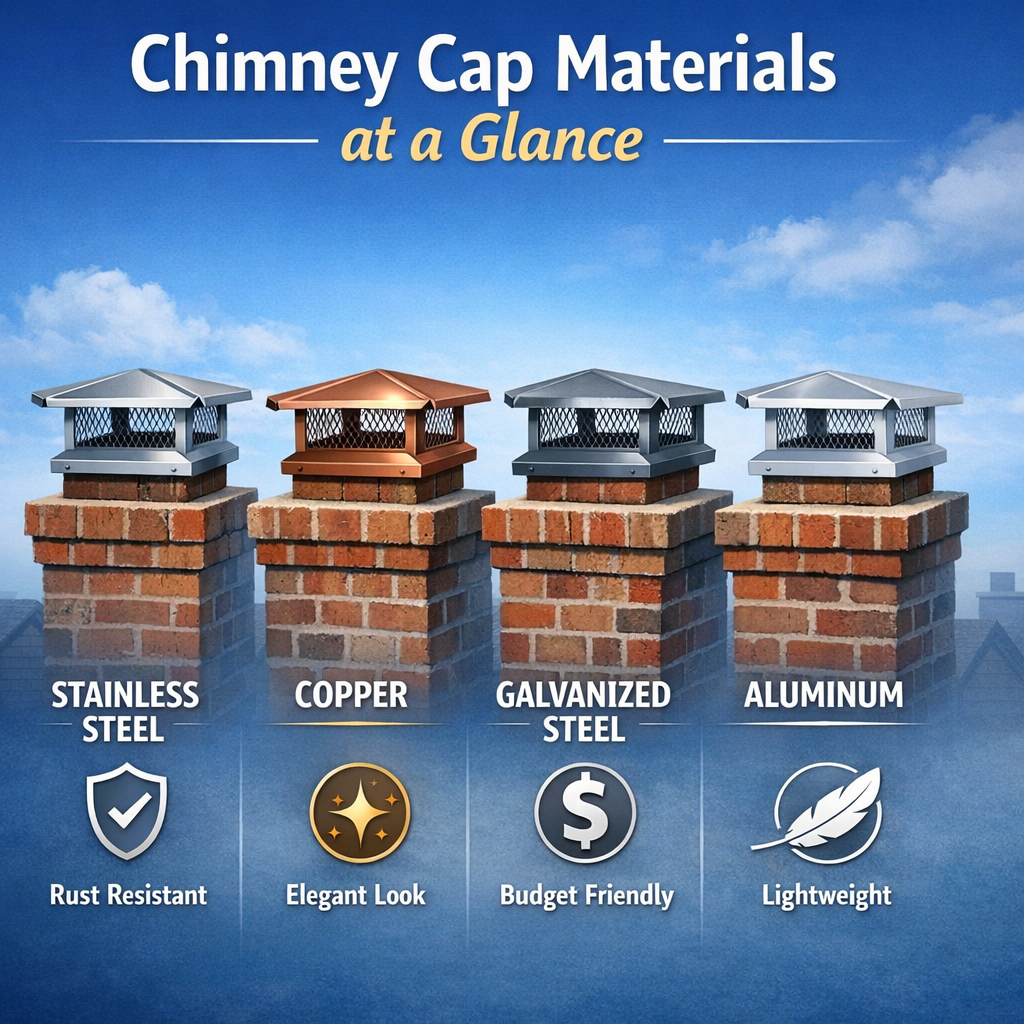
Not all chimney cap materials weather the same way in Forsyth County conditions. Here’s an honest breakdown:
| Material | Performance in Winston-Salem Climate | Key Considerations |
|---|---|---|
| 304 Stainless Steel | Excellent — resists rust, handles freeze-thaw cycling well | Industry standard for wood-burning applications; holds up to acid rain exposure |
| 316 Stainless Steel | Superior — added molybdenum increases corrosion resistance | Better choice near heavily traveled corridors where exhaust exposure is higher |
| Copper | Premium longevity; develops protective patina over time | Higher initial investment; often used on historic or high-end masonry chimneys in West End/Ardmore |
| Galvanized Steel (powder-coated) | Adequate short-term; degrades measurably faster in humid, acidic conditions | Zinc coating deteriorates in combination of humidity and acid precipitation; shorter service life |
| Aluminum | Lightweight but softer; less durable under hail impact | Not recommended as primary cap material in a climate with ice storms |
The practical takeaway: For most Winston-Salem homeowners, 304 stainless steel is the minimum recommended material for a chimney cap or chase cover that’s expected to perform for 15–20+ years in this climate. Galvanized steel options may carry a lower upfront investment, but the replacement cycle shortens significantly under local humidity and precipitation conditions — particularly the combination of summer humidity and the acid precipitation influenced by the broader Research Triangle industrial corridor to the east.
Competitors use the phrase “custom fit” frequently. What they rarely explain is what custom fitting actually involves — and why getting it wrong creates problems beyond just aesthetics.
A chimney cap isn’t just a rain cover dropped over a hole. The height of the cap above the top of the flue tile directly affects draft performance — the thermodynamic column of rising combustion gases that makes your fireplace draw properly. If a cap is installed too close to the flue tile opening, it can create negative pressure zones at the flue exit that worsen downdrafts rather than prevent them.
The general professional standard: a chimney cap should be positioned a minimum of 5 inches above the flue tile to allow proper draft clearance. Caps installed flush or too close to the flue opening are a documented source of smoke spillage into living spaces — a problem homeowners often attribute to other causes.
Proper cap sizing starts with the actual flue dimensions: the interior area expressed in square inches, the shape (round, rectangular, or oval), and the condition of the flue liner itself. For Winston-Salem’s significant inventory of pre-1980 homes with clay tile flue liners, this last point matters more than most homeowners realize. Clay tile liners can shift, settle, or crack from freeze-thaw cycling over decades — and a liner that’s moved even slightly may have different effective dimensions at the crown than it did originally. Direct measurement is non-negotiable for a proper cap specification.
For prefab chimney chases, the gauge of the chase cover sheet metal is a real durability variable that rarely gets mentioned:
Large chimney chases are common on the suburban homes that dominate Lewisville, Clemmons, and rural Forsyth County builds. A chase cover on one of those structures should be 20-gauge minimum, and the installation should include proper hemmed edges and a sloped design that directs water away from the flue pipe opening.
This is a dimension of chimney cap selection that gets almost no attention in consumer-facing content — and it’s worth understanding before you hire anyone.
NFPA 211 (Standard for Chimneys, Fireplaces, Vents, and Solid Fuel-Burning Appliances) is the governing industry standard for chimney systems in North Carolina. When it comes to spark arrestor mesh — the screen that surrounds most chimney caps — NFPA 211 and the International Residential Code (IRC) specify a clear performance window:
This isn’t arbitrary. Mesh that’s too fine (a common characteristic of lower-cost imported caps) clogs with creosote and combustion byproducts, restricting draft and accelerating dangerous creosote buildup. This is a particular concern during Winston-Salem’s cold snaps, which encourage slow, smoldering fires that produce more creosote than hot, full-combustion fires.
Mesh that’s too coarse fails its spark arrest purpose — relevant for any wood-burning fireplace in a region where dry-spell conditions in late summer and fall create wildfire risk.
For wood-burning applications, look specifically for caps carrying a UL 1777 listing. This is the Underwriters Laboratories standard for chimney liner systems, and UL-listed caps have been tested to performance and safety benchmarks that unlisted products haven’t cleared. It’s a reasonable question to ask any installer: are the caps you install UL 1777 listed for wood-burning applications?
North Carolina’s Department of Insurance adopts the IRC as the basis for its residential building code. A chimney cap installation that doesn’t meet IRC mesh sizing requirements or uses non-listed components on a wood-burning system isn’t just a performance issue — it’s a code compliance issue that can create complications with homeowner’s insurance claims if a chimney-related fire or water damage event occurs.
Installing a chimney cap on a deteriorating chimney crown is a common mistake that produces predictable results — continued water intrusion despite having a new cap. The crown and the cap work together; neither compensates for failure in the other.
The chimney crown is the sloped concrete or mortar surface that covers the top of the masonry chimney, surrounding the flue tile. Its job is to direct water away from the junction between the masonry and the flue tile — one of the most vulnerable transition points on the entire chimney structure. A properly formed crown extends past the chimney’s edge and slopes downward so water sheds off rather than pooling.
Older Winston-Salem masonry chimneys frequently have crowns that were formed with basic mortar rather than proper chimney crown mix, which is less durable and more porous. Combine that with decades of freeze-thaw cycling and you get:
A qualified inspector should assess crown condition before any cap installation proceeds. If the crown has significant cracking or deterioration, a crown repair or rebuild is the right first step — not skipping to the cap.
If you’re calling a contractor for chimney cap service in the Winston-Salem area, here’s what a complete assessment should address — not as a checklist to memorize, but as a baseline for evaluating whether the person showing up is doing the job properly:
A contractor who rushes past these steps in favor of quoting a product quickly is working backward. The assessment drives the solution — not the other way around.
The range of chimney systems across the Winston-Salem metro area — from historic masonry in Ardmore and West End, to mid-century brick homes throughout High Point and Kernersville, to post-1980 prefab chases in Lewisville, Clemmons, and King — means there’s no standard answer that fits every house. The right cap for a 1940s brick colonial in the West End historic district is a different product, a different installation method, and a different set of material considerations than the right chase cover for a 1988 vinyl-sided ranch in Clemmons.
That’s exactly why local experience isn’t just a marketing phrase. Knowing this region’s housing stock, understanding how Piedmont climate conditions affect exterior building materials over time, and being familiar with the specific failure patterns that show up repeatedly in Forsyth and Guilford County homes — that knowledge shapes every recommendation we make. It’s the difference between a generic product sale and a solution that actually protects your home for the long term. You can learn more about our approach and the team behind the work on our About Us page.
As chimney cap technology, building science, and regional climate awareness continue to evolve, homeowners in the Winston-Salem area should keep three priorities front of mind heading into the next season:
1. Schedule a Comprehensive Chimney Assessment Before the Heating Season
Don’t wait until the first cold snap to discover a failed crown, a rusted-through chase cover, or a cap that’s been displaced by wind or debris. A thorough pre-season inspection — one that covers the cap, crown, liner, flashing, and chase cover as an integrated system — gives you time to make informed decisions without the pressure of immediate need. Contractors book up quickly in early fall across Forsyth and Guilford counties, so late summer scheduling is consistently the better move.
2. Prioritize UL-Listed, Correctly Sized Caps from Established Manufacturers
The chimney cap market includes a wide range of products at a wide range of quality levels. In 2026, the standard you should hold any recommendation to is simple: UL listing for the specific application, correct sizing for your flue dimensions per NFPA 211, and material selection appropriate for the Piedmont climate. Stainless steel remains the benchmark for masonry applications in this region. For prefab chase systems, a properly gauged stainless steel chase cover — not galvanized — is the correct long-term answer. If a contractor can’t speak to these specifics, that’s useful information.
3. Treat the Crown and Cap as a System, Not Separate Line Items
One of the most common mistakes homeowners make is addressing the cap while ignoring a deteriorating chimney crown, or patching the crown while leaving an undersized or failing cap in place. In 2026, the right approach is a system-level evaluation. If your crown is cracked or showing porosity, water is entering your chimney structure regardless of what sits on top of it. Both components need to be in good condition simultaneously for your chimney to be properly protected.
For masonry chimneys — which represent the majority of older homes in neighborhoods like Ardmore, West End, and throughout High Point — a stainless steel single-flue or multi-flue cap is the most durable long-term choice. Stainless steel resists the corrosion that Piedmont humidity and seasonal temperature swings accelerate in galvanized or aluminum products. For prefab fireplace systems with an open chase, a stainless steel chase cover with a proper slope and fitted cap is the correct configuration. The right answer always starts with identifying your chimney type, measuring your flue accurately, and matching the product to the application. Our Chimney Caps service covers the full range of solutions for both masonry and prefab systems across the NC Triad.
Visible rust streaking on the chimney crown or upper masonry, water stains on interior walls or ceilings near the fireplace, visible damage to the mesh screen, a cap that has shifted or lifted off the flue, and animal entry into the firebox are all indicators that your current cap is no longer functioning as designed. In many cases, homeowners don’t notice a failing cap until water damage has already begun inside the flue or chase. A professional inspection is the most reliable way to assess whether your existing cap is correctly sized, structurally intact, and performing as required under NFPA 211 standards.
While basic single-flue slip-in caps are sometimes marketed as DIY-friendly, correct installation requires accurate flue measurement, proper fit verification, appropriate fastening, and an honest assessment of the crown and surrounding masonry condition before anything goes on. An improperly sized cap — even one that appears to sit in place — can allow water intrusion, restrict draft, or fail to meet the mesh sizing requirements that prevent both animal entry and ember escape. For chase covers on prefab systems, professional installation is strongly advisable given the roofline access, precise fabrication requirements, and the need to address any underlying structural issues with the chase or crown simultaneously.
The National Fire Protection Association’s NFPA 211 standard recommends annual chimney inspections, and that guidance applies directly to chimney caps, crowns, and chase covers. In the NC Piedmont specifically, the combination of humid summers, freeze-thaw cycles in winter, and seasonal storm activity means exterior chimney components take meaningful weathering stress each year. An annual inspection — ideally before the heating season — allows a qualified technician to catch mesh deterioration, early corrosion, crown cracking, and fit issues before they develop into water intrusion or draft problems inside the home.
A properly installed, correctly specified chimney cap is one of the most cost-effective protections you can put on your home. It is also one of the most commonly overlooked — until water, animals, or draft problems make it impossible to ignore. For homeowners across Winston-Salem, High Point, Kernersville, Clemmons, Lewisville, and the surrounding NC Triad, the right starting point is a thorough on-site assessment from a contractor who knows this region’s housing stock and takes the time to understand your specific system before recommending a solution.
If you’re ready to take that next step, we’re here to help. Contact Us to schedule your chimney cap inspection or consultation today.
Smithrock Roofing © Copyright 2026 • All Rights Reserved • Privacy Policy • Maintained by Mongoose Digital Marketing