
Unveiling the Best: Your Ultimate Guide to Window Blinds

Why Choosing the Best Window Blinds Transforms Your Home’s Comfort and Value

Windows are the eyes of your home, connecting you to the outside world while defining the character and comfort of your indoor spaces. But bare windows leave you exposed to harsh glare, prying eyes, and fluctuating temperatures. This is where the transformative power of the best window blinds comes into play. Far more than a simple covering, the right window treatments are a fundamental component of a well-designed, efficient, and comfortable home.

Choosing the perfect blinds can feel overwhelming with the sheer number of styles available. The top-performing options, which we will explore in detail, include:

  • Cellular (Honeycomb) Shades – Unmatched for insulation and energy efficiency.
  • Faux Wood & Real Wood Blinds – Classic style, durable, and highly versatile.
  • Roller & Solar Shades – Sleek, modern design with excellent light and UV control.
  • Roman Shades – The elegance of drapes with the functionality of a shade.
  • Zebra (Transitional) Shades – Innovative dual-layer design for precise light management.
  • Venetian & Vertical Blinds – Time-tested solutions for precise control and large windows.

The right blinds are a strategic investment that solves common household problems. They can slash high energy bills, provide instant privacy, eliminate screen glare, protect your valuable furnishings from sun damage, and even reduce outside noise. Research from the U.S. Department of Energy confirms that reflective window coverings can reduce heat gain up to 77% during summer months, making them one of the most effective upgrades for home comfort. When you select custom blinds with advanced insulating or UV-protective materials, you dramatically improve your home’s livability year-round.

With over 15 years of experience in exterior construction and home performance, I’m Jordan Smith. I’ve witnessed firsthand how the best window blinds work in synergy with quality windows to maximize a home’s energy efficiency, comfort, security, and ultimately, its value. This comprehensive guide will walk you through everything you need to know to make an informed decision.
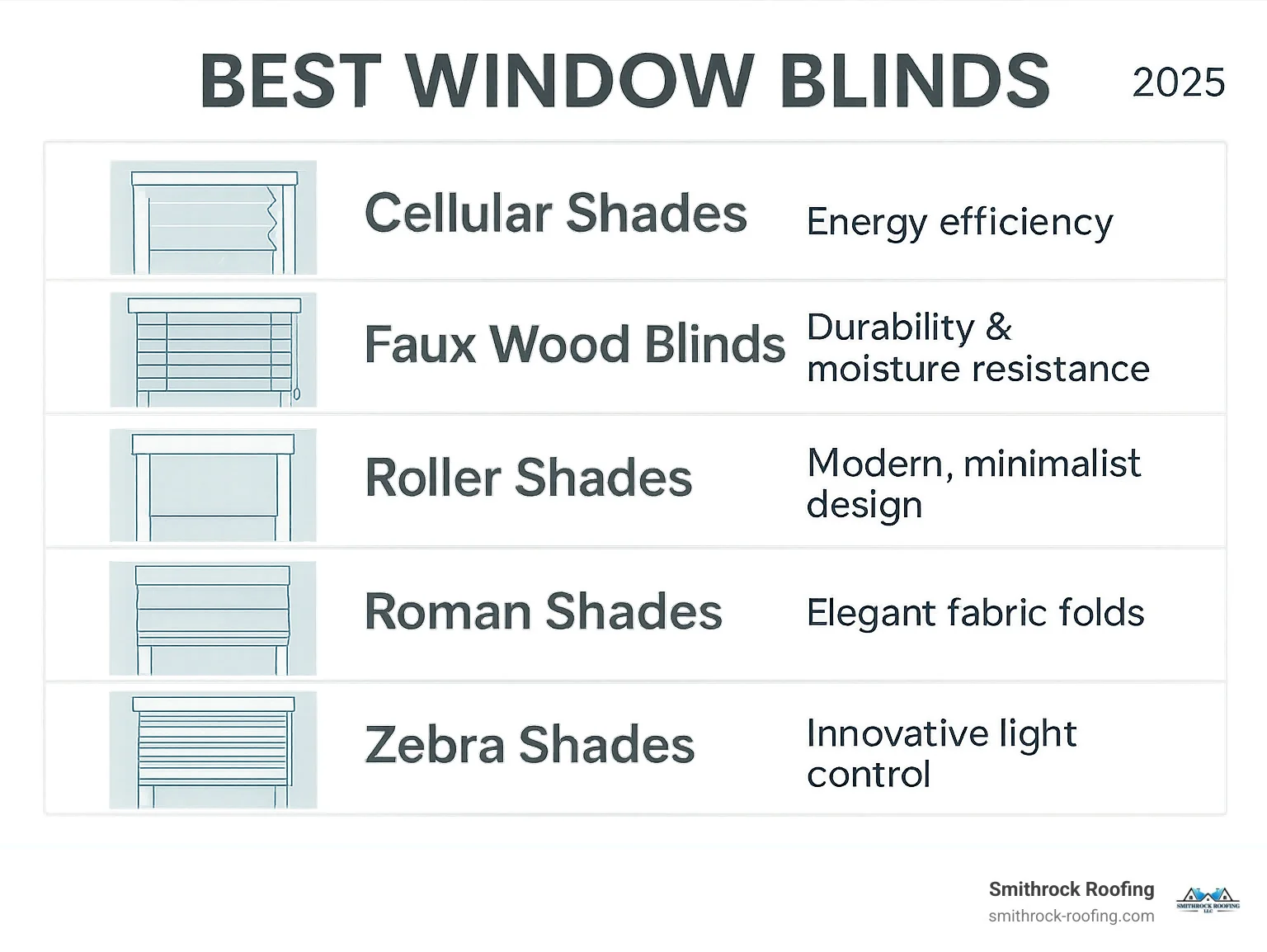
Comprehensive comparison infographic showing the top 5 types of window blinds with their key benefits: cellular shades for energy efficiency with honeycomb air pockets, faux wood blinds for durability and moisture resistance, roller shades for modern minimalist design, neat Roman shades for fabric folds, and zebra shades for innovative light control with alternating bands - best window blinds infographic

The Essential Benefits: Why Invest in Quality Window Coverings?

The best window blinds are a crucial home improvement, working quietly in the background to enhance your daily life. They are a multi-faceted investment that delivers tangible returns in comfort, efficiency, and value. Here are the essential benefits you can expect from quality window treatments:

  • Total Privacy Control: Quality blinds provide immediate and adjustable control over your home’s privacy. Unlike curtains that are either open or closed, blinds with slats (like wood or Venetian) or innovative designs (like top-down/bottom-up shades) allow you to block the view from the street while still letting in natural light from above. This granular control lets you tailor your privacy levels throughout the day, from shielding a ground-floor living room to ensuring complete seclusion in a bedroom or bathroom.
  • Precise Light Management: Blinds put you in the driver’s seat of your home’s lighting. You can fine-tune the amount and direction of natural light in any room to create the perfect ambiance. Tilt the slats to redirect harsh sunlight away from your eyes, reduce glare on TV and computer screens for better productivity and relaxation, or diffuse light gently to create a soft, welcoming glow. This control also protects your interiors from the sun’s bleaching effects.
  • Significant Energy Savings: Windows are a primary source of energy loss, responsible for up to 30% of a home’s heating and cooling energy use. Quality blinds act as a thermal barrier, mitigating this loss. In the summer, they block solar heat gain, keeping your home cooler. Research consistently shows that reflective window coverings can reduce heat gain up to 77% during summer months, significantly reducing the load on your air conditioner. In winter, insulating blinds (especially cellular shades) trap a layer of air, preventing heat from escaping and reducing the strain on your furnace. For maximum efficiency, pair new blinds with high-performance windows; you can find more info about the best windows for insulation to create the ultimate energy-saving combination.
  • UV Ray Protection: The same sunlight that brightens your home carries harmful ultraviolet (UV) rays that can cause irreversible damage to your belongings. Over time, UV exposure fades and degrades hardwood floors, expensive furniture, cherished artwork, and delicate fabrics. Quality blinds and shades act like sunscreen for your interiors, with many options filtering out up to 99% of harmful UV rays, preserving the life and color of your investments.
  • Increased Home Value and Curb Appeal: Updated, high-quality window treatments give rooms a polished, cohesive, and finished look. This signals quality and care to potential buyers, making them a valuable and often-overlooked home improvement. From the outside, uniform and attractive blinds enhance your home’s curb appeal, presenting a clean and well-maintained facade.
  • Effective Noise Reduction: In today’s busy world, a quiet home is a sanctuary. Thicker materials and specially designed blinds can help muffle outside noise from traffic, neighbors, and construction. Cellular shades are particularly effective, as their honeycomb-shaped air pockets absorb sound waves. Layering blinds with curtains can further enhance this sound-dampening effect, creating a more peaceful indoor environment.
  • Aesthetic Enhancement and Style Definition: Window treatments are a powerful interior design tool. They can serve as a subtle backdrop or a bold statement piece. The right choice of material, color, and style can tie a room together, reinforce a design theme (from minimalist to traditional), and add texture, warmth, and sophistication.

These benefits work in concert, making quality window coverings a smart and affordable investment that improves your home on multiple fronts.
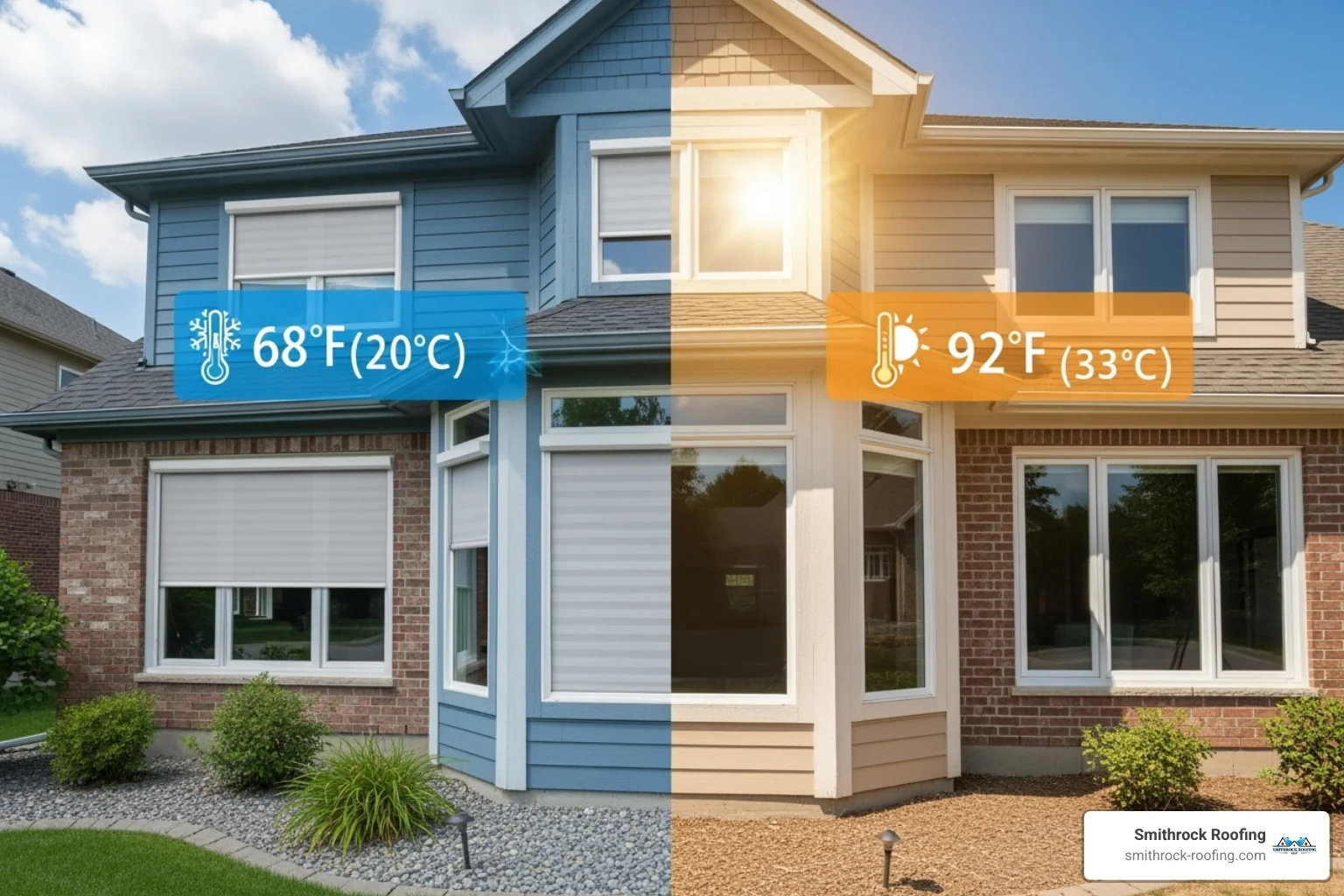
An illustration of a house with different window types, showing a thermometer indicating a cooler indoor temperature on one side of the house where energy-efficient blinds are installed, and a warmer temperature on the other side without them - best window blinds

Blinds vs. Shades vs. Curtains vs. Shutters: Decoding Your Options

When you’re shopping for window treatments, the terminology can be confusing. Understanding the fundamental differences between blinds, shades, curtains, and shutters is the first step to choosing the right product for your home’s functional needs and aesthetic goals.

Curtains (or Drapes) are fabric panels that hang from a rod above the window. They offer a soft, classic look and are available in an endless variety of colors, patterns, and fabrics, from sheer and airy to heavy and opulent. They excel at adding warmth, texture, and decorative flair. However, they offer limited light control (typically just open or closed) and can require more maintenance, such as professional washing or dry cleaning.

Blinds are considered “hard treatments” and feature individual horizontal or vertical slats (also called louvers) made from durable materials like wood, faux wood, aluminum, or vinyl. Their key feature is precision. You can tilt the slats to control the exact amount and direction of light entering a room, offering the best adjustability for light and privacy. They are generally durable and easy to clean with a simple wipe-down.

Shades are considered “soft treatments” and are crafted from a continuous piece of fabric or material that rolls, folds, or stacks neatly when raised. They offer a clean, streamlined look that combines the softness of fabric with excellent functionality. Fabric options range from sheer to light-filtering to complete blackout, giving you versatile control over light and privacy. Their seamless appearance is popular in modern and minimalist designs.

Shutters are a premium, architectural “hard treatment” built directly into or around the window frame. Typically made from real wood or a durable polysatin compound, they feature large, tiltable louvers. Shutters are incredibly durable, offer excellent light and privacy control, provide an additional layer of insulation and security, and can significantly increase home value. They are a permanent fixture and a long-term investment.

Here’s a quick comparison to help you decide:

FeatureBlindsShadesCurtainsShutters
Light ControlExcellent (Tilting Slats)Good (Fabric Opacity)Fair (Open/Closed)Excellent (Tilting Louvers)
PrivacyExcellent (Adjustable)Very Good (Solid Panel)Good (When Closed)Excellent (Solid & Adjustable)
InsulationFair to GoodGood to Excellent (Cellular)Fair to Good (Thermal)Very Good
DurabilityGood to Very GoodGoodFair to GoodExcellent
MaintenanceEasy (Wipeable)Easy (Vacuum/Spot Clean)High (Laundering)Easy (Wipeable)
Cost$-$$$-$$$$-$$$$$$-$$$$
AestheticsStructured, Clean, ClassicSoft, Modern, SeamlessFlowing, Traditional, DecorativeArchitectural, Timeless, Premium

Understanding these core distinctions is crucial. It allows you to match the right treatment to each room’s specific needs, whether it’s the precise glare control of blinds for a home office, the superior insulation of cellular shades for a bedroom, or the timeless architectural beauty of shutters for a living room.
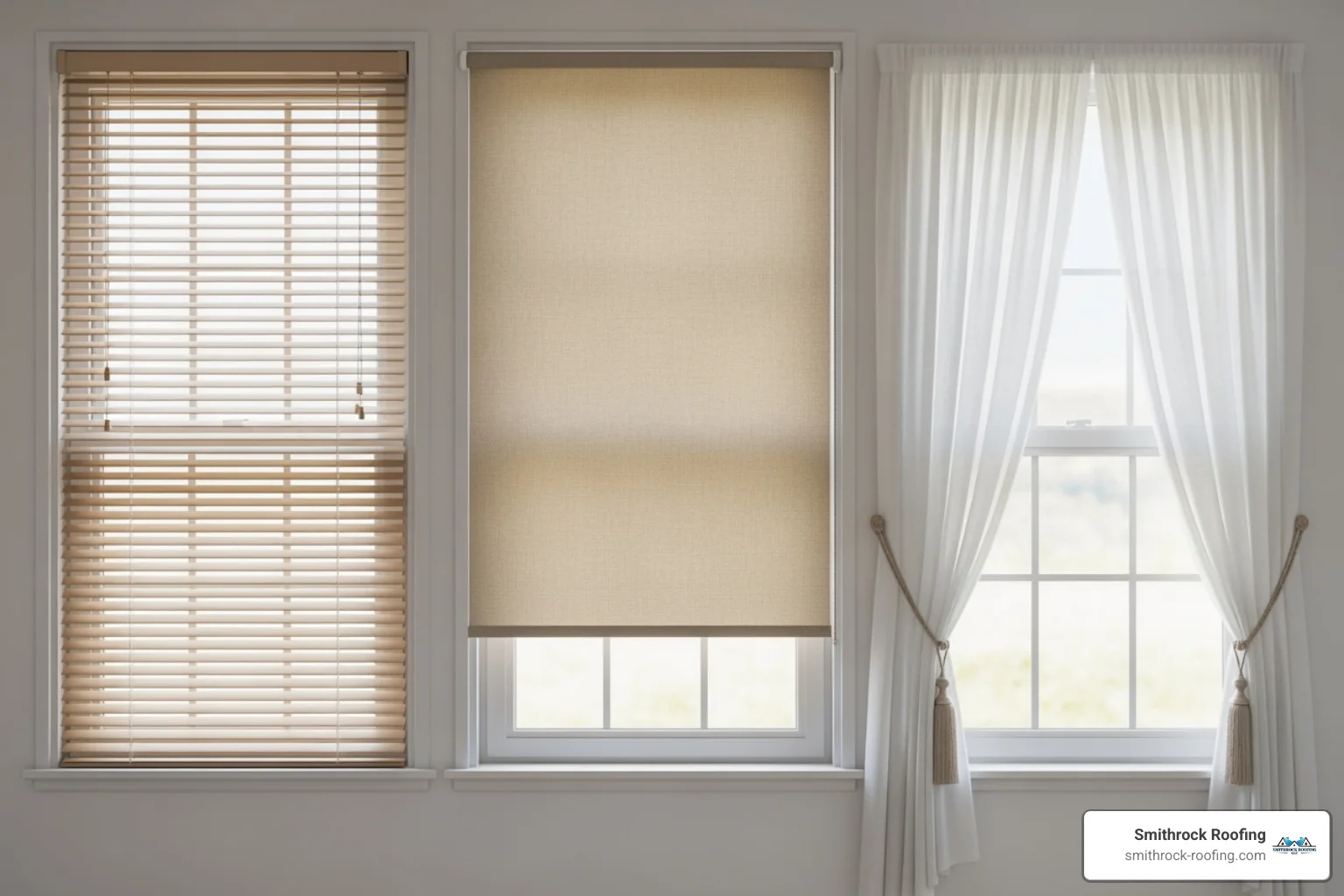
A clear side-by-side visual depiction of three identical windows. The first window shows a slatted blind, the second window features a fabric shade, and the third window displays a flowing curtain - best window blinds

A Roundup of the Best Window Blinds and Shade Styles

Once you understand the basics, you can explore the most popular styles in more detail. The best window blinds and shades are designed to solve specific problems while enhancing your home’s decor. Here’s a deep dive into the top contenders.

Cellular (Honeycomb) Shades: The Energy Efficiency Champions

Cellular shades, often called honeycomb shades, are the undisputed champions of energy efficiency. Their ingenious design features unique honeycomb-shaped air pockets that trap air at the window, creating a powerful layer of insulation. This barrier dramatically reduces heat transfer, keeping your home warmer in the winter and cooler in the summer. This can lead to significant savings on your energy bills. Natural Resources Canada says that insulating blinds significantly reduce energy use, and cellular shades are a top performer. They are available in single-cell, double-cell, and even triple-cell constructions; the more cells, the greater the insulation (and higher the R-value). They also provide excellent sound absorption and come in a full spectrum of opacities, from sheer and light-filtering to room-darkening and complete blackout options.

Wood & Faux Wood Blinds: Classic, Durable, and Versatile

Wood and faux wood blinds offer a timeless, sophisticated look that complements nearly any decor, from traditional to contemporary.
  • Real Wood Blinds are crafted from hardwoods like North American basswood or bamboo. They provide authentic natural beauty, warmth, and are surprisingly lightweight, making them ideal for larger windows. They come in a rich variety of stains and painted finishes. However, they are susceptible to moisture and are not recommended for high-humidity areas like bathrooms or kitchens.
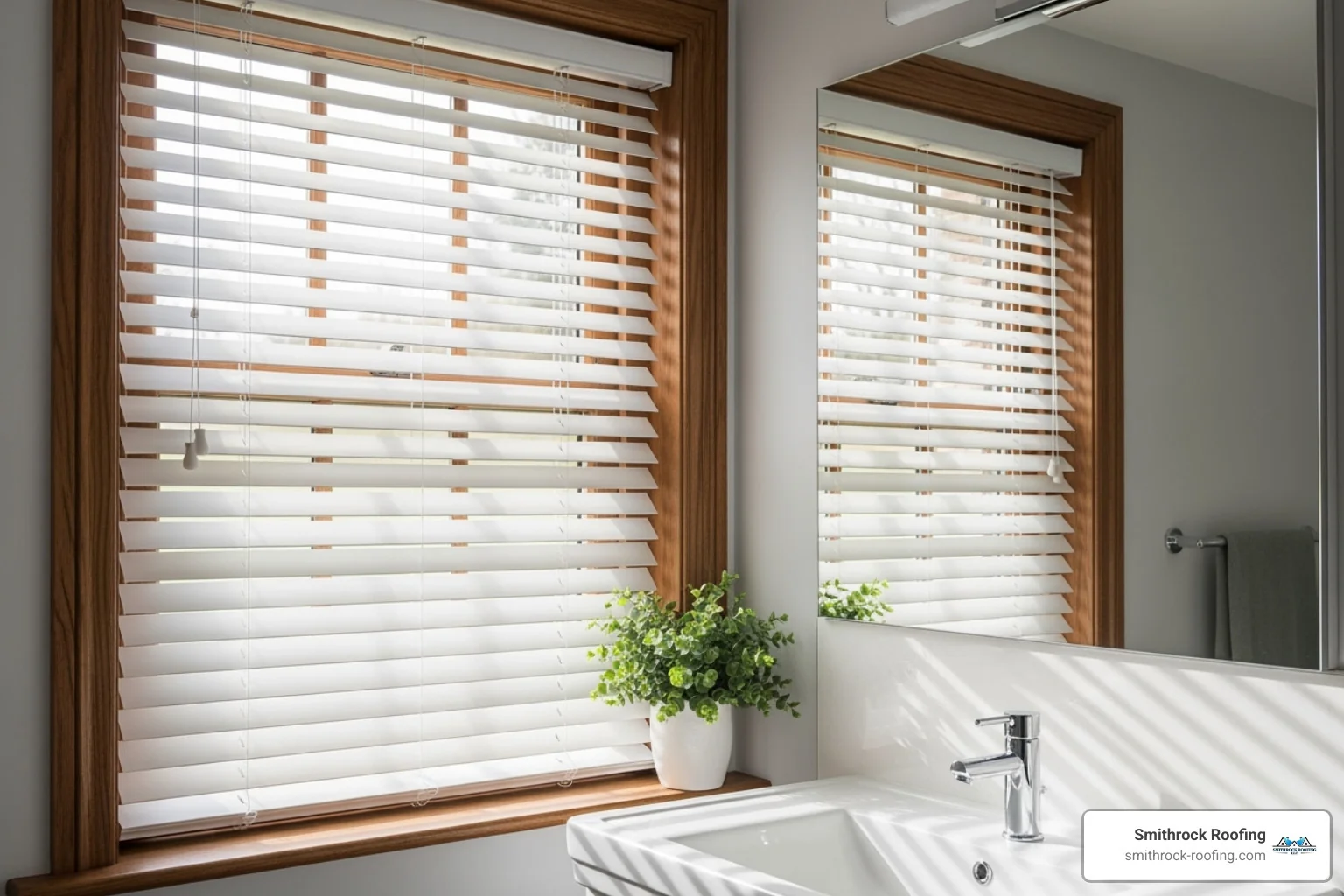
  • Faux Wood Blinds deliver the classic look of real wood with superior durability and moisture resistance. Made from robust PVC or composite materials, they are the perfect choice for kitchens, bathrooms, and laundry rooms because they will not warp, crack, or fade. They are incredibly easy to maintain and are often more budget-friendly than real wood. Both types are available in various slat sizes (typically 1″, 2″, or 2.5″), allowing you to customize your view and light control.

Classic white faux wood blinds installed in a stylish, well-lit bathroom, highlighting their resilience to moisture and neat appearance - best window blinds

Roller & Solar Shades: Sleek, Simple, and Modern

For a clean, minimalist aesthetic, roller shades are an ideal choice. They consist of a single panel of fabric that rolls up onto a tube, almost disappearing when raised to provide an unobstructed view. The fabric choices are nearly limitless, from decorative patterns and textures to high-performance materials. Blackout roller shades are perfect for media rooms and bedrooms, while solar shades are a unique sub-category. Solar shades are engineered to cut glare and block UV rays while still preserving your view of the outdoors. They come in different “openness factors” (e.g., 1% to 14%) that determine the degree of visibility and light control. Their simple operation, especially with cordless or motorized options, makes them safe, easy to use, and highly functional.

Roman Shades: Timeless Elegance and Softness

Roman shades masterfully combine the soft, luxurious feel of drapery with the clean, crisp function of a shade. Made of fabric construction, they form soft, elegant folds when raised, adding a layer of texture and sophistication to any room. You can choose from different fold styles to match your decor: a flat fold offers a clean, traditional look; a hobbled fold (or teardrop fold) has overlapping fabric for a more dimensional, cascading effect; and a relaxed fold has a gentle curve at the bottom for a softer, more casual feel. With a vast pattern variety and options for light-filtering or blackout liners, Roman shades are a designer favorite for living rooms and master bedrooms.

Zebra (Transitional) Shades: Innovative and Stylish

Zebra shades, also known as transitional blinds or layered shades, offer an innovative and visually striking approach to light control. They are constructed with alternating fabric bands of sheer and solid (or room-darkening) stripes. This dual-layered system allows you to adjust the alignment of the bands. Align the solid stripes for privacy and darkness, or align the sheer stripes to gently filter light and enjoy the view. This precise light management in a single shade, combined with their bold, modern design, makes them a unique and highly functional choice for contemporary homes.

Venetian Blinds: The Adjustable Classic

Venetian blinds are the original slatted blind, typically made from lightweight and durable aluminum or vinyl. They are known for their affordability and exceptional light control. Like wood blinds, their horizontal slats can be tilted with precision to direct sunlight exactly where you want it, making them a popular choice for home offices and commercial spaces. While often seen as a basic option, modern Venetian blinds come in a wide array of colors, finishes, and slat sizes, offering a practical and budget-friendly solution for any window.

Vertical Blinds: The Solution for Large Windows

For large windows, sliding glass doors, and patio doors, vertical blinds are often the most practical and effective solution. They feature vertical vanes that can be tilted and drawn to one side, allowing for easy access through the door. Modern vertical blinds have evolved far beyond the classic white PVC options. Today, they are available in a wide range of materials, including fabric, wood, and textured vinyl, in a variety of colors and patterns. Panel track blinds are a contemporary alternative, using wide, overlapping fabric panels that slide on a track for a sleek, sophisticated look on large expanses of glass.

How to Choose the Perfect Blinds for Every Room

Choosing the best window blinds is not a one-size-fits-all decision. The ideal choice is a careful balance of a room’s function, your home’s style, and your practical needs. By systematically considering a few key factors, you can confidently select the perfect treatment for every window.

Key Factors to Consider Before You Buy

  • Light & Privacy Requirements: This is the most critical functional consideration. Do you need to achieve pitch-black darkness for a bedroom? Choose a blackout material like a blackout roller or cellular shade. Do you want to gently diffuse harsh light in a living room? A light-filtering fabric is ideal. Want to maintain your view while cutting glare? Consider sheer shades or solar shades. For privacy, determine if you need full opacity or the adjustable privacy offered by slatted blinds or top-down/bottom-up shades.
  • Budget: Window treatment prices vary dramatically. Off-the-shelf vinyl blinds can cost as little as $20 per window, while custom, motorized hardwood shutters can run into the thousands. Establish a realistic budget, but also consider the long-term value. A higher upfront cost for durable, energy-efficient blinds can pay for itself over time.
  • Home Decor & Style: Your blinds should complement your existing decor. For a modern, minimalist home, sleek roller shades or zebra blinds work well. For a traditional or farmhouse style, consider classic wood blinds or elegant Roman shades. Choose colors and materials that harmonize with your wall color, furniture, and overall aesthetic.
  • Durability and Maintenance: Be realistic about the environment. For high-humidity areas like bathrooms and kitchens, choose moisture-resistant materials like faux wood, vinyl, or aluminum. For high-traffic areas or homes with kids and pets, prioritize durable materials and easy-to-clean surfaces.
  • Child and Pet Safety: This is non-negotiable. Dangling cords pose a serious strangulation hazard. Always prioritize safety by choosing cordless options. Modern cordless mechanisms include simple push/pull systems, motorized wands, and fully automated remote controls. Look for products certified as “Best for Kids.”
  • Window Size, Shape, and Function: Standard windows offer the most options. For extra-large windows or sliding glass doors, vertical blinds or panel track blinds are often the best solution. For specialty shapes like arches, skylights, or bay windows, you will almost certainly need a custom-made solution.

Room-by-Room Recommendations for the Best Window Blinds

  • Living Room: This multi-functional space demands versatility. Consider zebra blinds for their seamless transition between light and privacy, elegant Roman shades to add a touch of class, or insulating cellular shades for large picture windows. Layering treatments, such as pairing a light-filtering shade with decorative curtains, is also a popular and stylish choice.
  • Bedroom: The primary goal is promoting restful sleep. Blackout cellular shades or blackout roller shades are essential to block morning light, streetlights, and distractions. For the ultimate light control, pair an inside-mount blackout shade with an outside-mount frame or side channels to eliminate light leakage around the edges.
  • Kitchen: Durability and ease of cleaning are paramount. Faux wood blinds are the top choice as they resist moisture, heat, and grease and can be wiped clean easily. Washable roller shades or aluminum blinds are also excellent, practical options.
  • Bathroom: Privacy and moisture resistance are critical. Faux wood or vinyl blinds are perfect as they won’t warp in a humid environment. Top-down/bottom-up cellular shades are a fantastic solution for providing privacy on the bottom half of the window while letting natural light in from the top.
  • Home Office: The key is to reduce screen glare without creating a dark cave. Light-filtering roller shades, solar shades, or adjustable Venetian blinds are ideal. They allow you to control the direction and intensity of light, boosting comfort and productivity.
  • Nursery & Kids’ Rooms: Safety is the number one priority. Cordless cellular shades or cordless roller shades are the safest choices. They are available in fun colors and patterns, and blackout options are perfect for naptime.

Custom-Made vs. Off-the-Shelf: What’s the Right Choice?

  • Off-the-shelf blinds are a budget-friendly, readily available option for standard-sized windows. They are great for DIYers and rental properties. However, the selection of sizes, materials, and colors is limited. This can lead to a poor fit, creating unsightly gaps that compromise privacy and light control.
  • Custom blinds are professionally measured and manufactured to fit your windows perfectly. This precise fit eliminates gaps, maximizing insulation, privacy, and light blockage. The selection of materials, colors, operating systems, and advanced features like motorization is virtually unlimited. While the upfront cost is higher, the superior quality, perfect aesthetic, enhanced durability, and professional installation make them a worthwhile long-term investment that adds significant value to your home.

Mastering Your Blinds: Advanced Features and Installation

To truly get the most out of your new window treatments, it’s important to understand the modern features available and the fundamentals of proper installation. These details elevate your blinds from a simple covering to a high-performance component of your home.

Upgrading Functionality: Smart Features Worth Considering

Modern window treatments have evolved far beyond basic manual controls. These advanced features enhance safety, convenience, and energy efficiency.

  • Cordless Lift Systems: This is now the standard for safety and is an essential feature for any home with children or pets. By eliminating dangling lift cords, you remove a serious safety hazard. Operation is simple and clean; shades are raised or lowered with a gentle push or pull on the bottom rail.
  • Top-Down/Bottom-Up Operation: This feature offers the ultimate in light and privacy flexibility. You can lower the shade from the top to let in natural light while keeping the bottom portion closed for privacy. It’s a perfect solution for street-facing rooms, bathrooms, and bedrooms.
  • Motorized Blinds: Offering a touch of luxury and incredible convenience, motorized blinds can be operated with a remote control, a wall switch, or even a smartphone app. They are an ideal solution for very large windows, skylights, or any windows that are hard to reach. Motorization also provides a smooth, consistent operation that can extend the life of your blinds. Power options include:
    • Battery-Operated: The most common and easiest to install, often using a discreet, rechargeable battery wand.
    • Hardwired: Integrated directly into your home’s electrical system for maintenance-free power. Requires professional installation.
    • Solar-Powered: A small solar panel harnesses sunlight to charge the battery, offering a green and sustainable power source.
  • Smart Home Integration: This is the pinnacle of window treatment technology. Connect your motorized blinds to your smart home ecosystem (like Amazon Alexa, Google Home, or Apple HomeKit). This allows for voice commands (“Alexa, close the living room blinds”) and powerful automation. You can create automated schedules to open blinds at sunrise and close them at sunset, enhancing security. You can also link them to a smart thermostat to automatically close during the hottest part of the day, maximizing energy efficiency without you lifting a finger.

A Guide to Measuring and Installing Your New Blinds

Accurate measurements are the single most important step for a successful installation and a professional look. First, you must decide between an inside mount or an outside mount.

  • Inside Mount: The blinds fit neatly inside the window frame, providing a clean, built-in look. This is the most common choice but requires sufficient, unobstructed window depth.
  • Outside Mount: The blinds are installed on the wall or trim above and around the window. This is used when there isn’t enough depth for an inside mount, to hide unattractive trim, or to make a window appear larger. It also provides better light blockage as the blind overlaps the window opening.

How to Measure Accurately:

  • For an Inside Mount: Use a steel tape measure. Measure the window frame’s interior width at the top, middle, and bottom. Record the narrowest of the three measurements. Then, measure the height at the left, center, and right, and record the longest measurement. Finally, measure the depth of the frame to ensure it’s deep enough for the blind’s headrail.
  • For an Outside Mount: Decide how much you want the blind to overlap the window opening. A typical overlap is 3-6 inches on each side (width) and on the top and bottom (height). Measure the desired final width and height of the blind itself, not the window opening.

While DIY installation is achievable for many handy homeowners, the benefits of professional installation are significant. A professional ensures a perfect, secure fit, especially for complex jobs like motorized blinds, specialty window shapes, or difficult wall materials. They have the right tools and experience to handle any unforeseen challenges, and their work is often required to maintain the product’s warranty, giving you peace of mind.

For comprehensive information about professional window installation and replacement, we’re here to help.

Frequently Asked Questions about Window Blinds

Here are detailed answers to some of the most common questions homeowners have when navigating the process of choosing the best window blinds.

What type of blinds are most effective for blocking out light?

For the most effective light blocking, often called “blackout,” you need to focus on two things: material and fit.

  • Material: The best materials are inherently opaque. Blackout cellular shades are excellent because their honeycomb cells trap light, and the material itself is designed to block it. Blackout roller shades use a single piece of opaque fabric with a special backing to create a solid light barrier. When choosing Roman shades, ensure you select a multi-layered fabric with a dedicated blackout liner.
  • Fit: This is just as important as the material. A proper fit is absolutely crucial to prevent “light leakage” or “light halos” around the edges of the blind. For the best result, an outside mount installation that overlaps the window frame by several inches on all sides is the most effective method. If you prefer an inside mount, you can add light-blocking side channels, which are small tracks installed inside the window frame to seal the gaps along the edges of the shade.

How do I clean and maintain my window blinds?

Proper, regular maintenance will dramatically extend the lifespan of your blinds and keep them looking great. The method depends on the material:

  • Dusting Wood and Faux Wood Blinds: For regular cleaning, use a feather duster, a soft cloth, or a vacuum with a soft brush attachment. You can close the slats and wipe them down, then reverse the slats and repeat. For real wood, avoid moisture as it can cause warping. For durable faux wood, you can use a damp cloth with a mild detergent for tougher grime.
  • Cleaning Fabric Shades (Cellular, Roller, Roman): Regular dusting with a vacuum’s brush attachment is the best first step. For cellular shades, you can use a can of compressed air to blow dust out of the cells. For small stains on most fabrics, gently blot the spot (do not rub) with a cloth dampened with a solution of mild detergent and lukewarm water. Always test on an inconspicuous area first.
  • Wiping Down Aluminum and Vinyl Blinds: These are very easy to clean. They can be wiped down with a damp cloth and a mild cleaning solution. For a deep clean, they can sometimes be removed and washed more thoroughly.

Are expensive window blinds worth the investment?

Yes, in almost every case, quality window blinds are a worthwhile long-term investment. While the upfront cost is higher, they provide significant long-term value that outweighs the initial cost.

  • Durability and Material Quality: Higher-end blinds use superior materials, more robust internal mechanisms, and better construction. This means they will operate smoothly for years, resist fading and warping, and won’t break down like cheaper alternatives.
  • Performance and Energy Efficiency: Premium materials provide better insulation (lowering energy bills), superior UV protection (protecting your furniture), and more effective sound insulation. These tangible benefits improve your home’s comfort and can lead to real savings.
  • Customization and Perfect Fit: Investing more gives you access to a perfect, custom fit that eliminates gaps and looks professionally finished. You also gain access to advanced features like motorization and safer cordless systems.
  • Warranty and Support: Reputable brands stand behind their products with strong, long-term warranties, giving you peace of mind that your investment is protected.

What is the R-value of window blinds?

R-value is a measure of thermal resistance; the higher the R-value, the better a material is at insulating. While standard window blinds offer some insulation, certain types are designed specifically for it. A single pane of glass has an R-value of about 1. Adding a basic blind might bring it to R-2. However, high-performance cellular shades can have R-values ranging from 3 to over 7, depending on the fabric and whether they are single, double, or triple-cell designs. This can make a significant difference in your home’s energy consumption.

Are vertical blinds an outdated style?

While traditional, clunky PVC vertical blinds can feel dated, the category has been completely reinvented. Modern vertical blinds come in a wide array of luxurious fabrics, textured materials, and contemporary colors. Furthermore, panel track blinds, which use wide, overlapping fabric panels, offer a sleek and sophisticated alternative for patio doors and large windows that is very much in style in modern homes.

Conclusion: Your Guide to a More Comfortable and Efficient Home

Choosing the best window blinds is a significant and rewarding investment in your home’s comfort, style, energy efficiency, and overall value. As we’ve explored, the right window treatments do far more than just cover a window; they transform a house into a home. From the powerful insulating properties of cellular shades that can dramatically reduce energy bills to the timeless elegance of Roman shades and the modern ingenuity of zebra blinds, there is a perfect solution for every need and every room.

By considering key factors like light control, privacy, safety, and style, you can make an informed choice. Modern features like cordless lift systems are essential for safety, while smart home integration offers a new level of automated convenience and efficiency. The key to success is matching the blind’s function—be it the moisture resistance of faux wood for a kitchen or the complete light-blocking capability of a blackout roller shade for a bedroom—to the specific demands of each space.

An investment in high-quality, custom-fit blinds pays dividends for years to come through enhanced durability, superior performance, and increased home value. For the ultimate results, pairing the best window blinds with high-performance, well-insulated windows creates a powerful combination that maximizes your home’s potential for energy savings and year-round comfort.

At Smithrock Roofing, we understand how every element of your home’s exterior and interior works together to create a cohesive, high-performing system. While you select the perfect blinds to complete your rooms, we can provide expert guidance and installation for comprehensive window solutions that will serve your family for decades. We are proud to serve communities throughout Winston-Salem, King, Clemmons, Lewisville, Pilot Mountain, East Bend, Mt. Airy, Kernersville, Siloam, Danbury, High Point, Trinity, Pfafftown, Tobaccoville, Greensboro, Walnut Cove, Belews Creek, Rural Hall, Pinnacle, Bethania, Advance, Wallburg, Horneytown, Union Cross, and Midway, NC.

Learn more about the best windows for insulation to maximize your home’s comfort and savings.

Share:

Categories

Follow us

You can find us on Facebook, Instagram, and Google.
Smithrock Roofing LLC logo featuring stylized rooftops with chimneys and arched windows
Smithrock Roofing proudly services the cities of Winston-Salem, King, Clemmons, Lewisville, Pilot Mountain, East Bend, Mt. Airy, Kernersville, Siloam, Danbury, High Point, Trinity, Pfafftown, Tobaccoville, Greensboro, Walnut Cove, Belews Creek, Rural Hall, Pinnacle, Bethania, Advance, Wallburg, Horneytown, Union Cross, and Midway, NC.

Newsletter

Sign up to receive important tips, special offers, and discounts.

Smithrock Roofing © Copyright 2026 • All Rights Reserved • Privacy Policy • Maintained by Mongoose Digital Marketing