There’s a pattern that plays out in Wilmington every fall, right after the Atlantic season winds down. A homeowner gets their roof repaired following a named storm. The contractor replaces the visible missing shingles, maybe patches a section near the ridge, and calls it done. Twelve months later, the next storm rolls through and the same roof, sometimes worse sections of it, fails again.
This isn’t bad luck. It’s the predictable result of a repair that addressed symptoms instead of causes.
Wilmington’s roofing environment is genuinely different from most of the country, and even different from other parts of North Carolina. The combination of salt air, Atlantic hurricane tracks, an aging housing stock, and one of the state’s most complex homeowner’s insurance markets means that a roof repair done right here requires a different level of diagnosis than what a generalist contractor brings to the job. The difference between a repair that holds and one that fails again isn’t materials or price, it’s whether the contractor actually understands what’s happening beneath the surface and why it’s happening in the first place.
This guide walks through what that understanding looks like in practice: the specific failure mechanisms that affect Wilmington homes, what a thorough damage assessment should actually include, how to navigate the insurance documentation process, and what separates a qualified coastal roofing repair from the kind that gets redone season after season.
Most roofing content treats coastal climate as a single checkbox, “we know about salt air and hurricanes.” That’s not enough to actually protect a Wilmington home. The specific mechanisms that cause roofs here to fail are worth understanding in detailbecause they’re the same mechanisms your repair contractor should be addressing.
Salt-laden air doesn’t need to be ocean spray to do damage. Wilmington’s proximity to the Atlantic and the Cape Fear River estuary means airborne chloride concentrations are measurably elevated compared to inland NC communities like Winston-Salem or Greensboro. These chlorides accelerate oxidation on every metal component in a roof system, and that includes components homeowners rarely think about.
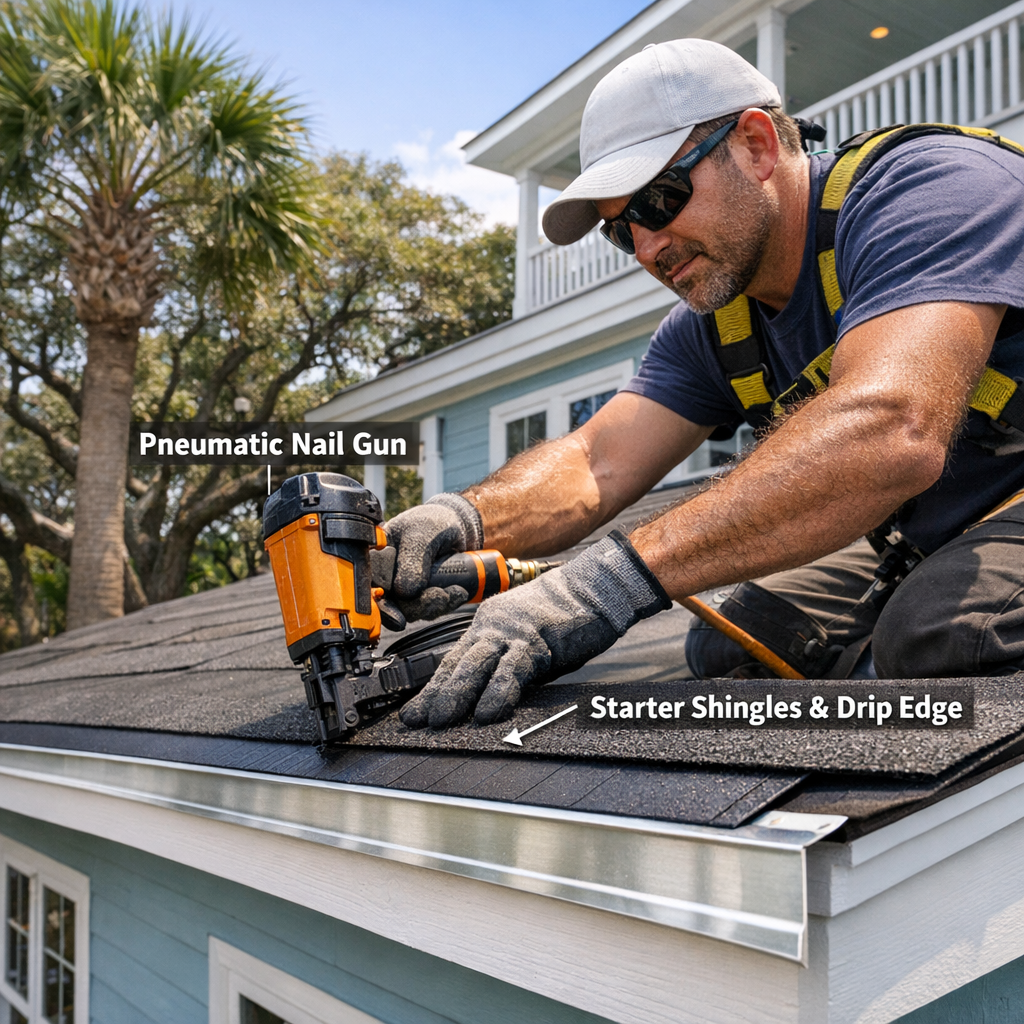
Standard galvanized drip edge, which meets code requirements in most of North Carolina, corrodes significantly faster in Wilmington’s salt environment. Within a few years, the zinc coating breaks down, the steel beneath rusts, and the drip edge begins to fail at its bond with the fascia, creating a pathway for water intrusion that shows up as rot in the fascia board and soffit rather than an obvious roof leak. By the time it’s visible from the ground, the damage is already weeks or months old.
The same corrosion process affects:
A proper coastal repair assessment specifies coastal-grade aluminum or stainless steel for any metal replacement componentsnot because it’s an upgrade, but because standard galvanized materials simply don’t have the service life in this environment.
Asphalt shingles rely on a factory-applied adhesive strip, the manufacturer’s seal that bonds each shingle course to the one below it. This seal is what gives a shingle system its wind resistance rating. In Wilmington’s climate, this adhesive faces a stress condition that isn’t commonly discussed: sustained high-humidity cycling.
Most coastal humidity discussions focus on moisture intrusion through the roof assembly. But the adhesive strip failure mechanism is different. When temperatures swing between warm, saturated coastal air and the heat of a late-summer afternoon, shingles thermally expand and contract repeatedly. In a standard continental climate, this cycling happens over a relatively dry baseline. In Wilmington, the cycling happens over an already-saturated baseline, which means the adhesive strip never fully cures to its rated bond strength between cycles.
The practical result: shingles that appear fully intact, flat, unlifted, no visible cracking, can have compromised adhesive bonds. They look fine in a ground-level inspection. They fail when sustained wind loading from a named storm pulls the unsealed edge up and the wind gets underneath.
This is one of the primary reasons storm damage in Wilmington often looks surprising to homeowners. The shingles weren’t obviously damaged before the storm. They failed because their adhesive bond had been degrading quietly for years under conditions that standard inspections don’t catch.
Wilmington’s position on the Cape Fear River basin creates a secondary moisture source that compounds the Atlantic humidity load. The river basin generates persistent low-lying moisture, particularly in early morning hours, that affects roofing assemblies differently than general ambient humidity.
This matters most for older homes with less robust ventilation systems. When the roof deck and attic assembly can’t adequately exhaust the moisture load they absorb overnight, that moisture works upward through the deck over years. The result is degraded OSB or plywood sheathing, not from a single water intrusion event, but from cumulative moisture cycling across seasons.
A repair contractor who doesn’t probe the deck and take moisture readings before applying new material is essentially installing a new top layer over a substrate that may already be structurally compromised. The repair looks complete. The deck continues to degrade underneath.
Need a hand with this in Winston-Salem, Greensboro and the NC Triad? Call (336) 971-0464 or request a free estimate. Honest answers, no pressure.
Wilmington has a substantial housing stock built before modern IRC sheathing requirements became standard practice. If your home was built before approximately 2000, there’s a meaningful possibility that your roof deck isn’t what you think it is, and this changes what a proper repair assessment needs to include.
Older Wilmington homes frequently used one of two substrate approaches that are structurally different from modern OSB or plywood decking:
Skip sheathing (also called spaced sheathing) consists of horizontal boards with gaps between them, originally designed for wood shingle or shake installations. When these homes were later re-roofed with asphalt shingles, contractors would sometimes overlay plywood or simply apply the new shingles directly. Decades of coastal humidity cycling cause the original boards to warp, crack, and separate, leaving the modern shingle system fastened to a substrate with increasingly marginal structural integrity.
Board decking (solid planks, typically 1×6 or 1×8) is more structurally sound than skip sheathing but presents its own problem in Wilmington’s climate: the gaps between boards allow moisture migration from the attic side upward, and the individual boards expand and contract independently with humidity changes, working nail fasteners loose over time.
Neither of these substrates shows up clearly in a ground-level visual inspection or even a basic attic observation. The problem lives in the connection between the deck surface and the framing beneath it.
A contractor who understands Wilmington’s housing stock should be doing the following before finalizing any repair scope:
When you receive a written assessment from a repair contractor, look for explicit mention of deck condition findings. An assessment that only describes shingle or flashing damage without noting substrate evaluation was not a thorough inspection, it was a surface-level observation.
Generic roofing content talks about wind damage as if it’s random and equally distributed across a roof. In Wilmington, it isn’t. The dominant storm tracks that affect New Hanover County create predictable wind loading patterns, and those patterns cause damage in specific roof zones that a trained eye can anticipate.
Named storms that make landfall near Wilmington, or track up the coast without direct landfall, typically generate the most damaging wind loading from the northeast quadrant as they approach and from the south and southwest as they pass. This creates a characteristic damage pattern:
Northeast and north-facing eave overhangs experience the highest uplift forces as the storm front arrives. The eave overhang is the most aerodynamically vulnerable point on any roof, the underside catches the approaching wind like a wing, and on north/northeast faces, that vulnerability is compounded by the storm’s approach direction.
Ridge terminations are the second most common failure zone. As wind passes over the ridge, pressure differentials between the windward and leeward faces create uplift loading at the ridge cap that exceeds what field-area shingles experience. This is why ridge cap loss is consistently one of the first and most widespread damage types seen after named storms in Wilmington.
Step flashing at dormers and wall intersections fails under the combination of wind-driven rain and the pressure cycling that occurs as gusts vary, the flashing flexes repeatedly, working sealant joints loose and allowing water penetration that may not appear immediately.
New Hanover County falls under ASCE 7 wind speed classifications that reflect its coastal exposure. For residential construction and repair, this classification has a direct bearing on how a roof system should be fastened, not just replaced.
The distinction between field nailing patterns and perimeter zone fastening patterns is one that separates qualified coastal roofing work from generic residential repair:
| Roof Zone | Standard Field Pattern | Perimeter/Edge Pattern (ASCE 7 Coastal) |
|---|---|---|
| Field area | 4 nails per shingle | 4 nails per shingle |
| Perimeter zones (eave, rake, ridge) | 4 nails per shingle | 6 nails per shingle minimum |
| Corner zones | 4 nails per shingle | 6+ nails per shingle, reduced exposure |
| First course (starter strip) | Standard exposure | Reduced exposure, continuous adhesive |
| Ridge cap | Standard 1-nail per cap | 2-nail pattern, enhanced adhesive |
A repair that replaces visibly missing shingles in the field area without addressing the fastening pattern in perimeter zones is a repair that will produce the same result in the next named storm. The shingles themselves may be new. The vulnerability that caused the original failure remains exactly where it was.
This is the single most common reason Wilmington homeowners find themselves filing repeated storm damage claims. The contractor replaced what was obviously gone. Nobody addressed why it went in the first place.
The repair-versus-replace decision is one that every roofing contractor should be able to walk you through honestly, with specific reasoning for your roof’s condition, not a default recommendation toward the higher-ticket option. In Wilmington’s market, a few factors make this decision more consequential than it might be in inland areas.
Repair is genuinely appropriate when:
In Wilmington’s environment, several conditions shift repair from practical to problematic:
The honest answer to the repair-versus-replace question depends on what a thorough assessment actually finds, not on what’s most convenient for the contractor’s schedule or most reassuring for the homeowner’s immediate budget.
Wilmington sits in one of North Carolina’s most active homeowner’s insurance zones, and the insurance process following storm damage here has specific characteristics that are worth understanding before you file a claim or accept a contractor’s scope of work.
The documentation package a contractor produces after a Wilmington storm inspection should be specific enough to support an insurance claim without ambiguity. This means:
Photographic documentation requirements:
– Date-stamped images of all damage zones, taken from multiple angles
– Close-up images of each specific failure type (lifted shingles, missing ridge cap, flashing separation, etc.)
– Wide-angle images that establish context and location on the roof
– Images of the deck surface wherever substrate issues are identified
– Attic photos documenting any interior moisture evidence linked to the roof failure
Written assessment elements:
– Specific measurements of damaged areas (linear feet of flashing, square footage of shingle damage by zone)
– Material identification, what’s currently installed, what failed, and what replacement specifications are appropriate
– Substrate condition notes with moisture reading data
– Fastening pattern observations where perimeter zone failures are involved
What separates adequate from excellent documentation:
An adjuster reviewing your claim is looking for evidence that connects cause to effect, the storm event produced these specific conditions, which caused these specific failure mechanisms, which require this specific repair scope. A contractor whose documentation stops at “shingles missing, replace shingles” gives the adjuster less to work with. A contractor whose documentation traces the failure back to its mechanism gives you a much stronger foundation for a fair settlement. For a detailed walkthrough of the claims process, Don’t Get Ripped Off: The Essential Steps for Your Roof Insurance Claim covers what homeowners need to know before they sign anything.
Multiple contractors in Wilmington’s market mention FORTIFIED™ certification as a credential. Very few of them explain what it actually means for you as a homeowner, and the explanation matters, because the insurance implications are real and specific.
The IBHS FORTIFIED Home™ standard has three designation levels:
| Designation Level | What It Covers | Insurance Relevance |
|---|---|---|
| FORTIFIED Roof™ | Enhanced roof deck attachment, sealed roof deck, improved drip edge and hip/ridge installation | Eligible for premium credits with participating NC insurers; affects NC Beach Plan eligibility criteria |
| FORTIFIED Silver™ | All FORTIFIED Roof™ requirements plus opening protection standards | Broader insurance credit applicability; relevant for homes in Wilmington’s higher-risk coastal corridors |
| FORTIFIED Gold™ | Full envelope: roof, openings, and attached structures | Maximum designation; most significant insurance treatment; often required for optimal NC Beach Plan access |
The critical distinction most homeowners miss: A new roof is not a FORTIFIED Roof™ designation. The designation requires that the work be performed to the specific IBHS 2020 standard and be inspected and verified by a FORTIFIED-certified evaluator. The third-party inspection and documentation process is what triggers insurer recognition, not the construction method alone.
For Wilmington homeowners with properties in coastal risk corridors who access coverage through the North Carolina Joint Underwriting Association (NC Beach Plan), the FORTIFIED designation can have direct bearing on available coverage terms. This is not a minor benefit, it’s a structural reason to ask any Wilmington roofing contractor specifically how they document and certify FORTIFIED work, not just whether they’re capable of performing it.
It’s worth addressing one more layer of complexity that’s entirely absent from most Wilmington roofing content: the relationship between repair work and current North Carolina building code compliance.
When a roofing repair reaches a certain scope, typically defined as exceeding a percentage of the total roof area within a set timeframe, the repair must comply with current North Carolina State Building Code requirements, not just the code that was in effect when the home was originally built. In New Hanover County, this creates a few compliance considerations that older homes specifically need to navigate.
North Carolina’s State Building Code now requires drip edge installation at both eaves and rakes on all residential roofing. For older Wilmington homes that were originally built without rake drip edge, a repair that triggers full re-roofing requirements must include bringing this detail into compliance. A contractor who installs new shingles on a home that lacks rake drip edge without addressing it isn’t cutting corners, they’re performing non-compliant work that can create permit issues and affect future insurance claims.
In Wilmington’s salt environment, the material specification for drip edge matters as much as its presence. Aluminum drip edge outperforms galvanized in coastal conditions by a significant margin, this is where the coastal building science intersects directly with code compliance.
North Carolina adopts the International Residential Code with state-specific amendments, and those amendments include provisions that affect coastal construction differently than inland requirements. New Hanover County’s classification under ASCE 7 wind speed maps means fastening requirements, underlayment specifications, and certain flashing details are subject to more stringent standards than what a contractor accustomed to working in the NC Triad region might default to.
This isn’t a criticism of inland contractors, it’s simply an acknowledgment that Wilmington’s specific wind zone classification creates requirements that only become second nature through consistent work in that market. When you’re evaluating repair contractors for a Wilmington property, asking specifically how they address New Hanover County’s wind zone fastening requirements in their repair scopes is a reasonable and informative question. The answer tells you a great deal about whether their experience is genuinely coastal or generically regional.
In New Hanover County, permit requirements are generally triggered when a repair involves structural work or when the scope reaches a threshold that constitutes re-roofing rather than simple maintenance. Replacing a small number of damaged shingles may not require a permit, but significant sheathing repairs, full layer removal, or work that affects flashing systems typically does. A licensed contractor familiar with Wilmington’s local requirements can assess your specific scope and determine the appropriate permitting path before work begins.
Salt air introduces chloride ions that accelerate corrosion in metal components, particularly flashing, drip edge, fasteners, and any exposed metalwork. In inland environments, galvanized materials perform adequately over a normal service life. In Wilmington’s coastal environment, those same materials can degrade significantly faster, compromising the integrity of the roof system at its most critical connection points. This is why material specifications that are standard practice inland, galvanized flashing, standard fastener grades, often underperform along the Cape Fear coast.
Ask specifically how they address New Hanover County’s wind zone fastening requirements, what metal specifications they use for flashing and drip edge in coastal applications, and whether they are familiar with the NC State Building Code amendments that affect coastal construction. A contractor with genuine Wilmington experience will answer these questions with specificity. Vague or generalized answers suggest their experience may be broader than it is deep in the coastal market.
Ideally within a few days of the storm event, and before filing any insurance claim if possible. Early professional documentation of damage, including photos, written assessments, and identification of pre-existing versus storm-caused conditions, creates a much stronger foundation for the claims process than waiting weeks for an inspection. Wilmington’s storm season creates high demand for roofing contractors, so contacting a professional quickly after a significant weather event also improves your access to timely service. Our roofing services include storm damage assessment and documentation to support you through that process from inspection to claim resolution.
Wilmington’s roofing environment does not forgive shortcuts. The combination of coastal wind exposure, salt-air material degradation, periodic hurricane-force events, and locally specific code requirements creates a standard of care that rewards preparation, informed contractor selection, and proactive maintenance. Property owners who understand these factors, and ask the right questions, are consistently better positioned when the next storm season arrives.
If you’re ready to discuss your property’s specific repair needs with a team that works exclusively in this market, we invite you to Contact Us.

Smithrock Roofing © Copyright 2026 • All Rights Reserved • Privacy Policy • Maintained by Mongoose Digital Marketing