Gutters Winston-Salem NC: What Homeowners Must Know

What Winston-Salem Homeowners Actually Need to Know About Gutters

Most gutter content on the internet reads like a product brochure. You get a list of services, a few photos of seamless aluminum, and a phone number. What you rarely get is a straight answer to the question that actually matters: why do gutters fail the way they do here, and what does a well-installed system actually look like for a home in this part of North Carolina?

This guide answers that question directly. Whether you’re replacing a system that’s been pulling away from your fascia for two years, dealing with basement moisture you can’t explain, or just trying to make a smart decision before the next round of fall storms, the goal here is to give you the kind of information that helps you evaluate your options — and your contractor — with confidence.

The NC Triad has specific conditions that matter enormously for gutter performance: a dense Piedmont hardwood and pine canopy, red clay soils that drain poorly, temperature swings that stress metal joints, and a housing stock with rooflines that vary widely from one neighborhood to the next. Generic gutter advice doesn’t account for any of that. This does.


Why Winston-Salem Is Harder on Gutters Than Most Contractors Admit

Rainfall Volume Is Only Part of the Equation

Winston-Salem receives roughly 43 inches of rain annually — close to the national average, but the distribution matters more than the total. The region gets meaningful rainfall across all four seasons, with no long dry stretch that gives gutters a chance to fully dry out and recover. Summer convective storms can dump two or more inches in under an hour, while slower winter systems — especially those that bring ice — sit on gutters for extended periods and stress every fastener and joint in the system.

This sustained moisture exposure accelerates every weak point: sealant breakdown at miters, hanger corrosion, and wood rot on any fascia that a gutter system isn’t properly draining away from.

The Piedmont Debris Problem Is Not Just About Leaves

Here’s something most homeowners — and many contractors — don’t fully appreciate: the tree canopy across Winston-Salem, Greensboro, Kernersville, and the surrounding Triad communities creates a multi-layer debris profile that behaves very differently from what gutter guard manufacturers design and test for.

The primary offenders are oak leaves, loblolly pine needles, and sweetgum seed balls. The problem isn’t any one of them — it’s the sequence and combination:

  • October through December: Large oak leaves fall first, lying flat across the gutter channel and trapping moisture underneath.
  • Year-round: Pine needles accumulate continuously, weaving through any existing leaf layer and forming a dense, tannic mat that resists rinsing.
  • Spring: Sweetgum seed balls — those spiky golf-ball-sized seed pods — drop in volume and sit in corners and outlet areas, physically blocking downspout throats.

This layered accumulation is why a gutter guard system that performs reliably in other parts of the country can underperform badly on a home in Ardmore or Buena Vista. Micro-mesh guards, for example, are often marketed as the premium solution for debris exclusion. They do a reasonable job with large leaves. But tannic pine needle accumulation on micro-mesh surfaces creates a surface-tension clogging effect that compounds over time, eventually requiring the same cleaning frequency the guard was supposed to eliminate. On roofs pitched above 6:12 — common on Winston-Salem’s older Colonial, Craftsman, and two-story traditional homes — many reverse-curve guard designs cause water to overshoot the gutter entirely during heavy flow events.

The honest answer is that there is no single gutter guard product that solves every debris challenge on every home in this region. The right system depends on your specific tree canopy, roof pitch, and how much maintenance you’re willing to do. We’ll tell you that plainly rather than sell you on a one-size-fits-all solution.

Piedmont Clay Soils Change the Entire Drainage Calculation

This is the most under-discussed factor in gutter performance for Winston-Salem homeowners, and it has nothing to do with the gutters themselves — it has to do with where the water goes after it leaves your downspouts.

Winston-Salem sits on Piedmont red clay, one of the lowest-permeability soil types in the Southeast. Unlike the sandy loam soils found on the NC coast, red clay does not absorb water quickly. When a downspout discharges at or near your foundation on a clay-dominant lot, the water doesn’t percolate down and away — it spreads laterally along the soil surface, finding the path of least resistance. On homes where that path leads toward the foundation, you end up with hydrostatic pressure against block or brick, moisture intrusion into crawl spaces, and over time, erosion that undermines the footing.

This makes downspout extension and placement decisions far more consequential in the Triad than in other regions. The standard 4-foot splash block and downspout extension that might work fine in Raleigh is often inadequate on Winston-Salem clay lots, particularly those with minimal natural grade away from the structure. Depending on your yard’s grading, extension distances of 6 to 10 feet — or underground drainage directed to a remote discharge point — may be the more appropriate solution.

The neighborhoods most affected by this are the older ones: Washington Park, Buena Vista, Ardmore, and similar mid-century residential areas where homes sit on established lots with mature trees, compacted soil, and crawl space foundations that were built long before anyone thought carefully about drainage engineering.

Winston-Salem Gutter System: 5 Local Factors That Determine Performance


Gutter Sizing: Why 5-Inch vs. 6-Inch Actually Matters on Your Home

One of the most common installation shortcuts in the industry is defaulting to 5-inch K-style gutters on every home regardless of roof size, pitch, or drainage area. It’s cheaper to stock one size, and most homeowners don’t know to ask the question.

Here’s what that shortcut can cost you.

Proper gutter sizing is based on the effective drainage area of each roof section — meaning the square footage of the roof plane that sheds water into a given gutter run, adjusted for roof pitch. A steeper roof delivers water to the gutter faster than a shallow-pitch roof of the same footprint. Combine that velocity with Winston-Salem’s peak storm intensity during summer convective events, and a 5-inch gutter on a steeply pitched home with a long run can be overwhelmed long before the storm ends.

K-Style Gutter Capacity Comparison

Gutter SizeApproximate Max Drainage Area (sq ft)Common ApplicationNotes for Winston-Salem Homes
4-inch K-styleUp to 1,200 sq ftSmall shed roofs, porch additionsRarely appropriate for primary roof sections
5-inch K-styleUp to 2,500 sq ftModerate-pitch residential (up to 6:12)Adequate for many Ranch and Cape Cod homes on shorter runs
6-inch K-styleUp to 5,200 sq ftSteeper pitches, longer runs, larger homesRecommended for homes with roof pitches above 6:12 or continuous runs exceeding 40 feet
6-inch Half-RoundUp to 4,500 sq ftHistoric homes, aesthetic match applicationsCommon in West End and historic Ardmore where profile matching matters

Roof pitch acts as a multiplier on effective drainage area. A roof section with a 12:12 pitch drains approximately 1.5 times the water volume of the same footprint at a 4:12 pitch, because the steeper angle delivers water to the edge faster. This is why a contractor who sizes gutters on visual inspection alone — rather than calculating drainage area — is making a guess, not an engineering decision.

Downspout Placement Is as Important as Gutter Size

Industry guidance calls for one downspout per 20 to 30 linear feet of gutter, adjusted upward for steeper pitches and longer uninterrupted runs. On larger Forsyth County homes — the split-levels, ranch-style homes with 60-foot continuous rooflines, and two-story Colonials — under-downspout configurations are one of the most common installation errors we see when we’re brought in to correct someone else’s work.

The consequence isn’t subtle. When a gutter run has too few outlet points, water backs up during peak flow events, overflows at the lowest point of the gutter (often over a doorway or along a foundation wall), and exerts sustained weight on the hanger system. That weight, repeated over multiple seasons, bends hangers, pulls fasteners out of fascia boards, and creates the characteristic sag that makes gutters look — and perform — like they’re decades older than they are.

Hip roofs, which are very common across Forsyth County’s post-war suburban neighborhoods, create an additional complication: the inside corner configuration concentrates water volume from two converging roof planes at a single point. That inside corner outlet needs to be sized and placed with that concentration in mind — something that requires experience with local roof geometry, not just a standard installation template.


The Seamless vs. Sectional Question — and Where Seamless Systems Actually Fail

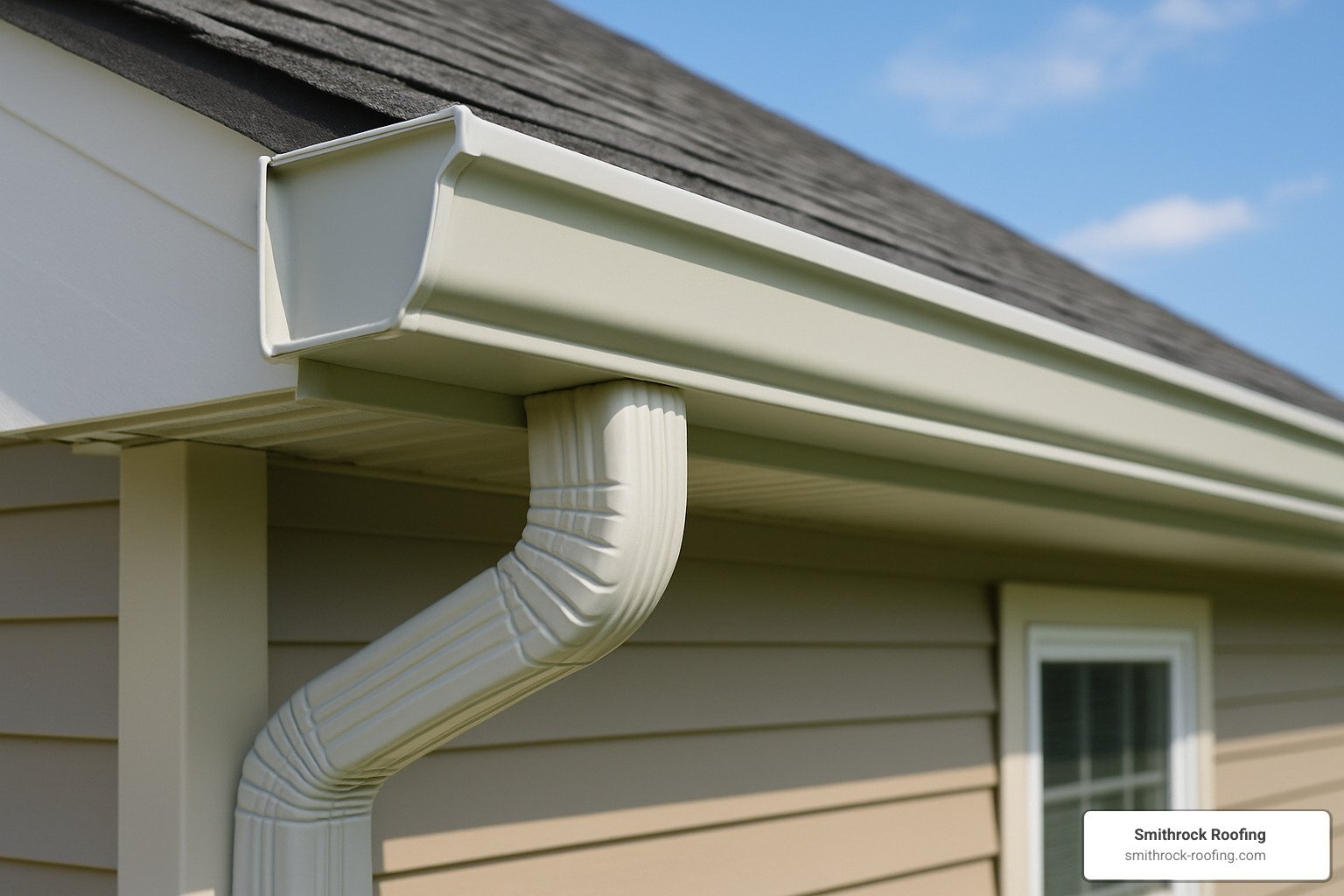
Seamless gutters are the right choice for most Winston-Salem homes, and the reasoning is straightforward: every joint in a sectional gutter system is a potential leak point. In a climate with year-round rainfall and freeze-thaw temperature cycling, those joints — sealed with caulk or snapped together with connectors — degrade over time. Seamless systems eliminate joints on the straight runs, which is where the majority of leak failures occur on sectional systems.

But seamless doesn’t mean maintenance-free, and it doesn’t mean failure-free. Understanding where seamless systems do have joints — and what happens to those joints over time — is what separates an informed homeowner from one who’s surprised by a leak five years into a new installation.

The Miter Joint: The One Place Seamless Gutters Are Never Truly Seamless

Every corner on a seamless gutter system requires a mitered joint — a fabricated corner piece sealed with gutter sealant and secured with rivets or screws. That miter joint is the single highest-stress point in the entire system, and it’s where nearly every seamless gutter failure originates.

Here’s why Winston-Salem’s climate makes this particularly important: aluminum expands and contracts with temperature at a rate of approximately 0.0000132 inches per degree Fahrenheit. Over the temperature range between a January ice storm and an August afternoon, that’s a meaningful cumulative movement on a long gutter run. That movement is absorbed by the straight runs without issue, but at a fixed corner miter, it concentrates stress directly on the sealant bead.

Gutter sealant has a service life of roughly 5 to 7 years under normal thermal cycling conditions. In Winston-Salem’s climate — where summer heat indexes regularly push into the 100s and winter temperatures drop below freezing multiple times per season — that service window should be treated as a maintenance checkpoint, not a guarantee. A miter joint that hasn’t been inspected and refreshed within that window is a candidate for a slow leak that drips directly onto the fascia board below.

Hanger Spacing and the Long-Run Problem

Proper hanger installation calls for placement every 24 inches on center. On homes with uninterrupted gutter runs of 40 feet or more — common on ranch-style and split-level homes across the Triad — spacing beyond that standard creates a span that flexes noticeably under debris load and standing water. Over time, that flex fatigues the hanger fasteners and the fascia board they’re anchored into.

Budget installations frequently use 36-inch or even 48-inch hanger spacing to reduce material and labor time. The result isn’t visible on day one, but it shows up clearly within a few years as a characteristic mid-span sag that collects standing water and debris — the opposite of what a properly pitched gutter system should do.


Fascia Board Health: The Prerequisite Conversation Most Contractors Skip

New gutters mounted to a rotting fascia board will fail. This isn’t a matter of installation quality — it’s physics. The fascia board is the structural anchor for every hanger, and if that wood has been compromised by moisture over years of inadequate drainage or previous gutter failure, the screws that secure your new hangers have nothing solid to bite into.

The typical failure timeline looks like this: a gutter that’s been leaking at a miter joint or pulling away from the fascia has been directing water onto the fascia board for months or years before it’s finally replaced. By the time the homeowner calls for new gutters, the fascia directly below that leak point has often absorbed enough moisture to begin softening. A contractor who doesn’t probe the fascia for soft spots before installation is doing the homeowner a disservice — because the new gutters will begin pulling away from that weakened anchor point within 12 to 18 months of installation.

At Smithrock Roofing, fascia assessment is part of every gutter evaluation. If we find compromised wood, we address it before a single hanger goes in. It’s a step that adds time and sometimes cost to a project, but it’s the difference between a gutter system that lasts and one that needs to be redone.


Gutter Guard Reality Check for the Piedmont Triad

Gutter guards are not a single product — they’re a category with meaningful performance differences depending on your specific conditions. Here’s an honest breakdown of how the main guard types perform in Winston-Salem’s debris and climate environment:

Gutter Guard Performance in the Winston-Salem Debris Profile

  • Micro-mesh guards
  • Strengths: Excellent at excluding large debris; performs well in low-pine-needle environments
  • Weaknesses in this region: Tannic pine needle accumulation creates a surface mat that blocks water infiltration; requires more frequent cleaning than advertised in Piedmont NC; water sheeting off dense needle mats can overshoot the gutter during heavy rain
  • Best fit: Homes with minimal pine canopy overhead and primarily deciduous tree coverage
  • Reverse-curve (surface tension) guards
  • Strengths: Handles high water volume well; no mesh to clog
  • Weaknesses in this region: Water overshoot is a documented problem on roof pitches above 6:12; seed balls and pine needles accumulate on the curved surface and require manual removal; not well-suited for steep Colonial or Craftsman rooflines common in older Winston-Salem neighborhoods
  • Best fit: Shallow-pitch roofs with moderate deciduous debris
  • Perforated aluminum covers
  • Strengths: Durable; handles leaf shedding reasonably well; lower profile option
  • Weaknesses in this region: Small perforations clog with pine needles and fine debris; sweetgum seed balls lodge in openings; cleaning requires cover removal
  • Best fit: Homes where aesthetics matter and debris volume is moderate
  • Foam and brush inserts
  • Strengths: Easy to install; inexpensive
  • Weaknesses in this region: Trap debris inside the foam or bristles; in humid NC climates, foam inserts promote mold and organic growth inside the gutter channel; not recommended for high-humidity environments
  • Best fit: Not recommended for Winston-Salem area homes
  • No guard with scheduled maintenance
  • Strengths: Full gutter access; no guard failure modes; most reliable in high-debris Piedmont environments
  • Weaknesses: Requires seasonal cleaning (typically twice annually in this region — post-fall leaf drop and post-spring pollen and seed pod season)
  • Best fit: Homes under dense mixed canopy where no single guard type performs adequately

The right answer for your home depends on what’s overhead, your roof pitch, and how you want to manage long-term maintenance. An honest contractor will walk you through those trade-offs rather than default to whatever they have in inventory. For a deeper look at how these products compare across real-world conditions, the article Gutter Guards: More Trouble Than They’re Worth? covers the trade-offs in detail.

Strategic Recommendations for 2026

As you plan your gutter project or maintenance schedule for the coming year, three specific steps will help you make the most informed decisions for your Winston-Salem home.

1. Schedule a Pre-Season Gutter Audit with a Local Contractor
Before spring pollen season hits, arrange a professional inspection of your existing gutters and downspouts. Ask the contractor to document slope inconsistencies, joint separations, and any fascia board softness behind the gutters. A written condition report gives you a baseline for comparing quotes and avoids paying for replacements that aren’t necessary yet.

2. Use the NC Forest Service Tree Canopy Map to Plan Guard Selection
The North Carolina Forest Service and local municipal GIS tools offer aerial canopy coverage data. Cross-referencing your property’s overhead canopy type — pine-heavy, mixed deciduous, sweetgum-dense — with the guard comparison above will help you narrow your options before you speak to a single salesperson. Going into that conversation with canopy knowledge removes one of the most common upselling pressure points.

3. Request a Multi-Contractor Comparison Using Identical Scope
When collecting estimates in 2026, provide each contractor with the same written scope: gutter material, gauge, profile, hanger spacing, downspout sizing, and guard type if applicable. Comparing quotes on identical specifications exposes price differences that actually matter and filters out contractors padding scope or substituting lower-grade materials.


Frequently Asked Questions

How often should gutters be cleaned in Winston-Salem, NC?

Most homes in the Winston-Salem area benefit from two cleanings per year — one after the fall leaf drop, typically in late November or early December, and one in late spring after the sweetgum seed pods, pine pollen, and oak tassels have finished falling. Homes situated directly under heavy pine or sweetgum canopy may need an additional mid-summer check, as debris accumulation in humid conditions accelerates organic breakdown and can block downspouts even between major shedding seasons.

What gutter size is best for homes in the Piedmont Triad region?

Six-inch K-style gutters are the most appropriate choice for the majority of Winston-Salem homes, particularly those with steeper rooflines, larger roof surface areas, or significant tree coverage. The Piedmont region receives enough high-intensity rainfall events that the added capacity of a six-inch profile meaningfully reduces overflow risk compared to the standard five-inch option. Downspouts should be sized to match, with three-by-four-inch or four-inch round profiles preferred over smaller alternatives.

Is seamless aluminum guttering worth it compared to sectional gutters?

For Winston-Salem homeowners, seamless aluminum gutters are generally the better long-term choice. The primary advantage is the elimination of seam joints, which are the most common failure points in sectional systems — especially given the region’s freeze-thaw cycles in winter and heavy summer rain events. Seamless gutters are fabricated on-site to the exact length of each run, which also reduces the number of end caps and connectors that can separate over time. The trade-off is that installation requires a professional with a roll-forming machine, but that is standard practice for most established local gutter contractors.

How do I know if my gutters are pulling away from the fascia?

The clearest visible signs include a gap between the back of the gutter and the fascia board, water staining or paint peeling directly behind the gutter line, and gutters that appear to sag or tilt away from the roofline when viewed from the ground. In older Winston-Salem homes with original wood fascia, rotted boards often contribute to this problem — the fasteners lose their grip as the wood deteriorates. If you notice any of these signs, the issue should be evaluated promptly, as a separated gutter during a heavy rain event can direct water directly against the foundation or into the soffit cavity.


Closing Thoughts

Gutters are one of the most consequential and most overlooked systems on a home. In a city like Winston-Salem — where mature trees, variable seasonal rainfall, and aging housing stock all converge — the decisions you make about material, profile, installation quality, and ongoing maintenance will have a direct impact on your foundation, your fascia, and your long-term repair costs. The homeowners who fare best are the ones who treat gutter work as a system decision rather than a commodity purchase.

If you’re ready to move forward with an inspection, a replacement estimate, or a conversation about what your specific property needs, we’re here to help.

Contact Us

Share:

Categories

Follow us

You can find us on Facebook, Instagram, and Google.
Smithrock Roofing LLC logo featuring stylized rooftops with chimneys and arched windows
Smithrock Roofing proudly services the cities of Winston-Salem, King, Clemmons, Lewisville, Pilot Mountain, East Bend, Mt. Airy, Kernersville, Siloam, Danbury, High Point, Trinity, Pfafftown, Tobaccoville, Greensboro, Walnut Cove, Belews Creek, Rural Hall, Pinnacle, Bethania, Advance, Wallburg, Horneytown, Union Cross, and Midway, NC.

Newsletter

Sign up to receive important tips, special offers, and discounts.

Smithrock Roofing © Copyright 2026 • All Rights Reserved • Privacy Policy • Maintained by Mongoose Digital Marketing