
If you’ve lived in High Point for any length of time, you already know the sky can go from clear to sideways rain in about twenty minutes. Summer thunderstorms roll through the Piedmont with real intensity — not the slow, soaking kind, but the kind that dumps three inches in an hour and leaves your yard standing in water. What most homeowners don’t realize is that your gutters aren’t just there to keep rain off your head when you walk out the front door. They’re the primary line of defense between that storm and your foundation, your crawl space, and the structural integrity of your home.
Here’s the part no one in the gutter industry seems to want to talk about: where you live changes what a gutter failure actually means. A poorly maintained gutter system in High Point carries risks that are measurably different — and more serious — than the same system in coastal North Carolina. The reason comes down to the ground beneath your feet. And once you understand that, every decision about gutter size, downspout placement, and seasonal maintenance starts to make a lot more sense.
At Smithrock Roofing, we’ve been serving homeowners across the NC Triad — High Point, Greensboro, Winston-Salem, Kernersville, Clemmons, Rural Hall, King, and the surrounding communities — for decades. We’ve seen what happens when gutters are sized wrong, installed on compromised fascia, or simply neglected during the wrong season. This guide gives you the honest, technical picture so you can make informed decisions about protecting your home.
High Point sits squarely on Piedmont red clay soil — one of the least permeable soil types in the entire Southeast. If you’ve ever tried to dig a garden bed after a rain and pulled up heavy, reddish clumps that hold their shape like modeling clay, you’ve met it firsthand.
Clay soil has a very slow infiltration rate. When water hits it, especially in volume, it doesn’t absorb quickly. It pools, it runs, and it presses laterally against whatever is in its path. For a home’s foundation, that means hydrostatic pressure — water pushing sideways against your foundation walls.
This is categorically different from what happens in, say, the Sandhills region of NC, where sandy soils absorb water relatively quickly and allow it to drain away from the structure. In High Point’s Piedmont clay environment, a two-inch gutter overflow event doesn’t just make a muddy mess in your flower bed. That water saturates against your foundation and stays there.
When gutters overflow, back up, or direct water too close to the house, several compounding problems follow:
This is why downspout extensions of at least 6 feet from the foundation aren’t a sales upgrade in High Point — they’re a genuine functional requirement driven by what’s in the ground. Many homes we inspect have downspouts terminating 12 to 18 inches from the foundation wall. On a sandy lot, that might be manageable. On Piedmont clay, it’s quietly causing damage that won’t show up until it’s expensive to fix. For a deeper look at how to redirect that discharge effectively, the article Bury Your Downspouts: Keep Your Foundation Dry and Your Yard Tidy walks through the options in detail.

Every gutter company will tell you that 6-inch gutters hold more water than 5-inch gutters. That’s true. But it doesn’t tell you when you actually need them — or why. Here’s the framework that matters.
A gutter’s required drainage capacity is determined by two variables: the drainage area of the roof surface it serves, and the rainfall intensity of the region. These two numbers together tell you what volume of water your gutter must move per minute during a peak storm event.
In High Point, peak summer thunderstorms regularly deliver 3 to 4 or more inches of rain per hour. The NOAA precipitation frequency data for North Carolina documents this intensity range for the Piedmont region. That’s the baseline your gutters need to handle — not a slow spring rain, but an aggressive July storm coming off the Blue Ridge corridor.
Roof pitch changes the effective drainage area a gutter must handle. A steeper pitch means water moves faster and in greater concentrated volume to the eaves — which means a roof with a 9:12 pitch is functionally dumping more water per minute on a gutter than a 4:12 pitch of identical square footage.
The general thresholds worth understanding:
| Roof Pitch | Adjustment Factor | Practical Implication |
|---|---|---|
| Up to 6:12 | 1.0x (standard) | Standard drainage area calculation applies |
| 7:12 – 8:12 | 1.05x–1.1x | Approaching the threshold for sizing up |
| 9:12 – 11:12 | 1.2x | Functionally increases drainage load by 20% — 5-inch gutters on large planes are often undersized |
| 12:12 and above | 1.3x+ | 6-inch gutters become a functional requirement, not an upgrade |
What this means for High Point homeowners specifically:
Gutter capacity isn’t just about the channel width. It’s also about how many outlets are moving water out. The industry standard is one downspout per 35 to 40 linear feet of gutter run. A 60-foot gutter run with a single downspout at one end will overflow at the far end in heavy rain, regardless of whether it’s a 5-inch or 6-inch profile — the water simply can’t travel fast enough to exit through one outlet.
When you’re reviewing a gutter estimate, counting the downspouts relative to the total linear footage is one of the clearest ways to evaluate whether you’re getting a properly engineered installation or a minimum-cost job.
Gutters aren’t installed perfectly level. They’re installed with a slight slope — typically ¼ inch of drop per 10 linear feet — angled toward the downspout. This slope is what keeps water moving rather than pooling.
Too little slope and water sits in the gutter channel. Standing water accelerates corrosion, creates breeding conditions for mosquitoes, and adds weight stress to the hangers. Too much slope and the gutter visibly sags or pitches in a way that’s both aesthetically off-putting and potentially problematic for water adhesion at the eaves.
This is one of the quality indicators that’s invisible at a glance but completely determinant for how well a gutter system performs over its lifespan. A properly installed gutter drains completely after every rain event. A gutter with inadequate slope holds water after every storm.
Seamless gutters aren’t better just because they have fewer joints. They’re better because seams are the primary failure point in any gutter system. Here’s why:
Seamless gutters are custom-fabricated on-site to the exact length of each eave run, eliminating interior joints entirely. The only seams present are at corners and downspout outlets — both necessary connection points, but far fewer in number than a sectional system.
Many of High Point’s established neighborhoods — particularly those near the Furniture Market district and the older residential areas surrounding downtown — were built between the 1940s and 1970s. These homes have significant character and craftsmanship, but they also carry a specific gutter vulnerability that newer construction doesn’t face in the same way.
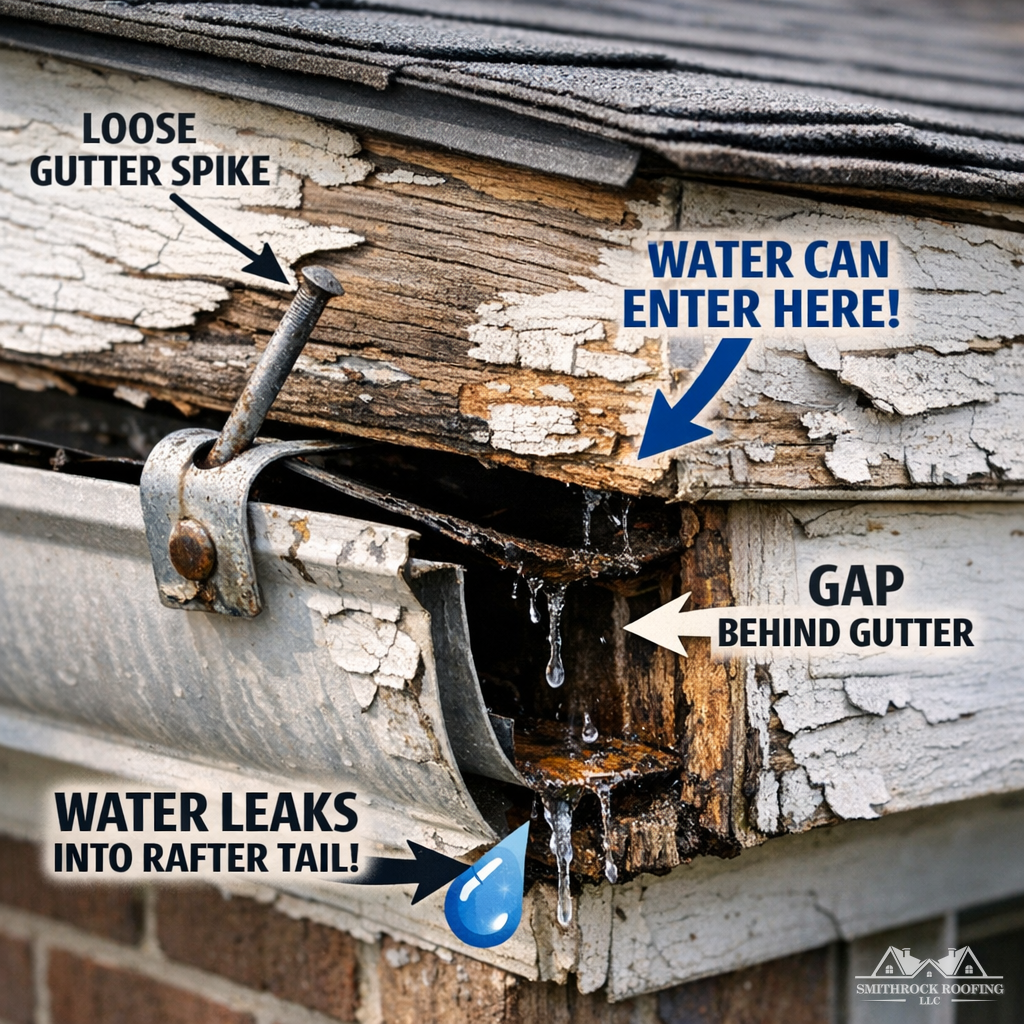
Original fascia boards in these homes are wood, not aluminum-wrapped composite. Decades of exposure mean many of these boards have experienced repeated wet/dry cycles, and wood that looks structurally sound from street level can be soft or compromised at the point where gutter hangers attach.
The original hanger style used on most of these homes was the spike-and-ferrule system — a long aluminum spike driven through the front of the gutter and into the fascia. Over time, this system is prone to pulling away from the wood, especially as the fascia softens or as freeze-thaw cycling works the spike loose. When a gutter begins to pull away from the fascia, even slightly, it creates an opening that channels water directly into the rafter tails — a damage pathway that can go undetected for years.
Before any gutter installation or replacement in older High Point neighborhoods, the fascia board condition should be assessed by the contractor. Specifically:
Installing new gutters on rotted or soft fascia is one of the most common avoidable failures we see in established neighborhoods. The gutters may look perfect on day one and begin separating within a season or two because the attachment point was never sound to begin with. The article DIY Fascia and Soffit Repair: Fix It Before Your House Notices covers what to look for and when a repair is warranted before new gutters go up.
This same logic applies to homes from the 1980s and 1990s on High Point’s western side, where vinyl-wrapped fascia was common. Vinyl wrapping can mask moisture infiltration behind the cover — the exterior looks clean while the wood underneath is actively deteriorating. A contractor who doesn’t pull back or probe behind visible vinyl before attaching new gutters is skipping a step that matters.
Gutter guards are often sold as a complete maintenance solution — install them once and forget about your gutters entirely. The reality is more conditional than that, and High Point homeowners deserve a straight answer.
Guard performance depends on three variables working together: roof pitch, debris type, and rainfall intensity. In the Triad, all three create conditions where guard selection genuinely matters:
No guard system eliminates maintenance entirely. The honest claim is that a well-matched guard system, correctly installed for your specific roof pitch and local debris profile, reduces the frequency of cleaning — typically from twice per year to every two to three years for most High Point homes. That’s a genuine benefit. But it should be framed accurately, not oversold. For a full breakdown of what different guard systems actually cost and deliver, see the article Protect Your Home: A High Point Guide to Gutter Guard Solutions.
Generic advice says “clean your gutters twice a year.” That’s not wrong, but it’s not specific enough to be genuinely useful for a High Point homeowner.
October through December — The Most Important Cleaning Window
High Point’s hardwood canopy — oaks, sweetgums, maples, and similar species — drops the bulk of its leaf load between mid-October and late November. This is the single most important cleaning window of the year. Gutters that enter December full of compacted leaf matter are gutters that will back up under winter rain events and, in the event of a freezing rain, form ice dams that add significant weight and can pull hangers loose.
Complete this cleaning after the majority of leaf drop is finished — typically late November to early December — so you’re not cleaning around actively falling debris.
March through April — The Overlooked Spring Window
Spring brings a second major debris cycle that many High Point homeowners miss entirely. Sweetgum seed pods, oak catkins, and pine pollen and seed cones fall heavily through March and April. This material is particularly problematic because it’s smaller and denser than fall leaves — it compacts in gutter channels and can form a paste-like mat when wet that resists flushing.
A spring cleaning in this window keeps gutters performing correctly through the peak summer thunderstorm season, which is exactly when you need full drainage capacity available.
During any cleaning, run water through each downspout from the top and confirm it exits freely at the bottom. A downspout that backs up or drains slowly has an obstruction — often debris that has passed through the gutter channel and compacted at an elbow joint. This is one of the most common causes of gutter overflow that isn’t caused by a clogged gutter channel itself.
Homeowners across High Point, Greensboro, Winston-Salem, Kernersville, and the surrounding Triad communities have options when it comes to gutter contractors. Here’s a practical checklist for evaluating any estimate or contractor:
At Smithrock Roofing, our approach to gutters reflects the same standards we apply to every exterior service — honest assessment, quality materials, and work that holds up over the long term. We’re fully licensed and insured, carry an A+ BBB rating, and have 312+ five-star reviews from homeowners across the Triad. When we look at your home’s gutter needs, we’re looking at the whole picture: your roof pitch, your fascia condition, your lot’s drainage characteristics, and the specific pressures that High Point’s climate and soil put on exterior systems.
For more on the relationship between your roof and your gutters — including how roofing material and slope interact with drainage — see our roofing services. And if you’re evaluating the full exterior picture, our gutters service page covers the systems and materials we work with in detail.
If you’re ready to have someone take an honest look at your gutters — whether you’re in a 1950s ranch near downtown High Point or a newer build on the west side — reach out to Smithrock Roofing for a free inspection. We’ll tell you what we find, explain what it means, and give you a clear path forward without any pressure. That’s how we’ve built our reputation across the NC Triad, and it’s the only way we know how to work.
As you plan ahead for your home’s exterior maintenance, here are three specific steps worth prioritizing in the coming year:
1. Schedule a Post-Winter Gutter Inspection Before Spring Rain Season
High Point’s winters bring freeze-thaw cycles that stress hanger connections, loosen seams, and accelerate fascia deterioration behind the gutter bracket. By scheduling an inspection in late February or early March — before the heavy spring rainfall arrives — you catch any damage before it compounds. A contractor who knows the Triad’s seasonal rhythm will know exactly what to look for.
2. Evaluate Your Downspout Discharge and Grading Together
With High Point’s clay-heavy soil, water that pools near the foundation doesn’t absorb — it sits and pressures. In 2026, consider having your gutter discharge points evaluated alongside your lot’s grading. This isn’t just a gutter conversation; it’s a foundation protection conversation. Extensions, buried drain lines, or splash block repositioning may be simple adjustments that prevent significant long-term problems.
3. Document Your Gutter System’s Current Condition with Photos
Before any storm season, walk your roofline and photograph your gutters, downspout connections, and fascia boards. This documentation gives you a before-and-after baseline, supports any insurance conversations after storm events, and helps a contractor understand your system’s history before they ever arrive on site.
Most homes in High Point benefit from gutter cleaning at least twice a year — once in late fall after the leaves have dropped, and once in early spring before peak rain season. Homes situated near mature hardwoods, which are common in established High Point neighborhoods, may need a third cleaning in late spring when seed pods and small debris fall heavily. Clogged gutters in this region are a leading cause of fascia rot and foundation drainage issues, so consistency matters more than most homeowners realize.
The right gutter size depends on your roof’s square footage, pitch, and the volume of water it sheds during High Point’s heavier rain events. Standard five-inch gutters work for many homes, but steeper roofs and larger drainage areas — particularly on two-story homes — often require six-inch gutters to handle peak flow without overflowing. A proper assessment looks at your specific roof, not just a default recommendation, which is why an on-site evaluation is more useful than a general answer.
Most older homes in High Point were installed with spike-and-ferrule gutter systems, where long nails were driven through the gutter face into the fascia. Over time — especially with the weight of water, debris, and seasonal temperature swings — those spikes loosen and pull out. The more durable solution is hidden hanger screws, which grip the fascia more securely and distribute load better. If your gutters are sagging or separating from the roofline, the fastener system is often the root cause rather than the gutter itself.
Yes. Smithrock Roofing provides both roofing and gutter services throughout the High Point area and across the NC Triad. Because gutters and roofing systems are directly connected — drainage problems at the gutter level affect roof edges, fascia, and soffit — having one contractor evaluate both often surfaces issues that a gutter-only or roofing-only specialist might miss. It also simplifies the process for homeowners who want a single point of accountability for their exterior.
Smithrock Roofing has built its reputation across Winston-Salem, Greensboro, High Point, and Kernersville by doing the work honestly and standing behind it — and that standard applies whether we’re replacing a roof or righting a gutter system that’s been quietly failing for years. If you’re in High Point and you’re not sure whether your gutters are doing their job, the most useful thing you can do is have someone take a clear-eyed look before the next heavy rain makes the answer obvious. Get a Free Estimate and let us show you what we find — no pressure, just an honest assessment from a team that knows this region and takes the work seriously.

Smithrock Roofing © Copyright 2026 • All Rights Reserved • Privacy Policy • Maintained by Mongoose Digital Marketing