If you’ve ever requested quotes from two different roofing contractors and come back with numbers that looked like they were describing completely different projects, you’re not imagining things. Roofing cost is one of the most misunderstood topics in home improvement — not because it’s inherently complicated, but because most of the information available to homeowners stops at the surface.
Most guides will hand you a table of materials, tell you labor runs a certain percentage of total cost, and send you on your way. What they won’t tell you is why two qualified contractors can look at the same 2,000-square-foot roof in Kernersville and walk away with fundamentally different scopes of work, different warranty structures, and different total project values. That gap in explanation is exactly where homeowners lose money, make decisions they later regret, or end up in disputes mid-project.
This guide is built differently. We’re going to walk through the real architecture of roofing cost — the factors that are visible before work begins, the ones that only surface during tear-off, and the long-term financial considerations that most homeowners never think to ask about until it’s too late.
Whether you’re in Winston-Salem, Greensboro, High Point, Clemmons, King, Rural Hall, or anywhere across the NC Triad, the fundamentals here apply directly to your situation — including the regional climate factors that make some roofing decisions here different from what you’d read in a generic national guide.
Here’s something most homeowners don’t realize: a roofing estimate is not a simple measurement exercise. It is a business document that reflects not only the materials and labor required for your specific roof, but also the overhead structure, capacity situation, and risk tolerance of the company producing it.
When an experienced contractor assesses your roof, they’re calculating several distinct cost layers simultaneously:
Direct material costs — the shingles, underlayment, flashing, ridge caps, ventilation components, and accessories. These are calculable from your roof’s square footage and complexity, but the material tier selected (entry-level vs. premium certified systems) significantly affects this number.
Labor costs — which are far more variable than most guides suggest. We’ll dig into this shortly.
Overhead recovery — every legitimate contractor operates with fixed business costs: insurance, licensing, equipment maintenance, crew vehicles, administrative staff, and warranty administration. These costs are distributed across every job. A company with higher overhead structures its prices differently from a one-person operation, and that difference reflects real differences in accountability, coverage, and professionalism.
Contingency margin — this is where experience shows. Contractors who have been around long enough know that certain roof types, certain neighborhoods, and certain home ages are more likely to produce post-tear-off surprises. An experienced contractor builds a reasonable contingency buffer into the scope-of-work language and sometimes into the price. An inexperienced one quotes lean and renegotiates after the decking is exposed.
Profit margin — a legitimate business needs a margin to stay in business, to maintain quality crews, and to honor warranties years after your project is complete. A contractor with suspiciously low margins is either cutting corners on materials, underpaying labor, or planning to renegotiate mid-project.
This is the question homeowners ask constantly, and it almost never gets a straight answer. Here are the most common legitimate reasons:
Roofing contractor pricing is not static. It responds to how busy a contractor is when they’re quoting your job. A contractor at near-full capacity has little incentive to sharpen their pencil — they have work. A contractor between projects has more motivation to price competitively to keep their crew productive.
This doesn’t mean you should exclusively chase slow contractors. Busyness is often a signal of quality and reputation. But it does mean that when you request quotes matters. Spring and early summer tend to be peak demand periods across the Triad, particularly after winter weather events. Requesting quotes in late summer or fall — or during slower weather periods — can shift the competitive dynamics in your favor without compromising on quality.
A useful question to ask any contractor during the quote process: “What does your current scheduling window look like?” Their answer tells you something about both their capacity and their transparency.
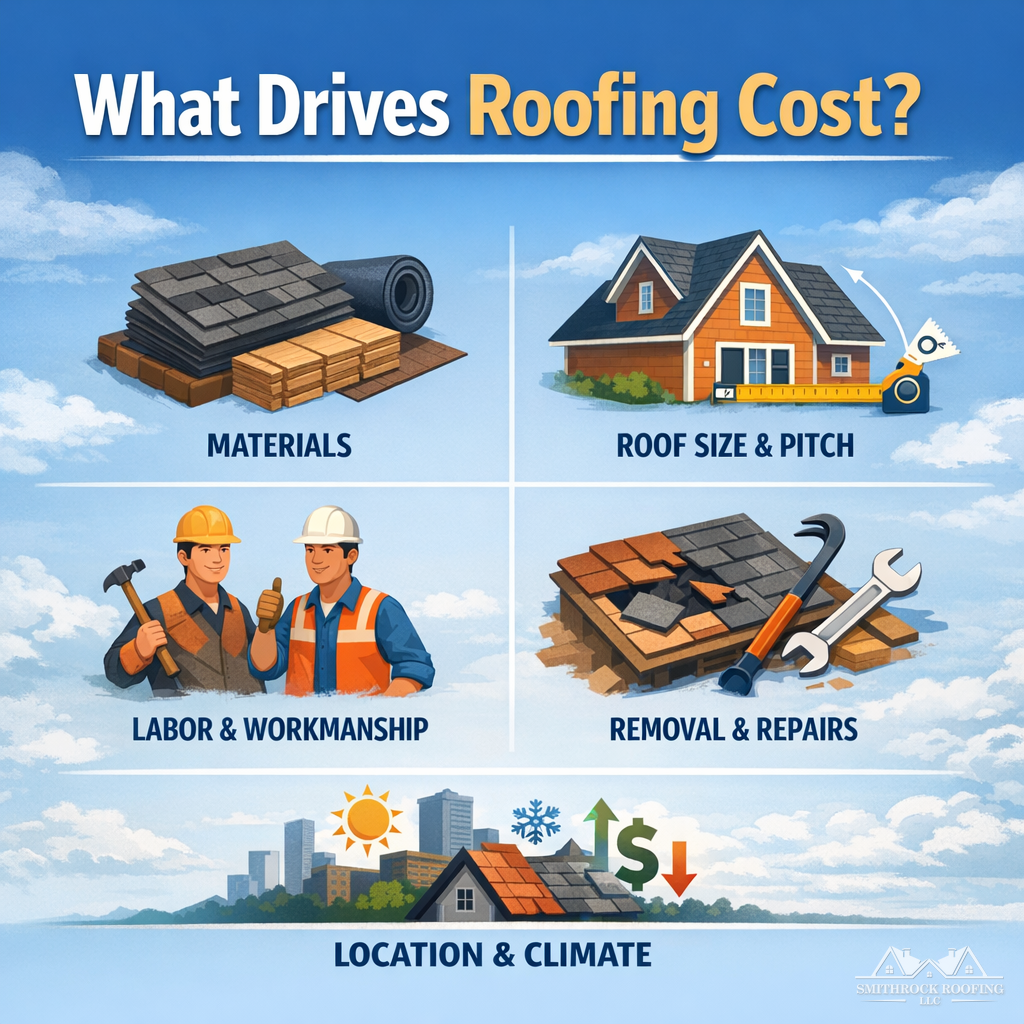
Roofing is priced by the “square” — a standard unit equal to 100 square feet of roof surface. This is not the same as your home’s footprint. Your actual roof surface is always larger because of pitch (slope), overhangs, and the geometry of multiple planes intersecting. A steeper roof means more surface area relative to your floor plan, and more surface area means more materials and more labor.
Waste factor also increases with complexity. A simple gable roof has minimal cutting waste. A roof with multiple hips, valleys, dormers, and angles requires more cuts, more fitted pieces, and more material to account for offcuts. Estimating waste accurately is a skill — and undercounting it is one of the ways low-ball quotes fall apart in the field.
Competitors consistently describe pitch as a cost adder: “steeper roofs cost more.” This is accurate but dramatically incomplete.
Pitch affects multiple dimensions of a project simultaneously:
For homeowners across the Triad with older two-story colonials or homes with complex rooflines — common in established Winston-Salem and Greensboro neighborhoods — pitch and complexity factors can be more significant than the base roof area suggests.
Most cost comparisons present material choices as a simple sticker-price exercise: material A costs less per square than material B. This framing is misleading because it ignores the total cost of ownership — the relationship between initial investment, expected lifespan, maintenance frequency, energy performance, and insurance implications.
Here’s a structured comparison of common roofing material categories on the dimensions that actually matter for long-term decision-making:
| Material Type | Typical Lifespan | Maintenance Requirements | Energy Performance | Impact Resistance Options | Notes for NC Triad Climate |
|---|---|---|---|---|---|
| Standard 3-tab asphalt | Shorter lifespan | Low maintenance but limited durability | Standard | Limited | Less suited to high-wind events; diminishing availability as architectural shingles dominate |
| Architectural (dimensional) asphalt | Mid-to-long lifespan | Low maintenance, good durability | Standard to moderate | Available in Class 3 and Class 4 ratings | Well-suited to Triad climate; dominant residential choice; manufacturer system warranties available |
| Premium designer asphalt | Long lifespan | Low maintenance, excellent durability | Moderate improvement | Class 4 commonly available | Best warranty tier access; visual range from wood shake to slate appearance |
| Metal (standing seam) | Very long lifespan | Very low maintenance | Strong energy performance | Excellent wind and impact resistance | Higher initial investment offset by longevity; increasingly popular in Triad new construction and re-roof |
| Metal (exposed fastener/ribbed) | Long lifespan | Low maintenance | Good energy performance | Good impact resistance | Lower entry point than standing seam; fastener maintenance matters over time |
| Natural slate | Exceptionally long lifespan | Moderate; periodic inspection and spot repair | Good thermal mass properties | Excellent hail resistance | Structural load requirements must be verified; specialized installation required |
| Concrete/clay tile | Very long lifespan | Low maintenance, periodic inspection | Good in warm climates | Good impact resistance | Structural load verification essential; less common in Triad residential market |
| Cedar shake/wood | Moderate lifespan with proper treatment | Higher maintenance; periodic treatment required | Moderate insulating properties | Moderate | Moisture management critical in NC humidity; fire rating must be verified |
The critical insight here is that a material with a higher initial cost but a significantly longer lifespan may produce a lower cost-per-year of service. When you layer in the warranty value, the insurance discount potential from impact-resistant ratings, and the reduced frequency of replacement, the “cheaper” option is often more expensive over time. For a deeper look at how these materials stack up specifically for homes in this region, the article on best roofing materials for Winston-Salem homes covers the tradeoffs in detail.
This is a factor that virtually every roofing cost guide ignores entirely, and it’s a genuine financial consideration for homeowners across the NC Triad.
Impact-resistant shingles carry standardized ratings (Class 3 and Class 4) that many homeowner’s insurance carriers recognize when calculating premiums. In areas with documented hail and wind exposure — and the Triad sits in a region that sees both — choosing a Class 4 impact-resistant shingle can produce meaningful reductions in your annual insurance premium. Depending on your carrier and policy, this discount can substantially offset the difference between a standard shingle and a premium impact-resistant product over the policy life.
Before finalizing your material selection, contact your insurance agent and ask specifically: “Do you offer a premium discount for Class 3 or Class 4 impact-resistant roofing?” The answer should inform your material decision as part of a complete financial picture.
“Labor is approximately 60% of roofing cost” is the most repeated statistic in every competitor’s article, and it’s also one of the least useful without context.
Labor cost on a roofing project is driven by a set of real-world variables that deserve direct explanation:
Crew composition and skill level. A crew with certified installers working under an experienced foreman installs differently — and more accurately — than a day-labor crew. Certification programs exist specifically because manufacturer warranty systems require installation precision: proper fastener placement, correct exposure, specific starter strip installation, and accessory product sequencing. Labor that cuts corners on these specifications may void the very warranty you’re paying for.
Seasonal demand cycles. In the NC Triad, peak roofing demand typically follows storm seasons and favorable weather windows. Spring and early fall are high-demand periods. High demand compresses scheduling availability and reduces the competitive pressure on labor pricing. Homeowners who can plan projects outside peak demand windows — or who address issues proactively rather than reactively after storm seasons — have more negotiating latitude.
Project complexity and non-standard conditions. Labor hours per square are not constant across roof types. A simple gable roof on a single-story rancher is the fastest job a roofing crew will run. A complex multi-plane roof on a two-story home with multiple chimneys, skylights, and dormers — common in many of Greensboro and Winston-Salem’s established neighborhoods — involves significantly more setup, precision, and time per square installed.
Tear-off layer count. This is one of the most under-discussed labor variables.
Every roofing guide mentions tear-off as a cost line item. Almost none of them explain the difference between tearing off one layer of shingles and tearing off two or three.
Many homes across the Triad — particularly those built in the 1980s and 1990s that are now on their second or third roof — have multiple layers of roofing material stacked on the decking. Some jurisdictions allowed this as standard practice for decades. Here’s why it matters significantly for cost:
If your home has had previous re-roofs without full tear-off, this should be part of your pre-project conversation with every contractor you consult.
This is the single most financially consequential piece of information a homeowner can have before starting a roofing project, and it is almost entirely absent from competitor content.
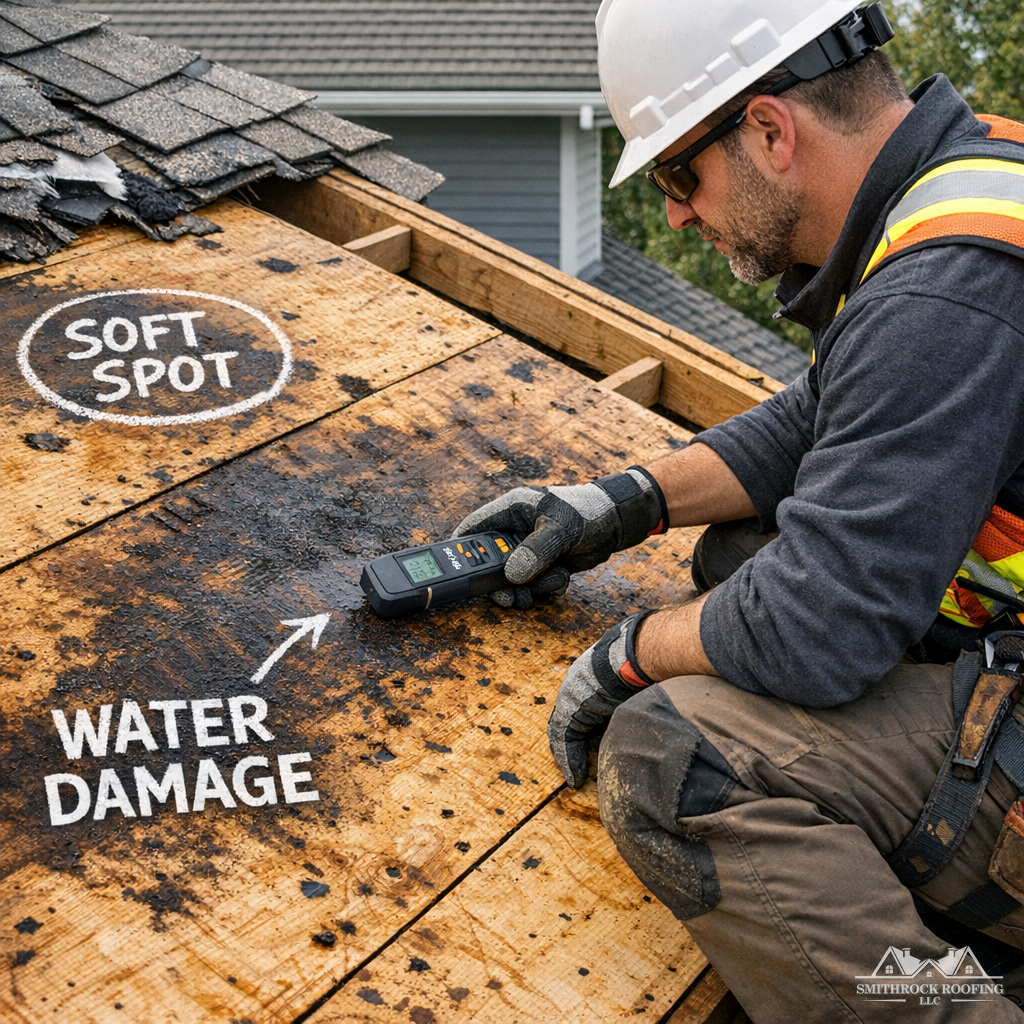
Once your existing roofing material is removed, the project enters what experienced contractors call the point of no return — not because anything goes wrong, but because what’s discovered at that moment must be addressed before re-roofing can proceed.
Common post-tear-off discoveries include:
Here is the critical dynamic: once the tear-off begins, the homeowner has no leverage over these discoveries. The roof is open. Materials are in the dumpster. Work must continue. A homeowner who didn’t discuss this scenario in advance can find themselves facing unexpected scope and cost additions with no time to get competitive bids.
A qualified contractor should perform a thorough pre-tear-off inspection that includes:
Beyond the inspection, your contract should include specific language addressing what happens when post-tear-off discoveries occur: what conditions trigger additional scope, how additional materials are priced, and what your approval process is before that additional work proceeds. A reputable contractor will not be threatened by this conversation. They’ll welcome it, because it protects both parties.
Ask most homeowners what roofing warranty they received, and they’ll name a single number — “30 years” or “lifetime.” In reality, that’s an incomplete picture of what they have, and understanding the complete warranty structure is essential to making an informed material and contractor selection.
Layer 1: Material warranty. This covers manufacturing defects in the shingles themselves. It’s provided by the manufacturer and available on products installed by any contractor. This is the most basic coverage tier.
Layer 2: System warranty. This is the coverage tier most homeowners don’t know exists. Manufacturers like CertainTeed offer enhanced system-level warranties that cover the entire installed roofing system — including underlayment, starter strips, ridge caps, and ventilation components — when specific accessory products are used together and installed by a manufacturer-certified contractor. If any required component is substituted or if the contractor is not certified, the system warranty is not available. Period.
Layer 3: Workmanship warranty. This is provided by the contractor and covers installation errors — things like improper fastener placement, missed flashing details, or incorrect exposure that lead to failure. The value of this warranty is entirely dependent on the contractor still being in business and honoring it when you need it. Five years is a meaningful workmanship warranty period from an established local company. A one-year warranty from a contractor who may not be in business next spring is worth very little.
When a contractor holds manufacturer certification — like Smithrock Roofing’s CertainTeed PREMIER ShingleMark Master Certification — they have demonstrated installation standards that qualify their customers for enhanced system warranty coverage. That coverage can include non-prorated lifetime material coverage, wind speed coverage, and, in some programs, coverage that transfers to the next homeowner if you sell. You can learn more about what these coverage tiers include on our Warranty page.
A non-certified contractor may install the same brand of shingle, but the system warranty is simply not available to their customers. This is a long-term financial difference that is completely invisible on the day of installation and only becomes visible when a claim arises years later.
When comparing quotes, ask every contractor directly: “What manufacturer warranty tier will my installation qualify for, and are you certified by that manufacturer to deliver it?” The answer will tell you a great deal.
Permits are mentioned in virtually every roofing cost guide. What’s almost never explained is why they matter beyond the day of installation.
Building permit requirements for roofing replacements vary by municipality. Winston-Salem, Greensboro, High Point, and the surrounding Triad municipalities each operate under North Carolina’s state building code with local amendments. In most jurisdictions, a full roof replacement requires a permit, which triggers an inspection — typically at completion — to confirm that installation meets current code requirements.
Current code requirements may differ from what was required when your roof was originally installed. This means a mid-project code upgrade isn’t a surprise penalty; it’s the legitimate process of bringing your home’s roof into compliance with updated standards that exist for your protection.
An unpermitted roof replacement creates real downstream problems that homeowners rarely anticipate when they’re accepting the “no permit needed” pitch from a contractor:
A contractor who suggests skipping permits to save money is asking you to accept a risk that accrues entirely to you, not to them.
Collecting multiple quotes is standard advice. What almost no one explains is that collecting multiple quotes without a structured comparison framework produces misleading results.
Three quotes for the same roof that haven’t been normalized to the same scope are three quotes for three different projects. Before comparing numbers, confirm that each contractor’s proposal addresses the same items:
A quote that looks competitive but excludes several of these items is not a lower price. It’s a different — and incomplete — scope of work.
National roofing guides treat geography as a footnote. For homeowners across Winston-Salem, Greensboro, High Point, Clemmons, Kernersville, King, and Rural Hall, local conditions are genuinely relevant to how your roof is specified and installed.
The NC Triad sits in a climate zone that delivers real thermal cycling — cold winter temperatures and humid summers — combined with periodic severe weather events including hail and high-wind thunderstorms. Ice damming, while less frequent here than in northern markets, does occur during hard freeze cycles and is something proper ice and water shield installation addresses directly.
Local contractors who have worked this market for years understand which product specifications perform reliably in this climate, which neighborhoods have common structural characteristics, and what local inspectors look for. That knowledge isn’t available in a national guide, and it’s not something a contractor from outside the region will bring with them.
When you work with an established Triad roofing company that carries 60-plus combined years of experience across these communities, you’re getting specification decisions informed by years of watching how products perform in this specific climate — not just what a product brochure says. You can learn more about our team, history, and why that depth of local experience shapes every project we take on.
Understanding roofing cost means understanding that the number on a proposal is the output of many variables — some visible before work begins, some only revealed during tear-off, and some that play out over years through warranty claims, insurance interactions, and home sale transactions.
The homeowners who make the best roofing decisions are the ones who:
Roofing is one of the most significant investments in the long-term health of your home. It deserves the same informed, systematic approach you’d bring to any major financial decision.
If you’re a homeowner across the NC Triad ready to get a straight-talking, no-pressure assessment of your roof’s condition and what a properly scoped replacement would actually involve, Smithrock Roofing is here for that conversation.
Before you commit to any roofing contract, these three steps can meaningfully improve your outcome:
1. Request a Pre-Proposal Attic Inspection
Most roofing estimates are generated from the exterior only. In 2026, make it standard practice to ask any contractor you’re seriously considering to assess your attic before finalizing a scope. Ventilation deficiencies, decking condition, and insulation gaps all affect what a proper replacement actually requires — and none of that is visible from a ladder on your gutterline.
2. Use the Insurance Supplementing Process as a Vetting Tool
If your replacement is insurance-related, ask each contractor directly: do you handle the supplementing process, or do you hand the file back to me after initial approval? A contractor who manages supplement negotiations on your behalf — line by line, with your adjuster — signals a level of claims experience that separates serious operators from volume-focused outfits chasing storm work.
3. Verify Manufacturer Certification Before You Sign
Before executing any contract, go directly to the manufacturer’s website and confirm that your contractor holds an active certified installer designation. This single step costs you nothing and protects you from scenarios where the warranty coverage you believe you’re purchasing doesn’t actually materialize — because the contractor applying the materials was never eligible to issue it.
The honest answer depends on factors that aren’t visible from the ground. Age of the existing system, the extent of damaged or missing shingles, the condition of the decking beneath, and whether previous repairs have compromised the underlying structure all factor into that determination. A qualified local contractor should be willing to get on the roof, check the attic, and give you a clear explanation of what they found — not just a recommendation to replace everything. Be cautious of any contractor who recommends full replacement before they’ve done a thorough inspection. The article on roof repair vs. replacement in Winston-Salem breaks down exactly how to think through that decision.
Proposals that look like they’re quoting the same job often aren’t. Differences in decking replacement assumptions, underlayment specifications, ice and water shield coverage, ventilation components, and warranty tier all affect the final scope — and most of those variables are buried in the fine print or simply absent from lower bids. Before comparing numbers, ask each contractor to identify exactly what’s included line by line. When proposals are normalized to the same scope, the variation between legitimate contractors tends to narrow considerably.
In many cases, yes — particularly when you’re replacing an aging system with a new one, or when you upgrade to impact-resistant materials that carry a recognized rating. The outcome depends on your carrier, your current policy structure, and the specific product installed. The right approach is to contact your insurance agent before finalizing your material selection, ask directly what credit or rating change a particular product might generate, and factor that into your total cost evaluation. Some homeowners find that the long-term insurance impact changes which material tier makes the most financial sense.
Start with the fundamentals: Are you licensed and insured in North Carolina? Will you pull the permit for this project? What manufacturer certification do you hold, and can I verify it? Who will actually be performing the work — your own crew or a subcontractor? How do you handle decking damage discovered during tear-off, and what documentation will I receive? A contractor who answers these questions directly and without hesitation is demonstrating the kind of operational transparency that tends to predict a well-managed project.
Homeowners in Winston-Salem and across the broader Triad deserve roofing guidance that’s grounded in how this specific market works — not templated advice that ignores local climate patterns, code requirements, and the contractor landscape you’re actually navigating. Smithrock Roofing brings over 60 combined years of experience serving Greensboro, High Point, Kernersville, and the surrounding communities, and that local depth is exactly what shows up in how we assess your roof, scope your project, and stand behind the work after it’s done. If you’re ready for a straightforward conversation about your roof’s condition and what a properly executed replacement actually involves, we’re ready to have it. Contact Smithrock Roofing to schedule your free estimate today.

Smithrock Roofing © Copyright 2026 • All Rights Reserved • Privacy Policy • Maintained by Mongoose Digital Marketing