
Most homeowners don’t think about their gutters until something goes wrong. A waterfall cascading over the front edge during a rainstorm. Paint peeling off the fascia. A muddy trench forming along the foundation. By the time these signs appear, the damage is already in motion.
The problem is that when homeowners in Winston-Salem, Greensboro, High Point, and the surrounding Triad communities finally do call a contractor, they’re often told they need a full replacement — with no explanation of why, no assessment of what led to the failure, and no honest conversation about whether repairs might have been sufficient.
That’s not how we operate at Smithrock Roofing.
This guide is built around one goal: helping you make an informed decision about your gutters before you spend a dime. We’ll walk through a genuine inspection process, explain what’s happening structurally behind your gutters, and give you the technical context that most contractors in this market simply won’t share. If replacement is the right call, you’ll understand exactly why. If it isn’t, we’ll tell you that too.
Before you evaluate your gutters, it helps to understand what they’re actually up against here in the Piedmont.
Winston-Salem receives approximately 45 to 47 inches of rainfall per year — meaningfully above the national average of around 38 inches. That alone puts more cumulative stress on gutter systems than most homeowners realize. But the type of rainfall matters as much as the total volume.
The Piedmont region experiences intense convective storm events — short-duration, high-intensity bursts common in late spring and summer. These aren’t slow, steady soaks. They’re events where several inches of rain can fall within an hour, sending massive volumes of water off your roof in a very compressed timeframe. This is a fundamentally different hydraulic challenge than what homeowners face in drier climates or on the Pacific coast.
Then factor in winter. Winston-Salem sits in a transitional precipitation zone — not quite the deep South, not quite the mountains. Ice storms and freezing rain events are a regular part of the seasonal pattern. Ice loading applies asymmetric stress to gutter systems that are already dealing with leaf and debris accumulation from the region’s significant tree cover, including the loblolly pines that dominate many Triad neighborhoods.
Add the NC Piedmont’s characteristic humidity, which accelerates corrosion and wood decay, and you have an environment that genuinely shortens gutter lifespans compared to more temperate regions — especially when the original installation wasn’t sized or anchored correctly for local conditions.

Here’s a question that almost no contractor in this market will raise unprompted: Are your gutters actually the right size for your roof?
The majority of older homes across Winston-Salem, Clemmons, Kernersville, and surrounding communities were built with 4-inch or 5-inch gutters. When those homes were constructed, that sizing was standard. The problem is that sizing standards were developed without accounting for the intense convective rainfall patterns common to the NC Piedmont, and they don’t account for roof-specific variables.
The amount of water your gutters need to handle depends on three factors working together:
A home with a moderately steep roof and large drainage planes can easily overload a 5-inch gutter during a Piedmont convective event, sending water sheeting over the front edge and straight down alongside the foundation. When homeowners see this happen and assume the gutter is “overflowing because it’s clogged,” they sometimes have the gutters cleaned and consider the problem solved. The gutter may be clean. It may just be undersized for the load.
The industry shift toward 6-inch K-style gutters in this region isn’t a sales pitch — it’s a response to exactly this hydraulic reality. A 6-inch K-style gutter handles approximately 40 percent more water volume than its 5-inch counterpart. On the right home, that difference is the gap between a properly functioning drainage system and one that’s perpetually overwhelmed.
When you’re evaluating your gutters, understanding whether your current system was sized correctly is part of the baseline — not an afterthought. For a deeper look at what proper sizing and installation actually involves, the article Gutters Winston-Salem NC: What Homeowners Must Know covers the local specifics in detail.
Walk through this inspection before requesting any quotes. It will help you have a much more productive conversation with any contractor, and it will tell you whether you’re looking at a repair situation or something more significant.
Stand at the corner of your home and look down the length of each gutter run with one eye closed, as if sighting down a gun barrel. You should see a straight, consistent line.
Any visible sag or bow indicates that hangers have failed, pulled out of the fascia, or were spaced too far apart in the original installation. Minor single-point sagging from one failed hanger is often repairable. Widespread sagging across multiple sections generally means the hanger system has reached end-of-life, and replacement is the more cost-effective path.
This is the step most homeowners skip — and the one that most directly determines whether gutter replacement will actually solve your problem.
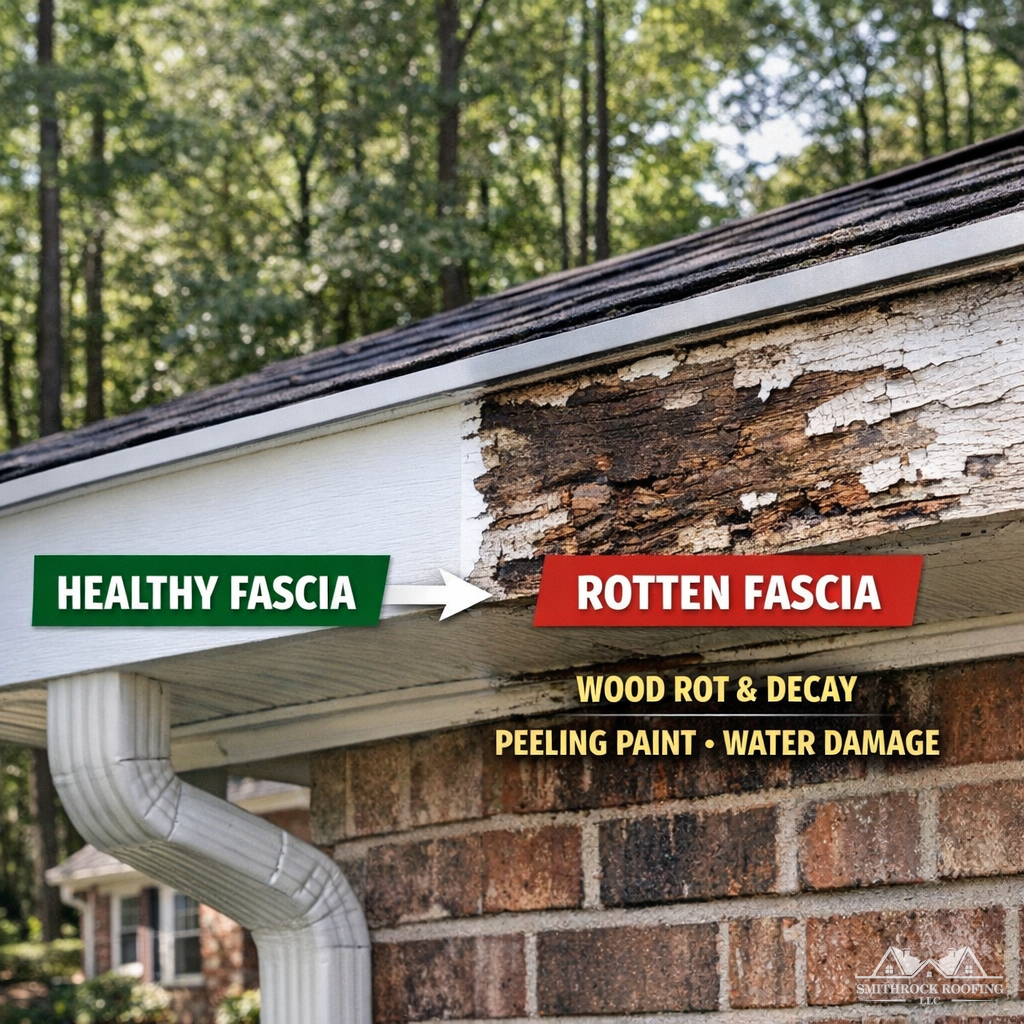
The fascia board is the vertical board running behind your gutters. It’s what the hangers attach to. If that board is soft, punky, or deteriorating, any new gutters installed over it will begin pulling away within two to three years.
Use a flathead screwdriver or a firm probe tool. Wherever the gutter meets the fascia, gently probe the wood at the gutter’s rear edge. Healthy wood is firm and resists the probe. Rotted wood gives way with minimal pressure. If you find soft spots — especially at the low end of a gutter run where water tends to back up — you’re looking at a fascia repair that must happen alongside, or before, gutter replacement.
Winston-Salem homes built during the 1960s through 1990s housing boom — large portions of the Lewisville, Clemmons, Pfafftown, and Rural Hall corridors — frequently have original wood fascia that has reached end-of-life at roughly the same time as their original gutters. This isn’t coincidence. The two systems were installed together and are aging together.
Sectional gutters — the type installed on the majority of older homes — are joined at seams with sealant. Over time, that sealant breaks down, and gaps open where sections meet. Small active leaks at seams are among the most repairable gutter problems that exist. Re-sealing is straightforward.
However, if you see multiple failed seams, if the seam gaps are wide and consistent rather than isolated, or if the metal around the seams shows heavy oxidation, pitting, or thin spots, you’re looking at a system that is past the point where patching is practical.
Seamless gutters — which are fabricated as a continuous run on-site — eliminate virtually all seam failures because there are no joints along the run, only at corners and end caps. This is one of the most practical reasons to upgrade to seamless systems during replacement.
Within 24 hours of a rainfall, check your gutters for pooled water. Some minor residual moisture is normal. Standing water that persists well beyond that is a problem — and the diagnosis matters.
Standing water can result from three different causes, each with a different solution:
| Cause | What It Looks Like | Repair or Replace? |
|---|---|---|
| Debris clogging blocking flow | Water pooling evenly across a section, debris visible | Clean — no replacement needed |
| Incorrect slope/pitch | Persistent pooling at mid-run with no obvious clog | May require re-sloping hangers; repair if structure is sound |
| Sag from failed hangers | Low point in the gutter profile visible from ground | Repair if isolated; replace if widespread |
| Bottom corrosion from long-term pooling | Rust staining, thin or pitted metal at low points | Replacement warranted |
Gutters require a precise downward slope toward the downspout — typically about a quarter-inch of drop for every ten feet of horizontal run. This isn’t dramatic; it shouldn’t be visible to the naked eye. But when hangers fail or settle over time, that calibrated slope is lost, and water begins sitting rather than flowing.
This is perhaps the most underappreciated element of gutter system performance, and it receives almost no attention from most contractors’ sales materials.
How many downspouts your system has, and where they discharge, directly affects both your gutter system’s performance and your foundation’s long-term health.
As a general principle, a downspout should serve no more than 30 to 40 linear feet of gutter run on a typical residential roof. Longer runs with a single downspout create pressure buildup during heavy events.
Equally important is where downspouts terminate. Winston-Salem and the broader Piedmont region are characterized by clay-heavy soils with poor drainage. When downspouts discharge directly onto splash blocks positioned too close to the foundation, that water has nowhere productive to go. It pools, saturates the soil, and increases hydrostatic pressure against crawl space walls and basement foundations over time. Extensions — either above-grade or underground — that carry water at least six feet away from the structure, ideally toward a positive slope, are worth discussing with your contractor during any gutter replacement conversation. The article Bury Your Downspouts: Keep Your Foundation Dry and Your Yard Tidy explains the options and tradeoffs in practical terms.
Your gutters communicate their health through the paint and surfaces around them. Walk the perimeter of your home and look for:
These aren’t cosmetic problems in isolation. Each one is evidence of a drainage failure that has been ongoing long enough to affect surrounding materials.
If your home has gutter guards installed, assess honestly whether they’re working.
This matters locally because Winston-Salem’s tree cover — particularly loblolly pines — creates a debris profile that defeats many standard guard designs. Loblolly pine needles are thin, long, and flexible. They slide through or around screen-style guards, wedge into reverse-curve systems, and accumulate into mats on micro-mesh surfaces that eventually restrict flow. A guard that handles oak leaves fine can be completely overmatched by pine needle accumulation.
If you’re finding regular clogging, overflow, or standing water despite having guards installed, the guard system may be the wrong technology for your specific debris load — not a failure of the gutter itself.
Not all gutter replacements are equal. The difference between a system that performs well for 20 years and one that begins sagging within five often comes down to installation decisions that aren’t visible after the job is complete.
Hanger spacing is the single biggest determinant of long-term gutter performance, and it’s also one of the details most homeowners never think to ask about.
Industry best practice calls for hidden hangers installed every 24 to 36 inches along the gutter run. Some budget installations space hangers at 48 inches or beyond. That may look identical on the day of installation. But over time — particularly through Winston-Salem’s freeze-thaw winter cycles and the weight of standing water during intense summer events — wider hanger spacing allows the gutter profile to flex and eventually sag between anchor points.
When you’re evaluating contractors, ask directly: what hanger spacing do you use as a standard? A contractor confident in their work will answer without hesitation.
Where the hanger screw ultimately terminates makes a significant difference in pull-out resistance — the force required before a hanger fails under load.
Screws driven through the fascia board and into the rafter tail behind it are substantially more resistant to pull-out than screws anchored in fascia board alone. This is particularly relevant on older homes where the fascia board itself may be showing early signs of age. A contractor who understands this difference will scope the attachment method as part of the installation, not as an optional upgrade.
Every gutter run should be calibrated to a precise slope before hangers are set. This isn’t something that can be eyeballed accurately. A chalk line or level is used to establish consistent fall toward the downspout along the entire run.
When this step is skipped or rushed, the result is standing water — which is both a performance problem and the primary driver of premature corrosion at the gutter’s low points.
Not all aluminum gutters are the same. Standard aluminum gutters are typically produced in .027-inch gauge material. Heavier-duty systems use .032-inch material — approximately 18 percent thicker — which resists denting, retains shape better under ice loading, and carries a longer effective service life in demanding climates.
The finish matters as well. A high-quality factory-applied paint finish on aluminum gutters should be a baked enamel or polyester coating that resists UV degradation and oxidation. The visible difference between a quality finish and an economy one may not be apparent at installation. It will be apparent at the five-year mark.
K-style and half-round gutters are the two profiles you’ll encounter in residential applications across the Triad. Most contractors treat the choice as purely cosmetic. It isn’t entirely.
K-style gutters have a flat back, a decorative ogee-profile front face, and a flat bottom. They carry more water volume relative to their opening size than half-round, which is why they’ve become the default for new construction. They attach flush to the fascia, which is structurally efficient.
Half-round gutters have a semicircular profile. They carry less volume for the same opening width, but their smooth interior shape resists the buildup of mineral deposits and organic debris more effectively than the flat-bottomed K-style. On older Winston-Salem homes — particularly Colonial Revival, Craftsman, and Tudor-influenced architecture common in historic neighborhoods like Ardmore, Buena Vista, and West End — half-round gutters are architecturally authentic and restore correct proportions that K-style profiles can’t replicate.
If you’re replacing gutters on a historic or architecturally distinctive home, the choice between profiles should be part of a broader conversation about the home’s character, not just capacity math.
Walking into a gutter replacement conversation with the right questions changes the dynamic completely. Here are the questions that separate contractors who understand their work from those who don’t:
That last question deserves its own attention. “Lifetime warranty” language appears throughout gutter marketing. But lifetime of what — the product, the installation, or the company providing the warranty? In a market where small contractors enter and exit regularly, a labor warranty tied to a company with no track record or BBB standing means considerably less than one backed by an established local contractor with verifiable history. You can review Smithrock Roofing’s warranty coverage directly to understand exactly what’s protected and for how long.
Here’s the honest framework: most gutter systems don’t fail all at once. They fail incrementally, section by section, hanger by hanger.
Repair makes sense when:
– Failures are isolated — one or two sections showing problems while the rest of the system is sound
– The underlying fascia is in good condition
– The gutter material itself retains structural integrity (no pervasive corrosion, thin spots, or profile distortion)
– The system is sized appropriately for the roof’s drainage load
Replacement makes sense when:
– Sagging, separation, or corrosion is distributed across more than roughly a third of the system
– Fascia deterioration is present and requires board replacement, which warrants full gutter removal regardless
– The system is undersized for the roof and site conditions
– The original installation used sectional gutters with multiple failing seams, and seamless systems represent a permanent solution to a recurring problem
– The home is approaching sale and a credible, warrantied gutter system adds documented value
There’s no formula that replaces a qualified inspection. But walking through this framework honestly — rather than defaulting to the easiest recommendation — is what homeowners in the Triad deserve from a contractor they’re trusting with their home.
Smithrock Roofing brings more than 60 combined years of experience to exterior work across Winston-Salem, Greensboro, High Point, Kernersville, Clemmons, Rural Hall, King, and the broader NC Triad. We’re fully licensed and insured, carry an A+ BBB rating, and have earned more than 312 five-star reviews from homeowners who expected straight answers and got them.
Gutter replacement isn’t complicated when you understand what you’re actually looking at. That’s why we come to every estimate ready to explain what we find — not just what we’d recommend. If your gutters need replacement, we’ll tell you why in plain terms. If they don’t, we’ll tell you that instead.
When you’re ready to have someone walk through your system honestly, we’re here.
If you’re planning exterior maintenance or preparing your home for sale in the coming year, three steps are worth prioritizing before problems compound:
1. Schedule a Post-Winter Inspection in Early Spring
Winston-Salem winters — with their freeze-thaw cycles, ice events, and heavy rain bursts — are hard on gutter systems. Spring is the right time to assess what the season left behind before summer storm activity begins. A qualified eye on the system now can separate what warrants repair from what needs full replacement, before water damage to fascia, soffits, or foundation grading makes the project more involved.
2. Upgrade Sectional Systems to Seamless Gutters
If your home still has sectional aluminum gutters with multiple seamed joints, 2026 is a practical year to make the switch. Seamless gutters eliminate the most common failure point in aging systems. Combined with properly sized downspouts and strategic placement, a seamless system dramatically reduces ongoing maintenance and the recurring cost of seam repairs over time.
3. Pair Gutter Replacement with Gutter Guard Evaluation
Not every gutter guard performs the same way, and not every home needs one. But if you’re replacing gutters and your property has significant tree coverage — common across Winston-Salem’s older neighborhoods — evaluating a quality micromesh or surface-tension guard at the same time makes practical sense. Installing guards on a new system is more efficient and typically more effective than retrofitting them later.
The honest answer depends on what’s actually failing and how widespread the problem is. Isolated issues — a single loose hanger, one cracked seam, minor end-cap leaking — are generally good candidates for repair, especially when the rest of the system is structurally sound. Replacement becomes the more practical decision when problems are distributed across a significant portion of the system, when the fascia boards behind the gutters have begun to rot or deteriorate, or when a sectional system has reached the point where seam failures are recurring faster than repairs can keep up. A qualified contractor should be able to walk you through exactly what they’re seeing and why they’re recommending one path over the other.
Most residential properties in the Winston-Salem area are served well by five-inch K-style gutters, which handle the rainfall volumes typical of the NC Piedmont. However, homes with steeper pitches, larger roof planes, or complex valley configurations that concentrate drainage can benefit from six-inch gutters and appropriately upsized downspouts. The right sizing comes from looking at actual roof dimensions and drainage load — not from applying a single standard to every house on the street. This is worth discussing during your estimate, particularly if your current system has a history of overflowing during heavy rain events.
For most single-family homes in the Triad, a full gutter replacement can be completed in a single day. The timeline depends on the size and complexity of the home, the condition of the existing fascia boards, and whether any underlying repairs need to be addressed before the new system goes up. Homes with significant fascia deterioration may require additional time to complete board replacement properly before gutters are rehung. A reputable contractor will give you a realistic project timeline during the estimate rather than committing to a schedule they can’t hold.
Yes. Smithrock Roofing serves homeowners across the broader NC Triad, including Greensboro, High Point, Kernersville, Clemmons, Rural Hall, King, and surrounding communities. The team brings the same licensed, insured approach and the same commitment to straight answers to every job in the region — not just the larger metro areas. If you’re unsure whether your location falls within the service area, the fastest way to find out is to reach out directly.
For homeowners across Winston-Salem and Kernersville who want a gutter system installed correctly the first time — by a team that will tell them honestly what they need — Smithrock Roofing brings the experience, credentials, and track record to back that up. More than 60 combined years of exterior work across the Triad means fewer surprises, better outcomes, and a system built to handle what the NC Piedmont actually throws at it. When you’re ready for a straightforward assessment of your gutters, Contact Smithrock Roofing and schedule your free estimate today.

Smithrock Roofing © Copyright 2026 • All Rights Reserved • Privacy Policy • Maintained by Mongoose Digital Marketing