Most homeowners in Mt. Airy have a straightforward expectation when they hire a roofer: fix the problem, and fix it so it stays fixed. That is a completely reasonable expectation. Yet a surprising number of roof repairs in this area fail within a few years — sometimes within months — of the original work being done.
This is not always a contractor character problem. In many cases, it is a contractor knowledge problem. A roofer who learned their trade working on flat subdivisions in the coastal plain or the Charlotte metro is walking onto a Mt. Airy roof without fully accounting for what that roof is dealing with every single year. The Blue Ridge foothills are not the rest of North Carolina, and the repairs that hold up here require a different level of thinking.
This guide walks through what actually causes roof problems specific to this area, how a qualified contractor evaluates whether you need a repair or a full replacement, what the job should involve beyond just new shingles, and what homeowners need to know before signing anything. If you are dealing with a leak, missing shingles, or damage from a recent storm, understanding these factors will help you make a better decision — and avoid paying for the same repair twice.
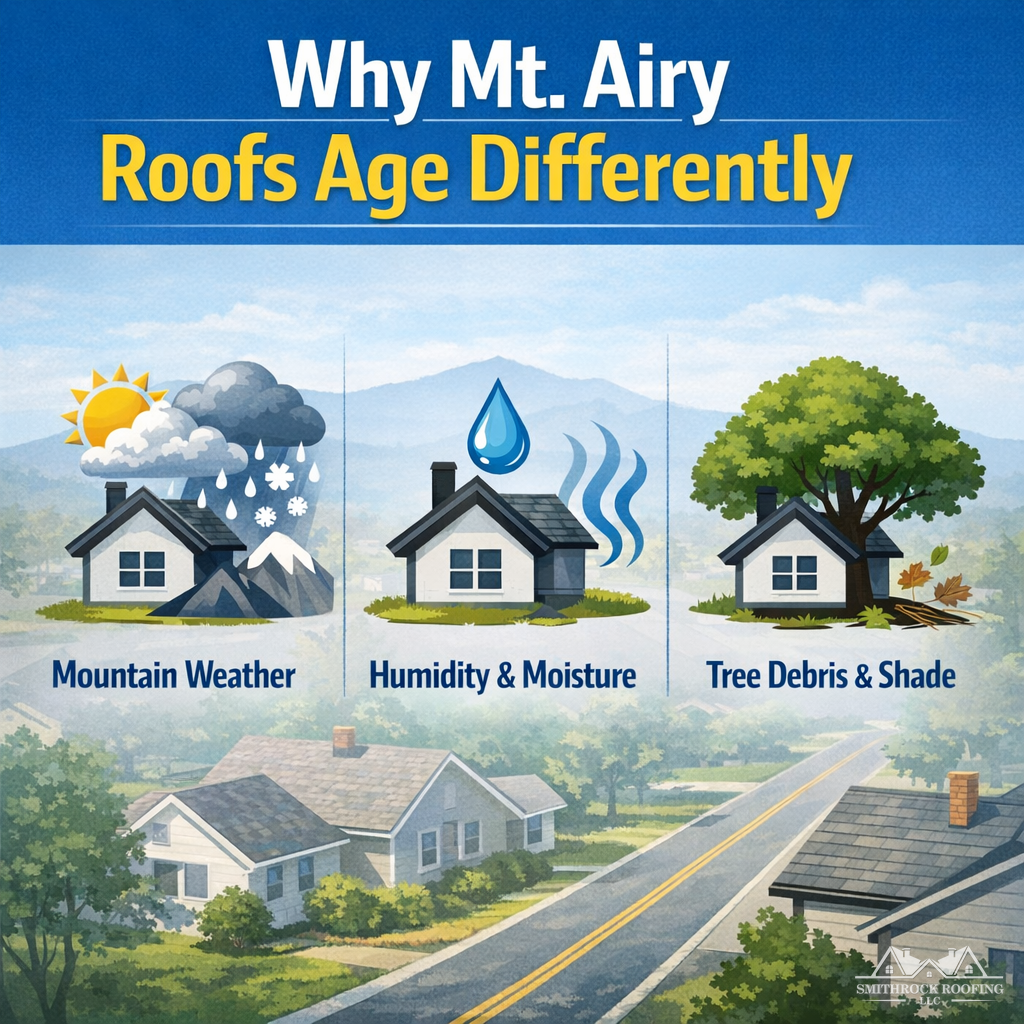
Mt. Airy sits at roughly 1,070 feet in elevation at the eastern edge of the Blue Ridge foothills — noticeably higher than Winston-Salem (about 30 miles to the southeast) and meaningfully different from cities deeper in the Piedmont like Greensboro or High Point.
That elevation difference is not just a scenic detail. It has direct consequences for how roofs age and where they fail.
When moisture-laden air from the Piedmont travels northwest and rises over the foothills, it cools and releases precipitation. Mt. Airy receives more freeze-thaw cycling than most of its neighboring communities. Water works its way under shingles or into small cracks, freezes overnight, expands, and pulls materials apart. This process repeats throughout winter and into early spring.
The practical result: shingle adhesive strips fail faster, flashing separates from masonry, and any repair that was not properly sealed is likely to open back up within a season or two. A repair done to Piedmont standards — adequate for Winston-Salem or Kernersville — may simply not last as long in Mt. Airy’s foothills environment without additional steps like upgraded underlayment and proper flashing reinforcement.
Ice dams are more common here than most homeowners realize. They form when heat escaping through an under-insulated attic warms the roof deck, melts snow, and sends water running toward the cold eave — where it refreezes and backs up under shingles. For a deeper look at how this process unfolds and what can be done to address it, the article How to Get Rid of Ice Dams walks through the mechanics and the remediation options in detail.
This is particularly relevant in Mt. Airy’s older housing stock. Homes built before 1990, especially those in the neighborhoods near downtown, were often constructed with minimal attic insulation by today’s standards. Those homes are highly susceptible to ice dam formation. A repair that does not address ice-and-water shield placement at the eaves is almost certainly going to see recurring leak activity in the same spots.
Higher elevation means more direct solar exposure. South- and west-facing roof slopes in Mt. Airy lose granules from asphalt shingles measurably faster than equivalent roofs at lower elevations. Granule loss is not just cosmetic — granules protect the asphalt layer from UV degradation. Once they are gone, the timeline to shingle failure accelerates sharply. This is worth knowing if you are deciding between a targeted repair and a partial replacement on an older, sun-exposed slope.
This is the question every homeowner wants answered honestly, and it is the one most contractors dodge. Here is the straightforward version of how a thorough inspection informs that recommendation.
If the area of damaged, missing, or significantly degraded shingles covers more than roughly 20–25% of your total roof surface, a full replacement typically provides better long-term value. This is not about contractors preferring larger jobs — it is about math and material behavior.
Widespread granule loss across a roof signals systemic aging of the shingle layer. Patching 30% of a roof that has 20 years of wear on the remaining 70% creates a mismatched system. The repaired sections will likely outlast the surrounding material, and you will be facing replacement within a few years anyway. Paying for both a significant repair and a replacement is the worst possible outcome.
Below that threshold — isolated storm damage, a few blown-off tabs, a localized leak around a penetration — repair is generally the right answer, provided it is done correctly.
In many Mt. Airy homes built during the 1950s through the 1970s, original roof decking was solid board sheathing rather than OSB panels. That material can develop localized rot or delamination that is completely invisible from a surface inspection. A contractor who only looks at your shingles may not catch deteriorating decking until they start removing material.
A thorough inspection probes the decking for soft spots, assesses moisture staining in the attic directly below problem areas, and checks whether previous repairs created moisture traps rather than solving them. Decking issues discovered during a repair need to be addressed in that same scope of work — not deferred.
If there is one factor that reliably predicts whether a roof repair will hold or fail, it is flashing condition. Chimney flashing, valley flashing, and step flashing around dormers or sidewalls are the most common sources of leak activity in residential roofing. The article Chimney Flashing Repair Cost: What NC Homeowners Must Know provides a detailed breakdown of what this work typically involves and what homeowners should expect to pay.
Here is what makes this important: replacing shingles around a failing flashing installation does not fix the leak. The water is not coming through the shingles. Any competent repair proposal should specifically address flashing — either confirming it is sound or including re-flashing as part of the scope. If a contractor walks your roof and does not mention your flashing, that is a gap worth asking about directly.
Attic ventilation is absent from most roofing conversations homeowners have, and that is a mistake. Here is why it matters:
Inadequate ventilation allows heat to build up in the attic during summer months, cooking the shingles from below and dramatically shortening their service life. In winter, that same inadequate ventilation allows warm, moist air to accumulate against the roof deck, promoting condensation, rot, and mold. Both scenarios create the conditions for premature roof failure — and neither one is visible until damage has already occurred.
Manufacturer warranties on quality shingles — including the CertainTeed Landmark shingles we install — require that ventilation meets minimum standards. If your attic does not meet those requirements at installation, the material warranty can be voided. That is a real consequence that most homeowners have never been told about.
A proper repair or replacement assessment includes an evaluation of your current ventilation ratio and whether your intake and exhaust configuration is functioning as designed.
A roof is a system. Shingles are the most visible component, but they are not the only one that matters. Understanding what a thorough repair includes helps you evaluate any proposal you receive.
| Component | Role in the System | Common Failure Points in Mt. Airy |
|---|---|---|
| Shingles | Primary weather barrier; UV and moisture resistance | Granule loss, tab lifting, cracking from thermal cycling |
| Underlayment | Secondary barrier between shingles and decking | Degraded felt or inadequate synthetic allows moisture penetration if shingles fail |
| Ice-and-Water Shield | Self-adhering membrane at eaves, valleys, and penetrations | Missing or improperly lapped — leads to ice dam damage and valley leaks |
| Flashing | Seals transitions at chimneys, walls, and valleys | Separation from masonry, corrosion, or improper overlap after previous repairs |
| Ridge Cap | Closes the roof peak; allows hot air to exhaust | Cracked, blown off, or improperly nailed — common after wind events |
| Decking | Structural substrate for the entire system | Rot, soft spots, or delamination — often hidden under acceptable-looking shingles |
| Attic Ventilation | Regulates temperature and moisture beneath the roof | Blocked soffit vents, insufficient net free area, mismatched intake/exhaust ratios |
| Gutters & Fascia | Channels water away from the foundation and eaves | Separation, overflow, or rot — can cause fascia damage that compromises shingle edge |
A repair that addresses only the component you can see from the ground is often an incomplete repair. The proposal you receive should reflect the actual scope of what needs attention, not the minimum that makes the visible symptom disappear.
The phrase “storm damage” gets used loosely. For insurance purposes and for repair planning, the type of damage matters significantly.
Hail impact leaves bruises in the asphalt mat beneath the granule surface. You may not see obvious missing granules immediately, but the bruising compromises the mat’s structural integrity and accelerates granule loss in that spot over the following months. Insurance adjusters are trained to identify hail strikes — they look for the distinctive dimple pattern across multiple roof planes and corroborate it with granule accumulation in the gutters. Documenting hail damage promptly after a storm matters because the visible evidence degrades over time.
Wind damage typically presents as lifted or missing tabs, failed adhesive strips along the shingle edge, or completely blown-off sections. The repair scope depends on how widespread the lifting is. Tabs that have lifted and re-adhered still have compromised adhesive and are far more likely to lift again in the next wind event. A thorough wind damage assessment checks adhesion across the entire affected plane, not just the visibly missing pieces.
Fallen branches and tree strikes create localized but often deep damage — cracked decking, punched-through underlayment, and broken shingles in a concentrated area. These repairs are usually well-defined in scope, but the assessment should confirm that the structural deck is sound before new material is installed over the damaged area.
This is a topic almost no roofing contractor brings up proactively, and it is one that can create real problems down the road.
North Carolina’s building code requires a permit for full roof replacements in Surry County. This is not optional, and it is not just a bureaucratic formality. A permitted replacement goes through inspection, which confirms that the work meets code — including ventilation requirements, underlayment type, and fastening schedules.
Why does this matter to you as a homeowner?
The right question to ask any contractor you are considering: “Will you pull the permit?” A contractor who says permits are not necessary for a full replacement, or who suggests it will slow things down, is giving you a warning sign worth taking seriously.
At Smithrock Roofing, we handle permitting as a standard part of our process for applicable work. It protects your home, your investment, and your ability to use that work history when you sell or file a claim.
These are two separate things, and confusing them is one of the most common mistakes homeowners make when evaluating a repair or replacement proposal.
The manufacturer warranty covers the shingle material itself — defects in the product. A premium architectural shingle may carry a limited lifetime warranty against manufacturing defects. What it does not cover is installation errors: improper nailing, inadequate ventilation, missing ice-and-water shield, or incorrect flashing integration. If the material fails because of how it was installed, the manufacturer warranty does not apply.
The workmanship warranty is provided by the contractor and covers installation quality. This is the warranty that protects you against leaks caused by how the job was done. Workmanship warranties vary widely — from one year to ten years or more, depending on the contractor and their certification level.
Smithrock Roofing backs installation work with a 5-year labor warranty. We are also CertainTeed PREMIER ShingleMaster certified, which is a credential that reflects not just the products we use but the installation standards we are required to maintain. That certification gives our customers access to enhanced warranty coverage that goes beyond what most contractors can offer — because most contractors have not met the requirements to achieve it.
When you are comparing proposals, ask every contractor what their workmanship warranty covers and for how long. The answer tells you a great deal about how confident they are in the quality of their own work.
Choosing the right contractor for roof repair in Mt. Airy and the surrounding Surry County area means looking beyond the truck wrap and the yard sign. Here is a practical checklist:
Smithrock Roofing serves Mt. Airy along with the broader NC Triad — including Winston-Salem, Greensboro, High Point, Kernersville, Clemmons, Rural Hall, and King. We bring 60-plus combined years of experience, an A+ BBB rating, and over 312 five-star reviews to every job we take on. Our approach is consultative: we show you what we find, explain what it means, and give you an honest recommendation — even if that recommendation is that you do not need as much work as you thought.
If you have a roof concern in Mt. Airy or anywhere in the Triad area, reach out for an inspection. We will tell you exactly what is happening and what a proper fix looks like.
As you plan ahead for roof maintenance and repair in the Mt. Airy area, here are three practical steps worth taking in the coming year:
Schedule a post-winter inspection before spring storm season. The freeze-thaw cycles common to Surry County winters create ideal conditions for flashing separation, shingle cracking, and attic moisture buildup. A professional inspection in late winter or early spring — before heavy rain arrives — gives you time to address issues before they become emergencies.
Document your roof’s condition with a dated inspection report. If you do not already have a written inspection on file, establish one now. A documented baseline makes it significantly easier to track changes over time, support future insurance claims, and demonstrate maintenance history if you sell the property.
Verify your homeowner’s insurance policy covers current roofing material types. Insurance carriers in North Carolina have updated coverage terms in recent years, and some older policies contain exclusions or depreciation schedules that homeowners are not aware of until they file a claim. Reviewing your policy now — and asking your contractor for documentation that supports replacement value — puts you in a stronger position before any weather event occurs.
The answer depends on several factors — including the age of the roof, the extent of damage, the condition of the underlying decking, and the roofing system type. A localized issue such as a few damaged shingles around a flashing point is typically repairable. When damage is widespread, the decking is compromised, or the shingles have reached the end of their service life, replacement is usually the more cost-effective long-term decision. A thorough inspection by a qualified contractor will identify which situation applies and explain the reasoning clearly.
It depends on the scope of work. Minor repairs — replacing a small number of shingles or sealing a flashing — generally do not require a permit in North Carolina. However, work that involves structural components, decking replacement, or a full re-roof typically does require a permit from the local building authority. A professional contractor will know which category your project falls into and will pull the appropriate permits without hesitation. Be cautious of any contractor who discourages the permit process.
Most standard repairs are completed in a single day. More involved repairs — those that include replacing damaged decking sections, addressing multiple penetration points, or working around complex roof geometry — may take longer depending on the scope. Weather is also a factor, since certain repair work should not be performed during rain or freezing conditions. Your contractor should give you a realistic timeline before work begins and communicate any changes promptly.
Move quickly but methodically. Place a container to catch active dripping, move any furniture or belongings away from the affected area, and take photos for insurance documentation. Do not attempt to access your roof in wet or unsafe conditions. Contact a licensed roofing contractor as soon as possible to schedule an inspection — the sooner the source is identified, the better the chance of limiting secondary damage to insulation, framing, and interior finishes. If you are in the Mt. Airy or Surry County area, Smithrock Roofing offers responsive inspections and can help you assess the situation accurately.
When your roof needs attention — whether you are in Mt. Airy dealing with storm damage or in King tracking down a slow leak that has defied explanation — the difference between a lasting repair and a temporary fix comes down to the contractor you choose. Smithrock Roofing brings more than six decades of combined experience, manufacturer-level certification, and a track record of honest, thorough workmanship to every project across Surry County and the broader Triad region. If you are ready to find out exactly what your roof needs, Contact Smithrock Roofing and schedule your inspection today.

Smithrock Roofing © Copyright 2026 • All Rights Reserved • Privacy Policy • Maintained by Mongoose Digital Marketing