If you’ve noticed cracks in your chimney mortar, white staining on the brickwork, or chunks of masonry collecting at the base of your fireplace, you’re not imagining things getting worse — they probably are. And if you live in an older home in Winston-Salem, Greensboro, High Point, or anywhere across the NC Triad, there’s a very good chance the story behind that damage is one most contractors in this area aren’t telling you.
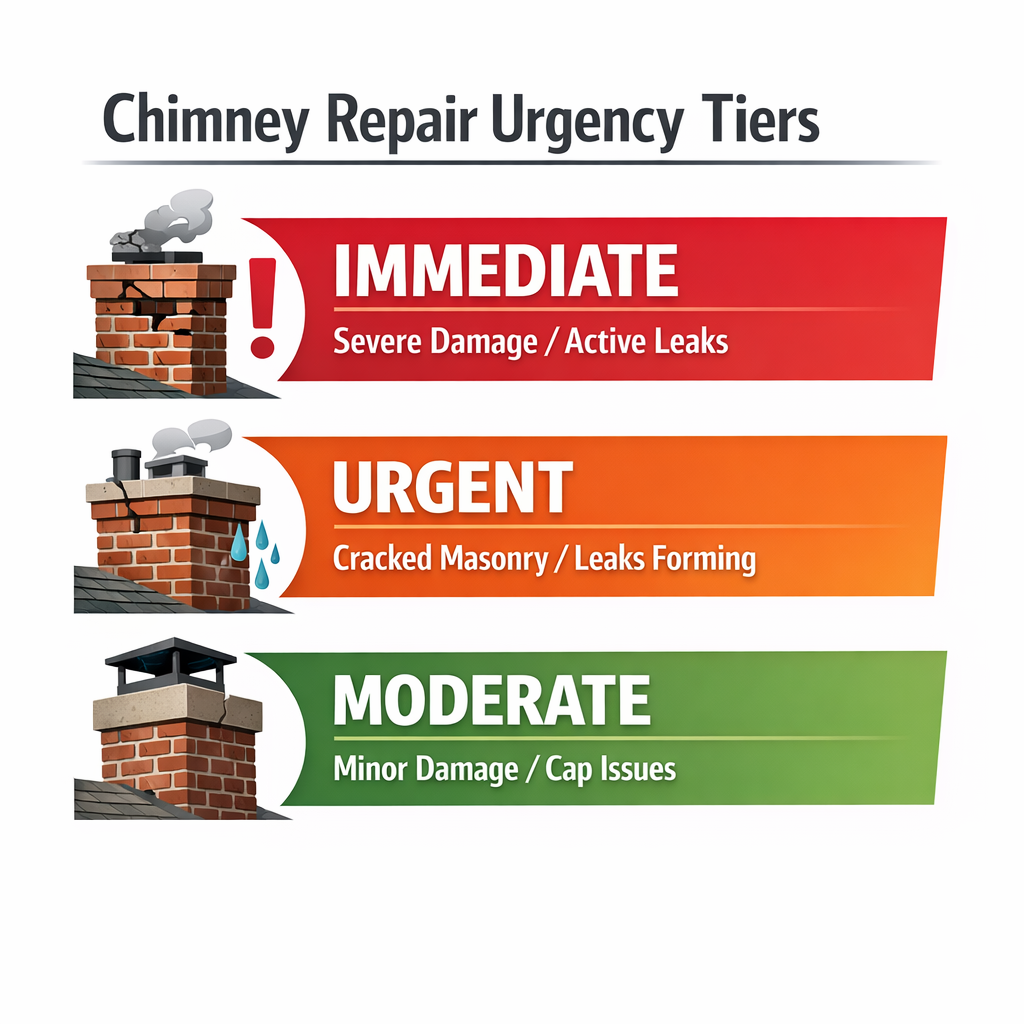
The honest truth is that chimney repair isn’t one thing. It’s a spectrum of problems — some that demand immediate attention for the safety of your household, others that represent slow cosmetic deterioration you can monitor sensibly over time. Knowing the difference is the most valuable thing you can walk away with before you ever pick up a phone.
This guide exists to give you that knowledge. We’ll cover why Winston-Salem’s specific climate accelerates masonry damage in ways most homeowners don’t realize, why the wrong repair on an older chimney is often worse than no repair at all, and how to build a clear picture of what your chimney actually needs — from a hairline crack in the mortar all the way to the question of whether a rebuild makes more sense than a repair.
Most people assume that chimneys suffer most in climates with brutal, sustained winters. The reality for Winston-Salem and the surrounding Triad region is almost the opposite.
Winston-Salem sits in USDA Hardiness Zones 7a and 7b, which means winter temperatures hover in a range where thermometers regularly cross the freezing threshold multiple times throughout a single season — and sometimes within a single week. This pattern of repeated freeze-thaw cycling is significantly more destructive to masonry than deep, sustained cold.
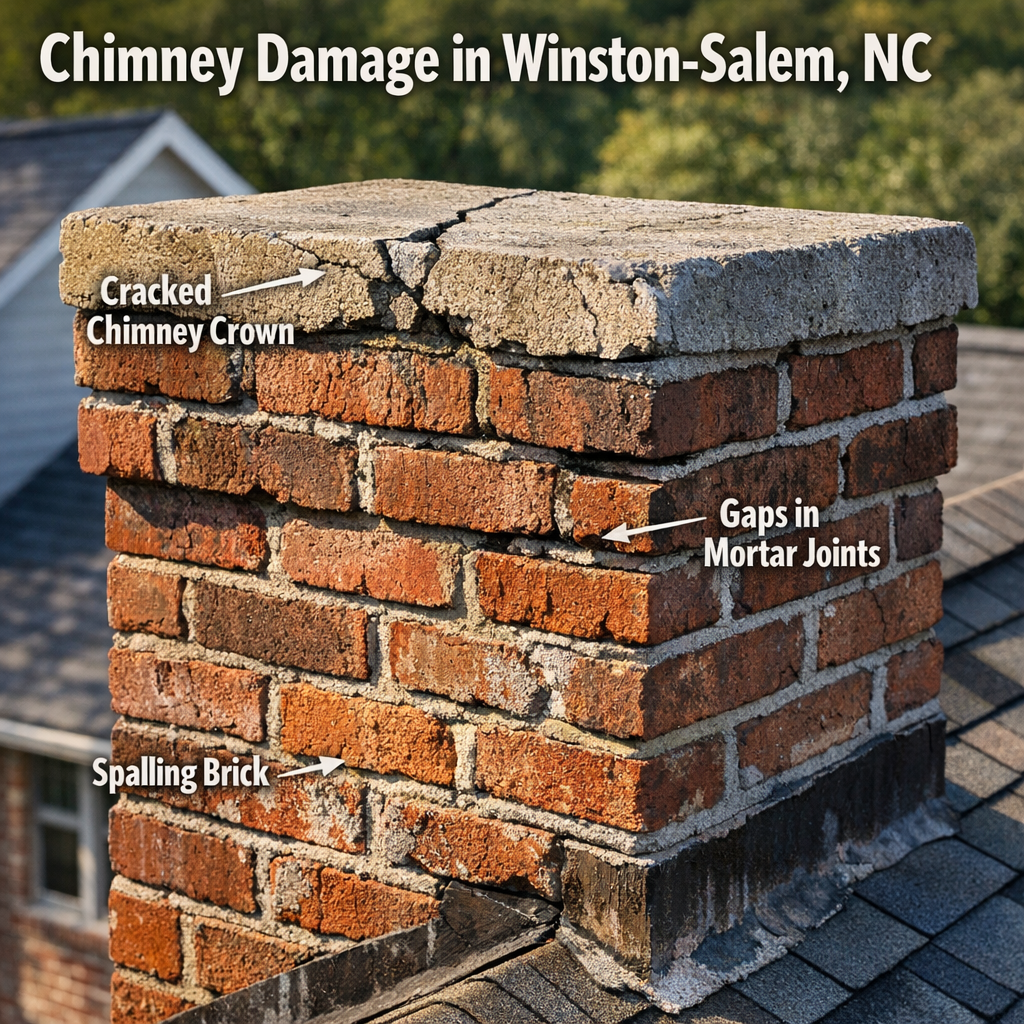
Here’s why. Brick and mortar are porous materials. During a wet autumn or a mild winter rain event, that moisture works its way into tiny surface pores and into the mortar joints. When temperatures then drop below 32°F, that trapped water expands. When temperatures rise again — as they routinely do here — it contracts. Each cycle works like a slow wedge, widening micro-fractures in the masonry until they become visible cracks, then open joints, then spalling (the flaking and popping of brick faces you see on older chimneys across the Triad).
A chimney in Minnesota may stay frozen for weeks at a time, meaning water expands once and stays there. A Winston-Salem chimney may experience that expansion-contraction cycle dozens of times between November and March. The cumulative effect is what you’re seeing on your brickwork.
Compound the freeze-thaw problem with the Piedmont’s characteristically high humidity during spring and summer, and you have a masonry structure that rarely gets to dry out fully. Moisture migrates upward through masonry (a process called rising damp) and downward through cap failures and open crown cracks. A chimney dealing with both vectors is deteriorating from multiple directions simultaneously.
This is also why chimney caps and crowns aren’t aesthetic features — they are the first line of moisture defense for the entire flue system, and when they fail in Winston-Salem’s climate, the damage below them compounds quickly.
This is the section most contractors would prefer you never read, because it explains exactly how well-intentioned but mismatched repairs cause significant long-term damage — and why the cheapest bid on a repointing job can be the most expensive decision you ever make for an older chimney.
Many of Winston-Salem’s most beautiful older homes — particularly in neighborhoods like Ardmore, West End, Washington Park, and Buena Vista — were built between the 1920s and 1960s. The chimneys on these homes were typically constructed using soft historic brick and natural lime-based mortar.
This wasn’t a compromise. It was smart engineering for the materials and construction methods of the era. Lime mortar is deliberately softer and more flexible than the brick it bonds. When a structure settles, when thermal expansion and contraction occur, and when freeze-thaw cycling happens, the mortar joint is designed to absorb that stress and crack before the brick does. Mortar joints are sacrificial by design — they can be repointed. Brick faces, once damaged, cannot be easily reversed.
The entire system depends on the mortar being the weaker element.
Modern Portland cement mortar — Type S and Type N mixes widely used in general masonry work today — is harder and less permeable than the historic soft brick found on these older chimneys. When a contractor repoints a historic chimney with Portland cement mortar without testing the existing mortar composition first, the balance of the system is reversed.
Now the mortar is harder than the brick. When stress, settlement, or freeze-thaw cycling occurs, the brick face bears the load instead of the mortar joint. Moisture that would normally migrate and escape through the softer mortar is instead forced into the brick itself. The result is accelerated and often catastrophic spalling — the brick faces literally blow off — within just a few years of the “repair.”
This is one of the most common and preventable forms of chimney damage we see on historic Triad properties. The homeowner had the chimney repointed. The contractor used the wrong mortar. The chimney looks worse five years later than it did before the repair.
A contractor who genuinely knows what they’re doing on a pre-1960s Winston-Salem chimney will:
If you’re getting quotes on repointing an older chimney, ask every contractor directly: how will you determine the appropriate mortar mix for this chimney? If the answer is a blank stare or a generic reference to “standard mortar,” keep looking.
One of the most common frustrations homeowners express is that they don’t know what part of the chimney is actually failing or why it matters. Here’s a plain-language breakdown of the key components and the repair issues associated with each.
The chimney crown is the concrete or mortar wash that covers the top of the chimney structure, sloping outward to shed water away from the flue. The chimney cap is the separate metal cover that sits over the flue opening, keeping out rain, animals, and debris.
These are the first points of failure in most chimneys. Crown cracks allow water to penetrate directly into the top courses of brick. A missing or damaged cap means the flue itself is exposed to the elements year-round. Our chimney cap installation guide for Winston-Salem homeowners covers what to look for when evaluating cap and crown condition together.
Common repairs: Crown sealing or full crown replacement; cap replacement with properly sized stainless steel or copper cap.
The joints between brick courses on the exterior of the chimney. In Winston-Salem’s climate, mortar joint deterioration is extremely common in chimneys over 20 years old — and nearly universal in chimneys over 40 years old that haven’t been maintained.
Common repairs: Repointing (tuckpointing) — removing deteriorated mortar and replacing with an appropriate mix. As detailed above, mortar selection is critical on older structures.
Flashing is the metal (typically lead, copper, or aluminum) that seals the joint between the chimney and the roof plane. It is among the most common sources of active roof and ceiling leaks attributed to chimneys. Step flashing, counter flashing, and saddle flashing each play a specific role in this waterproof seal. If you’re trying to trace a ceiling stain back to its origin, our article Ceiling Leak? Find the Real Source Before You Call Anyone walks through exactly how to determine whether flashing — or something else — is responsible.
Common repairs: Resealing open flashing joints; partial or full flashing replacement when metal has corroded, lifted, or was improperly installed.
The liner runs the interior length of the chimney from firebox to cap, protecting the surrounding masonry from combustion gases and heat. Per NFPA 211, a sound liner is required for safe chimney operation. Most older Winston-Salem homes have clay tile liners, which are durable but prone to cracking from thermal shock or structural movement.
Common repairs: Crack repair with appropriate sealant; full relining with a stainless steel flexible liner meeting UL 1777 standards for new liner systems. A UL 1777-listed liner is the quality benchmark you should ask about specifically when a contractor recommends relining.
This is the section most homeowners have never heard of — and the one that most chimney contractors barely mention. The smoke chamber is the compressed, funnel-shaped masonry space directly above the firebox opening, below the flue. Its job is to gather combustion gases and draw them efficiently into the flue above.
In most older chimneys, the smoke chamber is built from corbelled brick (courses that step inward toward the flue opening). This corbelled surface is then coated with parging — a smooth, heat-resistant mortar coating that seals the brick steps, prevents turbulent draft, and critically, prevents creosote from accumulating in the crevices between corbelled brick courses.
When smoke chamber parging deteriorates — and in older Winston-Salem homes, it almost always has — a few serious problems develop:
Smoke chamber repair involves applying a fresh layer of appropriate insulating parging compound to the entire chamber surface, restoring both the protective seal and the smooth draft-promoting geometry. It is one of the most fire-safety-significant repairs possible on an older chimney, and it is almost never discussed in standard chimney repair content in this market.
NFPA 211 defines three levels of chimney inspection. Understanding what each level involves helps you know whether your contractor is doing a thorough job — or just doing enough to check a box.
| Inspection Level | When It Applies | What’s Covered | Common Findings |
|---|---|---|---|
| Level 1 | Annual inspection, no changes to system or use | Visible accessible portions of exterior and interior, basic appliance connection | Mortar joint condition, cap and crown damage, visible liner condition, debris, light creosote |
| Level 2 | Change of fuel type, real estate transaction, after any event (chimney fire, earthquake, severe storm) | All Level 1 areas plus accessible attic, crawl space, basement; video scan of full flue interior | Liner cracks, smoke chamber parging condition, hidden water damage, flashing integrity, structural movement |
| Level 3 | Serious suspected hazard found at Level 1 or 2 that can’t be fully evaluated otherwise | All previous areas plus destructive access as needed (removal of components, wall openings) | Hidden structural failure, concealed damage requiring rebuild assessment |
For homeowners in Winston-Salem who are purchasing an older home, have recently had a significant weather event, or haven’t had an inspection in more than two years, a Level 2 inspection is almost always the appropriate starting point. The video scan component is the only reliable way to evaluate the condition of your liner and smoke chamber without physically opening the chimney structure.
Creosote is the byproduct of incomplete wood combustion that deposits on liner walls. It is flammable, corrosive to masonry over time, and — at Stage 3 — nearly impossible to remove by conventional sweeping alone. Understanding where your chimney sits on this spectrum directly affects what kind of repair or cleaning service it actually needs.
Stage 1 (First-Degree) — Loose, dusty deposits: Light gray or black flaky buildup. Removed effectively by standard brushing. A well-maintained chimney burning properly seasoned wood stays at this stage.
Stage 2 (Second-Degree) — Flaky, crunchy buildup or tar-like coating: Heavier accumulation that may include hardened flakes or a shiny tar glaze. Requires more aggressive mechanical removal tools. If liner cracks exist alongside Stage 2 deposits, the repair scope expands significantly.
Stage 3 (Third-Degree) — Glazed, hardened tar: Dense, hard, and penetrating into mortar pores. Standard sweeping will not remove this. Chemical treatments applied over multiple sessions, combined in severe cases with mechanical rotary tools, are required. Stage 3 buildup also generates sufficient heat during a chimney fire to crack clay liners and compromise the surrounding structure — which is the direct path from “needs cleaning” to “needs a full relining.”
If a contractor sweeps your chimney without ever discussing the degree of creosote present or what it means for your liner condition, that’s a gap in the service you should ask about directly.
The question homeowners dread most is whether they’re looking at a repair or a full rebuild — and nobody seems willing to give them a clear framework for thinking about it. Here’s an honest one.
A partial rebuild — removing and replacing only the chimney from the roofline up, which is typically the most weather-exposed and deteriorated section — is often the most cost-effective path when above-roof brick condition is severe but the firebox and lower structure remain sound.
The key principle: the goal is an honest assessment of where you are on that spectrum before committing to any scope of work. That assessment requires a proper inspection, not a visual estimate from the ground.
When you’re evaluating contractors for chimney repair in Winston-Salem or anywhere in the Triad, a few things separate genuine expertise from general contractor experience:
At Smithrock Roofing, we bring over 60 combined years of exterior expertise to every evaluation we do across the NC Triad. We’re fully licensed, fully insured, and hold an A+ rating with the Better Business Bureau backed by more than 312 five-star reviews from homeowners across Winston-Salem, Greensboro, High Point, Kernersville, Clemmons, Rural Hall, and King. When we look at your chimney, we tell you exactly what we see — what needs attention now, what can wait, and why we’re recommending what we’re recommending.
No pressure. No guesswork. Just straight answers and work you can trust.
If you’re a homeowner in the Winston-Salem area thinking about your chimney heading into the next season, here are three concrete steps worth prioritizing:
1. Schedule a Level 2 Inspection Before You Light Your First Fire of the Season
A Level 2 inspection — the standard required after any change in the appliance, after a chimney fire, or when a property changes hands — uses camera equipment to evaluate the full interior of your flue. Given how hard the Piedmont Triad’s freeze-thaw cycles hit masonry between October and March, getting this done proactively rather than reactively is the single highest-value step most homeowners can take. Don’t wait for a visible symptom.
2. Get Your Mortar Joints Documented Before Tuckpointing
Before any tuckpointing work begins, ask your contractor to photograph the existing mortar profile and confirm the replacement mix specification in writing. For homes built before 1950 — a significant portion of Winston-Salem’s housing stock — this documentation protects you from an incompatible repair that creates bigger problems five years from now. It’s a simple ask that separates contractors who know what they’re doing from those who don’t.
3. Address Your Chimney Cap and Crown Together
If your chimney cap is damaged or missing, have the crown evaluated at the same time. These two components work as a system. Replacing a cap over a cracked crown is a temporary fix. Addressing both in one mobilization saves time, protects the repair investment, and eliminates the most common entry points for water — the leading cause of accelerated chimney deterioration throughout the Triad.
The answer depends on which part of the chimney is failing and how far the deterioration has progressed. Spalling brick, cracked mortar, and a damaged crown are typically repairable conditions when caught before water infiltration reaches the flue liner or the firebox structure. A full rebuild is usually warranted when the masonry above the roofline has deteriorated to the point where individual repairs would be patching a structurally compromised system. The only reliable way to determine where your chimney falls on that spectrum is a proper inspection — not a ground-level visual estimate.
Historic brick — particularly the softer, handmade brick common in Winston-Salem homes built before 1950 — was manufactured to flex and breathe through seasonal temperature changes. Modern Portland cement mortars are significantly harder than that original brick. When a hard mortar is used to repoint soft historic brick, it eliminates that flexibility, and the stress that used to move harmlessly through the mortar joint now fractures the brick face instead. The result is accelerated and often irreversible damage. Matching mortar hardness to the original brick isn’t a preference — it’s a structural requirement.
The smoke chamber is the sloped, funnel-shaped cavity directly above your firebox that compresses rising combustion gases into the flue. It’s a common site for parging failures — cracking and deterioration of the protective coating — that most homeowners never see because it’s above the fireplace opening and below the visible flue. A damaged smoke chamber can allow combustion gases, including carbon monoxide, to escape into living spaces and creates rough surfaces that accumulate creosote. Any complete chimney inspection should include a smoke chamber evaluation.
The NFPA 211 standard recommends annual inspections for any chimney, fireplace, or venting system in use. In the Piedmont Triad specifically, the combination of clay-heavy soil movement, notable freeze-thaw cycling between fall and spring, and the prevalence of older masonry construction makes consistent annual inspections particularly important. Even if you use your fireplace infrequently, the structural components — the crown, the cap, the flashing, and the liner — are exposed to weather year-round and can deteriorate without any active use.
Chimney work done wrong is worse than chimney work deferred — the wrong mortar, an overlooked liner defect, or a misdiagnosed leak can turn a manageable repair into a significant structural problem. Smithrock Roofing brings the inspections, the honest assessments, and the technical standards that homeowners across Winston-Salem and Greensboro deserve from a contractor they can trust. If your chimney needs a closer look, we’re ready to give you straight answers and a clear path forward — Contact Smithrock Roofing today to schedule your free estimate.

Smithrock Roofing © Copyright 2026 • All Rights Reserved • Privacy Policy • Maintained by Mongoose Digital Marketing