Most homeowners don’t think about their gutters until something goes wrong — water pouring over the edge during a summer storm, paint peeling off the fascia, or a damp smell creeping up from the crawl space. By that point, a problem that started small has usually been quietly growing for months.
Here’s the honest truth: gutters are one of the most underestimated systems on your home. They’re not decorative trim. They’re the front line of defense between Greensboro’s weather patterns and your foundation, your framing, and your finished living spaces. When they’re sized correctly, installed to proper standards, and maintained with the Piedmont Triad’s specific tree canopy and climate in mind, they work invisibly and reliably for decades. When they’re not — and this is more common than most homeowners realize — the damage shows up everywhere except the gutters themselves.
This guide is written specifically for homeowners in Greensboro, High Point, Winston-Salem, Kernersville, and the surrounding Triad communities. We’re going to cover what actually governs gutter performance in this region: local rainfall intensity, soil composition, seasonal debris patterns, and installation standards that too many contractors skip over without explanation. By the end, you’ll know exactly what questions to ask and what to look for — whether you’re replacing an aging system, adding protection to a home that never had it, or just trying to understand what’s causing problems with what you already have.
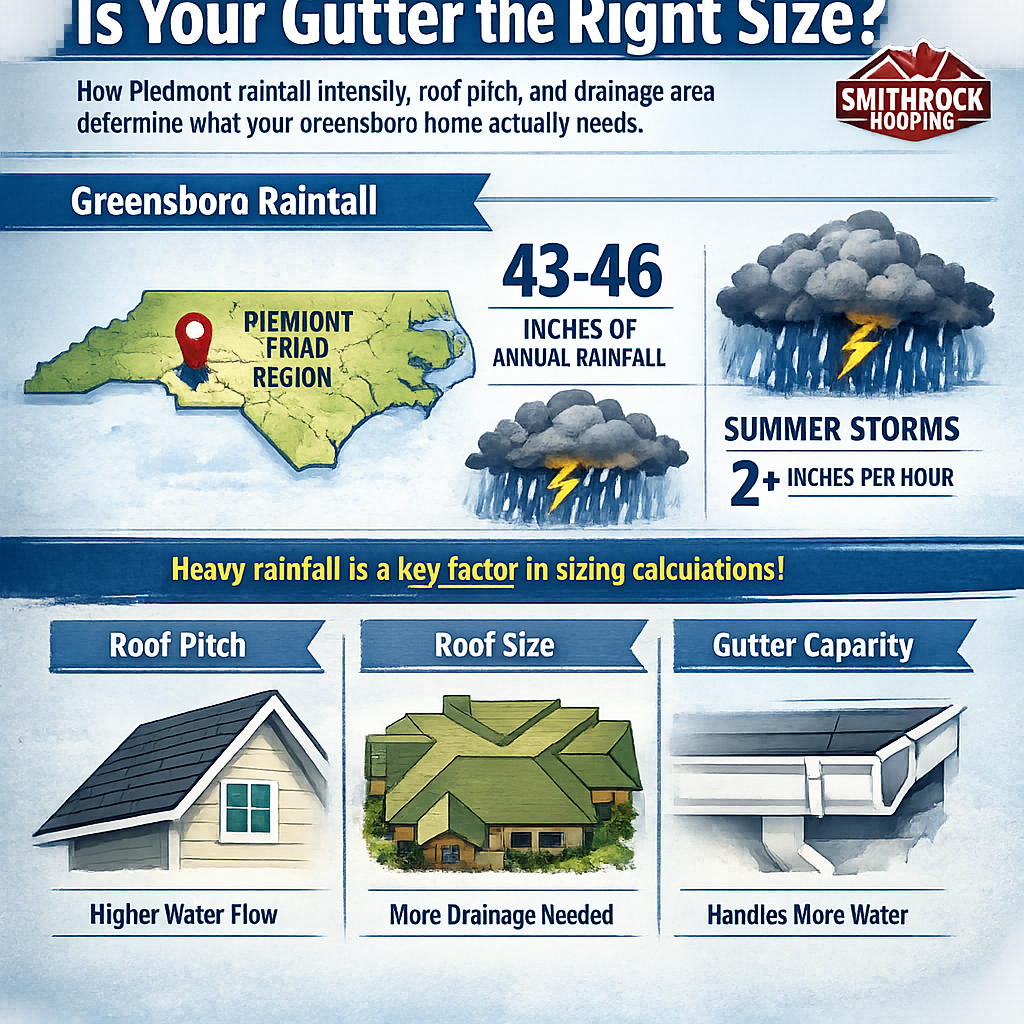
Greensboro sits in the Piedmont Triad, a geographic zone that receives roughly 43 to 46 inches of annual rainfall. That number sounds manageable — and spread evenly across the year, it would be. The challenge is that Piedmont weather doesn’t work that way.
Summer convective thunderstorms, which are a regular feature of Triad summers from June through September, can deliver two or more inches of rain in a single hour. These are fast, intense events that tax any drainage system. When you have a roof with significant square footage and a moderate-to-steep pitch, that volume of water has to go somewhere very quickly. If your gutters aren’t sized to handle the hydraulic load — or if the downspout placement doesn’t account for the drainage zones — the overflow goes over the edge and straight down your exterior walls.
This is where most homeowners are surprised: the sizing question isn’t just about the gutter channel itself. It’s about the relationship between your roof’s drainage area, its pitch, and the peak rainfall intensity your system will need to handle. More on that in the next section.
Greensboro averages between 20 and 30 freeze-thaw events per year. That cycle matters for gutters in two ways.
First, water that sits in a clogged gutter and freezes expands. That expansion places stress on seams, hangers, and the bracket connections to your fascia board. Over several winters, this accelerates joint failure and pulls hangers loose from the wood behind them.
Second, any moisture that’s already been introduced to your fascia or soffit through overflow or improper sealing is repeatedly frozen and thawed, which accelerates wood degradation. Fascia rot is almost always a moisture problem before it becomes a visible rot problem — and gutters that are pulling away from the roofline or overflowing are the most common source.
This is a point that doesn’t get nearly enough attention in the Greensboro market. The Piedmont region sits atop a combination of Piedmont clay and weathered metamorphic soils. These soils are dense and have very low permeability — meaning water doesn’t drain through them quickly. It pools, saturates, and creates lateral pressure.
When a gutter system discharges water too close to the foundation — or when downspouts empty onto splash blocks that don’t direct water far enough away — that water has nowhere to go but into the soil immediately adjacent to your foundation walls. In a clay-heavy soil profile, this creates hydrostatic pressure against your basement or crawl space walls. Combined with the freeze-thaw cycle described above, it accelerates both foundation movement and moisture infiltration into below-grade spaces.
The practical takeaway for Greensboro homeowners: your gutter system doesn’t end at the downspout outlet. Proper discharge — whether through extensions, underground drainage tie-ins, or correct splash block placement — is part of the system, and it matters more here than in regions with sandier, more permeable soils.
![type=infographic; title=”Is Your Gutter the Right Size?”; subtitle=”How Piedmont rainfall intensity, roof pitch, and drainage area determine what your Greensboro home actually needs”; item1_title=”Greensboro Rainfall”; item1_body=”The Piedmont Triad receives 43–46 inches of annual rainfall, with summer storms delivering 2+ inches per hour — a key factor in sizing calculations
(https://www.nrca.net/roofing-guidelines/resources).”; item2_title=”Drainage Area”; item2_body=”Gutter sizing starts with your roof’s horizontal footprint. Larger drainage zones require wider channels to handle peak flow without overflow.”; item3_title=”Pitch Factor”; item3_body=”Steeper roofs shed water faster, increasing effective drainage area. A steep pitch can push a standard 5\” gutter past its safe capacity.”; item4_title=”5\” vs. 6\” Gutters”; item4_body=”6\” K-style gutters handle roughly 40% more water volume than 5\” gutters. Large or steep-pitch roofs in the Triad often warrant the upgrade.”; item5_title=”Downspout Placement”; item5_body=”One downspout per 30–40 linear feet of gutter is a standard starting point, but high-intensity zones may require additional outlets.”; footer=”Smithrock Roofing | Gutters for the Piedmont Triad”]
The residential default across most of the country is a 5-inch K-style aluminum gutter. For many homes, that’s perfectly appropriate. But “standard” doesn’t mean “correct for every situation,” and this is where Greensboro homeowners can end up with a system that looks fine and fails under pressure.
Gutter sizing follows a hydraulic logic that factors in three variables:
For Guilford County, published storm intensity data from NOAA places the 10-year, 5-minute peak intensity in a range that exceeds what many standard 5-inch gutter installations are engineered for when paired with large or steep-pitch roof sections. Industry guidelines from the Sheet Metal and Air Conditioning Contractors’ National Association (SMACNA) provide the calculation framework that a qualified installer should be using — and those guidelines make clear that gutter sizing is not a one-size decision.
The practical result: a home with a steep 10/12 pitch and a drainage area over 800 square feet very likely needs 6-inch gutters on that run, not 5-inch. A 6-inch K-style gutter handles roughly 40 percent more volume than its 5-inch counterpart. If you’re unsure what your home currently has or whether it’s adequate, Smithrock Roofing’s gutter services include a full sizing evaluation as part of every assessment.
Many homeowners focus on gutter width and overlook downspouts — which is backward from an engineering standpoint. The downspout is the exit point for the entire system. If the outlet is undersized, incorrectly placed, or there aren’t enough of them, even a perfectly sized gutter will overflow.
A standard starting point is one downspout per 30 to 40 linear feet of gutter, but that rule of thumb gets adjusted based on drainage area and roof pitch. On a long wall with significant roof area above it, two downspouts placed at strategic intervals will dramatically outperform a single outlet at one end — even if the gutter itself is appropriately sized.
Downspout sizing matters too. A 2×3-inch downspout handles meaningfully less volume than a 3×4-inch one. On high-flow sections of roof, using the larger size is a simple upgrade that costs little but prevents real problems.
You’ve probably seen “seamless gutters” listed on every contractor’s website. It’s used as a marketing term so often that it’s lost most of its meaning. Here’s what it actually refers to — and why it matters.
Sectional gutters come in fixed lengths that are joined together on-site with connectors and sealant. Every joint is a potential failure point. Over time, the sealant that holds those joints together degrades from UV exposure, thermal expansion and contraction, and the freeze-thaw cycling common in Greensboro winters. When a joint opens up — even slightly — water begins to leak directly against the fascia board and drip down the exterior wall rather than traveling to the downspout.
Seamless gutters are produced on-site using a portable rollformer — a piece of equipment that extrudes a single continuous gutter run from a coil of aluminum to the exact length needed for your home’s wall. The result is a gutter with no intermediate seams. The only joints in the system are at corners and downspout outlets, where connections are unavoidable. That’s a fundamentally more durable product, and it’s why seamless aluminum has become the professional standard for residential installation. For a deeper look at how seamless systems compare and what the installation process involves, the article No Seams, No Problems: Everything You Need to Know About Seamless Gutters covers the topic in detail.
For Greensboro homes specifically, the combination of summer thermal expansion (aluminum moves with temperature changes) and winter freeze events makes joint integrity a real long-term concern. Fewer joints means fewer failure points, which means longer service life and less maintenance.
A gutter can be the right size, the right material, and cut perfectly — and still fail early if the hanger spacing is wrong. Hidden hangers (the internal bracket system used in modern K-style gutter installation) should be placed approximately every 18 to 24 inches in the Southeast. In areas with higher wind exposure or heavier debris loads, tightening that spacing to every 16 to 18 inches adds meaningful resistance to sagging and pull-away.
When hangers are spaced too far apart — a shortcut taken to reduce installation time — the gutter sags between support points. Sagging creates low spots where water pools instead of draining toward the downspout outlet. Standing water accelerates corrosion, harbors mosquito breeding, and adds weight that pulls the system further away from the fascia over time.
A gutter installed perfectly level will hold standing water in every low point. Proper installation includes a deliberate slope toward the downspout outlet — typically a quarter inch of drop for every 10 feet of run. On longer runs, this may be increased to ensure adequate drainage velocity.
This is not a detail that’s visible after installation. A homeowner can’t look at a finished gutter and verify the slope with the naked eye. It’s one of the installation standards that separates a contractor who knows what they’re doing from one who doesn’t — and it directly affects how well the system sheds water and resists debris buildup.
Any reputable gutter contractor will inspect the fascia board before attaching new gutters. Fascia that has begun to soften, delaminate, or rot cannot provide the structural anchor a gutter system requires. Installing new gutters over damaged fascia is a short-term solution that will fail — the hangers will pull loose, the gutter will separate from the roofline, and the underlying wood problem will continue to worsen beneath new aluminum.
At Smithrock Roofing, we don’t skip this step. If we find fascia damage during an assessment, we’ll tell you directly — because addressing it before installation protects your investment in the new system.
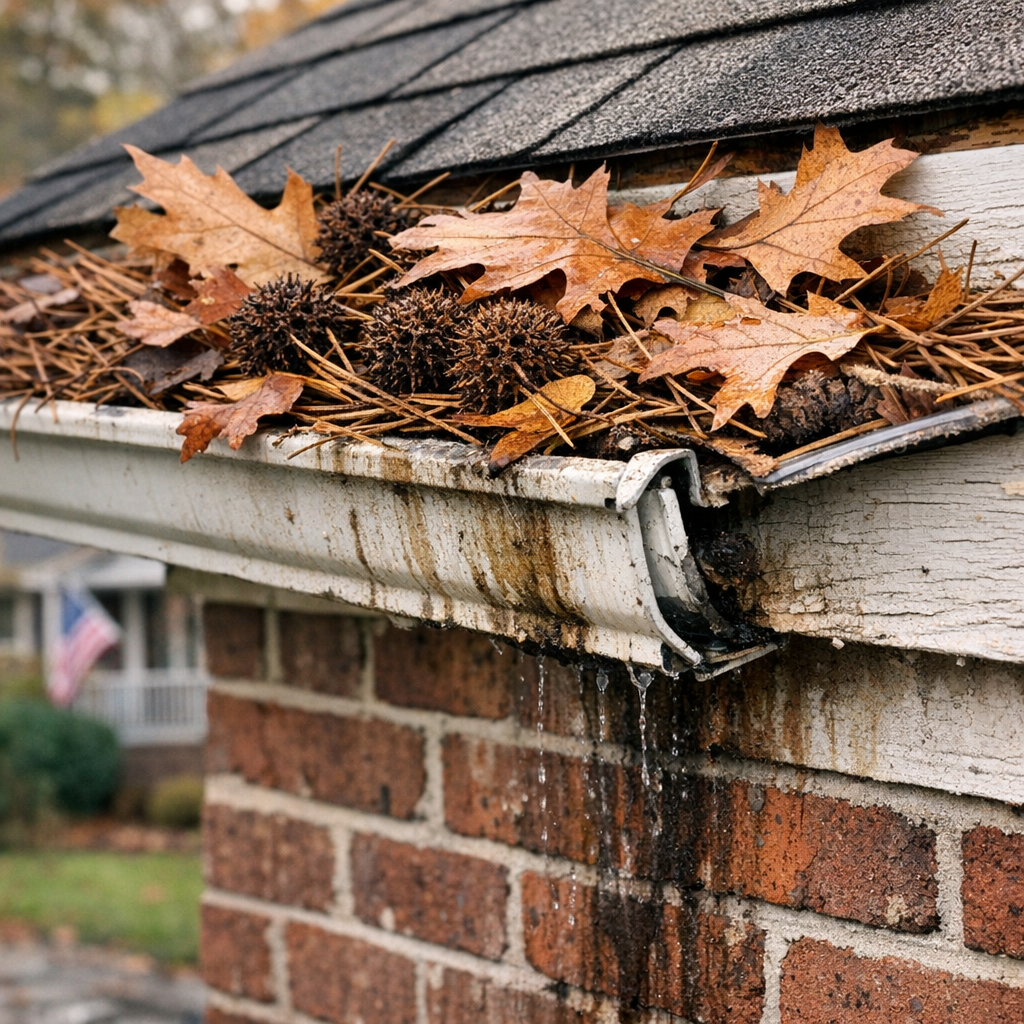
Competitors in the Greensboro market typically offer one piece of maintenance advice: clean your gutters twice a year. That’s not wrong, but it’s also not enough information for homeowners in established Triad neighborhoods where the tree canopy is dense and varied.
The Piedmont Triad’s mixed hardwood-pine ecosystem creates a debris cycle that runs across all four seasons, not just fall. Understanding that calendar helps you time maintenance correctly and choose protection products that actually match the debris types your home faces.
Greensboro’s spring season brings two debris types that are disproportionately damaging relative to their size:
A spring cleaning in late April or early May — after peak pollen season — addresses these accumulations before summer storm season begins.
Piedmont thunderstorms strip twigs, helicopter seeds from tulip poplars, and small branch sections from the tree canopy. This debris can accumulate quickly after a single storm event, and it lands on top of whatever fine particles were already present. If spring maintenance was skipped, summer storms compound the problem significantly.
The classic fall cleaning window — late October through November — is when deciduous leaf drop peaks. Established Greensboro neighborhoods like Fisher Park, Irving Park, and Starmount have mature oak and maple trees that produce large, dense leaf volumes. This is the most important maintenance window for most homeowners in the area.
Not all guards perform equally across this debris calendar. Here’s a practical comparison:
| Guard Type | Pine Needles | Large Oak Leaves | Sweet Gum Pods | Pine Pollen / Fine Particles | Debris Self-Clearing |
|---|---|---|---|---|---|
| Screen / mesh (standard) | Poor — needles pass through or bridge | Moderate | Poor — pods catch on screen | Poor — paste clogs mesh | Low |
| Reverse curve / surface tension | Poor — needles follow water in | Moderate | Moderate | Moderate | Moderate |
| Foam insert | Poor — needles embed in foam | Moderate | Moderate | Poor — pollen fills pores | Very low |
| Micro-mesh (quality grade) | Good — needles sit on surface | Good | Good | Moderate — requires periodic rinsing | High |
| Solid cover with trough edge | Good | Good | Good | Good | High |
The takeaway for Piedmont Triad homeowners: micro-mesh guards, when properly specified and installed, provide the most consistent performance across the full debris calendar. However, “micro-mesh” is not a uniform category — the opening size, frame material, and attachment method vary significantly between products. For a comprehensive breakdown of how different guard types stack up, the article Gutter Guards vs Leaf Guards: Which Is Right for You? walks through the key differences in detail. A guard that works well against large oak leaves may still allow pine pollen to accumulate unless the mesh is fine enough and the surface angle is steep enough to promote self-clearing.
Most homeowners think of a gutter problem as a gutter problem. In reality, the gutter is just the first link in a chain. When it fails, the damage appears downstream — in the components and systems it was protecting.
The fascia board is the primary attachment surface for your gutter system and the front face of your roof’s edge. When gutters overflow consistently or pull away from the roofline, water runs directly across the fascia rather than through the downspout. Fascia boards that are repeatedly wetted and dried will begin to delaminate, soften, and eventually rot — often from the back face first, which means the damage is advanced before it’s visible from the ground.
Soffit damage follows a similar pattern. Once moisture is introduced to the soffit cavity — through overflow, through fascia deterioration, or through improper flashing at the gutter line — it creates conditions for wood decay and, in crawl space-heavy construction common in Greensboro’s older neighborhoods, can introduce moisture pathways into the structure.
As covered earlier, Greensboro’s clay-heavy soil profile makes foundation drainage a legitimate concern. Gutters that direct water close to the structure — through overflow, improper downspout discharge, or inadequate extension length — saturate the soil immediately adjacent to foundation walls.
The symptoms of this problem often appear inside the home: efflorescence on basement block walls, a persistent musty odor from the crawl space, or hairline cracking in foundation mortar that expands slowly over several years. None of these are immediately attributed to gutters, but inadequate water management at grade is a primary driver.
A more immediately visible consequence of gutter overflow is the erosion channels that develop in the landscaping directly below failure points. Repeated high-volume discharge in the same location strips topsoil, undermines plantings, and eventually creates grade changes that can direct water toward the foundation rather than away from it.
Aluminum remains the dominant gutter material for residential installation in the NC Triad, and for good reasons that go beyond cost. It doesn’t rust, handles thermal expansion reasonably well when installed with proper technique, and is available in a wide range of profiles and colors. For seamless installations, aluminum is the standard rollformer material.
In Greensboro’s climate — with its combination of humid summers, moderate UV exposure, and freeze-thaw cycles — aluminum’s performance profile is well-matched. A quality aluminum gutter with proper gauge (0.027 inches is a common residential standard; 0.032 inches provides additional rigidity on longer runs) will provide decades of service when installed correctly.
Galvanized or painted steel gutters are heavier and more rigid than aluminum, making them appropriate for applications with unusual span requirements or high snow/ice loads. They are not commonly specified for standard residential work in Greensboro but have applications in commercial and specialty projects.
Copper gutters are a premium option that develops a natural patina over time. They’re most commonly specified for historic homes or high-end architectural projects where aesthetics are a priority. The material cost is substantially higher, but the service life — measured in decades — can justify the investment on the right property.
Vinyl gutters are an entry-level option that can be appropriate in limited circumstances. The limitation in the Greensboro climate is UV degradation: vinyl becomes brittle with extended sun exposure, which can lead to cracking and joint failure over time. For a permanent, low-maintenance installation, aluminum or copper provides a better long-term return.
When Smithrock Roofing visits your home to assess your gutter system, we’re not just counting linear footage. A thorough assessment covers:
We’ll give you a straight answer about what we find, including if something is fine and doesn’t need to be replaced. That’s the kind of honest assessment we’d want if the shoe were on the other foot.
For homeowners who want to dig deeper into the engineering behind gutter sizing and drainage standards, the following resources are authoritative starting points:
Smithrock Roofing serves homeowners across Greensboro, Winston-Salem, High Point, Kernersville, Clemmons, Rural Hall, King, and the surrounding NC Triad. With 60+ combined years of experience and an A+ BBB rating, we’re the neighbor you call when you want honest answers and work that lasts.
If you’re planning ahead for your home’s exterior maintenance, here are three concrete steps worth taking before next year’s storm season arrives:
Schedule a post-winter gutter inspection in early spring. Greensboro winters — even mild ones — put stress on hangers, seams, and downspout joints through freeze-thaw cycling. A professional eye in March or April catches fatigue before the heavy spring rains expose it the hard way. Smithrock Roofing offers full system assessments that evaluate everything from fascia attachment to discharge clearance.
Evaluate your gutter guard situation before leaf season. If you currently have no protection, or if your existing guards have been underperforming, mid-summer is the ideal window to make a change. You’ll have the installation complete before fall debris volume peaks, and you’ll enter the following spring with a system that’s had a full season to prove itself under real Piedmont conditions.
Document your current system with photos now. Homeowners who keep a simple photo record of their gutters, fascia, and downspout discharge points have a meaningful advantage when something changes. You’ll be able to tell whether a sag is new, whether a seam gap has grown, and whether discharge is migrating closer to your foundation over time. It takes ten minutes and costs nothing.
Most Greensboro homeowners benefit from cleaning gutters at least twice a year — once in late fall after the bulk of leaf drop is complete, and once in early spring to clear out debris that accumulated over winter. Homes surrounded by pine trees or near heavy canopy coverage may need an additional mid-summer cleaning, since pine needles and seed pods fall year-round and are particularly effective at clogging downspout inlets.
Five-inch K-style gutters handle the majority of residential rooflines in the NC Triad reasonably well, but the right answer depends on your roof’s drainage area, pitch, and how your downspouts are positioned. Larger roofs, steeper pitches, or valleys that concentrate runoff into a single section often warrant six-inch gutters. A proper assessment accounts for Greensboro’s specific rainfall intensity data rather than defaulting to a one-size-fits-all answer.
For most homeowners, yes. Sectional gutters have joints every ten feet or so, and every joint is a potential leak point — especially as caulk ages and metal expands and contracts through seasonal temperature swings. Seamless gutters are fabricated on-site to the exact length of each run, which eliminates the majority of those failure points. Over the life of the system, that reduction in leak risk and maintenance frequency tends to justify the difference in upfront investment.
The most common indicators are soil erosion or mulch displacement directly below gutter sections, water staining on foundation walls or in crawl spaces following rain events, and ground that stays saturated near the house long after a storm passes. If downspouts are discharging too close to the foundation, or if gutters are overflowing due to blockage or undersizing, the water has to go somewhere — and over time, that somewhere is often into the soil surrounding your footer. A gutter assessment that includes evaluating discharge distance and direction can identify whether your current setup poses that kind of long-term risk.
Greensboro’s mix of hardwood canopy, clay-heavy soil, and concentrated storm rainfall makes a well-functioning gutter system less of an optional upgrade and more of a genuine line of defense for your home’s structure. Smithrock Roofing has spent decades helping homeowners across Greensboro and High Point protect their foundations, fascia, and interiors with honest assessments and installations built to hold up through real NC weather — not just ideal conditions. If you’re ready for a straight answer about what your gutter system actually needs, Contact Smithrock Roofing and we’ll schedule a no-pressure evaluation at your convenience.

Smithrock Roofing © Copyright 2026 • All Rights Reserved • Privacy Policy • Maintained by Mongoose Digital Marketing