
If you’ve searched “gutter guards vs. leaf guards” and ended up more confused than when you started, you’re not alone. Most of what shows up in search results is either a product listing, a brand homepage, or a retail category page. None of them actually answer the question you’re asking.
So let’s settle it plainly: the terms “gutter guard” and “leaf guard” are mostly interchangeable marketing language. They both describe the same broad category of product, a protective system installed over or inside your gutters to reduce debris accumulation and keep water flowing where it belongs. The meaningful differences have nothing to do with what a product is called. They have everything to do with how the system works, what kind of debris it handles well, and whether it suits your specific roof, your local climate, and the trees on your property.
That’s the conversation this article is here to have.
At Smithrock Roofing, we’ve spent decades working on homes across Winston-Salem, Greensboro, High Point, KernersvilleClemmons, Rural Hall, King, and the surrounding NC Triad. We’ve seen gutter protection systems perform beautifully, and we’ve seen expensive ones fail completely, often because the wrong product was matched to the wrong home. What follows is the honest, practical guidance we’d give any homeowner sitting across from us at their kitchen table.
Before diving into product types, it’s worth spending a moment on why this question gets confusing in the first place.
“Leaf Guard” is both a generic descriptive phrase and a registered brand name, LeafGuard® is a specific company that manufactures a proprietary one-piece seamless gutter and guard system. When homeowners search “leaf guard,” they may be thinking about debris protection generally, or they may have encountered the LeafGuard® brand specifically. The two are not the same thing, and conflating them can lead to comparing products that aren’t in the same category at all.
“Gutter guard” is the broader industry term for any device, screen, hood, mesh, brush, or foam insert, that sits on, over, or inside a gutter to prevent clogs.
For the purposes of this article, we’ll use “gutter guard” as the umbrella term and walk through the distinct types that fall under it, including hood-style systems like those LeafGuard® produces. The question isn’t which name is better. The question is which mechanism is right for your home.
Need a hand with this in Winston-Salem, Greensboro and the NC Triad? Call (336) 971-0464 or request a free estimate. Honest answers, no pressure.
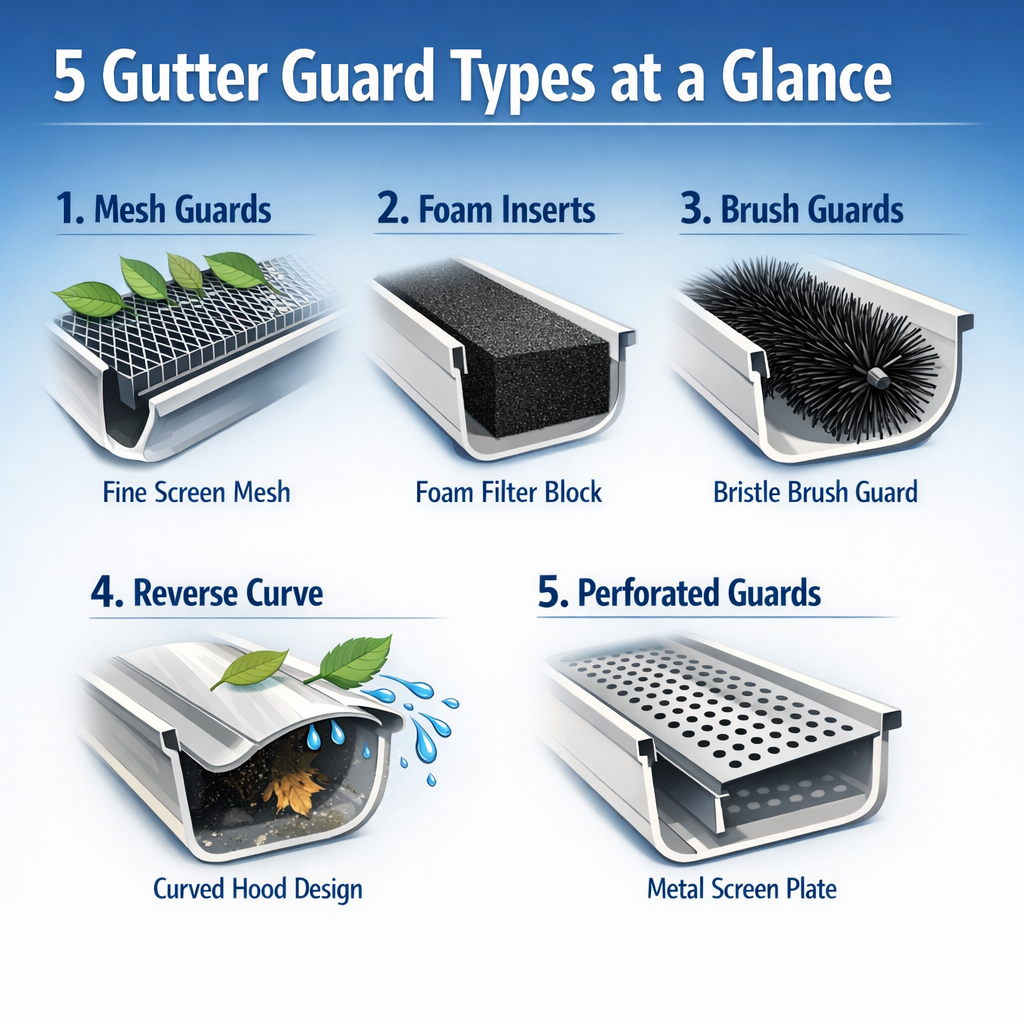
Understanding how each guard type functions is the foundation of making a smart decision. Every system uses one of five basic mechanisms. Here’s what each one does, and where each one struggles.
These guards feature a curved surface that encourages water to cling to the material and follow the curve down into the gutter opening, while leaves and larger debris are supposed to fly off the front edge. LeafGuard®’s system is the most well-known example of this design.
Where they work well: Large, flat debris like oak and maple leaves. When rainfall is moderate and consistent.
Where they struggle: High-intensity rainfall events, which are common across the NC Triad during summer storm season, can overwhelm the surface tension effect. When water volume exceeds what the curved surface can redirect, water overshoots the gutter entirely rather than flowing into it. This is sometimes called the “waterfall effect” or “overshoot,” and it can direct water straight down against your foundation. Additionally, small debris like pine needles and seed pods can follow the water curve right into the gutter rather than shedding off.
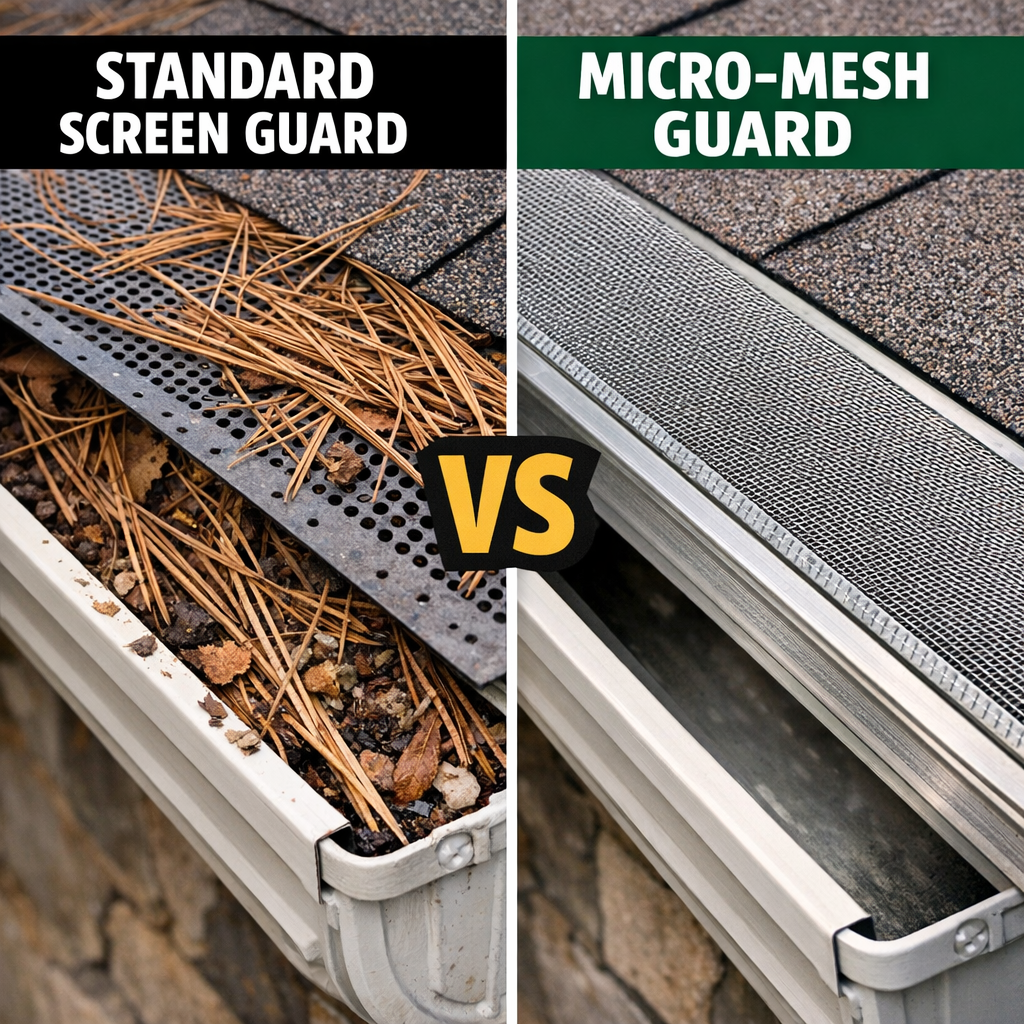
These use a finely perforated surface, typically stainless steel mesh, stretched over a frame that sits across the top of the gutter. Water filters through the tiny openings; debris sits on top and ideally blows away or dries and falls off.
Where they work well: High water-volume situations, roofs with moderate to steep pitch, and homes surrounded by a mix of tree types. When installed correctly, quality stainless steel micro-mesh is the most versatile performer across debris types.
Where they struggle: Pollen and fine shingle grit can gradually blind the mesh surface, reducing water flow over time. The NC Triad sits in one of the highest tree pollen zones in the countryif you’ve ever walked outside in April and found a yellow film on your car, you understand what we’re talking about. That same pollen accumulates on micro-mesh and can require periodic cleaning to maintain performance.
These are flat or slightly curved screens, typically aluminum or vinyl, with holes or slots that allow water through while blocking larger debris. These are the most common DIY-style guards found at hardware stores.
Where they work well: Homes with large, flat leaf debris and light to moderate tree coverage. They’re a reasonable choice for a homeowner who wants basic protection and is comfortable doing seasonal maintenance.
Where they struggle: Fine debris passes right through the openings. Pine needles are notorious for threading through standard screen guards and accumulating below the screen where they’re nearly impossible to clean without removing the guard entirely. Shingle grit and seed pods also pass through smaller screen openings.
Foam guards are porous triangular inserts that sit inside the gutter channel. Water theoretically passes through the foam while debris rests on top.
Where they work well: Very light debris loads and short-term use. They add no structural stress to the gutter.
Where they struggle: The porous surface is an ideal environment for seed germination. Maple helicopters, in particular, will root directly into foam inserts and be nearly impossible to remove without replacing the guard entirely. Moss and lichen spores also colonize foam readily. These require the most frequent maintenance of any guard type and have the shortest functional lifespan.
Similar in concept to foam, brush guards are cylindrical bristle inserts that sit inside the gutter. Large debris is supposed to rest on top of the bristles while water flows through.
Where they work well: Large leaf debris in low-volume situations.
Where they struggle: Pine needles and small debris work their way into the bristles and pack tightly, requiring hands-on cleaning that is often more difficult than cleaning an unguarded gutter. Like foam, these are also prone to seed germination.
This is where most homeowners, and, frankly, most product marketing, gets it completely wrong. The question is never “which guard is best?” The question is “which guard is best for the debris my trees produce?”
Every tree species sheds differently. A home surrounded by large white oaks in Greensboro faces a completely different problem than a home under a stand of loblolly pines in Kernersville, or a yard full of silver maples near Winston-Salem. Matching the wrong guard mechanism to the wrong debris type is the single most common reason homeowners end up disappointed.
Use this framework as your starting point:
| Debris Type | Why It’s Problematic | Best-Matched Guard Mechanism | Guards to Avoid |
|---|---|---|---|
| Large flat leaves (oak, maple, sycamore) | Bridge across wide screen openings | Reverse curve hood or micro-mesh | Brush inserts (debris compacts on bristles) |
| Pine needles & seed pods | Thread through screens, pack into brushes | Stainless steel micro-mesh with steep pitch | Basic screens, brush inserts, foam inserts |
| Maple helicopters (samaras) | Germinate inside foam and brush guards | Smooth-surface hood or stainless micro-mesh | Foam inserts, brush inserts |
| Shingle grit & fine sediment | Permanently clogs foam and fine mesh | Aluminum screen or open-style guard | Foam inserts, fine micro-mesh |
| Moss & lichen spores | Colonize any porous surface | Non-porous stainless mesh | Foam inserts, brush inserts |
| Mixed debris (multiple tree types) | No single debris profile dominates | Professional-grade stainless micro-mesh | Basic DIY screens |
A note for NC Triad homeowners specifically: If your home falls into the “mixed debris” category, a high-quality micro-mesh system professionally installed is typically the most reliable performer, with the understanding that seasonal inspection and occasional cleaning remain part of responsible home maintenance.
Here’s something you won’t find on a product packaging label: the performance of every gutter guard on the market is directly influenced by your roof’s pitch and how hard it rains in your area.
Pitch, the steepness of your roof, determines how fast water travels before it reaches the gutter. On a steeper roof, water moves faster and hits the gutter with more velocity. On a shallower roof, water moves slower and has more time to sheet across the surface.
For surface tension or reverse curve guardssteep pitch can be a disadvantage. Water arriving with high velocity has more momentum to carry it past the guard opening. The surface tension effect that the design depends on requires water to slow down and “grip” the curved surface, and fast-moving water doesn’t always cooperate.
For micro-mesh guardspitch is less of a concern for performance, but installation angle matters. A guard that lies flat on a shallow pitch may accumulate debris that never dries out or blows away; one installed on a steeper pitch tends to self-clear more effectively.
Our area receives meaningful rainfall throughout the year, with intense summer thunderstorms being a consistent seasonal feature. According to data from the National Weather Service Raleigh officeNorth Carolina’s Piedmont region regularly experiences high-intensity short-duration rain events, the kind that can deliver a significant volume of water in 15 to 30 minutes.
For homeowners in Winston-Salem, Greensboro, and surrounding communities, this matters directly for guard selection:
The practical takeaway: for homes in the NC Triad with steeper pitches and heavy seasonal storms, micro-mesh tends to be the more reliable long-term performer, provided it’s properly installed and inspected periodically.
This may be the most practically important point in this entire article, and it’s something almost no one in the industry talks about openly: certain gutter guard installation methods can affect your existing roof or gutter warranty.
There are three distinct installation approaches, and each carries different implications:
Several professionally installed micro-mesh systems attach by sliding a bracket underneath the first course of shingles along the eave. This technique disturbs the shingle seal line, the adhesive bond that keeps your bottom row of shingles lying flat and watertight.
Many roofing manufacturer warranties include language that voids coverage if the shingle installation is modified after the fact. Before agreeing to any guard system that uses this attachment method, ask your contractor directly whether the installation method is compatible with your current roofing warranty. A contractor who won’t answer that question clearly is a red flag.
These are common in DIY guard products and some entry-level professional installations. They clip to the front edge of the gutter using tension.
Over time, and particularly in climates with temperature swings like the NC Triad, where summers are hot and winters bring periodic freezes, repeated thermal expansion and contraction can stress the gutter’s front edge. This can cause K-style gutters to deform slightly, pulling them away from the fascia board and compromising the gutter’s attachment to the home. It’s a slow process, but it’s a real one.
Foam and brush inserts sit inside the gutter channel and don’t connect to the roof or the gutter’s structural edges at all. From a warranty and structural standpoint, they’re the safest option, zero stress added to existing components.
The trade-off, as covered above, is that they introduce their own maintenance demands and are the most prone to organic growth and debris compaction over time.
The honest advice here: before any guard installation, review your current roofing and gutter documentation, and ask your contractor to confirm that the installation method won’t affect any existing coverage. This is a straightforward conversation a reputable contractor should welcome. If you’d like to understand exactly what Smithrock Roofing stands behind on every project, you can review our warranty details directly.
One last factor that rarely comes up in homeowner conversations but matters significantly: not all guards are designed to work with all gutter sizes.
Residential gutters in the NC Triad are most commonly either 5-inch or 6-inch K-style profiles, though some older homes have half-round gutters. Guard products are typically engineered to specific gutter dimensions. A guard designed for a 5-inch gutter installed on a 6-inch system will leave gaps at the edges, gaps that are often large enough for debris to enter freely, defeating the entire purpose of the system.
Before purchasing any guard product, whether at a hardware store or through a contractor, confirm that the product is rated for your gutter’s actual size and profile. If you’re not sure what size your gutters are, a quick measurement from the back wall to the front lip of the gutter will tell you. A qualified contractor can verify this during an assessment.
A number of gutter protection brands, particularly those selling hood and reverse curve systems, market their products with language suggesting you’ll never need to clean your gutters after installation.
Let’s be straightforward about this: every gutter protection system has a debris saturation threshold. Every single one. The question is not whether a system will eventually require attention, it’s how often and how easily that attention can be provided.
A well-installed, properly matched gutter guard system will meaningfully reduce how often you need to address your gutters. “Never” is a marketing claim, not an engineering reality. A contractor who tells you otherwise isn’t doing you any favors. At Smithrock Roofing, we’d rather set accurate expectations upfront than have a customer frustrated six months later.
Based on everything above, here are the questions that should drive your decision:
For a helpful breakdown of how different gutter protection systems perform across conditions, the Roofing Contractors Association of Texas and resources from the National Roofing Contractors Association provide additional technical context on drainage system performance and installation standards.
If you’re in Winston-Salem, Greensboro, High Point, Kernersville, Clemmons, Rural Hall, King, or anywhere across the NC Triad and you’d like an honest, no-pressure assessment of what your home actually needs, Smithrock Roofing is here to help. We’ll look at your gutters, your roofline, and your tree canopy and give you a straight answer, not a sales pitch.
As gutter protection technology continues to evolve and homes across the NC Triad face increasingly variable weather patterns, here are three concrete next steps worth taking before the end of 2026:
1. Schedule a Debris-Specific Site Assessment
Before purchasing any gutter guard system, have a qualified roofing contractor walk your property and document the actual debris your gutters collect across seasons. Pine needles, sweet gum balls, and oak leaf clusters all behave differently, and a visual inspection in late fall or early spring, when accumulation is most visible, will give you far more useful information than any product brochure. Ask the contractor to photograph problem zones and identify whether your current gutters are properly pitched and sized before any guard system is installed on top of them. Our gutters service includes exactly this kind of site-specific evaluation for NC Triad homeowners.
2. Cross-Reference Any Product Against NRCA Installation Guidelines
The National Roofing Contractors Association maintains updated guidance on drainage system performance and installation standards. Before committing to a system, ask your contractor whether the installation method aligns with these standards and whether it will interact with any existing roof or gutter warranty you hold. This one question can prevent a lot of headaches down the road.
3. Build a Simple Annual Gutter Maintenance Record
Regardless of which system you choose, start keeping a basic log, even a note in your phone, of when you or a contractor last cleared your gutters, what debris was found, and whether water was flowing freely at the downspouts. Over one to two full seasons, this record will tell you whether your current or new system is actually performing as expected, and it gives a contractor useful context if problems arise.
The terms are often used interchangeably in marketing, but they describe the same general category of product: a covering or filtering system installed over or inside your gutters to reduce how much debris enters and blocks water flow. The word “leaf guard” tends to emphasize protection from large debris like leaves, while “gutter guard” is the broader industry term. What matters far more than the name is the mechanism, whether it uses micro-mesh, reverse curve, foam, brush, or screen, and whether that mechanism matches the specific debris and rainfall conditions at your home.
In most cases, yes, but it depends on the condition, size, and profile of your existing gutters. Gutter guards are designed to fit standard gutter widths, but gutters that are already damaged, improperly pitched, or undersized for your roofline will perform poorly with any guard on top of them. A contractor should assess your existing gutters before installation and confirm the guard product is compatible with your specific gutter profile. Installing a guard over a gutter with problems just makes those problems harder to address later. For homeowners considering whether their gutters are worth protecting or due for replacement, the article Gutter Replacement: What Contractors Don’t Tell You walks through the key indicators in plain terms.
Every gutter protection system requires some level of periodic maintenance, the honest answer is that no product eliminates this entirely. How often depends on the system type, your tree canopy, and seasonal debris patterns in your area. Micro-mesh systems generally require less frequent cleaning than open screens or surface tension hoods, but all systems benefit from at least one inspection per year and a check after significant storms. Homes surrounded by pine trees or heavy leaf canopy may still need attention two to three times annually regardless of which system is installed.
This is a question worth discussing with your contractor before committing. If a full roof replacement is on the near-term horizon, timing the installation of gutter guards to coincide with or follow that project often makes practical sense, it avoids the possibility of disrupting a new guard installation during roof work and gives your contractor the opportunity to address any fascia or drip edge issues at the same time. If your roof has a longer expected lifespan, waiting isn’t necessary, but confirming that guard installation won’t affect your roofing warranty is an important step either way.
At the end of the day, the best gutter guard system is the one that’s correctly matched to your home, properly installed, and backed by a contractor who gives you straight answers. Homeowners across Winston-Salem and Greensboro trust Smithrock Roofing because we take the time to look at your actual roofline, tree canopy, and gutter condition before recommending anything, and we stand behind the work we do. If you’re ready for an honest, no-pressure conversation about what your home actually needs, we’d be glad to help. Get a Free Estimate and let’s take a look together.
Need a local pro? Learn more about our gutter installation and repair in High Point.
See also: Rain Gutter Guards: Find the Right Fit for Your Home

Smithrock Roofing © Copyright 2026 • All Rights Reserved • Privacy Policy • Maintained by Mongoose Digital Marketing