Most homeowners shopping for vinyl siding in High Point, NC focus almost entirely on the product itself, the color, the profile, the manufacturer name on the box. That’s understandable. The panels are what you see every day. But here’s what experienced exterior contractors know that most siding content never tells you: the quality of your installation matters more than the brand of panel you choose.
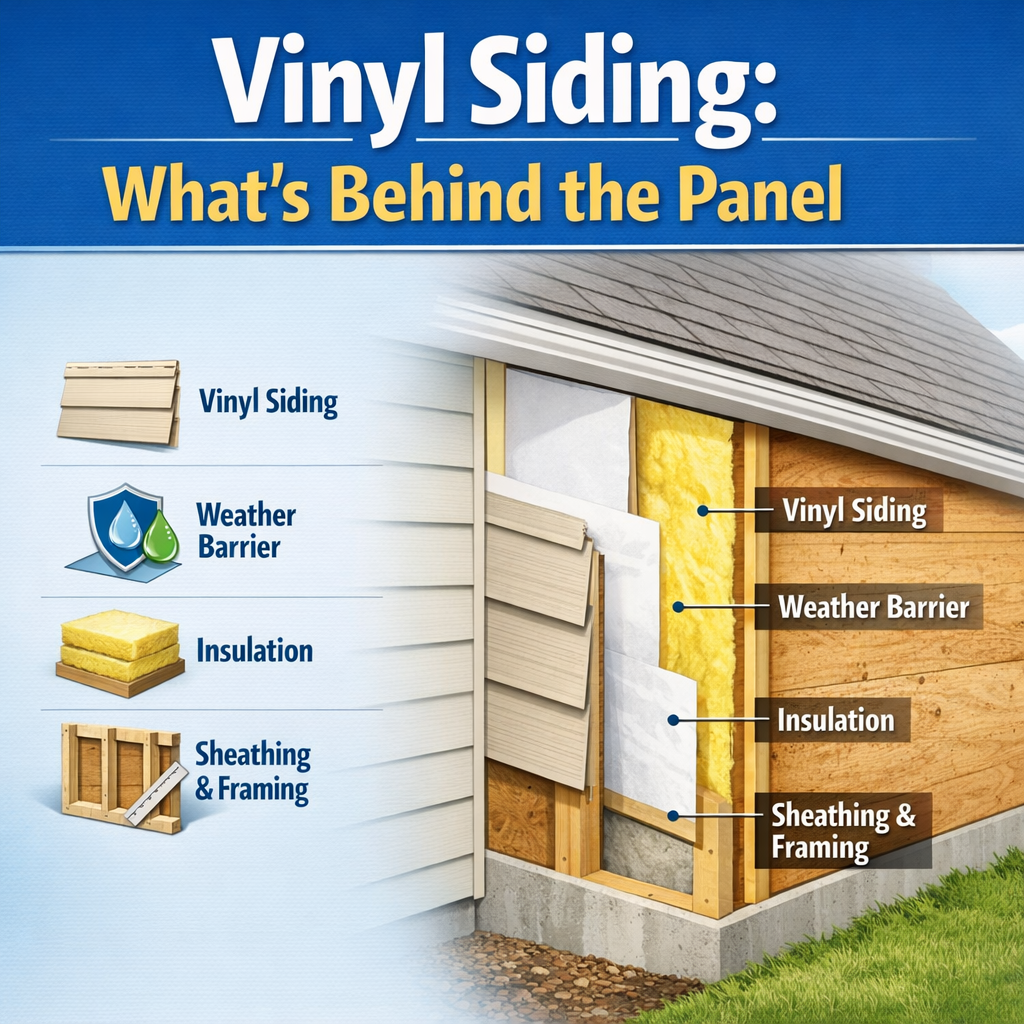
This isn’t a knock on quality materials, they absolutely matter. It’s a recognition that vinyl siding is a building enclosure system, not a decorative skin. Every component, from the housewrap layer directly against your sheathing to the way J-channel is cut at your window corners, works together to keep your home dry, efficient, and structurally sound over the long haul. Get those details right and your siding performs beautifully for decades. Get them wrong and you’ll be looking at buckling panels, hidden rot, and rising energy bills within a few years, regardless of which brand was installed.
At Smithrock Roofing, we’ve been working on homes across the NC Triad long enough to have seen both outcomes firsthand. What follows is an honest, technically grounded look at what vinyl siding installation in High Point actually involves, the climate factors, the substrate realities, and the installation details that separate work that lasts from work that disappoints.
Our area sits in IECC Climate Zone 4Aa mixed-humid zone that delivers both significant heating loads in winter and serious cooling loads in summer. That designation matters for siding installation because vinyl is a thermoplastic material: it expands and contracts with temperature changes. At approximately 0.4 inches of movement per 10°F of temperature change per 12-foot panelthe math adds up fast.
On south- and west-facing wall exposures in High Point, surface temperatures on a vinyl panel can exceed 150°F on a July afternoon and drop to near-freezing on a January night. That’s a swing of more than 120°F across the year, and it means every 12-foot panel on those exposures is moving roughly half an inch between its summer maximum and winter minimum position.
An installer who doesn’t account for this will:
The result isn’t immediate. The first summer or two may look fine. But thermal stress accumulates. By season three, you’ll see the characteristic S-curve buckle along panel runs, or panels that have pushed hard enough against corner posts to deform them. At that point, the only fix is reinstallation.
Correct technique is straightforward once you understand the mechanics: fasten through the center of each nail slot (not the edges), leave the fastener head with a small gap to allow panel movement, and always maintain the manufacturer-specified clearance at every trim connection. It costs nothing extra to do this correctly, it just requires knowing why it matters.
Our area regularly sees moisture and storm systems that bring wind-driven rain events, and humidity remains elevated through much of the year. These conditions matter because vinyl siding is not a waterproof systemit’s a weather-resistant cladding that’s designed to work in combination with the water-resistive barrier (WRB) beneath it.
Water gets behind vinyl siding. That’s normal and expected. The system is designed so that when it does, it drains down and out at the bottom of the wall. When the drainage plane is set up correctly, meaning the WRB is properly lapped, taped at seams, and integrated with window and door openings, this works exactly as intended for the life of the building. When the drainage plane is incomplete or improperly installed, that same moisture gets trapped, sits against the sheathing, and begins the slow process of wood degradation that most homeowners don’t discover until it’s already expensive.
Need a hand with this in Winston-Salem, Greensboro and the NC Triad? Call (336) 971-0464 or request a free estimate. Honest answers, no pressure.
A significant portion of residential neighborhoods in our area feature homes built between 1950 and 1985. During that era, the most common wall sheathing materials were board sheathing, Celotex fiberboard panels, and early-generation OSBall of which behave very differently than the modern Zip System or structural plywood sheathing used in newer construction.
These older substrates present three specific challenges that any experienced contractor needs to evaluate before the first vinyl panel goes on:
1. Degraded fastener-holding capacity. Fiberboard sheathing that has absorbed moisture over decades may no longer hold a nail reliably. If fasteners don’t seat securely in the substrate, the siding system can rack or pull away over time, particularly during high-wind events.
2. Inconsistent surface planes. Board sheathing installed in horizontal runs can create an uneven plane across the wall face, which affects how cleanly panels sit and whether starter strips and corner posts can be properly plumbed and leveled.
3. Compromised or absent original moisture barriers. Many pre-1980s homes were sheathed with felt paper that has since degraded, torn, or been partially removed during prior repairs. Installing new vinyl siding over a compromised or missing WRB without replacement puts the entire system’s moisture management at risk.
A thorough substrate assessment, walking the walls, probing suspect areas, identifying sections that need furring, partial re-sheathing, or additional blocking, isn’t an upsell. It’s the difference between an installation that performs correctly and one that transfers risk directly to you as the homeowner.
Some contractors will install new vinyl siding directly over existing siding to reduce labor. This practice requires careful evaluation. While it can work in specific circumstances, it carries real implications that homeowners deserve to understand upfront:
At Smithrock Roofing, our approach is to assess the existing conditions honestly and explain what we find before recommending an approach. The right answer depends on your specific home’s condition, not a blanket policy.
The first few steps of a vinyl siding installation establish the geometry for everything that follows. If the starter strip, the metal channel that holds the bottom course of siding, isn’t level, the entire wall will run visibly out of alignment by the time you reach the soffit line. If corner posts aren’t plumb and properly anchored, the horizontal panel runs won’t return correctly at the corners, leaving gaps that allow wind-driven rain direct access to the WRB layer.
Correct starter strip installation requires:
– Leveling across the full wall spannot just one section
– Securing with fasteners at the specified spacing so it doesn’t sag between attachment points
– Maintaining clearance from grade or roof surfaces per manufacturer specifications to prevent moisture wicking
Corner posts and J-channels must be:
– Plumb in both directionschecked with a level rather than assumed
– Nailed through the center of nail slots to allow vertical thermal movement
– Cut with a small relief at top and bottom where they meet horizontal trim to allow for expansion
The most common source of vinyl siding failure isn’t a damaged panel, it’s the connection between the siding system and the window or door openings it surrounds. This is where installation complexity increases significantly, and where inexperienced or rushed installers make decisions that don’t cause visible problems for five to eight years.
Here’s what proper integration requires:
| Location | What Correct Installation Looks Like | What Incorrect Installation Causes |
|---|---|---|
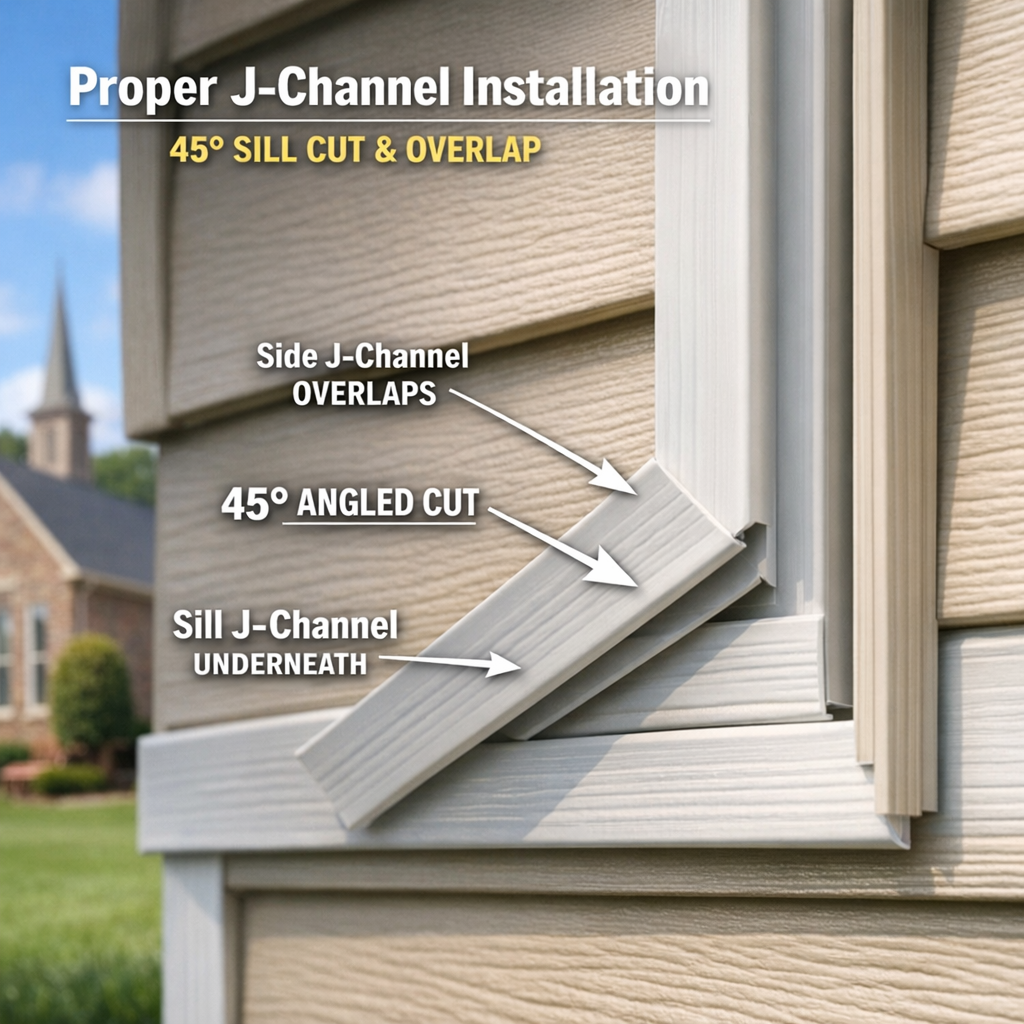
| Window sill | Sill pan flashing installed beneath window unit; J-channel cut at 45° at sill corners and lapped correctly to direct water outward | Water enters at sill corner cut, tracks behind J-channel, accumulates on rough opening sill, causes framing rot |
| Window sides | J-channel installed plumb; housewrap lapped over side flanges of window unit | Water infiltrates at flange edge, saturates sheathing along window jamb |
| Window head | J-channel at head installed last; housewrap lapped down over top flange; drip cap integrated correctly | Water runs behind head trim during rain events, enters wall cavity |
| Door threshold | Siding terminates above threshold height with proper clearance; sill flashing integrates with door pan | Siding termination too low collects debris and standing water, accelerates rot at door framing |
| Electrical/HVAC penetrations | All penetrations sealed with compatible flashing material before siding installed | Water infiltrates at penetrations, tracks down inside wall cavity |
Water that gets behind siding at these transition points doesn’t cause damage immediately. It causes rot in the rough opening framing and sill that typically reveals itself five to eight years after installation, often long after a short-term labor warranty has expired. Understanding this is the difference between an installer who thinks about siding as panels on a wall and one who thinks about it as a building enclosure system. If you want to understand exactly what a labor warranty should cover and how Smithrock’s terms are structured, that information is available before you sign anything.
Many established neighborhoods have active HOA covenants that govern exterior changes, including siding material, color, and profile selections. Communities in our area are among those where homeowners have reported HOA architectural review requirements for exterior modifications.
Before committing to a specific color or profile, it’s worth confirming whether your neighborhood has an architectural review process and what its approval timeline looks like. A reputable contractor will ask about this during the estimate conversation, not because it creates a hurdle, but because discovering a required approval after materials are ordered creates unnecessary delays and frustration.
Depending on the scope of your project, a building permit may be required by your local authority. Re-siding projects that involve structural repairs, sheathing replacement, or changes affecting the building envelope can cross permitting thresholds that a straight cosmetic re-skin might not. Working with a licensed, insured contractor ensures that permit requirements are identified and handled correctly before work begins, protecting you from code compliance issues that can surface during a future home sale.
For current permit requirements in Guilford County, the Guilford County Planning and Development department provides guidance on residential permit thresholds. The City of High Point Inspections Division also maintains current information on local building code requirements for residential exterior work.
For homeowners dealing with localized damage, a handful of panels impacted by a fallen branch or hail, matching existing siding presents a practical challenge that experienced contractors handle differently than inexperienced ones.
The core issue is this: vinyl siding profiles and colorways change. Manufacturers discontinue product lines, reformulate color batches, and retire profiles. A home sided ten years ago with a specific exposure width and color may have no direct equivalent in current production. Even when a similar profile exists, dye-lot variation between an older installed panel and a new replacement panel from the same manufacturer can produce a visible color mismatch, particularly on south-facing walls where UV exposure has faded the originals over time.
What this means practically:
For a deeper look at when patching makes sense versus when a broader replacement is the smarter call, the article Vinyl Siding Patch Repair: Fix It Right or Replace It? walks through the decision framework in detail.
An honest assessment of what’s realistically achievable, rather than a blanket “we can match anything” assurance, is what homeowners actually need when making repair decisions.
With 60+ combined years of exterior experience and deep familiarity with the NC Triad’s housing stock, Smithrock Roofing approaches every siding project the same way: with an honest assessment of what’s there before a single recommendation is made. That means substrate evaluation, WRB inspection, window and door integration review, and a clear explanation of what our team finds and why it matters.
Our A+ BBB rating and 312+ five-star reviews from homeowners across Winston-Salem, Greensboro, High Point, Kernersville, Clemmons, Rural Hall, and King reflect the same thing our team believes in the field: the right installation, done correctly the first time, is what protects your home and your investment.
When you’re evaluating any contractor for a vinyl siding project in High Point, here are the questions worth asking:
Vinyl siding done right is one of the most durable, low-maintenance exterior upgrades available to High Point homeowners. The panels, the system beneath them, and the hands that install them all matter equally. That’s the honest picture, and it’s the standard we hold ourselves to on every project.
The honest answer depends on what’s underneath the visible panels, not just what you can see from the street. If your current siding shows widespread warping, persistent moisture intrusion at windows or doors, or soft spots in the substrate beneath the cladding, a full replacement is likely the more sound long-term decision. Localized cracking or impact damage to a limited number of panels can often be addressed with targeted repairs, provided the underlying substrate and weather-resistive barrier are still intact. A proper substrate assessment before any recommendation is made is the only way to give a homeowner an accurate answer.
In most cases, yes. Local building departments typically require permits for full siding replacement projects, particularly when work involves changes to the building envelope, substrate, or moisture management system. Your contractor should pull the appropriate permits on your behalf. If a contractor proposes to skip the permit process, that is a meaningful red flag about how they approach compliance on the rest of the job as well.
Our area experiences a full range of seasonal stress, heat and humidity through summer, freeze-thaw cycling in winter, and periodic severe storm activity. For this climate, a minimum panel thickness in the .044″ to .046″ range is a reasonable starting point for durability, though heavier profiles offer additional impact resistance and dimensional stability. Dutch lap and beaded profiles both perform well here. More important than profile selection, however, is proper installation: panels that aren’t allowed to expand and contract freely will fail regardless of their grade, and that failure comes back to nailing technique and spacing, not the product itself.
On a single-story home with straightforward geometry and a substrate in sound condition, a professional crew can typically complete installation in two to four days. Two-story homes, complex rooflines, or projects that require substrate repair, new housewrap installation, or window flashing remediation will extend that timeline. Weather windows also matter in our area, installation in temperatures below 40°F requires adjusted handling protocols to prevent panel brittleness and cracking. A contractor who gives you a firm timeline before completing a substrate inspection is estimating, not planning.
Homeowners in High Point and across Guilford County deserve an exterior contractor who brings the same honesty to the assessment phase that they bring to the installation itself, and that is exactly what Smithrock Roofing has built its reputation on throughout the NC Triad. Whether your project is a full re-side on an older home in High Point or targeted repairs in Kernersville, our team brings licensed expertise, verified materials knowledge, and a labor warranty that actually means something. If you’re ready to get an honest evaluation of your home’s exterior, Get a Free Estimate and let’s start with the truth about what your home needs.
Need a local pro? Learn more about our siding installation and repair in High Point.

Smithrock Roofing © Copyright 2026 • All Rights Reserved • Privacy Policy • Maintained by Mongoose Digital Marketing