
If you’ve ever pulled a handful of wet, matted leaves from a gutter and wondered why it clogs so quickly, the answer isn’t bad luck. It’s geography. Winston-Salem sits in the heart of the Piedmont Triad, surrounded by one of the most gutter-unfriendly tree canopies in the Southeast — and most of the advice homeowners find online was written for somewhere else entirely.
The standard “clean twice a year” recommendation gets repeated everywhere. It sounds reasonable. But for a home in Ardmore, Reynolda Manor, or Sherwood Forest, that schedule can leave your gutters overwhelmed before you’ve even noticed a problem. Understanding why your gutters face the specific challenges they do — not just that clogs are bad — is what separates a protected home from one quietly accumulating damage behind the fascia.
At Smithrock Roofing, we’ve spent decades working on homes across the NC Triad. What we see in the field every season tells a different story than the generic guidance floating around online. This guide covers that real story.
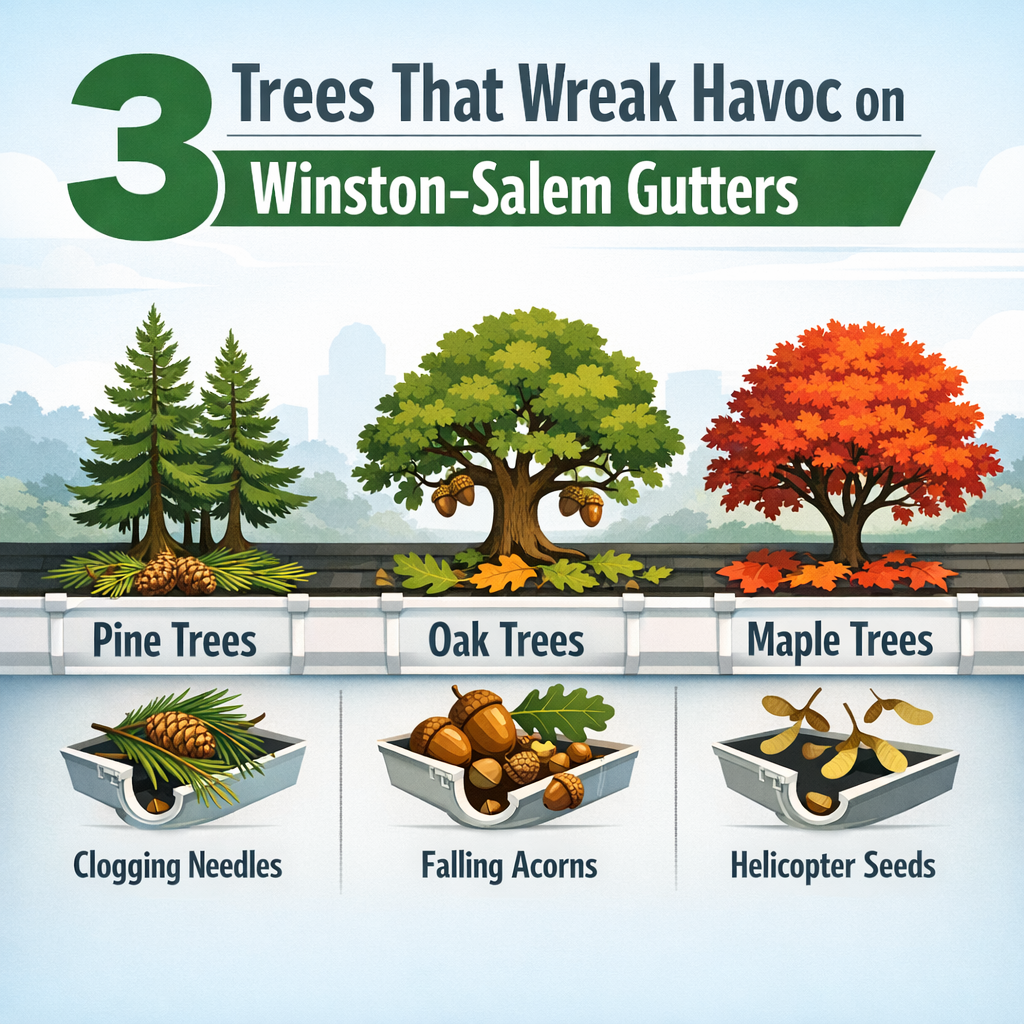
Most gutter cleaning content treats debris as one undifferentiated category: leaves fall, gutters clog, end of story. But the type of debris matters enormously, and the Piedmont Triad has a particularly aggressive mix of tree species that interact with gutters in different and compounding ways.
Willow Oaks are one of the most common street and yard trees across Winston-Salem’s established neighborhoods. They’re beautiful, long-lived shade trees — and a genuine problem for gutters. Their leaves are narrow, almost needle-thin, and drop in enormous volumes through late fall. That narrow profile means they slip through nearly every gutter guard mesh specification on the market and settle at the bottom of the trough. Once wet, they compact into a dense paste that standard flushing alone struggles to dislodge. If you have Willow Oaks overhanging your roofline and you’re relying on gutter guards for full protection, you’re likely experiencing this already.
Sweet Gum trees drop their signature spiky seed balls — sometimes called “gumballs” — in significant quantities from late September through early winter. Unlike soft leaves that decompose or compress, these seed balls are rigid and spherical. They don’t wash through the system. They roll directly into downspout elbows and lodge there, creating a blockage point that looks fine from outside and only reveals itself when water starts sheeting over the gutter edge during a storm. Many homeowners in the Triad attribute this to a roof leak when the actual culprit is a single seed ball wedged in a downspout elbow 12 inches below the gutter outlet.
From roughly March through May, Loblolly and other pine species in the region deposit a heavy, waxy pollen layer across every outdoor surface — including gutters. On its own, this pollen layer is mostly an aesthetic nuisance. But it creates a binding effect: subsequent leaf debris that would otherwise flush out of a clean aluminum trough now sticks to the pollen coat and builds up faster. This is why spring is not a safe period to defer gutter maintenance in this region, even though trees aren’t actively shedding leaves the way they do in fall.
The national standard advice — clean in spring and again in fall — was developed for temperate climates with two predictable debris seasons. The Piedmont Triad doesn’t operate that way, and following that schedule leaves real gaps in your home’s protection.
Winston-Salem receives between 44 and 46 inches of rainfall annually. That number alone isn’t unusual for the South — but how that rain falls matters. The Piedmont’s convective storm pattern produces frequent, high-intensity, short-duration events rather than slow, steady rain. When a summer storm drops an inch of rain in 45 minutes, a partially blocked gutter isn’t just inefficient — it’s overwhelmed. Water has nowhere to go except over the edge and down the exterior wall.
Unlike coastal North Carolina cities where rainfall is more seasonally concentrated, the Triad sees meaningful precipitation across nine or ten months of the year. A gutter clogged in September doesn’t get a reprieve. It faces a full storm load almost immediately.
The Piedmont sits at an elevation and latitude where winter weather frequently arrives as a transition between rain and ice rather than clean snowfall. When temperatures hover near freezing and precipitation is heavy, gutters with any debris load become prime sites for ice damming. Ice dams form when water backs up behind a blockage point, freezes in place, and then continues to expand with each freeze-thaw cycle. The weight stress on gutters and hangers is significant. More damaging is the water infiltration that can occur at the fascia and soffit as ice pries apart connections that were already under load. For a deeper look at what ice dams do and how to address them, the article How to Get Rid of Ice Dams covers the mechanics and remediation options in detail.
Competitors in this market almost never mention ice storm risk — likely because much of the content ranking for local gutter searches was written by companies that also serve warmer Gulf Coast or Deep South markets where this dynamic simply doesn’t exist. For Winston-Salem homeowners, it’s a real and recurring concern.
Given the three-species debris problem and the local rainfall pattern, a two-cleaning annual schedule leaves predictable gaps. A schedule that actually matches Triad conditions looks more like this:
| Cleaning | Timing | Primary Purpose |
|---|---|---|
| Late May | After pine pollen season ends | Remove pollen residue and spring debris before summer storm peak |
| Late August | After summer convective storm season | Clear buildup before fall leaf drop begins |
| Late November / Early December | After Sweet Gum and Willow Oak drop completes | Full pre-winter cleaning before ice season |
Three cleanings per year is not an upsell — it’s a defensible response to the actual conditions your gutters face in this climate. Depending on your specific tree coverage and roof pitch, some homes may genuinely manage on two, while others with heavy canopy may need attention four times. The point is that no rigid national schedule applies here without local reasoning behind it.
One of the most significant gaps in the information homeowners find online is that “clogged gutters” gets presented as a single problem with a single solution. In practice, gutters fail through distinct stages, and each stage calls for a different response.
This is the most common and most visible stage. Debris accumulates and the trough can no longer channel water to the downspouts. Water spills over the front edge during rain. Signs include water staining on exterior siding, saturated soil along the foundation, and visible debris mounds in the gutter channel. This is the stage where a cleaning is the right and complete solution.
Gutters that have been holding water and debris weight for extended periods begin to pull away from the fascia. On older homes with spike-and-ferrule fasteners — common in Winston-Salem’s mid-century housing stock — the spikes loosen progressively rather than catastrophically. From the ground, the gutter may look level and attached. Up close, there’s a gap developing between the back of the gutter and the fascia board. Water runs into that gap with every rain event, directly onto wood that was never meant to be exposed. At this stage, a cleaning alone isn’t sufficient — the hanger system needs evaluation and likely re-fastening.
When structural failure is left unaddressed, the fascia board behind the gutter begins to absorb moisture consistently. On homes from the 1945–1975 era — which make up a substantial portion of Winston-Salem’s Ardmore, Buena Vista, and Reynolda Manor neighborhoods — the original wood fascia has no modern moisture barrier protection. Dry rot sets in gradually and is often invisible until a gutter cleaning reveals soft, discolored wood behind the hanger. At this point, the repair scope has expanded well beyond gutter service.
The final and most serious stage involves the foundation, basement, or crawl space. The real mechanism here is soil behavior at the drip line — not simply “water near the foundation.” When gutters consistently overflow or when downspouts terminate too close to the home, the soil along the foundation goes through repeated saturation and drying cycles. This expansion-contraction movement is cumulative and, over years, contributes to foundation settlement and movement. Similarly, crawl space moisture from consistently saturated perimeter soil accelerates wood rot in floor joists and creates conditions favorable to pest activity. By the time these symptoms appear, the gutter maintenance failure is years in the past.
Most homeowners picture a professional gutter cleaning as debris removal and a hose flush. That’s the minimum. What separates a genuinely useful service visit from a surface-level clean is the inspection that happens alongside it.
A thorough professional visit should include:
If the company cleaning your gutters isn’t providing any of this information, you’re paying for debris removal and nothing else. That has value, but it leaves you without the context to make smart decisions about your home.
Gutter guards are marketed aggressively in this market, and the claims made for them deserve honest examination. The short version: guards reduce cleaning frequency for most homes, but no guard eliminates it — particularly in the Piedmont Triad’s debris environment. For a thorough look at how the major guard types compare in real-world conditions, the article Gutter Guards vs Leaf Guards: Which Is Right for You? breaks down the differences in a way that’s useful for homeowners making this decision.
Here’s how the common guard types interact with Triad-specific debris:
| Guard Type | How It Works | Performance with Willow Oak Leaves | Performance with Sweet Gum Balls | Performance in Heavy Rain |
|---|---|---|---|---|
| Surface tension / reverse curve | Water clings to curved surface and enters gutter; debris falls off | Poor — fine leaves follow the water curve and enter the gutter | Moderate — balls may roll off or get lodged at opening | Can overshoot in heavy convective events |
| Screen / mesh (standard) | Mesh allows water through; blocks larger debris | Poor — narrow leaves pass through most mesh sizes | Good — balls blocked at surface | Adequate in moderate rainfall |
| Micro-mesh | Very fine mesh filters out small debris | Good for most Willow Oak leaves | Good | Good, though surface requires periodic cleaning |
| Foam insert | Porous foam fills trough; water passes through | Poor — debris accumulates on top and seeds can root in foam | Poor — balls compact against foam surface | Degrades over time; not recommended |
| Brush insert | Bristle brush fills channel | Very poor — bristles trap fine debris and Willow Oak leaves | Poor — seeds embed in bristles | Not recommended for this region |
Micro-mesh is generally the most effective option for the Triad’s debris profile, but it still requires periodic surface cleaning — the pollen layer from pine season can partially seal even fine mesh. Any contractor selling guards as a permanent, maintenance-free solution is overstating the technology.
A significant share of Winston-Salem’s residential neighborhoods — particularly Ardmore, Buena Vista, Sherwood Forest, Reynolda Manor, and comparable areas in Kernersville and High Point — were developed between 1945 and 1975. This housing stock has real and specific vulnerabilities that newer construction doesn’t face.
Original wood fascia boards remain on many of these homes. Unlike modern composite or PVC fascia, wood is highly susceptible to moisture damage when gutters fail even briefly. Extended overflow events, even minor ones, accelerate dry rot in a way that can compromise the entire gutter mounting system within a few seasons.
Spike-and-ferrule fasteners were standard installation hardware for decades. The spike is driven through the gutter face, through a metal ferrule inside the trough, and into the fascia. Over time — especially after years of debris weight and ice loading — these spikes work loose. The gutter shifts forward, the gap behind it allows water infiltration, and the fascia deteriorates. Converting loose spikes to hidden hanger screws is a straightforward repair, but only if someone identifies the problem during an inspection.
Brick veneer exteriors, common in mid-century Winston-Salem construction, present a specific overflow risk. The mortar joints at the roofline are not indefinitely waterproof. When gutters overflow consistently, water saturates the top courses of brick, migrates through aging mortar joints, and appears inside the home as a ceiling or wall stain. Homeowners — and sometimes contractors — diagnose this as a roof leak and pursue costly repairs in the wrong place. The actual fix is gutter maintenance and possible mortar repointing, a fraction of the cost of unnecessary roofing work.
Understanding the construction history of your specific neighborhood isn’t background information — it’s directly relevant to how you maintain and protect your home.
The market for gutter services in Winston-Salem includes everything from national franchise operations to individual handymen. The right questions to ask before hiring come down to a few fundamentals:
At Smithrock Roofing, our gutter services are backed by 60-plus combined years of experience on Triad homes specifically — not generic exterior experience transplanted from another market. We hold a CertainTeed PREMIER ShingleMaster certification, carry full licensing and insurance, and maintain an A+ BBB rating supported by more than 312 five-star reviews from homeowners across Winston-Salem, Greensboro, High Point, Kernersville, Clemmons, Rural Hall, and King.
When we clean gutters, we’re also looking at the roof edge, the fascia condition, and the downspout drainage path — because in this region, those systems are connected, and a problem in one almost always has implications for the others.
For more information on how gutters interact with your broader roofing system, the National Roofing Contractors Association publishes homeowner guidance on exterior maintenance that’s worth reviewing. The North Carolina Department of Insurance also maintains licensing verification tools so you can confirm any contractor’s credentials before signing anything.
Gutter cleaning isn’t the most dramatic home improvement conversation, but it’s one of the most consequential. In Winston-Salem’s climate — with its specific tree species, its convective rainfall pattern, its ice storm risk, and its significant inventory of older homes with original wood components — deferred gutter maintenance doesn’t stay contained. It compounds.
The good news is that the solution is straightforward: clean on a schedule that matches your actual environment, choose a company that treats inspection as part of the service, and address what the inspection finds before small repairs become large ones. That’s not complicated advice. But it’s advice built on real experience in this specific region — and that’s the difference between guidance you can actually rely on and generic content that happens to mention your city’s name.
As you plan your home maintenance calendar for the coming year, three steps stand out as particularly valuable for Winston-Salem homeowners who want to stay ahead of gutter-related problems rather than react to them.
1. Schedule a Post-Winter Inspection Before Spring Pollen Season Hits
Late February or early March — before the Bradford pears and pine trees begin dropping — is the ideal window to assess any ice storm or freeze-thaw damage from winter and clear whatever accumulated during fall and early winter. Waiting until pollen season is already underway means cleaning gutters that are already working harder than they should be.
2. Ask Your Contractor to Document Fascia and Soffit Condition Annually
Given how many Winston-Salem homes have original wood fascia, a simple photo record taken during each cleaning visit gives you a year-over-year comparison that’s genuinely useful. Deterioration that happens gradually is easy to miss without a reference point. Requesting this documentation costs you nothing and can save significant repair expense down the road.
3. Evaluate Whether Gutter Protection Is a Fit for Your Specific Tree Canopy
Gutter guards are not a universal solution, but for homes surrounded by the fine debris producers common to this region — sweet gums, loblolly pines, and river birches especially — the right guard system can meaningfully extend the interval between cleanings. Have that conversation with your contractor based on your actual lot conditions, not a general sales pitch.
Most Winston-Salem homes need gutter cleaning at least twice a year — once in late spring after tree flowering and pollen season, and once in late fall after deciduous trees have fully dropped their leaves. Homes with heavy tree canopy, particularly those near sweet gums, oaks, or pine trees, often benefit from a third cleaning in late summer. The region’s convective storm pattern means debris accumulates faster here than national averages suggest, so a schedule built around your specific lot is more reliable than a generic twice-yearly recommendation.
Clogged gutters can’t move water away from the roofline fast enough during heavy rainfall, which is common in the Piedmont Triad. When water backs up, it can saturate fascia boards, seep under shingles at the roof edge, overflow against the foundation, and erode landscaping near the home’s perimeter. In older Winston-Salem homes with original wood components, even a single significant overflow event can initiate rot that takes months to become visible but is already causing structural damage.
Sometimes, but not reliably. Visible overflow during rain, plants growing from gutters, sagging sections, and staining on siding are all signs you can spot without a ladder. However, partial clogs at downspout openings, early fascia deterioration behind the gutter, and minor joint separations are not visible from ground level. A proper inspection requires getting eyes on the gutter interior, the back wall where the gutter meets the fascia, and the condition of the hangers — none of which are assessable from the yard.
Gutter maintenance won’t change your premium directly, but deferred maintenance can affect how a claim is handled. North Carolina homeowner’s insurance policies typically exclude damage resulting from neglect or lack of maintenance. If water intrusion at the fascia, soffit, or foundation is traced back to chronically clogged gutters, an insurer may deny or reduce the claim on the basis that the damage was preventable. Keeping a record of regular professional cleanings provides documentation that you maintained the system appropriately — which is worth having if you ever need to file a claim.
Gutters are a small system with an outsized impact on everything connected to them — and in a climate like Winston-Salem’s, that impact is felt more than most homeowners realize until something goes wrong. Smithrock Roofing proudly serving Winston-Salem, Greensboro, High Point, and Kernersville brings the kind of region-specific knowledge that turns routine maintenance into genuine protection, whether you’re in an older Craftsman neighborhood in Winston-Salem or a newer development in Kernersville. If you’re ready to get on a schedule that actually fits your home and your trees, Get a Free Estimate and let’s start with an honest look at what your gutters need.

Smithrock Roofing © Copyright 2026 • All Rights Reserved • Privacy Policy • Maintained by Mongoose Digital Marketing