Most homeowners in Winston-Salem don’t think about their roof until something forces them to. A brown stain spreading across a bedroom ceiling after a storm. Shingles collecting in the gutters after a windy November week. A home inspection report flagging “granule loss” without any further explanation.
When that moment arrives, the pressure to make a fast, confident decision falls on someone who — through no fault of their own — has never had to think carefully about roofing before. You search online, every contractor’s website says essentially the same thing: licensed, insured, free estimate, local and trusted. The differences are hard to see.
That’s exactly why this guide exists.
At Smithrock Roofing, we’ve spent decades working on homes across Winston-Salem, Greensboro, High Point, Kernersville, Clemmons, Rural Hall, and King. What we’ve learned is that the homeowners who make the best decisions aren’t the ones who found the lowest bid — they’re the ones who understood enough to ask the right questions. This guide is built around giving you that understanding.
We’re going to cover the things that rarely come up in a competitor’s brochure: why Winston-Salem’s climate is harder on roofs than most homeowners realize, what’s actually happening inside your roof system right now, the specific risks that come with living in a historic neighborhood, and what separates a roof that lasts 30 years from one that struggles to reach 15.
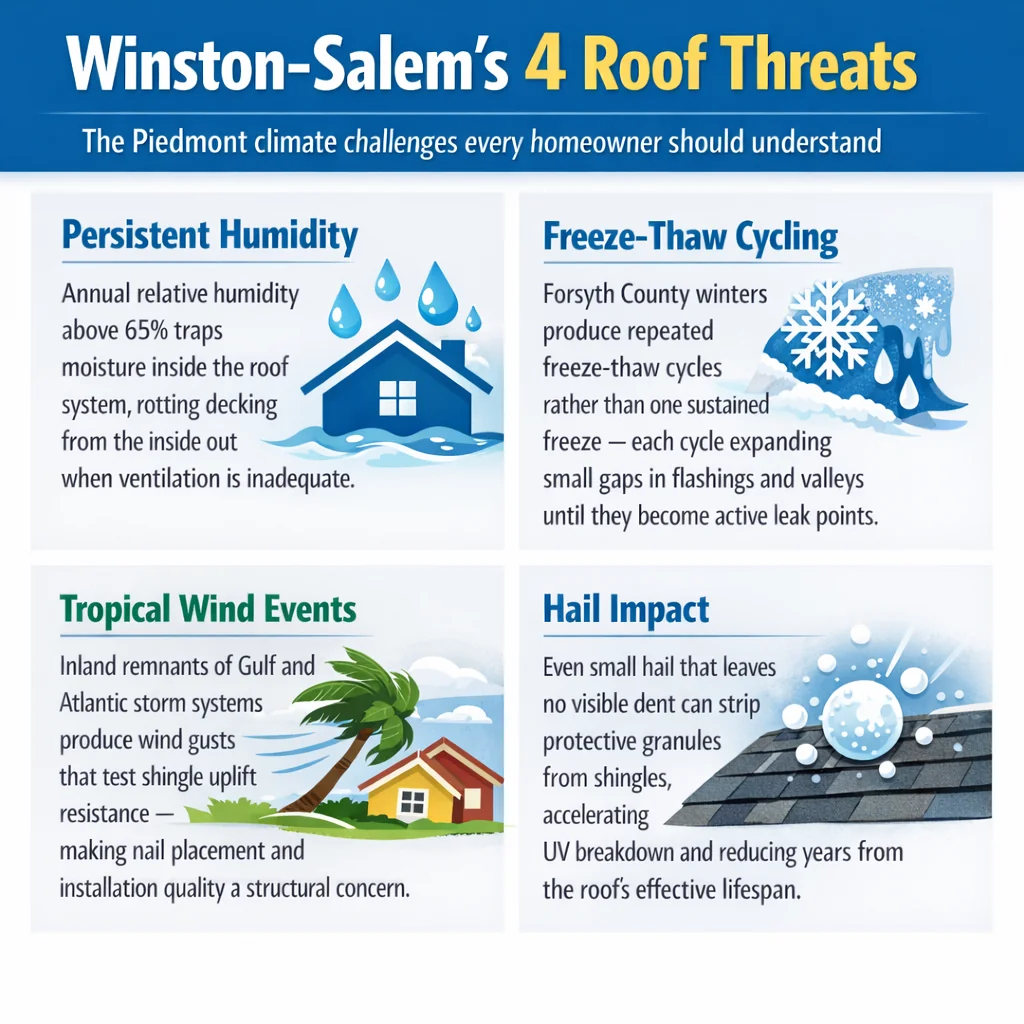
Winston-Salem sits in the NC Piedmont Triad — geographically positioned to absorb moisture from both the Atlantic coast and the Blue Ridge foothills. The result is a climate that stays persistently humid for most of the year. Average relative humidity in Forsyth County regularly exceeds 65%, and during summer mornings it routinely climbs above 85%.
That moisture doesn’t just sit in the air. It works its way into every porous surface of your home’s exterior — including the wood decking beneath your shingles. When attic ventilation is insufficient, that moisture has nowhere to go. It accumulates in the sheathing, feeds mold and mildew, and begins a slow degradation process that no shingle can prevent. By the time a homeowner notices a problem, the deck may already be compromised.
This is why a roof inspection in Winston-Salem has to go beyond the surface. A contractor who only looks at shingles is leaving the most important part of the assessment undone.
People often assume that Northern cities take the worst beating from winter weather. But from a roofing perspective, a climate like Winston-Salem’s — where temperatures cross the freezing threshold repeatedly throughout the winter rather than staying frozen — can be more damaging than one that simply stays cold.
Each freeze-thaw cycle forces water that has infiltrated small cracks and gaps to expand and contract. Over a single winter, Forsyth County homes can experience dozens of these cycles. Every cycle widens the gap a little more. What began as a minor gap around a flashing seal or a small crack in a valley can become a pathway for water infiltration within a few seasons.
The practical takeaway: minor roofing issues in Winston-Salem don’t hold steady. They get worse, predictably, every winter. Addressing small problems before November arrives is always the better path.
Winston-Salem is far enough inland that homeowners sometimes assume they’re protected from hurricane-force weather. The record tells a different story. Post-hurricane wind events from systems like Florence and Michael produced significant wind gusts across Forsyth County, well above what standard residential roofing is typically tested against without proper installation.
Hail is also more frequent in the Piedmont than many residents recognize. Even hail that doesn’t leave visible dents on a shingle can dislodge the protective granule layer, accelerating UV degradation and shortening the roof’s effective lifespan by years. If you’ve recently experienced a storm event, the Hail Damage Roof Repair: What You Can’t See article breaks down exactly what inspectors look for after impact.
If you asked most homeowners what determines how long their roof will last, they’d point to the shingles. That’s understandable — shingles are visible, they carry the warranties, and they’re what you discuss with a contractor during a sales call. But the roofing professional’s honest answer is different: proper attic ventilation may matter more than any material choice you make.
Here’s the core principle. Your attic is a buffer zone between your living space and the outside environment. For that buffer to function correctly, air needs to move through it continuously — cool, dry air entering at the soffit vents low on the roof, warm moist air exhausting through ridge vents at the peak. This movement is what keeps the underside of your decking dry in summer, prevents dangerous heat buildup, and stops moisture from condensing against the wood and insulation during cooler months.
When this system is blocked, imbalanced, or was never properly designed, heat and moisture accumulate. In Winston-Salem’s humid climate, that accumulation is not a minor inconvenience — it is an active decay process. Sheathing begins to soften. Rafters can show mold staining. In winter, moisture that condenses against cold roof surfaces can produce frost on rafters or visible moisture damage on insulation.
The International Residential Code (IRC) provides a baseline standard: one square foot of net free ventilation area for every 150 square feet of attic floor space, divided roughly equally between intake (soffit) and exhaust (ridge or upper vents). This is known as the 1:150 ratio.
In practice, many older Winston-Salem homes — particularly those built before updated energy codes tightened construction standards — were either under-ventilated from the start or had their ventilation inadvertently blocked during subsequent renovations. Adding attic insulation is a common culprit: if insulation is pushed to the eaves without maintaining a clear channel above it, intake ventilation is effectively eliminated even if the soffit vents are still physically present.
A competent roof inspector will assess net free area at both intake and exhaust, verify that airflow paths aren’t blocked, and flag imbalances that will shorten the life of whatever roof system goes on top.
Signs of ventilation failure to watch for:
If a roofing contractor proposes to install a new roof on your home without assessing these factors, that is a meaningful red flag. A new roof laid over compromised decking — regardless of shingle quality or warranty — will underperform and may fail prematurely.
The roofing industry has a communication problem. Because shingles are what homeowners see, they tend to anchor all their questions and decisions there. But shingles are the outermost layer of a multi-component system, and every component underneath them contributes to how well the whole system performs.
Here’s a breakdown of what a properly specified roof system should include — and what each component actually does:
| Component | Function | What Inferior Specification Looks Like |
|---|---|---|
| Roof Decking (Sheathing) | The structural foundation everything attaches to; typically 7/16″ or 1/2″ OSB or plywood | Delaminated, soft, or mold-stained boards that weren’t replaced during tear-off |
| Drip Edge Metal | Directs water away from the fascia board at eaves and rakes; prevents fascia rot | Thin, lightweight gauge metal or complete absence at rake edges |
| Ice and Water Shield | Self-adhering membrane applied at eaves and in valleys; prevents ice dam infiltration and valley leaks | Skipping valleys or applying only a single-course at eaves below minimum code depth |
| Synthetic Underlayment | Secondary water barrier across the full deck surface beneath shingles | Using outdated 15 lb felt, which tears easily during installation and degrades faster |
| Starter Strip Shingles | Pre-adhesived shingles at eaves and rakes; provide the first row’s seal and wind resistance | Using cut-down standard shingles instead of purpose-made starter strips |
| Architectural Shingles | The visible, weather-facing surface layer | Selecting builder-grade products that meet minimum code but sacrifice longevity |
| Ridge Cap Shingles | Purpose-made caps for the ridge line; provide weather protection at the most exposed seam | Using cut shingles, which lack the required thickness and adhesive for this application |
| Pipe Boots and Flashings | Seal penetrations and transitions (chimneys, walls, skylights, valleys) | Using worn or reused old flashings; applying only caulk rather than proper metal step flashing |
| Attic Ventilation System | Maintains airflow balance to prevent heat and moisture buildup | Imbalanced or blocked ventilation, or no assessment performed prior to installation |
At Smithrock Roofing, we use CertainTeed Landmark shingles backed by their full system warranty program — but the reason our roofs perform long-term is that every component in this table gets proper attention, not just the shingles.
One of the most important conversations a homeowner can have with a roofing contractor is about what happens when the old roof comes off. Because until that moment, no one — not the most experienced inspector in Winston-Salem — can see the full condition of the decking underneath.
A responsible contractor will walk you through what they find and what they recommend before adding any cost to your project. What they’re looking for:
Expect to discover some level of decking damage in most full replacements, particularly in homes that are more than 15 to 20 years old or in neighborhoods with mature tree canopy that keeps the roof shaded and damp. This is normal. What matters is that you’re informed before decisions are made, not surprised by additions after work has begun.
Winston-Salem has a meaningful number of neighborhoods where exterior changes — including roofing — fall under the oversight of the Winston-Salem Historic Properties Commission. Areas including portions of West End, Washington Park, and Ardmore carry Historic District overlay zoning designations that require homeowners to obtain a Certificate of Appropriateness (COA) before completing exterior work visible from a public street.
This is not a bureaucratic formality that contractors routinely handle in the background. It is a legal requirement, and non-compliance has real consequences: the Historic Properties Commission has authority to require the removal of unapproved materials and restoration to compliant alternatives, entirely at the homeowner’s expense.
The COA review process evaluates whether proposed materials and designs are consistent with the historic character of the district. For roofing, the Commission typically examines:
The timeline for COA approval varies but typically requires a submission window and a scheduled Commission meeting. For homeowners planning a replacement, this means starting the regulatory process well before you expect work to begin — ideally before requesting contractor bids, so your material options are already scoped to what will be approved.
A contractor who is unfamiliar with Winston-Salem’s historic district requirements — or who waves the question away as “not a big deal” — is not the right partner for a property in these neighborhoods. The consequences of proceeding without approval fall on the homeowner.
Of all the installation factors that separate a 15-year roof from a 30-year roof, nail placement is one of the most consequential — and least discussed with homeowners.
Every asphalt shingle has a designated nail zone: a specific band printed or marked on the shingle where fasteners must be placed to provide the correct hold, correct shingle alignment, and correct weather seal. This zone is not a suggestion. Manufacturers specify it precisely because placement outside this band — whether too high or too low on the shingle — directly reduces wind uplift resistance, as tested under ASTM D3462, the industry standard for asphalt shingle performance.
Two types of nailing errors are common when pneumatic nail guns are used by less-experienced crews or with improperly calibrated equipment:
Both errors reduce the force required to lift or strip a shingle in high winds. In a region where Forsyth County has experienced post-hurricane wind events from systems tracking inland from the Gulf and Atlantic, this is not a theoretical concern — it is a documented failure mode. The Wind Damage Shingles: Know When It’s Serious article outlines how inspectors identify installation-related failures versus pure storm damage — a distinction that matters significantly during the insurance claims process.
There’s an additional layer most homeowners don’t know: many shingle manufacturers’ warranties explicitly require nails to be placed within the designated nail zone. An insurance adjuster reviewing a wind damage claim on a roof with chronic nailing errors may have grounds to attribute the damage to improper installation rather than the storm event — shifting the outcome away from the homeowner’s favor.
At Smithrock Roofing, our installation process treats nail placement as a verifiable quality standard, not an afterthought.
When a contractor tells you your new roof includes a warranty, the honest follow-up question is: which one?
Every properly installed roof comes with two distinct warranty coverages that protect different things, from different parties, under different conditions.
The Manufacturer’s Material Warranty is provided by the shingle or roofing product manufacturer — not the contractor. It covers the materials themselves against defects in manufacturing: premature granule loss, shingle cracking, algae discoloration (on algae-resistant products), and similar product failures. The duration varies by product tier, but premium architectural shingles can carry limited lifetime coverage.
The important caveat: manufacturer warranties are conditional on proper installation. If a shingle is installed outside the nail zone, if the wrong underlayment is used, or if required accessories aren’t part of the system, the manufacturer has grounds to deny a claim even if the shingle itself failed prematurely.
The Workmanship Warranty is provided by the contractor. It covers failures that result from how the roof was installed — flashing that wasn’t properly sealed, ridge cap that wasn’t correctly applied, a valley that was cut wrong. This is the warranty that holds the installer accountable for their own work.
At Smithrock Roofing, we back our work with a 5-year labor warranty alongside the limited lifetime manufacturer warranty that comes with CertainTeed Landmark shingles installed as part of a complete system. You can review the full details of what our warranty covers before we begin any project. Understanding both protections — what they cover, what voids them, and who you call when something goes wrong — is something we walk every customer through before we begin.
North Carolina requires roofing contractors to hold a General Contractor’s license for projects above certain thresholds, issued through the NC Licensing Board for General Contractors. This license requires passing a technical examination and providing proof of financial responsibility. It is a meaningful baseline credential.
But licensing is a floor, not a ceiling. A license confirms that a contractor understands enough to pass a test — it does not confirm that they use premium materials, employ experienced crews, maintain proper insurance coverage for all workers on your job site, or stand behind their work with a meaningful warranty. These are the factors that separate comparable-looking contractors in practice.
Questions worth asking any roofing contractor before signing:
A contractor who answers these questions clearly, without defensiveness, and with specific rather than vague responses is demonstrating the kind of transparency that matters more than any marketing claim.
After significant wind or hail events in the Winston-Salem area, out-of-area contractors frequently move through the region offering quick inspections and rapid replacements. Some of these operations are legitimate. Many are not.
Common warning signs:
Working with an established, locally rooted contractor — one with a verifiable physical presence, a documented review history, and long-term accountability to the community — is always the more protected choice after a storm event.
With 60-plus combined years of experience and a CertainTeed PREMIER ShingleMaster Certified designation, our team at Smithrock Roofing has worked on homes across every neighborhood type in the Winston-Salem area — from historic Craftsman bungalows in West End to newer construction in Clemmons and Rural Hall. That breadth of local experience isn’t a marketing point. It shapes every recommendation we make.
We understand the specific roof pitch profiles that are common in Forsyth and surrounding counties. We’ve navigated the Historic Properties Commission process. We’ve seen what Piedmont humidity does to decking that was installed without adequate ventilation. We know what Florence and Michael left behind on roofs across the Triad.
When you call us for an inspection, you’re getting an assessment from people who have seen those same conditions on hundreds of homes in your area — not a national franchise running a generic checklist.
Our A+ BBB rating and 312-plus five-star reviews reflect something simple: we treat every project the way we’d want our own home treated. Straight answers, thorough work, clean job sites, and a finished product we’re accountable for long after we leave your driveway.
If your roof needs attention — or if you just want to understand what condition it’s actually in — reach out to schedule a professional inspection. We’ll tell you what we find, explain what it means, and let you decide what to do next. No pressure, no upselling. Just honest roofing.
As roofing materials, weather patterns, and insurance workflows continue to evolve, Winston-Salem homeowners can take three concrete steps to stay ahead of potential problems and make more informed decisions about their roofs.
1. Schedule a Documented Baseline Inspection
If you haven’t had a professional roof inspection in the last two years — or if you’ve never received a written inspection report — 2026 is the right time to establish one. A documented baseline gives you a defensible record of your roof’s condition before storm season, which matters when filing insurance claims and evaluating future repair quotes. Smithrock Roofing provides written inspection summaries with photos so you always have something in hand.
2. Review Your Homeowner’s Insurance Coverage for Wind and Hail
North Carolina’s insurance market has shifted. Many policies now include ACV (Actual Cash Value) provisions for roofing rather than full replacement cost coverage, which can significantly affect how a claim settles. Before your next renewal, contact your agent specifically to ask whether your roof is covered at replacement cost or depreciated value. An inspection report from a licensed contractor can support your position when requesting a coverage review.
3. Research Your Roofing Materials Before You Need Them
CertainTeed’s Roofing Product Selector and the NRCA’s consumer resources are both free, straightforward tools that allow homeowners to compare shingle performance ratings, wind resistance classifications, and warranty structures before a project begins. Going into a contractor conversation already familiar with Class 4 impact-resistant options or algae-resistant shingle lines puts you in a much stronger position to evaluate what’s being proposed — and why.
The honest answer depends on several factors your contractor should walk you through in writing: the age of the existing roof, the extent and location of damage, whether the decking beneath the shingles has been compromised, and whether spot repairs are likely to hold long-term or just delay a larger expense. A reputable inspector will show you photo evidence from your specific roof and explain which factors are driving the recommendation. If a contractor recommends full replacement without being able to explain why repairs won’t suffice, that’s worth questioning. The Roof Repair vs. Replacement in Winston-Salem: Key Criteria article walks through the specific decision points in detail.
Yes. Our team has extensive experience working alongside homeowners and their insurance adjusters throughout the Triad region. We can provide detailed inspection documentation, material specifications, and scope-of-work reports in formats that support the claims process. We work on your behalf to make sure the damage assessment reflects what’s actually on your roof — nothing inflated, nothing overlooked.
Given the Piedmont’s combination of high summer humidity, seasonal hail exposure, and periodic high-wind events, shingles with strong algae-resistance ratings and impact-resistant classifications tend to perform well over time. CertainTeed’s higher-tier product lines meet those standards and carry warranties that reflect it. For historic homes in neighborhoods like West End or Waughtown, material compatibility with existing architecture is an additional consideration we factor into every recommendation.
Most residential roof replacements in the Winston-Salem area are completed in one to two days under normal weather conditions. Larger or more complex roofs — those with steep pitches, multiple valleys, dormers, or significant decking repairs — may require additional time. We provide a project timeline before work begins so you’re never left guessing about scheduling or site access.
Choosing the right roofing contractor in the Winston-Salem area means choosing someone who will still be accountable to you a decade from now — someone with deep roots in Forsyth County and a reputation built one roof at a time across neighborhoods like Kernersville, Clemmons, and beyond. Smithrock Roofing brings that combination of certified craftsmanship, local experience, and straightforward communication to every project we take on, whether it’s a routine inspection or a full replacement following storm damage. If your roof is due for attention, we’re ready to take a look — Contact Smithrock Roofing today to schedule your professional inspection.

Smithrock Roofing © Copyright 2026 • All Rights Reserved • Privacy Policy • Maintained by Mongoose Digital Marketing