Homeowners pursuing a flat roof replacement estimate often run into the same frustration: they collect two or three quotes, the numbers look different, and there is no clear way to understand why. The problem is not the quotes themselves. The problem is that the estimates were built on different assumptions, different scopes, and sometimes the wrong materials for the building entirely. This article breaks down what actually drives a flat roof replacement estimate, what questions to ask before accepting any quote, and what an experienced contractor should be evaluating that many do not bother to explain.
A pitched roof replacement is relatively straightforward to scope. The slope drains water by gravity, material selection is narrower, and the installation method is well-standardized across the industry. A flat roof system is a different animal entirely.
Flat roofs require a sealed membrane system, a planned drainage configuration, and often a layer of insulation that is specifically designed to create or correct slope. Each of these components can be specified in multiple ways, and different contractors frequently make different choices without explaining them. When two estimates land on your desk at different prices, the gap almost never reflects pure profit margin differences. It usually reflects differences in what each contractor actually planned to install.
Before price comparison makes any sense, the scope needs to be verified line by line.
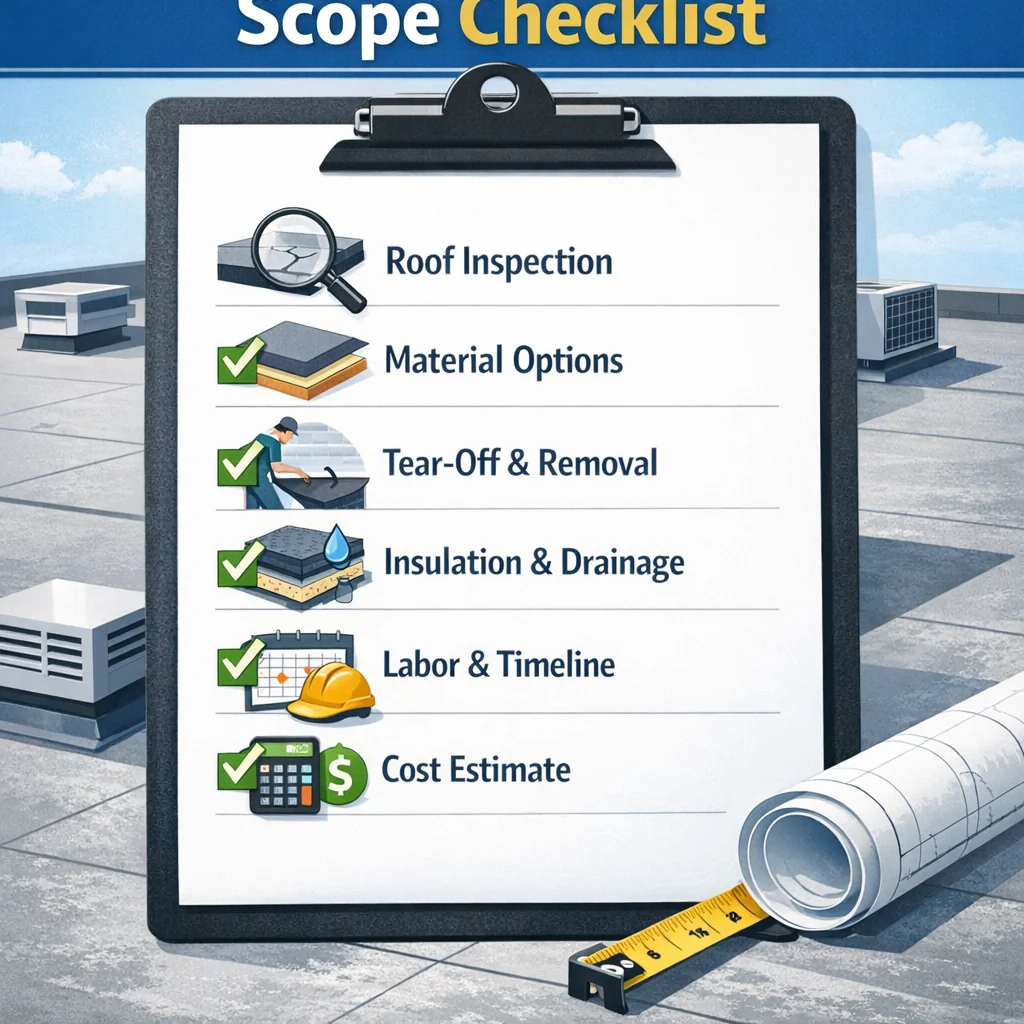
When you receive a flat roof replacement estimate, the following items should be explicitly listed. If any are missing, ask before you compare prices.
Most resources present flat roof material selection as a budget decision. Choose the affordable option or choose the premium option based on how long you plan to own the building. That framing is incomplete.
Material selection for a flat roof is first a compatibility decision, and then a budget decision. The building’s use, the roof’s environment, and the presence of equipment or foot traffic all determine which membranes will hold up and which will degrade prematurely.
| Scenario | Compatibility Consideration | Preferred Membrane |
|---|---|---|
| Rooftop deck with regular foot traffic | Standard membranes can crack under repeated point-load pressure | Reinforced TPO or PVC with walk pads |
| Roof adjacent to rooftop HVAC exhaust | Petroleum-based adhesives and some membranes degrade with prolonged heat and exhaust exposure | TPO or PVC (heat-welded seams, no adhesive at risk zones) |
| Commercial kitchen or restaurant roof | Animal fats and grease break down certain membranes over time | PVC (grease-resistant by formulation) |
| Roof over unconditioned space with wide temperature swings | Some membranes become brittle in sustained cold or flex poorly through freeze-thaw cycles | TPO (remains flexible across a wide temperature range) |
| Chemical storage or manufacturing facility | Chemical off-gassing can degrade standard membranes | Consult manufacturer for chemical-resistant specifications |
The practical point here is this: an estimate built around the wrong membrane is not a competitive quote. It is an incorrect specification. If a contractor proposes a material without asking how the space below the roof is used or whether there is equipment on the roof, that is a gap in their process worth addressing before work begins. For a broader look at what goes into scoping any replacement project, our article on roof estimate costs, materials, and what to expect is a useful reference.
Need a hand with this in Winston-Salem, Greensboro and the Triad? Call (336) 971-0464 or request a free estimate. Honest answers, no pressure.
Every general guide lists roof size, material type, and labor as the primary cost drivers of a flat roof replacement estimate. What almost none of them address is drainage.
A flat roof is not actually flat. It requires a minimum slope to move water toward drains, gutters, or scuppers. When that slope is insufficient, water pools. Pooling water accelerates membrane degradation, adds significant structural weight, and creates the conditions for leaks that are slow-developing and hard to trace.
Drainage design decisions during a replacement include:
If a flat roof replacement estimate does not address drainage configuration in any way, ask directly: how is the drainage slope being handled? The answer reveals a lot about how thorough the contractor’s assessment actually was.
On a pitched roof, a failed shingle or a bad flashing detail usually produces a visible interior leak relatively quickly. The symptom and the cause are close together in time, which limits how long damage can accumulate undetected.
Flat roof installation failures work differently. A poorly welded seam, inadequate membrane adhesion at the edges, or an improperly flashed penetration does not fail immediately. Water enters slowly, works its way beneath the membrane, and saturates insulation and decking over weeks or months before any interior symptom appears. By the time a stain shows up on a ceiling or a soft spot develops in the decking, the damage is already extensive.
This is why installation quality on a flat roof matters more, not less, than on a pitched system. The gap between a minor installation error and a significant repair bill is measured in months and in structural damage that was invisible the entire time.
Certified installation for heat-welded membrane systems like TPO and PVC requires specific training and equipment. Seam welds must reach a precise temperature range to bond correctly. Too cool and the seam is weak; too hot and the membrane is compromised. This is not a task that can be performed adequately with general roofing experience and borrowed equipment.
When evaluating a contractor for a flat roof replacement, confirm:
At Smithrock Roofing, our team brings more than 60 combined years of exterior contracting experience, and our CertainTeed PREMIER ShingleMark Master Certified status reflects ongoing training and credentialed expertise. That standard carries into every project we take on, including flat roof and low-slope systems. Whether you need roofing in High Point or anywhere else across Winston-Salem, Greensboro, Kernersville, Clemmons, Rural Hall, King, and the surrounding NC Triad, you can expect the same quality of assessment and installation regardless of roof type.
A flat roof replacement estimate should include an assessment of the roof deck before any membrane is specified. The deck is the structural foundation the membrane sits on. If the deck has sustained water damage, rot, or delamination from years of undetected pooling or slow leaks, replacing the membrane over compromised decking simply delays the problem.
Deck remediation is a separate scope item from membrane replacement. When it is needed, it changes the project meaningfully, and a contractor who does not assess the deck before issuing an estimate is handing you a number that may not reflect the actual scope of the work.
Signs that deck assessment should be a priority:

An honest estimate accounts for what is beneath the membrane, not just the membrane itself. At Smithrock Roofing, our assessment process includes evaluating the full system before we put a scope together, because an estimate that misses the deck is not doing the homeowner any favors.
A flat roof replacement estimate is not just a number to accept or reject. It is a document that should answer specific questions about how your roof will be rebuilt, what materials are going into it, how long those materials are warranted, and who stands behind the work.
When the estimate answers those questions clearly, comparison becomes straightforward. When it does not, price is not a reliable guide.
Smithrock Roofing serves homeowners and property owners throughout the NC Triad with the kind of honest, thorough assessment that produces estimates you can actually use. Our roofing service covers the full scope of what your building needs, from initial inspection through certified installation and final warranty documentation. With more than 350 five-star reviews and a commitment to quality materials and certified craftsmanship, we build estimates around your building’s specific needs, not a generic template. If you are ready to get a flat roof replacement estimate you can trust, reach out to our team to schedule your inspection.
A thorough flat roof replacement estimate should include the scope of work, the specific membrane system being installed, how existing layers will be handled, insulation details, drainage provisions, and warranty information for both materials and labor. If an estimate only lists a total figure without breaking down these components, you do not have enough information to evaluate it properly.
The timeline depends on the size of the roof, the membrane system being installed, and the condition of the existing deck. A straightforward replacement on a residential flat roof may be completed in one to two days, while a larger or more complex project requiring deck repairs or additional layers can take longer. Your contractor should give you a realistic project timeline before work begins.
Yes, and it is one of the most important variables in any flat roof estimate. If the deck beneath the membrane has been compromised by moisture, rot, or structural damage, those areas need to be repaired or replaced before the new membrane goes down. A contractor who does not assess the deck before providing an estimate may be leaving a significant unknown out of the scope.
Look for specifics: the membrane type and thickness, how the old roof is being removed, what happens if deck damage is found, insulation R-value if applicable, and the terms of the workmanship warranty. If two estimates use different materials or different scopes of work, the numbers are not directly comparable no matter how similar they look on the surface.
Homeowners and property owners in Winston-Salem and Greensboro deserve a flat roof replacement estimate that is honest, detailed, and built around the actual condition of their building, and that is exactly what Smithrock Roofing delivers throughout the NC Triad. With more than 350 five-star reviews and a team of certified installers who treat every project with the same level of care, we are here to make the process straightforward from the first inspection through the final walkthrough. Call us at (336) 971-0464 or Contact Smithrock Roofing to schedule your inspection and get an estimate you can actually rely on.

Smithrock Roofing © Copyright 2026 • All Rights Reserved • Privacy Policy • Maintained by Mongoose Digital Marketing