A gutter cleaning estimate sounds simple on the surface: a contractor looks at your home, considers the size, and gives you a number. In practice, the estimate reflects a much more detailed evaluation, one that considers your roofline, your trees, your downspout condition, and the current state of the gutters themselves. Homeowners who understand what goes into that evaluation are better positioned to compare quotes accurately, ask the right questions, and avoid surprises when the crew arrives. This guide walks through exactly what a qualified estimator is assessing and why each variable matters.
When a contractor arrives to evaluate your gutters, they are not simply counting linear feet and multiplying by a rate. They are building a picture of the actual labor involved. That picture includes factors you can see clearly from the ground and factors that only become apparent once someone is on a ladder with their hands in the gutter channel.
The most straightforward starting point is total gutter length. A larger home with more roofline means more gutters to clean, more time on the job, and more debris to remove. Estimators typically work from the linear footage of your gutter system, accounting for every section along the eaves.
Multi-story homes add a meaningful layer of complexity. Working at height requires more equipment, more careful setup, and more time. A two-story colonial in Kernersville and a single-story ranch in Clemmons with similar square footage may have very different gutter systems in terms of accessibility and labor requirements.
Roof pitch is a factor many homeowners do not think to mention when calling for a quote, but it directly influences the scope of work. A steeper roof means gutters positioned at a less accessible angle, which slows the cleaning process and increases the care required to work safely.
There is also a debris-flow consideration. Steeper-pitched roofs tend to push debris toward downspouts more aggressively, which means downspout blockages are more likely even when the gutter channel itself appears relatively clean from the ground. An estimator who understands this relationship will factor downspout inspection into the job automatically, rather than treating it as an afterthought.
Downspouts are one of the most consistently underestimated variables in a gutter cleaning estimate. Competitors in this space often treat downspouts as a brief footnote, worth mentioning but not worth explaining. The reality is that a blocked downspout can fundamentally change the scope of a cleaning job.
When debris accumulates in a downspout, it does not behave like debris in the open gutter channel. It compacts under the weight of water and additional debris, can bind to the interior walls of the downspout, and may require partial disassembly to clear properly. This is a meaningfully different task from scooping loose debris out of a gutter trough, and it represents a potential line item on an estimate rather than a simple inclusion.
Before requesting an estimate, check each downspout at the ground level. If water flows freely out of it during a rain event, the downspout is likely clear. If you notice pooling near the base, slow drainage, or no drainage at all during rain, mention it explicitly when you contact a contractor. That information helps produce a more accurate quote before anyone sets foot on your property. For a deeper look at what professional gutter work involves from start to finish, our Gutter Cleaning Winston-Salem: Local Expert Guide covers the full scope of what homeowners in this region should expect.

Most homeowners know that heavy tree coverage means more frequent gutter cleaning. What is less commonly understood is that the type of trees near your roofline affects how difficult and time-consuming each cleaning will be, which in turn affects the estimate.
Loose, dry deciduous leaves are the easiest debris to remove. They can be scooped or blown out with relative efficiency, and they do not tend to bind together in the gutter channel.
Pine needles are a different matter. They fall in high volume, they compact tightly together when wet, and they form dense mats that resist simple scooping. A gutter channel packed with wet pine needle debris requires more deliberate extraction and takes longer to clear than the same channel filled with loose leaves.
Oak tassels, seed pods, and similar small organic debris behave similarly. They retain moisture, add significant weight, and pass easily into downspouts where they compact and cause blockages. Homes surrounded by established oak trees, common throughout the Winston-Salem and High Point areas, are more likely to experience downspout blockages specifically because of this debris type.
Before calling for an estimate, take a few minutes to identify the dominant tree species within falling distance of your roofline. This is not a trivial detail. An estimator who knows they are dealing with a pine-heavy environment versus an open yard with a few maples will build a more accurate estimate from the start.
Debris sitting in gutters absorbs water and becomes significantly heavier than it looks from the ground. An apparently modest accumulation of pine needles or oak debris, once saturated, can represent a substantial load on your gutter hangers and fascia boards.
This matters structurally. Gutters are anchored to the fascia boards along your roofline. Extended loading from heavy, wet debris causes hangers to loosen and fascia boards to pull away from the structure. The result is the sagging or detached gutter that homeowners often notice too late. An estimator assessing a home with dense, moisture-retaining debris will consider whether there is existing stress on the gutter attachment points, because that determination affects whether the scope of work involves cleaning only or cleaning plus repair.
Need a hand with this in Winston-Salem, Greensboro and the Triad? Call (336) 971-0464 or request a free estimate. Honest answers, no pressure.
One of the most practical questions a homeowner can ask about a gutter cleaning estimate rarely gets a straight answer: can you give me an accurate quote over the phone, or do you need to see the gutters first?
The honest answer is that it depends on what the gutters look like.
For a straightforward job, single-story home, gutters in apparent good condition, no visible sagging or pest activity, standard debris from common deciduous trees, a phone estimate based on home size and linear footage is a reasonable starting point. Many experienced contractors can provide a reliable ballpark in this scenario because the variables are predictable and the scope is standard.
The moment any of the following conditions are present, a phone estimate becomes an educated guess rather than a reliable quote:
These are not edge cases. For many homes across the Triad, one or more of these conditions exist without the homeowner being aware. An in-person inspection in these situations protects both the homeowner and the contractor: the homeowner gets a quote that reflects what the job actually involves, and the contractor arrives prepared with the right equipment.
Accepting a phone estimate when your gutters show any of these warning signs is a risk. The technician who arrives may identify complications that change the scope significantly, and what felt like a clear agreement becomes a conversation you were not prepared for.
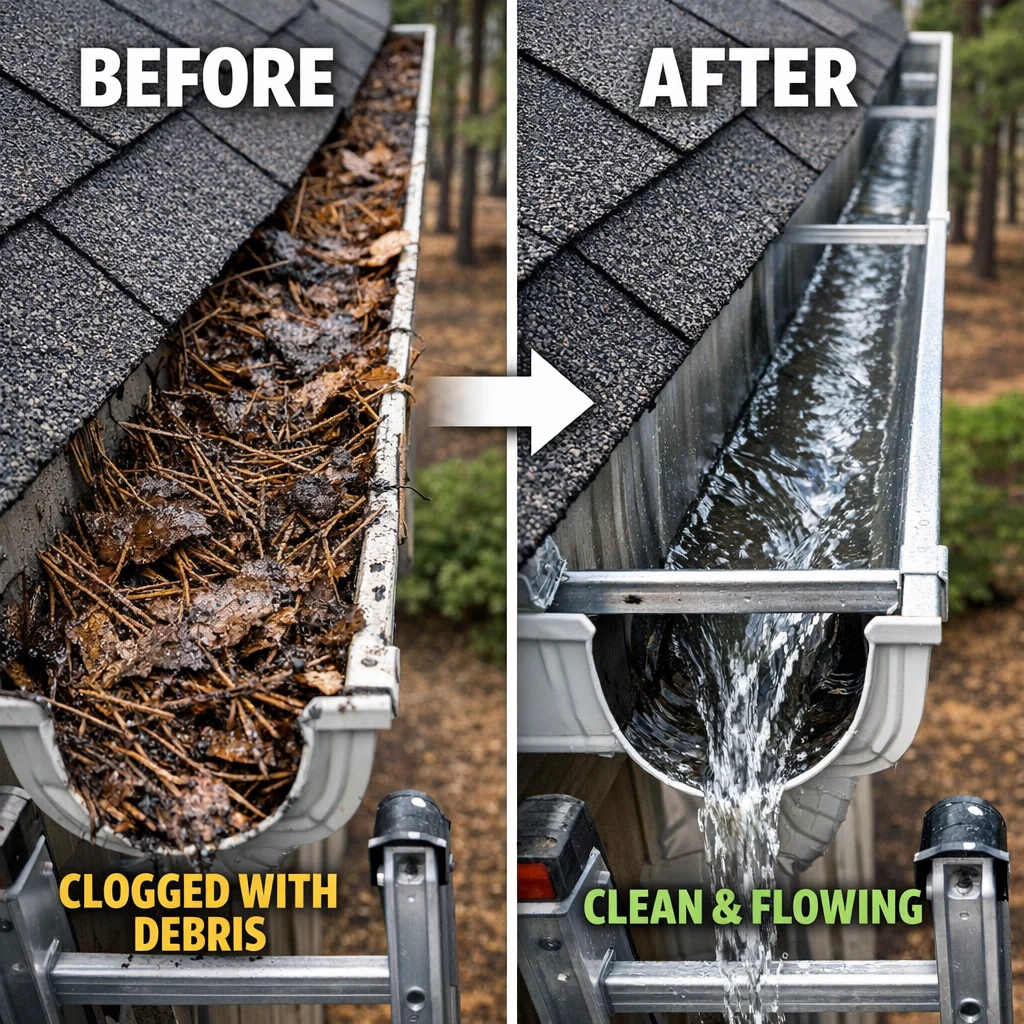
If you are gathering quotes from multiple contractors, it is worth understanding that two estimates for “gutter cleaning” may not represent the same service.
There are two broad approaches to debris removal during a gutter cleaning:
Flush and go: The technician uses a hose or pressure attachment to push debris through the gutters and out the downspouts. This is faster and may produce a lower estimate. The debris ends up in your driveway, on your lawn, or in your garden beds.
Manual collection and removal: The technician scoops or extracts debris by hand, collects it, and hauls it away. This takes longer and is reflected in the estimate accordingly. Your property is left clean.
These are not equivalent services at different price points. When comparing estimates, ask each contractor directly: do you flush debris out or do you manually collect and remove it? If one quote reflects manual collection and another reflects flushing, you are not comparing the same job. The lower number may look appealing until you are cleaning compacted wet debris out of your flower beds afterward.
A gutter cleaning estimate and a gutter repair estimate are separate things. Occasionally, a technician arrives for a cleaning and identifies conditions that require repair before cleaning can be completed effectively. Loose hangers, sections pulling away from the fascia, or cracked gutter joints are examples of issues that can appear only once someone is up close.
This is not a bait-and-switch scenario; it is the nature of working on a system you cannot fully evaluate from the ground. Understanding this distinction in advance helps you approach the conversation calmly. Ask your contractor upfront: if you identify repair needs when you arrive, how do you handle that communication? A trustworthy contractor will stop, explain what they found, and let you make an informed decision before proceeding. If you want to understand what repair work might involve and what it typically costs, the Gutter Repair Winston Salem Guide: Protect Your Home is a useful reference.
You do not need to be a gutter expert to prepare for an estimate conversation. A few minutes of observation from the ground gives you useful information to share:
Walk the perimeter of your home and note:
When you call for an estimate, mention:
This information transforms a vague quote call into a productive conversation. It allows the estimator to give you a more accurate assessment of whether your job is a standard cleaning or something more involved.
At Smithrock Roofing, we have more than 60 combined years of exterior experience serving homeowners across Winston-Salem, Greensboro, High Point, Kernersville, Clemmons, Rural Hall, King, and the surrounding Triad communities. We are fully licensed and insured, hold a CertainTeed PREMIER ShingleMaster Certification, and carry an A+ BBB rating backed by more than 350 five-star reviews.
Our approach to gutter cleaning estimates reflects the same philosophy we bring to every service: honest evaluation, clear communication, and no shortcuts. We tell you what we find, explain what it means, and let you decide how to move forward. We handle debris manually rather than flushing it across your landscaping, and when we identify repair needs on-site, we communicate those clearly before proceeding.
Gutters are a straightforward system, but they protect your home’s foundation, siding, and fascia from water damage that compounds over time. Getting a thorough, accurate estimate from a contractor who takes the time to look carefully is how you make sure the job gets done right the first time. To learn more about the full scope of what we offer, visit our gutters service page for details on everything from routine cleaning to complete gutter solutions.
To schedule your gutter cleaning estimate with Smithrock Roofing, reach out to our team directly. We serve the full NC Triad region and are ready to take a look.
The cleaning itself is the best diagnostic tool. In many cases, homeowners suspect a clog when the real issue is a sagging section, a separated joint, or a downspout that has shifted away from the foundation drain. A thorough on-site estimate gives a contractor the opportunity to distinguish between a straightforward debris removal and a situation that also involves minor repairs. If overflow or slow drainage persists after a cleaning, that is usually a sign something structural needs attention.
Timing does affect what a contractor can see and assess. A late fall estimate, after the bulk of deciduous leaves have dropped, captures the heaviest debris load of the year and gives you a clear picture of how well the system is functioning heading into winter. Spring estimates help identify any damage that accumulated over freeze and thaw cycles. Either window is useful, and in areas with heavy pine coverage like much of the NC Triad, mid-year cleanings are often warranted as well.
This varies by contractor and by what is visible from the ground or a ladder position. At minimum, an estimator should be getting close enough to the gutters to assess debris depth, gutter slope, bracket condition, and downspout attachment. A contractor who quotes entirely from the driveway without inspecting the gutters directly is working from incomplete information, which typically results in either an underestimate or unexpected add-ons once the job begins.
Use it as a starting point for a real conversation. Ask the estimator to walk you through anything they flagged, whether that is debris volume, a section of fascia that looks compromised, or a downspout that is not properly pitched. Understanding what is driving the scope of work helps you make a confident decision rather than simply approving a number on a form.
Homeowners across Winston-Salem and Greensboro trust Smithrock Roofing because we show up, look carefully, and give you a straight answer about what your gutters actually need, nothing more, nothing less. With more than 60 combined years of exterior experience and an A+ BBB rating built on honest work throughout the Triad, we are the local team you can count on to get it right. Call us at (336) 971-0464 or Contact Smithrock Roofing to schedule your free gutter cleaning estimate today.

Smithrock Roofing © Copyright 2026 • All Rights Reserved • Privacy Policy • Maintained by Mongoose Digital Marketing