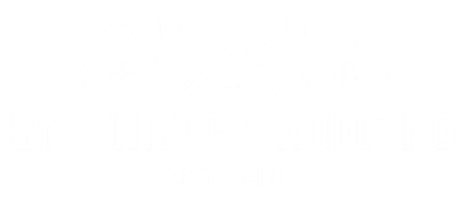
A commercial flat roof develops a leak. Someone calls a contractor, a patch goes down, and the problem appears solved. Then three months later, the leak returns, sometimes in a slightly different location. The repair failed not because the work was sloppy but because it addressed the surface while the real damage was occurring one layer deeper.
That pattern repeats across commercial properties throughout the NC Triad. Understanding why it happens and how to avoid it is the difference between a repair that holds for years and one that becomes a recurring expense.
This article explains how a flat roof system actually fails from the inside out, what the repair-versus-replace decision genuinely involves, how to handle insurance documentation in the right order, and why a maintenance plan is not optional if you want your warranty to stay intact.
The membrane you can see from the rooftop is the outermost layer of a multi-component assembly. Below it, working downward, are the seams and penetration flashings, the insulation board, the vapor retarder, and the structural deck. Each layer performs a specific function. When one layer is compromised, the layers around it begin to degrade faster.
The most misunderstood failure sequence in commercial roofing works like this: water infiltrates through a small seam separation or a cracked flashing. It does not travel straight down to the interior. Instead, it migrates laterally through the insulation board. Wet insulation loses its thermal resistance and, more critically, changes how it behaves during temperature swings. As the building heats and cools, the wet insulation expands and contracts at a different rate than the membrane above it. That differential movement stresses the seams from below, accelerating separation at points that may be several feet from the original entry point.
The result is a surface patch that looks correct but sits over insulation that is still saturating and still stressing the membrane. The new leak that appears nearby three months later is not a coincidence. It is the original failure mechanism completing its path.
This is why a thorough commercial flat roof assessment evaluates all five layers, not just the top one. Our Commercial Roof Inspections Guide explains what a complete multi-layer evaluation covers and what property owners should expect from the process.
Need a hand with this in Winston-Salem, Greensboro and the Triad? Call (336) 971-0464 or request a free estimate. Honest answers, no pressure.
Most contractors simplify this decision down to a single rule of thumb, such as a percentage of the roof surface that is damaged. That shortcut causes expensive mistakes in both directions: properties get partial repairs that fail again within a season, or they get full replacements when a restoration would have added years of life at lower disruption.
The actual decision involves five distinct variables, each of which can change the outcome on its own.
| Variable | What It Measures | How It Affects the Decision |
|---|---|---|
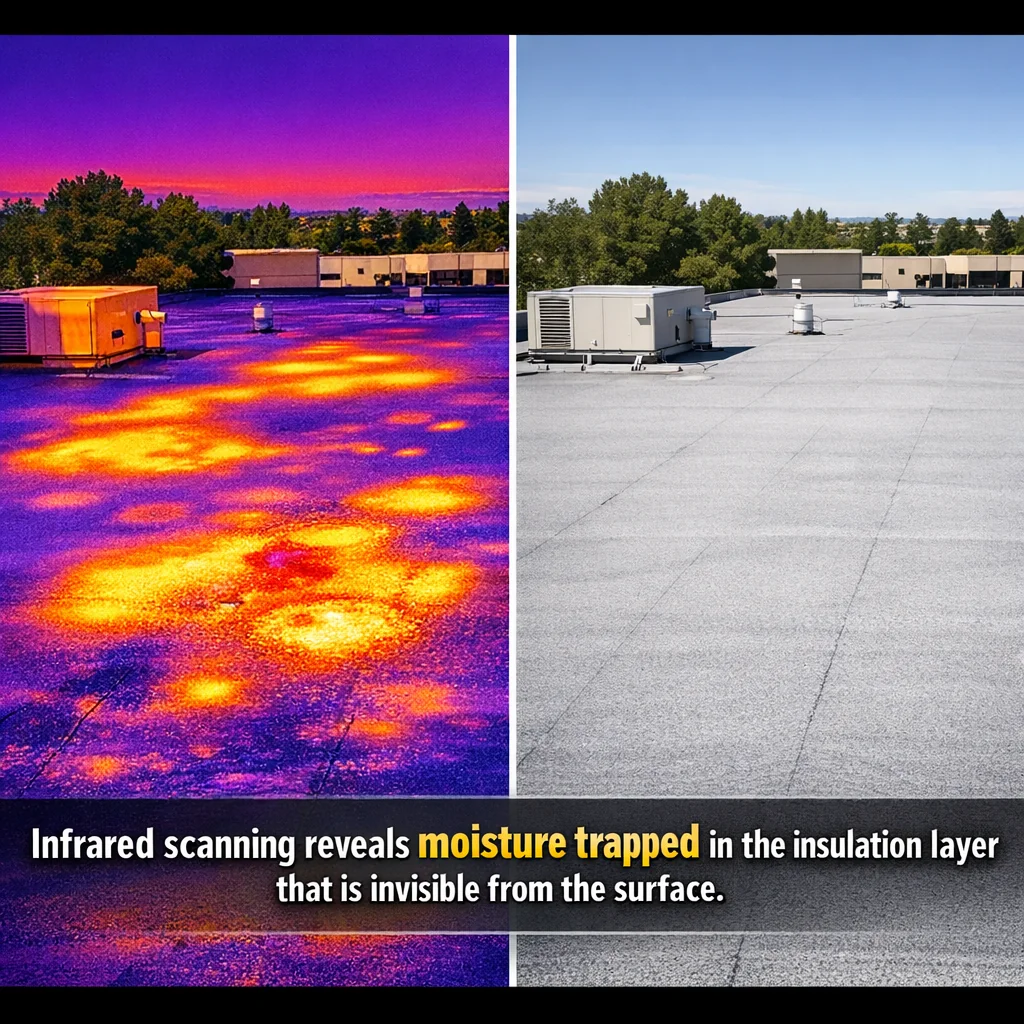
| Moisture Saturation Level | Percentage of insulation board that has absorbed water, typically assessed with infrared scanning or core samples | Restoration is generally viable when saturation is limited to a small portion of the total assembly; widespread saturation usually requires tear-off and insulation replacement |
| Deck Structural Condition | Integrity of the substrate beneath the insulation, including any deflection, rot, or fastener pull-out | A compromised deck cannot support any new assembly regardless of membrane condition; this variable alone can make replacement mandatory |
| Remaining Membrane Life | Estimated years of useful life left in the current membrane based on material type, age, and condition | A membrane near the end of its serviceable life is a poor candidate for restoration even if current damage is localized |
| Insulation R-Value Compliance | Whether existing insulation meets current energy code requirements | Some jurisdictions require code-compliant insulation when a roof is significantly altered; this can affect whether a partial repair or overlay is permissible |
| Overlay Eligibility | Whether the current assembly can legally and structurally accept a new membrane layer on top | Building codes limit the number of roof layers on most structures; if the roof has already been overlaid once, tear-off is required before any new system is installed |
A roof with only minor moisture saturation may still require replacement if the deck has deflection damage. A roof with more widespread membrane wear may still be a strong restoration candidate if the deck is solid and the insulation is dry and code-compliant. The variables interact. No single number settles the question. For a closer look at how this decision plays out in practice, the article on roof repair vs. replacement in Winston-Salem walks through the key considerations property owners face.
Contractors often organize their repair services around membrane material: TPO repair, EPDM repair, modified bitumen repair. That framing is useful for homeowners trying to identify their roof type, but it skips a step that determines what the actual repair needs to accomplish.
The correct repair approach is determined by the failure mechanism, not the material alone.
Consider a seam failure on a TPO membrane. If the seam separated because of improper heat-weld technique during installation, the fix involves re-welding with correct temperature and pressure settings. If the seam separated because of thermal movement from an undersized expansion joint, re-welding alone will fail again because the movement is still occurring. If the separation is the result of substrate settlement pulling the membrane, the deck issue must be addressed before the seam repair will hold.
Same material. Same visible symptom. Three different repairs.
An experienced contractor identifies the failure mechanism first, then selects the repair method. A contractor who goes straight to the patch without that diagnostic step is solving the symptom rather than the problem.
When storm damage is involved, the order of steps before filing a claim is not arbitrary. It directly affects whether a claim is approved or denied.
Insurance policies generally cover damage from sudden, external events like severe weather. They exclude pre-existing wear, deferred maintenance, and manufacturing defects. The same leak can fall into either category depending entirely on how the damage is characterized and when it is first documented.
Here is why getting a private contractor inspection before contacting the adjuster protects the property owner:
An insurance adjuster’s initial site visit often becomes the defining record of damage cause. If an adjuster visits first and documents a roof that shows both storm damage and pre-existing wear, the adjuster may characterize the pre-existing condition as the primary cause of the leak. That characterization can shift the entire claim into the excluded category before the property owner has any independent record to dispute it.
A private inspection completed first creates a contractor-verified, contemporaneous record of what the storm caused versus what was already present. That documentation is in the property owner’s hands before the adjuster arrives. It establishes a timeline the owner controls rather than one that defaults to the adjuster’s interpretation.
The sequence is not about disputing the insurer. It is about entering the claims process with complete, accurate documentation instead of relying on a single evaluation performed by a party whose interests may not align with the property owner’s.
Manufacturer warranties on commercial membrane systems are not unconditional. Most require documented, periodic maintenance by a qualified contractor to remain valid. If a roof fails and the property owner cannot produce maintenance records, the manufacturer may decline the warranty claim on the basis that the required upkeep was not performed.
This is not a technicality buried in fine print. It is a straightforward condition that many property managers do not discover until they need the warranty.
A properly structured maintenance plan typically includes semi-annual inspections, drainage clearing, seam and flashing checks, and documentation of any findings. Beyond protecting the warranty, regular inspections catch the early signs of insulation saturation, flashing separation, and drain blockage before they become full repair events.
The math here is straightforward without involving any numbers: routine maintenance is a scheduled, controlled expense. Deferred maintenance converts into emergency repairs and potential warranty voidance on a timeline you cannot predict or control.
Smithrock Roofing brings more than 60 combined years of experience to commercial and residential exterior work throughout the NC Triad, serving roofing in Winston-Salem, Greensboro, High Point, Kernersville, Clemmons, Rural Hall, King, and surrounding communities. Our team is fully licensed, fully insured, and certified, and our process starts with a thorough multi-layer assessment before any repair recommendation is made.
We do not quote repairs without understanding the failure mechanism. We do not patch surfaces over compromised insulation and call the job complete. And we do not recommend replacement when a properly executed restoration will protect the building for years to come. Our roofing service covers every stage of the process, from initial inspection and failure diagnosis through repair, restoration, and full replacement when that is the right answer.
With more than 350 five-star reviews and an A+ BBB rating, our reputation in this region is built on honest assessments and work that holds. If your commercial flat roof is showing any of the signs discussed in this article, the right next step is a thorough inspection, not a guess.
The answer depends on the condition of the underlying insulation and decking, not just the surface membrane. If water has saturated the insulation or the structural deck shows signs of deterioration, a surface repair alone will not solve the problem. A thorough multi-layer inspection is the only reliable way to determine whether targeted repair, restoration, or replacement is the appropriate path forward.
Seams and flashings are the points where separate membrane sections meet and where the roof transitions to walls, curbs, drains, and penetrations. These areas experience concentrated stress from thermal expansion and contraction, foot traffic, and water pooling. Over time, adhesives break down, seams lift, and flashing separates from the substrate. These failures are among the most common entry points for water infiltration on commercial flat roofs.
Yes, and it is one of the most overlooked conditions in commercial roofing warranties. Most manufacturer warranties require documented, periodic maintenance performed by a qualified contractor. If a roof fails and maintenance records cannot be produced, the manufacturer has grounds to deny the claim. Semi-annual inspections, drainage clearing, and documented findings are the foundation of a maintenance program that keeps warranty coverage intact.
The timeline depends on the size of the affected area, the type of membrane system in place, and the scope of the underlying damage. A localized repair on a well-documented roof system can often be completed in a single visit. Larger restoration work or repairs that require insulation replacement will take longer. A proper inspection is the only way to give an accurate timeline for any specific project.
When your commercial flat roof shows signs of failure, the building deserves an honest assessment from a team that has seen every failure type and knows how to address the root cause, not just the surface symptom. Smithrock Roofing has earned the trust of property owners and managers throughout Winston-Salem, Greensboro, and the surrounding NC Triad through straightforward inspections, reliable work, and a track record that speaks for itself. Call us at (336) 971-0464 or Contact Smithrock Roofing today to schedule your inspection and get a clear picture of what your roof actually needs.

Smithrock Roofing © Copyright 2026 • All Rights Reserved • Privacy Policy • Maintained by Mongoose Digital Marketing