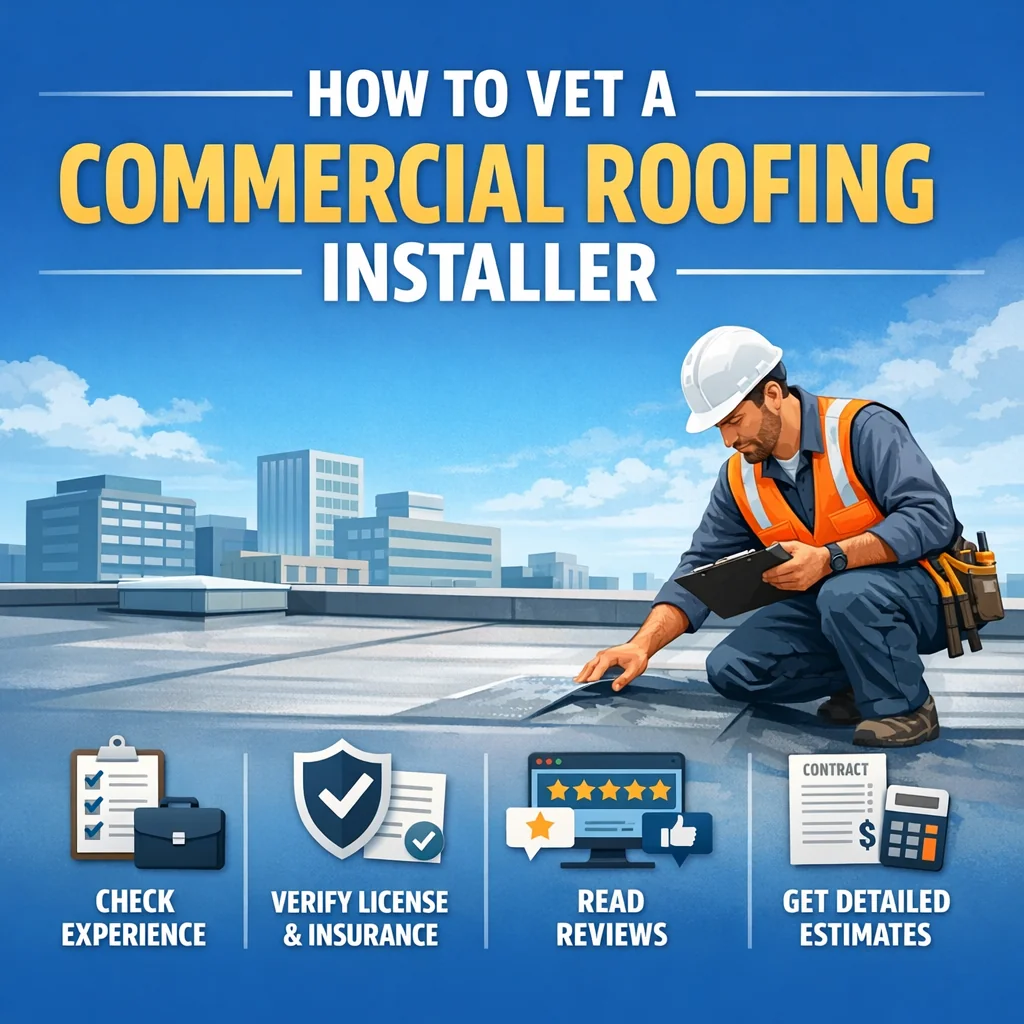
Choosing the wrong commercial roofing installer rarely announces itself upfront. The problems tend to surface eighteen months later, when a seam separates after a wet spring, or when a warranty claim gets denied because the installing contractor didn’t hold the right certification tier. By then, the building owner is left managing a repair that should have been covered, negotiating with parties who have little incentive to help. This article walks through how commercial roofing installation actually works, what separates a qualified installer from a generalist, and what to verify before signing any contract. If you own or manage commercial property in Winston-Salem, Greensboro, High Point, or the surrounding NC Triad area, the framework below will help you ask the right questions and read any proposal with much more confidence.
Commercial roofing is not residential roofing at a larger scale. The systems, installation methods, load considerations, and quality benchmarks are genuinely different disciplines. A crew that installs asphalt shingles on residential homes five days a week does not automatically possess the knowledge or equipment to properly install a thermoplastic membrane on a low-slope commercial roof.
The most common commercial roofing systems you will encounter include:
Each system has legitimate use cases. The question is not which material is best in the abstract. The question is which system is appropriate for your specific roof geometry, deck condition, building use, and long-term maintenance expectations.
When commercial roofing contractors describe membrane systems, they almost always focus on the material itself. What rarely gets explained is that the seam installation method is the variable that most directly determines how that membrane performs over time.
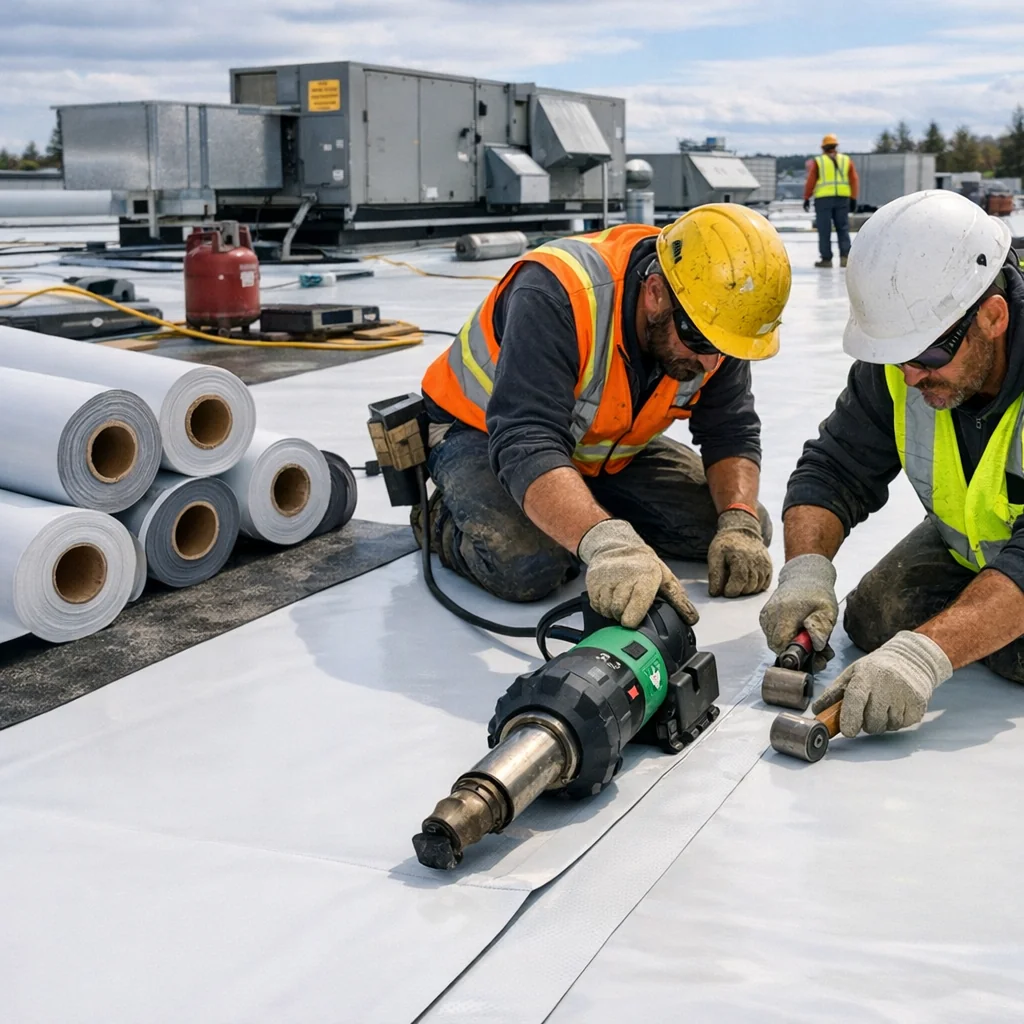
TPO and PVC membranes use heat-welded seams. A calibrated hot-air welding tool fuses the overlapping edges of adjacent membrane sheets together at the molecular level. A properly executed heat weld does not rely on adhesive chemistry. It creates a bond that is, at that seam, as strong as the membrane itself. Wind uplift, thermal cycling, and moisture have far less effect on a welded seam than on an adhesive-dependent one.
EPDM seams, by contrast, are joined using adhesive tape or liquid bonding agents. This is not a flaw in EPDM as a system. It is a characteristic that requires careful surface preparation, appropriate adhesive selection, and disciplined installation technique. In conditions where temperature or moisture levels are not managed during installation, adhesive seams are the most common point of future failure.
The practical takeaway: when evaluating any commercial roofing proposal, ask specifically what seam method will be used and why that method is appropriate for your roof’s geometry, size, and any penetrations (HVAC equipment, drains, curbs) that require field fabrication. A contractor who cannot answer that question in plain terms is likely working from a default preference rather than a roof-specific plan. For a deeper look at what drives project costs, the article on commercial roofing repair cost breaks down the key variables worth understanding before you budget.
Need a hand with this in Winston-Salem, Greensboro and the Triad? Call (336) 971-0464 or request a free estimate. Honest answers, no pressure.
One of the most persistent points of confusion in commercial roofing is warranty language. Proposals frequently describe coverage in a way that blurs two legally distinct documents into a single reassuring phrase like “backed by the best warranty available.” In practice, there are always two separate warranties involved.
Manufacturer product warranty: Issued by the material manufacturer, this covers defects in the roofing membrane, adhesives, or accessories themselves. Its duration, scope, and claim process are defined by the manufacturer, not the installing contractor. Critically, most manufacturer warranties are only valid when the installing contractor holds a specific certification tier with that manufacturer. A contractor who is not certified, or whose certification level is lower than what a particular warranty requires, cannot issue that warranty on your behalf regardless of what their proposal says.
Contractor workmanship warranty: Issued by the roofing company itself, this covers the quality of the installation labor. It addresses failures caused by how the system was installed, not what it was made of. These warranties vary widely in scope, exclusions, and duration.
When reviewing any commercial roofing proposal, ask for both documents separately. Confirm that the contractor holds the certification tier required to activate the manufacturer warranty they are citing. And evaluate workmanship warranty claims in the context of the contractor’s business history. A lifetime workmanship warranty is only as durable as the company standing behind it. You can also review our roofing service to understand the standards and coverage we bring to every commercial project.
Some commercial roofing bids come from companies whose primary business is residential roofing. Their commercial work fills calendar gaps when residential demand slows. This is not a hypothetical concern. It is a documented pattern in the roofing industry, and it matters because the installation skills required for membrane roofing are genuinely different from those required for shingle application.
Low-slope commercial roofing requires precise understanding of drainage design, penetration flashing, membrane termination at parapets and curbs, and the mechanical or adhesive systems that hold the membrane to the deck under wind load. These are skills developed through repetition on commercial projects, not transferable from residential work without meaningful retraining.
The way to screen for this is straightforward. Ask the contractor what percentage of their completed projects in the last three years have been commercial. Ask for references from commercial property owners or facility managers specifically. Ask which manufacturer certifications they hold and at what tier, because commercial-grade manufacturer certifications require documented installation volume and inspection performance on commercial projects, not residential ones. The guide on evaluating a roofing contractor in Winston-Salem offers a detailed framework for making that assessment.
Before any discussion of TPO versus EPDM or modified bitumen versus BUR, a qualified commercial roofing installer needs to assess your existing roof deck. The deck is the structural substrate everything else attaches to, and its condition and material type directly affect what installation methods are viable.
A steel deck handles mechanical fastening differently than a wood deck. A concrete deck requires different adhesive systems than either. If the existing deck has moisture damage, delamination, or structural compromise, installing a new membrane over it produces a system that will fail from the substrate up, regardless of how well the membrane itself is installed.
Ask any commercial roofing installer you are evaluating to include a deck assessment in their inspection process and to explain, in their written proposal, how the deck condition influenced their system recommendation. If a proposal skips this step and moves directly to material selection, that is a gap worth pressing on before the project begins.
Smithrock Roofing brings more than 60 combined years of experience to commercial and exterior roofing projects across Winston-Salem, Greensboro, High Point, Kernersville, roofing in Clemmons, Rural Hall, King, and the surrounding communities. Our team holds CertainTeed PREMIER ShingleMaster certification, and we carry full licensing and insurance on every project. With more than 350 five-star reviews and an A+ BBB rating, our reputation is built on honest assessments, quality materials, and work that holds up long after the crew leaves the job site. If you are evaluating commercial roofing installers in the NC Triad, we are glad to walk through the questions above with you directly and give you a clear, no-pressure picture of what your property actually needs.
Commercial roofing installers are trained and equipped to work with flat and low-slope roofing systems that are common on commercial buildings, such as TPO, EPDM, modified bitumen, and built-up roofing. Residential roofers primarily work with steep-slope systems using shingles or tiles. The installation methods, material handling, safety requirements, and equipment involved in commercial work are distinct enough that experience in one category does not automatically transfer to the other. When evaluating contractors for a commercial property, it is worth confirming that their portfolio and certifications reflect actual commercial project experience.
A qualified commercial roofing installer should be able to answer this after a thorough inspection that includes both the membrane surface and the underlying deck. Indicators that lean toward replacement include widespread membrane shrinkage or cracking, repeated ponding water across multiple drainage points, significant seam failures, or evidence of moisture intrusion into the deck itself. Isolated punctures or localized seam separations may be candidates for repair if the rest of the system is structurally sound. A written inspection report with supporting documentation gives you an objective basis for making that decision rather than relying on a verbal estimate alone.
Relevant certifications vary by the materials involved, but manufacturer certifications are among the most meaningful. Contractors authorized by manufacturers such as CertainTeed, GAF, or Carlisle have demonstrated installation proficiency specific to those product systems and are often required to maintain those credentials through ongoing training. Beyond manufacturer credentials, confirm that the contractor holds a valid state contractor’s license, carries general liability insurance, and maintains workers’ compensation coverage. Requesting certificates of insurance directly, rather than accepting verbal confirmation, is standard practice on any commercial project.
Project duration depends on the size of the building, the roofing system being installed, weather conditions, and whether the existing membrane requires removal before the new system goes down. A small to mid-size commercial roof may be completed within a few days under favorable conditions, while larger or more complex projects can extend over several weeks. A reliable commercial roofing installer should provide a project timeline in the proposal and communicate proactively if conditions on site affect that schedule.
Smithrock Roofing has spent decades earning the trust of commercial property owners across the NC Triad, and that track record is built on doing the job right the first time rather than the fastest. Whether your property is in Winston-Salem or Greensboro, our team brings the same thorough inspection process, honest assessment, and quality installation to every project. Call us at (336) 971-0464 or Contact Smithrock Roofing to schedule your free estimate and get a straightforward look at what your roof actually needs.

Smithrock Roofing © Copyright 2026 • All Rights Reserved • Privacy Policy • Maintained by Mongoose Digital Marketing