Replacing a roof is one of the larger decisions a homeowner makes, and it deserves more than a surface-level checklist. The basics matter, of course: choose quality materials, hire a licensed contractor, time the project well. But the decisions that protect your home and your budget most are usually the ones that sit just underneath that surface layer of common advice. Understanding why a tear-off matters structurally, what your insurance policy actually covers before a storm arrives, and how to weigh repair against replacement honestly, those are the details that separate a smooth project from a costly mistake. This guide covers those specifics plainly, because that is the standard every homeowner in Winston-Salem, Greensboro, High Point, and the surrounding NC Triad deserves.
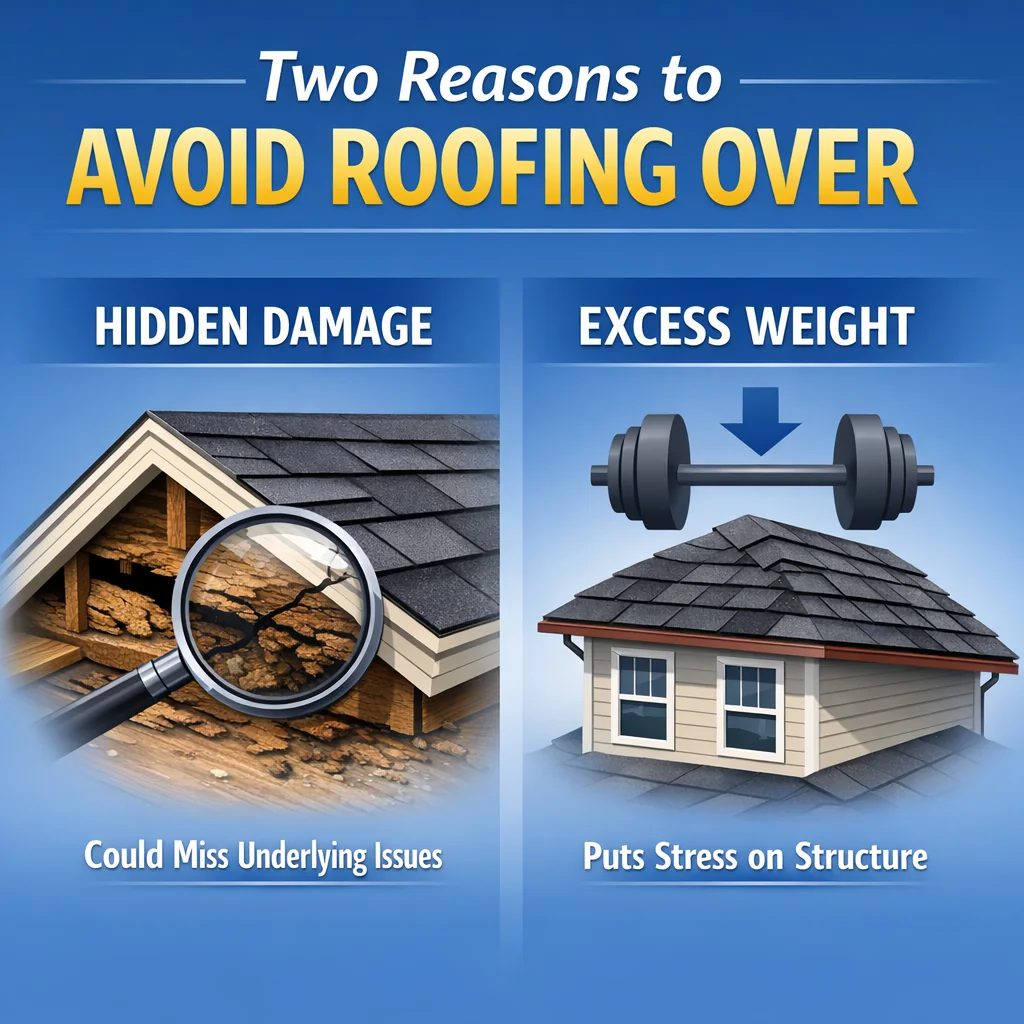
The idea of roofing over an existing layer of shingles is appealing on the surface. It sounds faster and less disruptive. Some contractors will offer it as an option. But there are two distinct structural problems with that approach, and understanding both of them gives you a much stronger position when evaluating any contractor’s recommendation.
Every shingle layer adds meaningful dead load to your roof deck and the structural framing beneath it. Architectural shingles are heavier than the older three-tab style, which means a second layer today is not the same weight equation as a second layer installed thirty years ago. When that cumulative load exceeds what your framing was designed to carry, you are not just shortening the life of your shingles. You are putting stress on the structure of your home.
The second failure mechanism is independent of weight entirely, and it is the one most homeowners never hear about. When new shingles are installed over old ones, heat builds up between the layers. That trapped heat works against the new shingles from below, accelerating the deterioration of the adhesive strip, warping the shingle mat, and reducing the lifespan of what should be a long-term investment. Shingles are engineered to release heat upward. They are not designed to sit on a heat-retaining surface.
These two problems are separate. A contractor who argues in favor of a layer-over because local code permits one layer should still be asked to address both mechanisms directly. If the answer focuses only on code compliance and not on heat management and structural load, that is worth noting.
The practical takeaway: always ask for a full tear-off, and understand that the reasoning goes well beyond regulation.
You may have come across the guideline that if repair costs exceed 30% of full replacement cost, replacement is the smarter financial move. That benchmark is reasonable as a starting point, but it is incomplete as written, and relying on it alone can lead you in the wrong direction.
The missing variable is time. Specifically, how much of your roof’s expected lifespan has already been used.
Consider two roofs. Both need repairs that represent 25% of the cost of a full replacement. One roof is five years old. The other is twenty-two years old on a thirty-year architectural shingle system. The 30% rule treats those situations identically. Any experienced roofer will tell you they are not the same situation at all.
The five-year roof has most of its useful life remaining. A targeted repair makes clear financial sense. The twenty-two-year roof is approaching the end of its designed lifespan. Investing in repairs at that stage is spending money on a system that will need full replacement within a few years regardless. In that case, replacement now avoids a second round of disruption and expense in the near term. For a detailed look at what full replacement actually costs in today’s market, the Roof Replacement Cost 2025 article breaks down the numbers by material type and scope.
The second variable the 30% rule does not address is the nature of the damage itself. There is a meaningful difference between localized damage and systemic deterioration, and that distinction should drive the repair-or-replace decision as much as cost percentages do.
Localized damage is isolated. A small section of shingles damaged by a fallen branch, a single area of flashing failure, a localized puncture. With a relatively young roof and otherwise sound materials, a professional repair is entirely appropriate.
Systemic deterioration is a different situation. Widespread granule loss across multiple roof planes, curling or cupping shingles throughout, sagging sections, or widespread algae and moss penetration are not spot problems. They reflect a roof that is failing broadly. No patch addresses systemic failure.
Use this framework when evaluating any repair-or-replace recommendation:
| Situation | Roof Age (Relative to Lifespan) | Damage Type | Likely Best Path |
|---|---|---|---|
| Minor flashing repair needed | Early to mid-life | Localized | Repair |
| Storm damage to one roof section | Early to mid-life | Localized | Repair with inspection |
| Multiple shingle failures | Late in lifespan | Mixed | Replacement |
| Granule loss, curling across planes | Late in lifespan | Systemic | Replacement |
| Any damage + active leaking into structure | Any age | Systemic concern | Professional assessment immediately |
| Repair estimate approaches 30% of replacement | Late in lifespan | Any | Strong case for replacement |
When in doubt, have a qualified contractor assess both the damaged area and the overall roof condition before committing to either path.
Need a hand with this in Winston-Salem, Greensboro and the Triad? Call (336) 971-0464 or request a free estimate. Honest answers, no pressure.
Homeowners commonly assume that if a storm damages their roof, their insurance policy covers the cost of a new one. For many policies, that assumption is accurate. For others, it is significantly wrong, and the difference comes down to one question that most articles in this space gloss over.
Replacement Cost Value coverage pays what it actually costs to replace your roof with a comparable new system. Actual Cash Value coverage pays that same amount minus depreciation. On an aging roof, depreciation can be substantial. The payout on an ACV claim for an eighteen-year-old asphalt roof may cover only a fraction of what a new roof actually requires.
The detail that many insurers do not advertise: many policies automatically switch from RCV to ACV once a roof reaches a certain age, often somewhere between fifteen and twenty years. A homeowner with a nineteen-year-old roof who has never looked closely at their policy may believe they have full replacement coverage when they actually have depreciated coverage.
Before you schedule a roof replacement, call your insurance company and ask two specific questions:
The answers to those questions change the financial logic of when to replace. If your roof is already on an ACV policy, the financial argument for proactive replacement before a major weather event becomes considerably stronger. A post-storm ACV claim may not close the gap between the payout and the actual project cost, leaving you responsible for a larger portion than you anticipated.
This is not an argument for panicking. It is an argument for having the right information before a storm makes the decision for you.
Most material comparisons in this space present options by lifespan and leave the rest to you. Knowing that architectural asphalt shingles last twenty-five to thirty years and metal roofing lasts considerably longer is useful, but it is only one input into a decision that has several moving parts.
Your home’s structural capacity. Heavier roofing materials require adequate framing support. A standard wood-frame home built for asphalt shingles may need structural assessment before moving to slate or concrete tile. This is a conversation to have with your contractor before falling in love with a particular material.
Your timeline in the home. If you plan to sell within five to seven years, the calculus around premium roofing materials is different than if you are planning to stay for twenty years. Premium materials add real value, but the return horizon matters.
The performance profile you need. Architectural shingles from a certified manufacturer like CertainTeed are a strong choice for most homeowners: proven performance, wide availability of qualified installers, and backed by manufacturer warranties that hold their value over time. Metal roofing offers advantages in longevity and energy reflection. Each material has a legitimate use case. The goal is matching the material to your specific home and situation, not defaulting to whichever option has the longest lifespan number. Explore our roofing service to see the full range of materials and systems we install for NC Triad homeowners.
License, insurance, references, and a written contract are the baseline. Every credible roofing guide covers those four items. What matters just as much is understanding what certain answers actually tell you. For a deeper look at how to evaluate candidates side by side, the article on evaluating a roofing contractor in Winston-Salem walks through the process in detail.
Asking whether a contractor subcontracts the installation work is a reasonable question. Many established companies use their own trained crews exclusively. Some use a managed network of subcontractors. The key follow-up is accountability: who is responsible for the quality of the installation, and is that responsibility backed by a written labor warranty?
A contractor who hesitates on accountability or cannot clearly state who stands behind the workmanship is worth examining more closely.
If a contractor does not pay their material supplier after completing your job, the supplier may have legal grounds to place a lien on your property, even though you already paid the contractor in full. A lien waiver is a document from the supplier confirming payment was received. Asking a contractor whether they provide lien waivers upon project completion is not an unusual request. A contractor who is current with their suppliers will not be caught off guard by it.
A strong labor warranty from a contractor, paired with a manufacturer warranty from a certified material line, gives you two layers of protection. Smithrock Roofing backs installations with a five-year labor warranty alongside CertainTeed’s limited lifetime manufacturer warranty, because both layers matter. When evaluating any contractor’s warranty offer, confirm what each warranty covers, who honors it, and whether it is transferable if you sell the home.
Adequate attic ventilation is not a luxury addition to a roofing system. It is a functional requirement that directly affects how long your shingles last. The mechanism is straightforward: heat builds up in an inadequately ventilated attic space. That heat radiates upward into the underside of the roof deck. The deck transfers heat into the shingles above it. Over time, that sustained heat exposure breaks down the shingle’s adhesive strip, warps the mat, and accelerates granule loss, exactly the same failure mode seen in a layer-over installation, just working from a different source.
Proper intake ventilation at the soffits and exhaust ventilation at or near the ridge allows heat to move through and out of the attic space. When a full replacement is on the table, it is the right time to evaluate whether your current ventilation setup is adequate. This is not an add-on conversation. It is part of getting the full value from whatever material you install.
Roof replacement done right is a long-term investment in your home’s structure, energy performance, and resale value. The homeowners who get the best outcomes are typically the ones who understand the reasoning behind the recommendations, not just the recommendations themselves. If you are weighing a replacement for your home in Winston-Salem, Greensboro, roofing in High Point, Kernersville, Clemmons, Rural Hall, King, or anywhere across the NC Triad, Smithrock Roofing brings more than 60 combined years of experience, CertainTeed PREMIER ShingleMark Master Certification, and a commitment to honest, straightforward guidance from the first conversation forward.
The honest answer depends on several factors: the age of the existing shingles, how much of the surface area is affected, and whether the damage has reached the deck. A roof nearing the end of its rated lifespan with widespread granule loss, multiple areas of lifting or curling, or soft spots in the deck is generally a better candidate for full replacement than repair. Patching a roof that is structurally compromised rarely solves the underlying problem and often delays an inevitable larger expense. A thorough inspection by a qualified contractor will tell you which situation you are actually dealing with.
Installing new shingles over existing layers traps heat between them, accelerates adhesive breakdown, and prevents a proper inspection of the deck below. If the deck has soft spots, rot, or damaged sheathing, none of that gets addressed in a layer-over installation. The result is a new surface sitting on a compromised foundation, which shortens the lifespan of the new material regardless of its quality. Full tear-off gives you a clean, inspectable surface to work from and allows the new system to perform as designed.
Look at two separate warranties: the manufacturer’s material warranty and the contractor’s labor warranty. A material warranty covers defects in the shingles themselves, but installation errors are not material defects, and that distinction matters. The labor warranty covers the workmanship. Confirm how long each warranty runs, who you contact if something goes wrong, and whether the warranty is transferable to a future buyer. Certifications like CertainTeed’s PREMIER ShingleMark Master Certification indicate a contractor has met elevated installation standards, which is directly tied to the quality of warranty coverage you receive.
Poor ventilation allows heat to accumulate in the attic space and radiate into the underside of the roof deck. That sustained heat transfers into the shingles above, breaking down the adhesive strip and accelerating granule loss over time. This is the same failure pattern seen in layer-over installations, just driven by a different source. A roof replacement is the right moment to assess whether your current intake and exhaust ventilation setup is adequate, because even the highest-quality shingles will underperform if the system they are installed on is running too hot.
Homeowners across Winston-Salem and Greensboro trust Smithrock Roofing because the guidance they receive on day one is the same as what gets built into the finished roof, honest, experienced, and backed by more than 60 combined years in the trade. If you are ready to move forward or simply want a straight answer about what your roof actually needs, call us at (336) 971-0464 or Contact Smithrock Roofing to schedule your free estimate.

Smithrock Roofing © Copyright 2026 • All Rights Reserved • Privacy Policy • Maintained by Mongoose Digital Marketing