Hiring commercial roofers without a clear framework for evaluating them puts property owners in a difficult position. The contractor controls the inspection, interprets the findings, and recommends the solution. Without independent criteria to work from, a property owner has no reliable way to verify whether a repair is genuinely sufficient, whether a replacement is truly necessary, or whether the warranty being offered will actually pay out when it matters.
This article gives you that framework. It explains what separates a workmanship warranty from a manufacturer warranty, why flashing is the detail that determines whether a commercial roof holds or fails, and how to distinguish between a repair, a recover, and a full replacement using observable conditions rather than a contractor’s word alone.
Commercial roofing and residential roofing share basic principles but differ significantly in materials, system design, and installation complexity. Most residential roofs use asphalt shingles over a sloped deck. Commercial roofs are typically low-slope or flat, which means water does not shed quickly by gravity alone. The entire system, membrane, drainage design, penetration details, and edge terminations, must work together to move water off the building before it finds a path in.
The roofing systems used in commercial work include:
Choosing the right system is not a matter of contractor preference. It depends on roof slope, existing substrate condition, drainage design, occupancy type, foot traffic requirements, and local building code. A qualified commercial roofer evaluates these factors before making a recommendation. If a contractor presents a system recommendation without walking through this logic with you, that is worth noting.
Commercial roofers routinely mention both a workmanship warranty and a manufacturer warranty. These are not two versions of the same protection. They cover entirely different failure scenarios, and confusing them is a costly mistake.
A workmanship warranty is issued by the contractor and covers defects caused by installation errors. If a seam is improperly heat-welded, if a drain is set at the wrong elevation, or if flashing is not correctly integrated at a parapet wall, those are workmanship failures. The contractor is responsible, and the workmanship warranty is what you use to get it corrected.
Smithrock Roofing backs its work with a 5-year labor warranty, which means accountability does not end the day the crew leaves. You can review the full details of what that coverage includes on the Smithrock Roofing warranty page.
A manufacturer warranty covers material defects in the roofing product itself. If the membrane delaminates, if shingles fail prematurely due to a manufacturing flaw, the manufacturer’s warranty is the protection that applies.
Here is the part most property owners do not know: improper installation can void the manufacturer warranty entirely. Manufacturers know that the most common cause of premature system failure is not a bad product, it is bad installation. To protect against paying warranty claims caused by contractor error, manufacturers attach certification requirements to their highest-tier warranties.
This is why contractor certifications are not just marketing credentials. CertainTeed’s PREMIER ShingleMaster certification, for example, exists because CertainTeed requires demonstrated installation competency before they will back a contractor’s work with their top-tier warranty. Smithrock Roofing holds CertainTeed PREMIER ShingleMaster Master Certified status, which means the manufacturer warranty is not just a promise on paper; it has the contractual backing to be honored.
If a contractor is not certified by the manufacturer whose product they are installing, ask directly how that affects the warranty tier being offered. The answer will tell you a great deal.
Need a hand with this in Winston-Salem, Greensboro and the Triad? Call (336) 971-0464 or request a free estimate. Honest answers, no pressure.
This is the detail that separates a technically rigorous contractor from one who installs membrane correctly but misses where roofs actually fail.
The field membrane, the large flat expanse of material covering most of a commercial roof, is engineered to be durable and weather-resistant. When it fails, it is usually because of age, UV degradation, or physical damage. But most active leaks in commercial buildings do not start there.
They start at flashings.
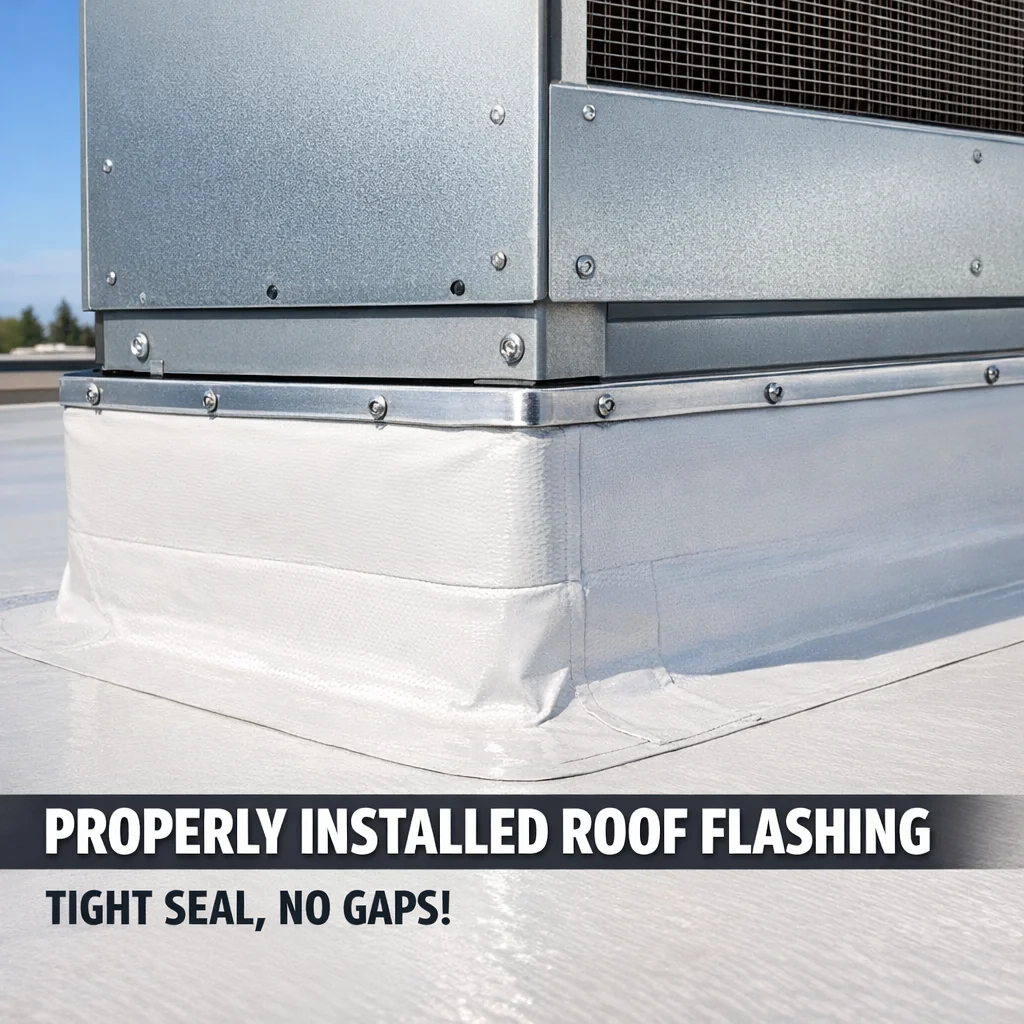
Flashings are the material transitions where the roof membrane meets anything that penetrates or terminates it: HVAC curbs, drains, pipe boots, parapet walls, skylights, expansion joints. These transitions are the most mechanically complex parts of the system. They accommodate movement, they bridge different materials, and they are exposed to concentrated stress wherever the roofplane changes direction or is interrupted.
A poorly detailed flashing at an HVAC curb allows water to wick under the membrane during a heavy rain. A flashing that fails at a parapet wall allows moisture to travel horizontally into wall assemblies before it ever appears as a ceiling stain. By the time a property owner sees evidence of a leak inside the building, the water may have been moving through compromised flashing for months.
Before signing a contract, ask every candidate these three questions:
What material do you use for flashing at penetrations, and why? A knowledgeable contractor can explain the material choice in terms of compatibility with the primary membrane system and expected service life. A vague answer is informative.
How do you detail the transition at HVAC curbs specifically? This is the most failure-prone penetration on most commercial roofs. A contractor who has a clear, practiced answer demonstrates genuine field experience.
What does your inspection protocol include for existing flashings? On a re-roof or maintenance visit, flashing condition should be evaluated separately from field membrane condition. Ask whether that evaluation is documented.
These questions do not require technical expertise to ask or to evaluate. They require only that you listen for specificity. Generalities signal risk. For a broader look at what separates qualified contractors from the rest, our guide to evaluating a roofing contractor in Winston-Salem covers additional criteria worth reviewing before you sign anything.
Every commercial roofing company mentions inspections. Few explain what a thorough one actually covers. This matters because a surface-level walkthrough can completely miss the moisture intrusion that determines whether a repair will hold or whether a full replacement is already overdue.
A rigorous commercial roof assessment evaluates:
| Assessment Component | What It Detects | Why It Matters |
|---|---|---|
| Infrared moisture scan | Wet insulation beneath the membrane | Wet insulation is invisible from the surface but degrades decking and membrane performance |
| Core cuts | Actual moisture content and deck condition | Confirms what the infrared scan indicates; provides physical evidence |
| Seam integrity check | Open, lifted, or improperly bonded seams | Seam failures are the primary entry point for water in single-ply systems |
| Drain flow testing | Blockages, improper slope, ponding risk | Standing water accelerates membrane deterioration |
| Flashing condition survey | Lifting, cracking, or separating terminations | Most active leaks trace back here |
| Parapet and edge metal inspection | Corrosion, gaps, displaced coping | Edge failures allow wind-driven rain to penetrate horizontally |
| Penetration survey | Condition of all pipe boots, curbs, and skylights | Each penetration is an independent potential failure point |
If an inspection report does not address most of these components, it is a visual check, not a diagnostic assessment. The distinction matters when you are deciding between a targeted repair and a full system replacement. Our commercial roof inspections guide goes deeper on each of these components and what to expect from a properly documented assessment.
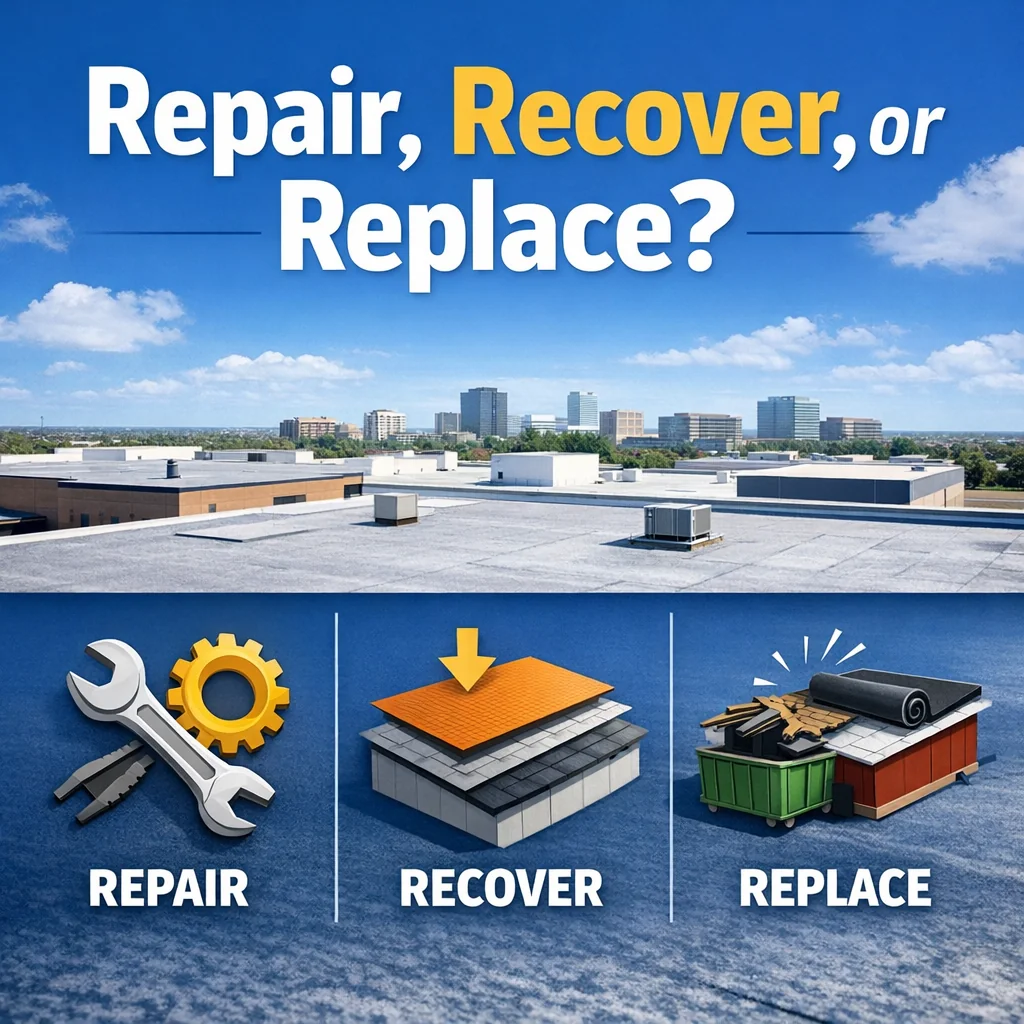
Commercial roofers present three possible recommendations for a deteriorating roof. Understanding what makes each option appropriate, or inappropriate, gives you a basis for evaluating what you are being told.
Repair is appropriate when damage is genuinely isolated. A single failed seam near a drain, a pipe boot that has separated, a small area of membrane damage from foot traffic: these are repair-scale problems when the rest of the system is intact and has meaningful service life remaining. The diagnostic question is whether the damage is local or systemic.
Recover (overlay) is a middle path where a new membrane is installed directly over the existing one. It avoids the labor and disposal involved in a full tear-off and can extend service life at a lower cost than full replacement. However, it is typically only permitted once by code. It is only viable if the existing membrane is dry (confirmed by infrared or core cut), the deck is structurally capable of supporting the additional weight, and local code allows the overlay. If these conditions are not confirmed, an overlay creates a second problem on top of the first.
Full replacement is warranted when moisture has compromised the deck, when the system has reached end of design life with widespread deterioration, when a recover is no longer code-compliant due to existing layers, or when the cost of sustained maintenance and repair exceeds the value of continued investment in the existing system.
A general threshold used in the commercial roofing industry: if more than roughly 25 percent of the roof area shows moisture intrusion or membrane failure, replacement typically delivers better long-term value than continued repair. That threshold is not a rigid rule, but it provides a starting point for an honest conversation with your contractor.
Smithrock Roofing serves property owners across Winston-Salem, Greensboro, High Point, Kernersville, Clemmons, Rural Hall, and surrounding communities with more than 60 combined years of exterior contracting experience. For those managing properties in the northern Triad, our roofing in King extends the same standard of credentialed, accountable work that defines every project we take on. The team holds CertainTeed PREMIER ShingleMaster Master Certified status, is fully licensed and insured, and backs its work with a 5-year labor warranty alongside the manufacturer’s limited lifetime warranty.
With more than 350 five-star reviews and an A+ BBB rating, the track record speaks directly to what property owners and facility managers care about most: showing up on time, communicating clearly, doing the work correctly the first time, and leaving the job site clean.
Whether you are managing a commercial property in Greensboro, overseeing a facility in High Point, or evaluating roof replacement options in Winston-Salem, the approach is the same. A thorough assessment, an honest recommendation, and work backed by credentials that mean something from the manufacturer’s perspective as much as from ours.
If your commercial roof is showing signs of wear, starting with a proper diagnostic assessment is the right first step. Our roofing service covers the full range of commercial and residential systems, from initial evaluation through installation and long-term support. Smithrock Roofing is ready to help you understand exactly what you are working with before any decisions are made.
Commercial roofers typically begin with a thorough inspection that includes visual assessment, moisture scanning, and a review of the roof’s age and maintenance history. The evaluation looks at the extent of membrane failure, the condition of the substrate and insulation, and whether the existing system still meets current code requirements. When moisture intrusion or membrane deterioration affects a significant portion of the roof area, replacement generally offers better long-term value than continued repair investment.
The most widely installed commercial roofing systems include TPO, EPDM, modified bitumen, built-up roofing, and metal panel systems. The appropriate choice depends on factors like building use, roof slope, load capacity, local climate conditions, and budget considerations. A qualified commercial roofer will assess the specific demands of your building before recommending a system type.
Project duration varies considerably depending on roof size, system type, existing conditions, and weather. A straightforward recover on a smaller commercial building may be completed within a few days, while a full tear-off and replacement on a large facility can extend over several weeks. Your contractor should provide a realistic project timeline during the proposal phase before work begins.
At minimum, a commercial roofing contractor should carry appropriate state licensing and full insurance coverage, including general liability and workers’ compensation. Manufacturer certifications are also worth verifying, as they indicate the contractor has met training and installation standards that can affect warranty eligibility. A documented track record, verifiable references, and a clear written scope of work are equally important before any agreement is signed.
Smithrock Roofing has spent more than 60 years building a reputation across the NC Triad that property owners and facility managers in Winston-Salem and Greensboro have come to rely on, not because of promises, but because of consistent, credentialed work that holds up over time. Whether your building needs a diagnostic assessment, targeted repairs, or a complete system replacement, the team brings the experience, manufacturer certifications, and local knowledge to handle it correctly from the first visit to the final walkthrough. Call (336) 971-0464 or Contact Smithrock Roofing today to schedule your commercial roof assessment.

Smithrock Roofing © Copyright 2026 • All Rights Reserved • Privacy Policy • Maintained by Mongoose Digital Marketing