Metal roofing is one of the more considered investments a homeowner can make. When it performs well, it performs for decades, with minimal maintenance, excellent weather resistance, and a look that holds up long after cheaper materials have given out. When it underperforms, it is usually because the decision was made on surface-level information: a lifespan claim here, an energy savings figure there, and a single “lifetime warranty” checkbox that nobody stopped to read. Homeowners across Winston-Salem, Greensboro, High Point, Kernersville, Clemmons, Rural Hall, King, and the surrounding NC Triad area deserve a straight account of how metal roofing actually works and what separates a well-specified system from one that looks identical on paper but delivers a different outcome on your roof.
This is that account.
The most common way metal roofing is sold is around longevity. Forty years, fifty years, sometimes more. Those figures are real, but they belong to a system, not to a panel sitting in a warehouse. The outcome depends on several variables that a knowledgeable residential metal roofing company will walk you through before a contract is ever signed.
The coating on a metal panel determines how it holds color, resists chalking, and handles UV exposure year after year. PVDF coatings (sold under brand names like Kynar) are the industry standard for long-term performance. SMP coatings are a step down and still widely used. Polyester coatings are common on budget panels. The panel underneath may be identical across all three; the coating is where the performance gap opens up over a decade or two.
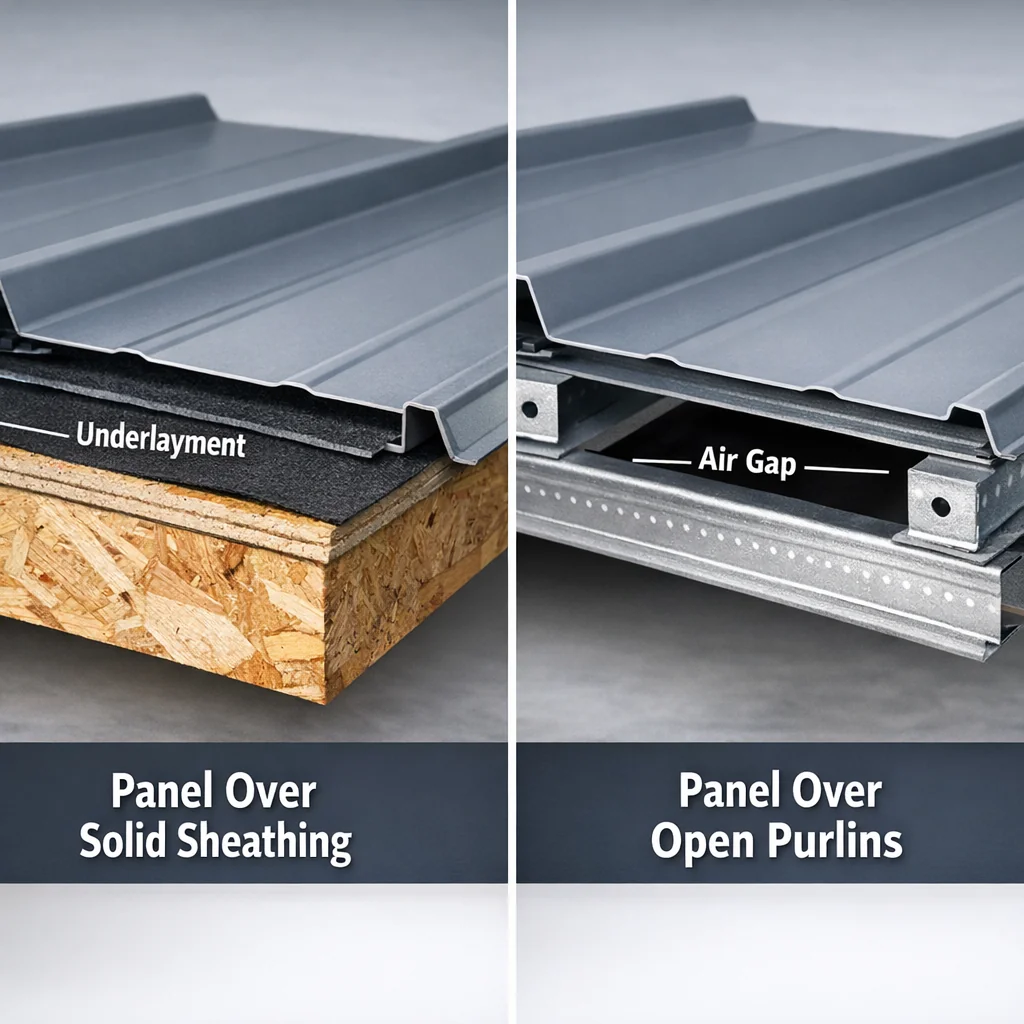
Gauge refers to the thickness of the metal. Thicker is more rigid, more dent-resistant, and more tolerant of foot traffic during installation and maintenance. The gauge that makes sense for your roof depends in part on what it is being installed over. Metal over solid sheathing sits differently than metal on open purlins, and those two scenarios place different structural demands on the panel.
Fasteners are one of the most overlooked variables. Exposed fastener systems use screws that pass through the panel face and are sealed with a rubber gasket. Over time, those gaskets can compress, crack, or pull loose. Concealed fastener systems, including most standing seam profiles, clip the panel mechanically without penetrating the face, which removes one of the more common failure points. Neither is universally better. The right choice depends on the panel profile, the substrate, the slope of the roof, and how the system is engineered to handle thermal expansion. For a deeper look at how these choices affect total project cost, the article on metal roofing sheet prices per foot and square foot breaks down the variables in detail.
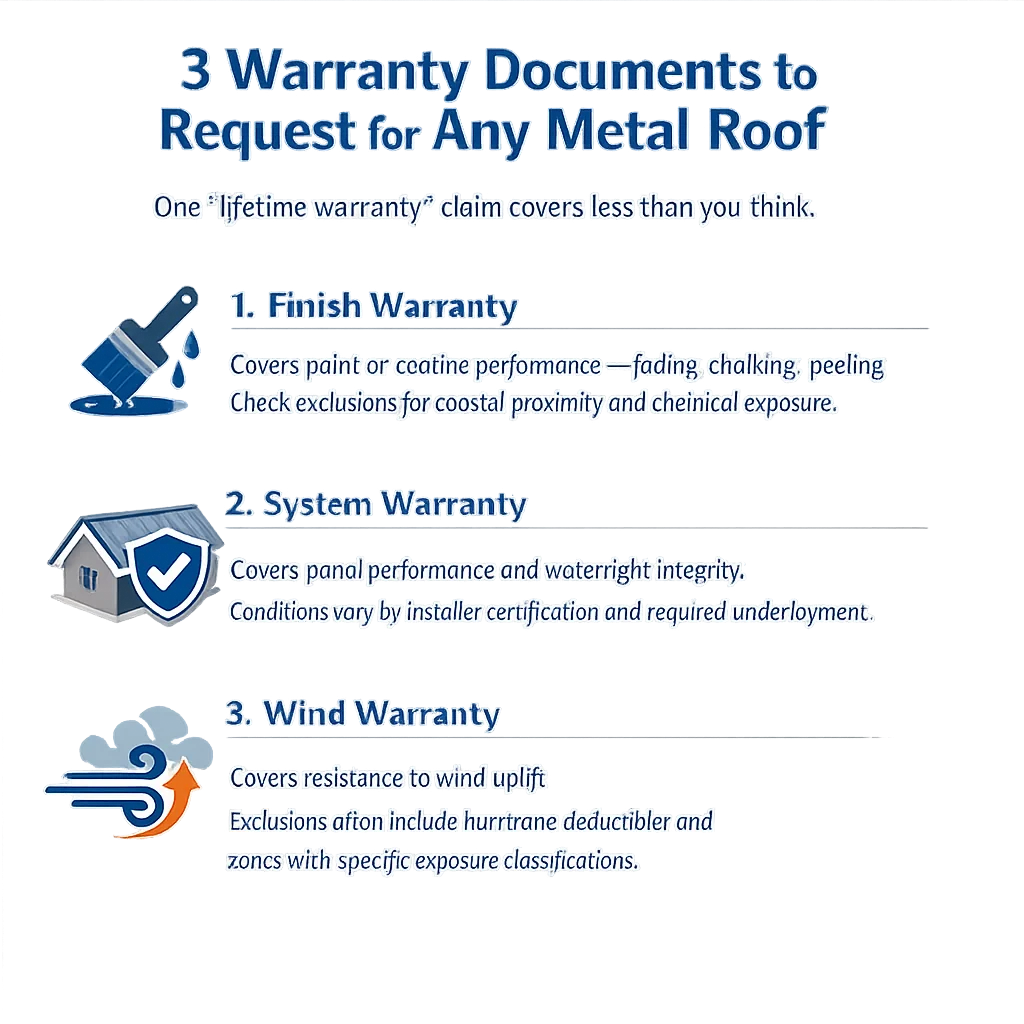
When a contractor says “lifetime warranty,” that is a starting point for a conversation, not an ending point. Metal roofing warranties are not a single document. They are typically three separate documents, each covering a different scope, each with its own exclusions.
A homeowner comparing two bids using “lifetime warranty” as a shorthand is comparing fundamentally different documents. Before signing, ask each contractor to provide all three warranty documents and identify what each one excludes. That single step tells you more about a bid than almost any other question.
Need a hand with this in Winston-Salem, Greensboro and the Triad? Call (336) 971-0464 or request a free estimate. Honest answers, no pressure.
Metal panels are commonly marketed as Class A fire-rated. This is often accurate, but there is a precision worth understanding: under ASTM E108, the fire classification belongs to an assembly, not to an individual panel. The panel, the underlayment, and the decking beneath it together form the tested assembly. Change the underlayment, and the fire rating of the resulting assembly may no longer match the marketing on the panel’s data sheet.
This matters practically. A contractor can install a panel that is tested as Class A over an incompatible underlayment, and the resulting installation loses its Class A classification. There is no visible indicator of this after the panels are on. If a permit inspection or an insurance claim references the fire rating, it is the assembly specification that gets scrutinized, not just the brand name on the panel.
The question to ask before signing is direct: “What is the complete tested assembly you will install, and can you provide the evaluation report number?” A contractor who has done this work correctly can answer that question without hesitation. Our roofing service is built around this standard, documented specifications, verified assemblies, and answers provided before the panels go on, not after.
Metal roofs have a reputation for being noisy in rain. The standard rebuttal from most contractors is that a properly installed metal roof is no louder than any other roofing material. That rebuttal is correct. It is also incomplete, because the condition that makes it true is exactly what varies between a quality installation and a cut-rate one.
A metal roof installed over solid sheathing with a quality decoupling underlayment is not meaningfully louder than an asphalt roof. The sheathing and underlayment absorb and disperse sound. A metal roof installed over open purlins, which occurs in agricultural applications and in some re-roofing-over-existing scenarios, has less material between the panel and the interior, and the difference is audible.
| Installation Scenario | Solid Decking | Decoupling Underlayment | Noise Outcome |
|---|---|---|---|
| Full tear-off, new sheathing | Yes | Yes | Comparable to asphalt |
| Install over existing shingles | Yes (existing) | Depends on spec | Comparable if underlayment is added |
| Open purlin installation | No | No | Noticeably louder |
| Panel over old sheathing, no underlayment | Yes | No | Moderate improvement |
The single question that converts this from a marketing claim into a verifiable specification: “Will this be installed over solid decking with a decoupling underlayment?” If the answer is yes and the spec is documented, the noise rebuttal holds. If the answer is vague, keep asking.
The questions in this article are not meant to make the process feel complicated. They are meant to give you a clear way to evaluate any contractor you speak with. A qualified residential metal roofing company will not hesitate when you ask about assembly specifications, warranty documents, or decking requirements. Those questions reflect the standard of work they should already be planning to deliver.
At Smithrock Roofing, we have more than 60 combined years of experience working with homeowners across the NC Triad. We are fully licensed and insured, and we bring the same commitment to materials, communication, and job-site professionalism to every exterior project we touch. When you call us, you get straight answers from people who have done this work long enough to know that cutting corners on a metal roof spec costs you far more than it saves.
If you are considering a metal roof for your home in Winston-Salem, Greensboro, roofing in High Point, Kernersville, Clemmons, Rural Hall, King, or anywhere in the surrounding area, we are ready to walk you through your options with no pressure and no shortcuts.
A properly installed metal roof on solid decking with a quality underlayment can last 40 to 70 years depending on the panel system and coating used. Asphalt shingles in the same climate typically require replacement every 15 to 25 years. The longevity difference is real, but it depends on the full installation assembly, not just the panel material itself.
Not necessarily. Noise level is determined almost entirely by how the roof is installed. A metal panel installed over solid sheathing with a decoupling underlayment performs comparably to asphalt shingles in sound tests. The louder metal roof experience most people associate with the product comes from open purlin installations with no underlayment, a method more common in agricultural or commercial buildings than in residential construction.
Ask whether the installation will include solid decking beneath the panels, what underlayment product will be used and why, and whether the warranty documentation covers both the material and the workmanship separately. A qualified contractor will have clear, specific answers to all three. Vague responses or resistance to those questions is a reliable signal to keep looking. The article on how to install metal roofing and avoid costly mistakes covers additional red flags worth knowing before you hire.
Many insurance carriers offer premium reductions for homes with impact-resistant metal roofing, particularly in regions prone to hail or high winds. On the energy side, metal panels with reflective coatings can reduce heat gain in summer months, which may lower cooling loads. Both outcomes vary by carrier, coating type, and local climate, so it is worth asking your insurance provider and your contractor for specifics relevant to your home.
When you are ready to move forward, Smithrock Roofing is the team homeowners in Winston-Salem and Greensboro trust to deliver honest assessments, documented specifications, and craftsmanship backed by more than 60 combined years of experience in the field. We answer questions directly, we put the details in writing, and we show up to every job prepared to do the work right the first time. Call us at (336) 971-0464 or Contact Smithrock Roofing to schedule your free estimate today.

Smithrock Roofing © Copyright 2026 • All Rights Reserved • Privacy Policy • Maintained by Mongoose Digital Marketing