An aging roof creates a specific kind of pressure for homeowners. The signs of wear are visible, but the right course of action is not always obvious. Some contractors recommend a full tear-off. Others suggest recovering the existing roof with a new layer of shingles. Both options can be appropriate, and both can be completely wrong depending on what is actually happening with the roof system beneath those old shingles.
The problem is that most information on this topic treats the decision as a simple two-column checklist. That framing leaves out the diagnostic reasoning that separates a sound long-term solution from one that fails within a few years. This article walks through the real evaluation process for an old roofing system, including the factors that are most commonly misunderstood or skipped entirely.
Age alone does not determine what needs to happen next. A 20-year-old roof on a well-ventilated home with an intact deck is a very different situation from a 15-year-old roof that has been quietly accumulating moisture damage since installation. The right starting point is not the shingle age, it is the condition of the entire roof assembly.
The roof assembly includes the shingles, the underlayment beneath them, the decking those layers rest on, and the attic environment below. Each layer affects the others. Evaluating old roofing means looking at all four, not just what is visible from the street or from a ladder at the edge.
A proper evaluation of an aging roof examines the following:
(https://www.nrca.net). Their raised profile creates an uneven surface and voids most warranties.”; item5_title=”Ventilation Status”; item5_body=”Poor attic ventilation causes decking rot and premature shingle failure. It must be corrected before any new layer goes on.”; footer=”Smithrock Roofing, Serving Winston-Salem, Greensboro, High Point, and the NC Triad”]
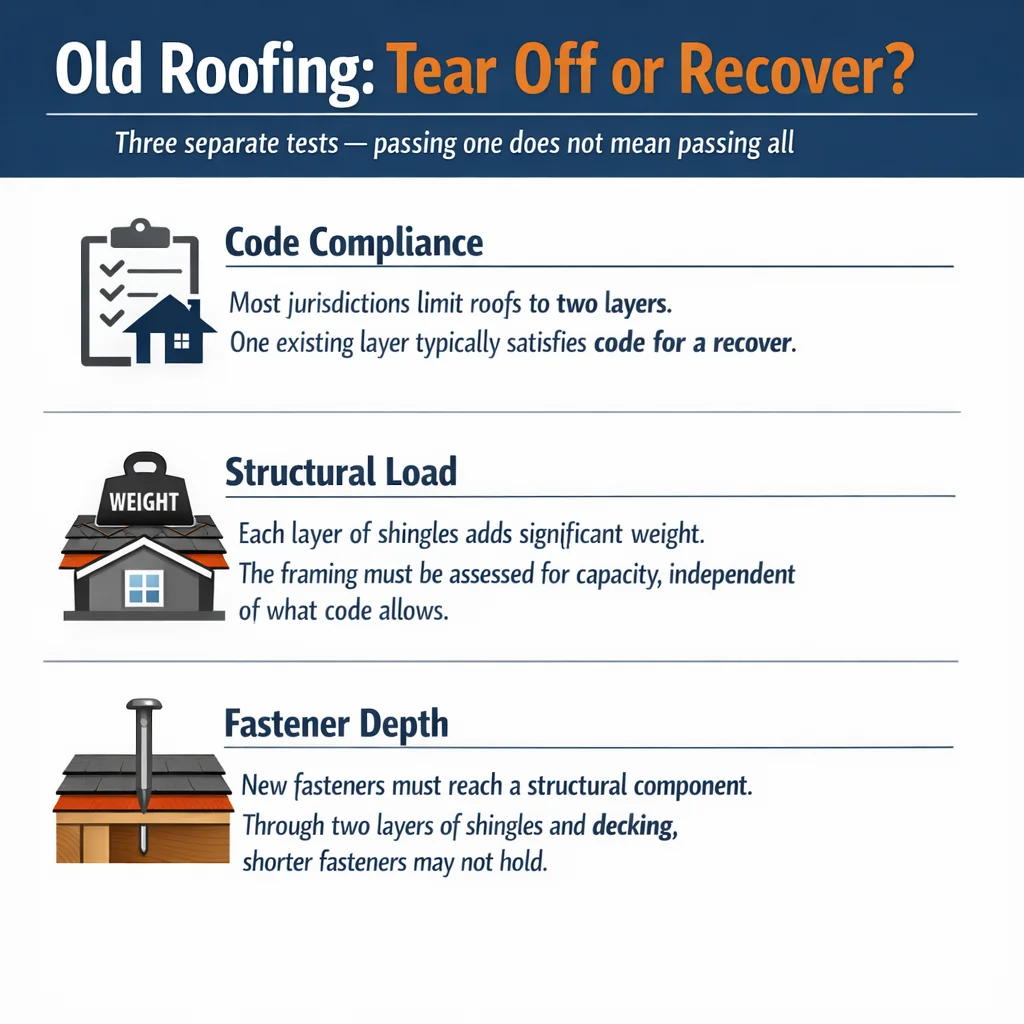
Homeowners often hear that local building code allows a second layer of shingles and conclude that recovering is a straightforward option. Code compliance is one threshold, but it is not the only one. Layer count actually triggers three separate evaluations, and a roof can pass one while failing the others.
Test 1: Code compliance. Most jurisdictions limit residential roofs to two layers of shingles. If your home already has two layers, a recover is off the table regardless of anything else.
Test 2: Structural load capacity. Roofing materials are heavy. A second layer of shingles adds meaningful weight to the framing below. The structure that supports your roof was engineered for a specific load, and adding a full second layer pushes that number higher. Code permits the second layer as a general rule, but the actual framing in your home is a specific condition. A qualified contractor assesses whether the structure can handle that additional weight safely.
Test 3: Fastener penetration depth. New shingles are mechanically attached with fasteners that must reach into a structural component, typically the roof decking, to hold properly. When new shingles are installed over an existing layer, the fasteners are starting from a higher point. If the existing layer is thick or the decking is thinner than standard, fasteners may not reach the depth needed for a secure connection. This is a performance and safety issue that exists independently of what local code says.
Need a hand with this in Winston-Salem, Greensboro and the Triad? Call (336) 971-0464 or request a free estimate. Honest answers, no pressure.
Here is the point that is most often treated as a footnote when it deserves to be the first thing homeowners understand about recovering old roofing.
Laminated shingles, also called architectural or dimensional shingles, have been the standard residential shingle for a long time. If the home you are evaluating was re-roofed at any point in the past two or three decades, there is a strong likelihood that laminated shingles are what is currently on the roof.
Most manufacturers explicitly do not recommend installing new shingles over existing laminated shingles. This is not a minor preference, it is a material incompatibility.
Laminated shingles have a raised, layered surface profile. Unlike the flat profile of an older three-tab shingle, the surface of a laminated shingle is uneven by design. That variation in height creates an irregular substrate for a new layer. When new shingles go down over that surface, they conform to the bumps and ridges beneath them rather than lying flat. The result is an uneven finished surface, gaps that can trap water, and a new shingle layer that is not lying in the geometry it was manufactured to perform in. Beyond the performance issues, installing new shingles over laminated shingles typically voids the manufacturer warranty on the new material. If you want to understand how different roofing materials compare in terms of durability and long-term performance, the article on durable roofing solutions covering slate, metal, and tile offers a useful breakdown.
The practical consequence is this: if your old roofing consists of laminated shingles, recovery is not a realistic option. Full tear-off is the appropriate path, and that fact should be established at the start of the evaluation, not discovered at the end.
Attic ventilation is consistently treated as an afterthought in discussions of old roofing decisions. It appears at the end of checklists, in footnotes, and as a secondary consideration. That placement is misleading.
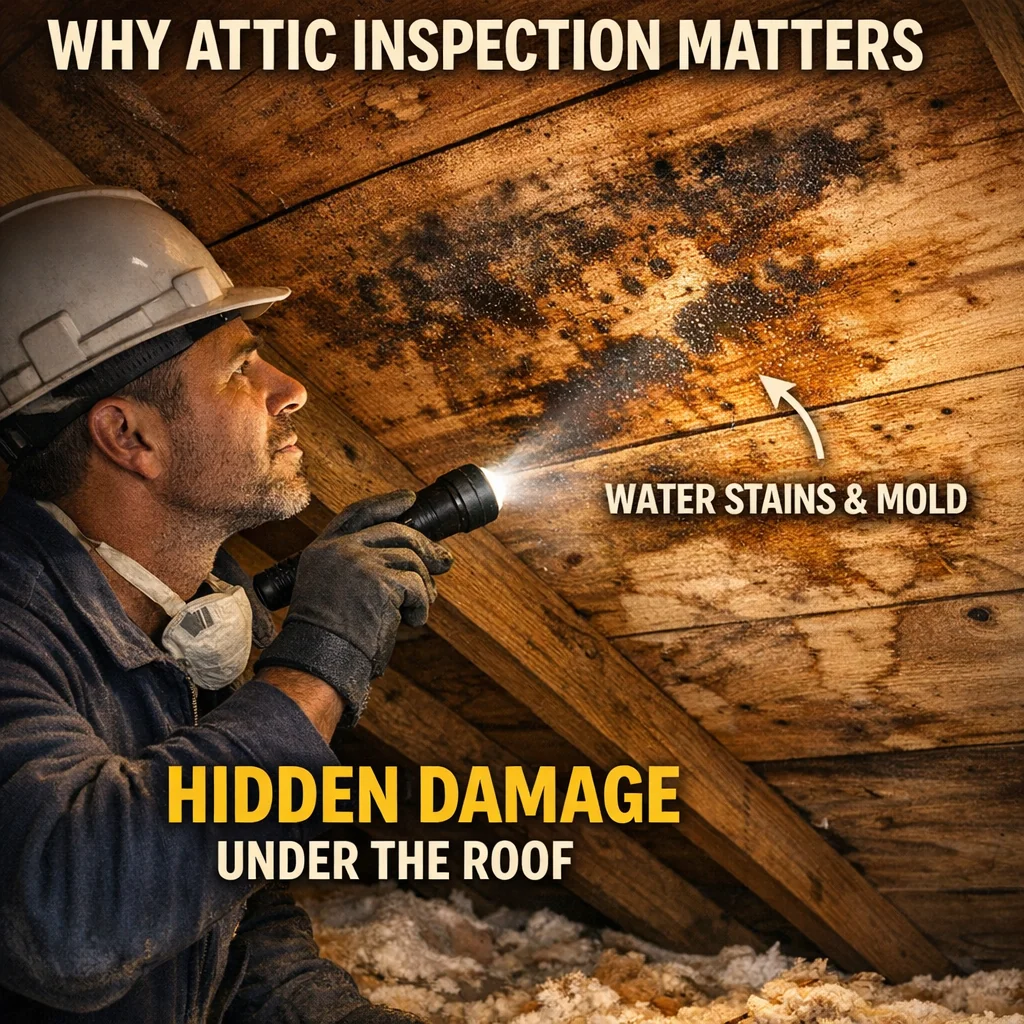
Inadequate attic ventilation is one of the primary mechanisms through which roof systems fail prematurely. When warm, moist air from the living space below cannot escape the attic effectively, it condenses on the underside of the roof decking. Over time, that moisture causes the decking to rot, the sheathing to delaminate, and the shingles above to blister and curl from the heat that builds up in a poorly ventilated attic.
When a homeowner or contractor looks at an old roof and sees curling shingles, soft decking, or staining on the rafters, those conditions often share a single cause: ventilation that was never adequate or that has been partially blocked.
This matters for the recover versus replace decision in a direct way. If ventilation deficiency contributed to the failure of the old roofing, installing new materials without correcting the ventilation problem recreates identical conditions. The new shingles will experience the same heat buildup and moisture cycling. The warranty on those materials may be voided by the inadequate ventilation. The deck that looked marginal at the time of re-roofing will continue to deteriorate beneath the new layer.
A full tear-off allows a contractor to inspect the deck thoroughly, assess rafter bay ventilation, correct any blockages, and make sure the system beneath the new roof is sound. That inspection opportunity is not a perk of choosing tear-off. It is often the reason tear-off is the only honest recommendation. For a closer look at the warning signs that indicate your roof may already be past the point of recovery, the article on signs of roof damage you can’t ignore covers the most critical indicators in detail.
Full tear-off is a larger project than a recover, but it resolves the uncertainty that recovery leaves in place.
| Factor | Full Tear-Off | Recover (Over Existing Layer) |
|---|---|---|
| Deck inspection | Complete visual access to all decking | No access; damage remains hidden |
| Ventilation correction | Rafter bays can be cleared and corrected | Ventilation issues persist beneath new layer |
| Laminated shingle compatibility | Not a factor; all old material is removed | Typically incompatible; may void new warranty |
| Structural load | Reduced; old material weight is removed | Increased; both layers remain on structure |
| Fastener depth | Full depth into clean decking | Reduced; fasteners must pass through existing layer |
| Warranty validity | Full manufacturer warranty available | May be voided depending on substrate condition |
| Long-term performance | New system starts from a clean baseline | Performance limited by condition of existing layer |
Recovery is not always the wrong choice. On a home with a single layer of flat three-tab shingles, a structurally sound deck, confirmed adequate ventilation, and a code-compliant framing assembly, recovery can be a reasonable option. But those conditions need to be confirmed, not assumed.
At Smithrock Roofing, we have more than 60 combined years of experience working with old roofing systems across Winston-Salem, Greensboro, High Point, Kernersville, Clemmons, Rural Hall, King, Mount Airy, and the surrounding NC Triad communities. That experience shows up in how we approach the evaluation process.
We look at the full system: shingle condition, deck integrity, existing layer profile, structural capacity, and attic ventilation, before we make a recommendation. We are CertainTeed PREMIER ShingleMaster certified, which reflects the standard of training and installation practice we bring to every project. When homeowners in the area reach out to us about roofing in Greensboro or any of the surrounding communities, they get the same thorough system evaluation regardless of roof size or complexity. When we install new shingles, we use CertainTeed Landmark shingles backed by a 5-year labor warranty and a limited lifetime manufacturer warranty.
Our roofing service is built around honest evaluation first, so you understand exactly what your roof needs before any work begins. If your old roofing can be responsibly recovered, we will tell you. If it cannot, we will explain exactly why and show you what we found.
If your roof is showing its age and you are ready for a straight answer, contact Smithrock Roofing to schedule an inspection.
The answer depends on several factors that require a hands-on evaluation: the number of existing shingle layers, the condition of the roof deck beneath them, current attic ventilation, and the structural capacity of your framing. A single layer of flat shingles over a sound deck with proper ventilation may be a candidate for recovery. Multiple layers, soft spots, moisture damage, or ventilation deficiencies typically point toward full replacement. There is no reliable way to determine this from the ground or from a surface-only visual check.
It can. Many shingle manufacturers place conditions or limitations on warranty coverage when new shingles are installed over an existing layer. The condition of the substrate, the profile of the existing shingles, and whether installation meets the manufacturer’s specifications all factor into whether a full warranty applies. If warranty coverage matters to you, that is an important question to ask before any work begins.
Existing shingles that are curled, buckled, or uneven create an irregular surface that prevents new shingles from lying flat. This affects both appearance and performance. Beyond surface profile, hidden moisture damage in the old layer or the deck beneath it can continue to deteriorate after the new layer is installed, shortening the life of the new roof without any visible warning signs on the exterior.
Most residential roof replacements on a standard single-family home are completed in one to two days under normal conditions. Larger homes, complex rooflines, steep pitches, or the discovery of deck damage that requires repair can extend that timeline. Weather also plays a role in scheduling. Your contractor should be able to give you a realistic timeframe once the scope of work is confirmed after inspection.
When old roofing reaches the end of its reliable service life, the decisions you make next affect your home’s protection for decades to come, and that is exactly why Smithrock Roofing takes the evaluation process seriously for homeowners across Winston-Salem, Greensboro, and the surrounding NC Triad. Whether your home is in High Point or Kernersville, our team brings the same thorough, honest approach to every inspection, with no shortcuts and no pressure. Call us at (336) 971-0464 or Contact Smithrock Roofing to schedule your inspection and get a straight answer about what your roof actually needs.

Smithrock Roofing © Copyright 2026 • All Rights Reserved • Privacy Policy • Maintained by Mongoose Digital Marketing