Deciding whether you need a new roof comes down to three things working together: the severity of what you are seeing, the actual condition of the system underneath the shingles, and an honest accounting of how much functional life the existing roof has left. Get all three right and the repair-versus-replace question answers itself. Miss any one of them and you risk either overspending on a replacement that was not yet necessary or underinvesting in a repair that only delays a larger problem.
This guide walks through each factor in the order a qualified inspector would consider them, starting with urgency triage and working through the hidden variables most homeowners never hear about until they are already mid-project.
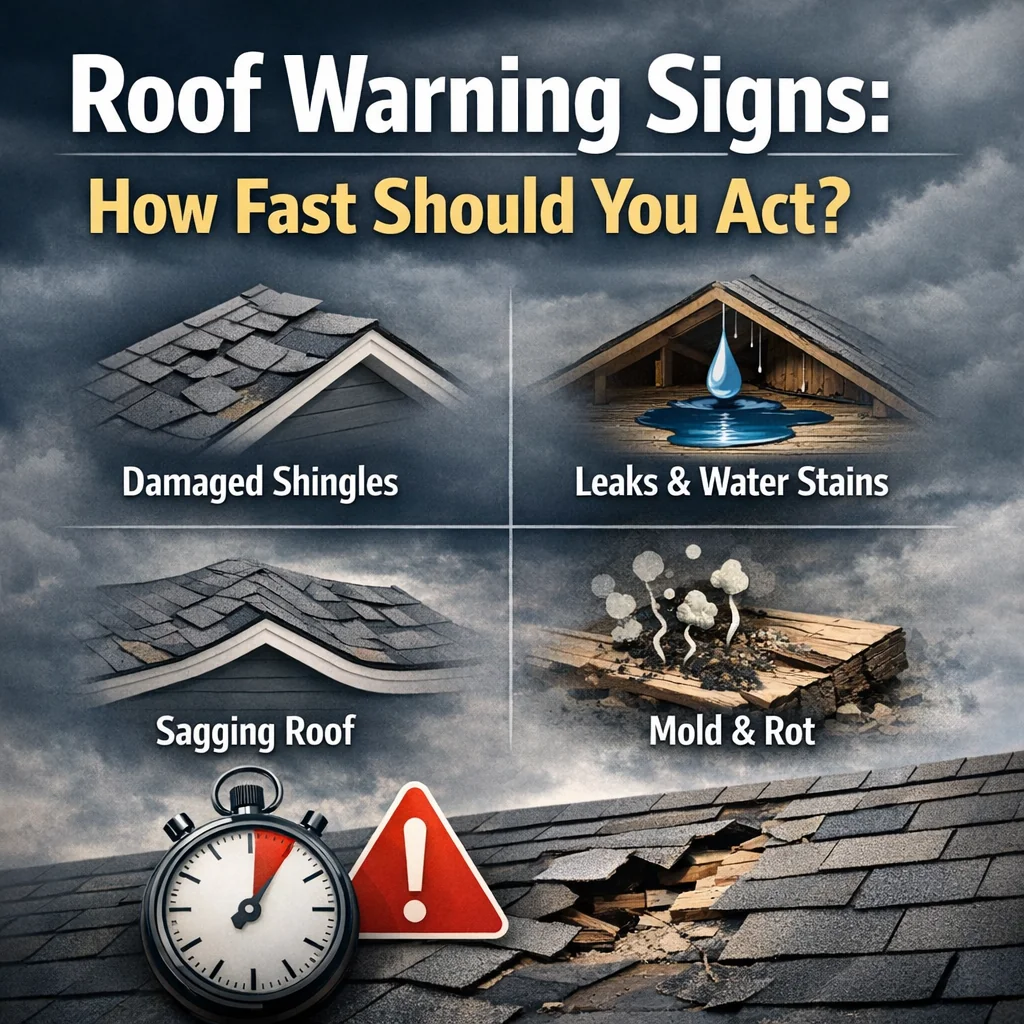
Every roof inspection guide lists the same warning signs. What those guides rarely do is tell you how fast to act on each one. The difference between a cosmetic indicator and a structural one is not just a matter of degree; it determines whether you have weeks to gather estimates or hours to make a call.
These indicators point to problems that can worsen quickly and, in severe cases, create safety risk.
Sagging or deflection in the roofline. Any visible dip, wave, or sag in the plane of your roof is a red flag that something beneath the shingles is failing. This can mean saturated decking, compromised rafters, or both. It is not a sign to photograph and add to a list; it is a sign to call a professional the same day.
Daylight visible through attic boards, especially accompanied by water staining. Light coming through the roof deck means there is a breach. If that breach has been there long enough to stain the wood around it, moisture has likely already worked into the framing. The longer this goes unaddressed, the more the repair scope grows.
Multiple active leaks that have returned after previous patching. One isolated leak repaired cleanly is a repair situation. Recurring leaks in multiple locations after honest attempts at repair are a sign that the roof’s waterproofing layer has failed broadly, not in one spot.
These signs point to normal aging or surface-level deterioration. They are worth taking seriously, but they do not require an emergency response.
Granule accumulation in gutters or at downspout outlets. Some granule loss is normal on newer shingles as excess manufacturing material sheds. Significant, sustained granule loss on a roof more than ten years old means the shingles are losing the UV-protective coating that keeps them functional. This is a sign to get a professional opinion on remaining life, not necessarily a sign to replace immediately.
Curling or cupping at shingle edges. Curling upward at the edges (cupping) or downward at the center (clawing) usually indicates the shingles are losing moisture balance. This can be driven by age, heat buildup from poor ventilation, or both. It shortens remaining lifespan and deserves an inspection, but it is not a structural emergency on its own.
Algae streaking or moss growth. Dark streaks are typically algae. Moss is more concerning because it holds moisture against the shingle surface. Neither is an immediate structural problem, but moss left untreated can eventually lift shingle edges and allow water infiltration.
Flashing deterioration around chimneys, vents, and valleys. Flashing is often where roofs fail first. Cracked, corroded, or improperly sealed flashing can sometimes be addressed without a full replacement, but failing flashing that is also accompanied by other age indicators warrants a broader evaluation.
The most widely cited guidance for this decision is the 30% rule: if repairs will cost more than 30% of what a full replacement would cost, replace instead. It is a reasonable starting point, but it has a flaw that most guides never mention.
The rule assumes you are getting value from the repair over a meaningful remaining lifespan. On a roof with ten or more years of functional life ahead, a repair that comes in well under the 30% threshold is almost always the right call. But consider a roof that is 22 years old, made of standard three-tab asphalt shingles, and showing broad granule loss across multiple slopes. A repair priced at 20% of replacement cost passes the 30% test. It still may not be the right investment if that roof has two or three functional years remaining and the repair addresses only the most visible problem.
A more complete framework uses two variables together.
Repair-to-replace cost ratio: Is the repair under 30% of replacement value? If yes, proceed to the second variable.
Remaining estimated lifespan: Based on the roof’s age, material, installation quality, and current condition, how many functional years does a qualified inspector estimate are left? If the answer is fewer than five to seven years, even a repair that clears the cost threshold may not be financially sound. Our New Roof Replacement Guide walks through this decision-making process in further detail.
Neither variable alone gives you the full picture. Together, they make the decision much cleaner.
One additional consideration often overlooked: are you planning to sell the home within the next few years? A new roof is a tangible, documentable selling point. An older roof with visible wear, even if technically functional, can complicate inspections and buyer negotiations. In that situation, the financial math shifts.
Need a hand with this in Winston-Salem, Greensboro and the Triad? Call (336) 971-0464 or request a free estimate. Honest answers, no pressure.
Roofing material lifespan tables show up in nearly every guide on this topic. Standard asphalt shingles: 20 to 30 years. Architectural shingles: 25 to 30 years. Metal: 40 to 70 years. These numbers are accurate as theoretical maximums under ideal conditions. What they do not show is that “ideal conditions” includes quality installation, and many roofs were not installed that way.
Inadequate nail penetration, improper starter strip application, insufficient shingle overlap, and the use of undersized or low-grade underlayment all reduce a roof’s effective lifespan, sometimes significantly. A homeowner reasoning “my asphalt roof is 18 years old and the table says 20 to 25 years, so I have a few years left” may be working from a false premise if the original installation was mediocre.
How can you get a read on installation quality retroactively? A few indicators are accessible without a full tear-off.
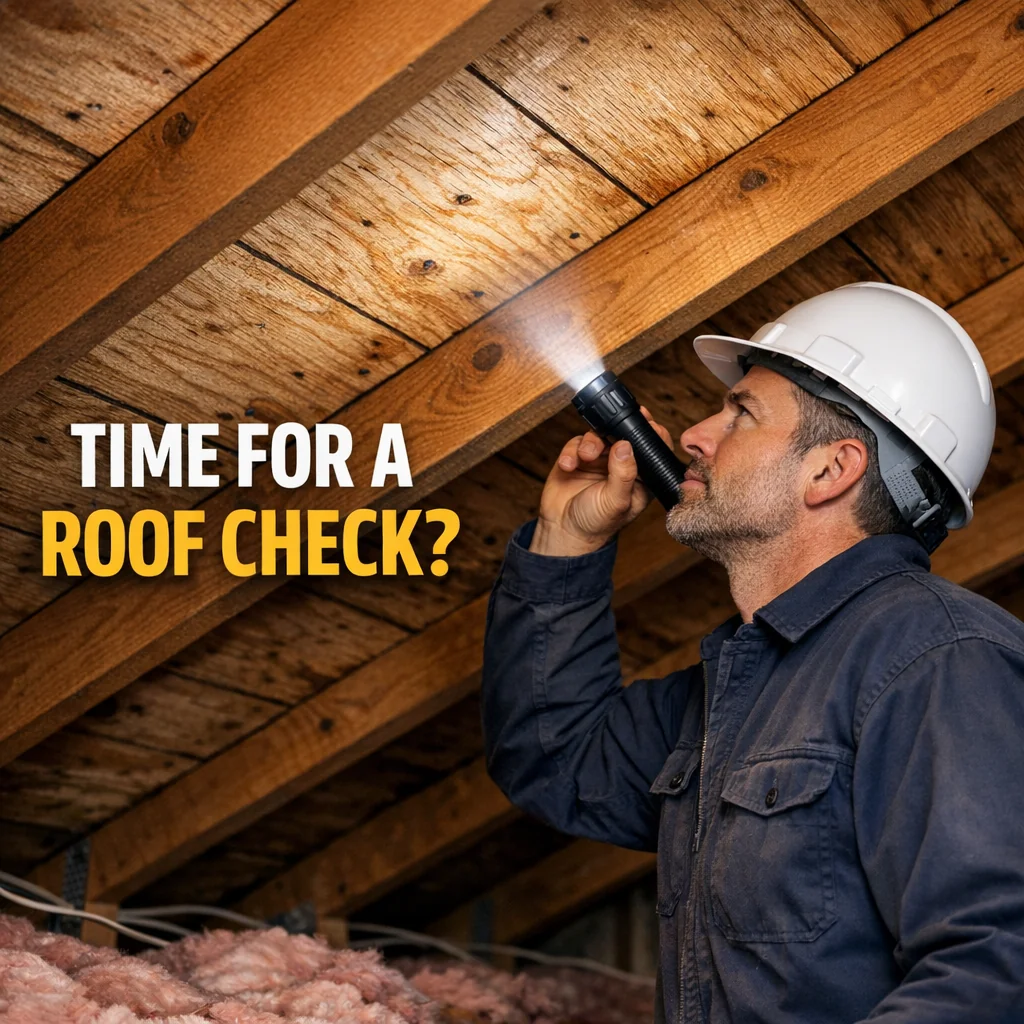
Attic inspection for ventilation adequacy. An expert can assess whether your attic has sufficient intake and exhaust ventilation. Poor ventilation traps heat and moisture against the underside of the decking, accelerating breakdown of both the decking and the shingles above it. If your attic runs extremely hot in summer or shows moisture or frost in winter, ventilation is likely inadequate and shingle life has been shortened as a result.
Shingle alignment and uniformity. From the ground or a ladder at the eave line, look for inconsistent shingle courses, visible gaps, or waves in the surface. Straight, consistent lines indicate careful installation; irregular patterns suggest otherwise.
Granule wear patterns. Accelerated granule loss in specific zones rather than evenly across the surface can indicate localized installation problems, poor drainage design, or areas where heat concentration is highest due to ventilation issues.
This matters for a straightforward reason: if you are replacing a roof that failed early due to poor installation, simply choosing the same material without addressing the underlying system problems (ventilation, decking condition, underlayment grade) risks the same outcome. The shingles are not the whole roof.
One of the most common mid-project surprises in a roof replacement is the discovery of damaged decking once the old shingles are removed. Roof sheathing can absorb moisture over years of minor leaks or condensation without showing obvious signs from the attic. It may feel firm to a light press but be delaminating internally. When it comes off, the actual extent of the damage becomes visible for the first time.
This is not a contractor bait-and-switch scenario; it is a genuine limitation of pre-removal inspection. But there are steps homeowners can take to minimize the surprise.
Before signing a replacement contract, ask your contractor to walk through the attic with you. Look for soft spots in the decking visible from below, areas of staining or discoloration, and any evidence of long-term moisture intrusion. This will not reveal every problem, but it gives you a realistic baseline and signals whether decking replacement is likely or unlikely once tear-off begins.
A contract that addresses this scenario clearly, specifying how decking replacement will be priced and authorized if discovered during tear-off, protects you from ambiguity. A contractor unwilling to discuss this scenario in advance is worth questioning.
Attic ventilation is absent from almost every guide written about roof replacement. This is a significant gap because ventilation directly affects how long your new roof will last.
The principle is straightforward. Heat and moisture that cannot escape the attic space work against the roof system from the inside. Heat degrades shingle adhesive strips and accelerates granule breakdown. Moisture causes wood to expand, contract, and eventually rot. In winter, warm air escaping from living spaces into an under-ventilated attic can create ice dams, where melting snow refreezes at the eave line and backs water under shingles. Understanding how heat and moisture move through your roof system is essential, our article on why snow melts on your roof explains the mechanics in practical terms.
A properly designed roofing system balances intake ventilation (typically at the soffit) with exhaust ventilation (at or near the ridge). The ratio matters, and it should be evaluated as part of any replacement project, not treated as a separate issue to address later.
If a contractor proposes a full replacement without mentioning ventilation, that is worth raising directly. Installing new premium shingles over a ventilation problem is like putting new tires on a car with a misaligned frame. The tires will wear unevenly and prematurely, and the underlying problem will still be there.
Material selection conversations often focus on lifespan and appearance. Both matter. What often gets skipped is the structural dimension of the choice.
Heavier materials place more load on the framing below. Clay tile and slate, for example, are significantly heavier than asphalt or standard metal panels. Before committing to a heavier material on a roof replacement, an assessment of the existing framing condition is warranted. A structure built or engineered for asphalt shingles may require reinforcement to safely carry tile or slate. This is not a reason to avoid those materials; it is a reason to sequence the decision correctly: assess the structure before finalizing the material, not after.
| Material | Relative Weight | Typical Lifespan Range | Key Structural Consideration |
|---|---|---|---|
| 3-tab asphalt | Light | 20 to 25 years | Minimal; suitable for most standard framing |
| Architectural asphalt | Light to moderate | 25 to 30 years | Minimal; widely compatible |
| Metal (standing seam or panel) | Light to moderate | 40 to 70 years | Generally compatible; verify with older framing |
| Wood shake | Moderate | 20 to 30 years | Requires good ventilation and maintenance |
| Concrete tile | Heavy | 40 to 50 years | Framing assessment required before selection |
| Clay tile | Heavy | 50 to 100 years | Framing assessment required; may need reinforcement |
| Slate (natural) | Very heavy | 75 to 150 years | Structural engineering assessment strongly recommended |
At Smithrock Roofing, our roofing service features CertainTeed Landmark architectural shingles as our primary material. They offer a meaningful lifespan improvement over standard three-tab shingles, perform reliably under NC Triad conditions, and carry a limited lifetime manufacturer warranty backed by our 5-year labor warranty. For most homeowners in roofing in Winston-Salem, Greensboro, High Point, Kernersville, Clemmons, Rural Hall, King, and Mount Airy, they represent the balance of performance and durability that holds up well over time.
A few specific things separate a roofing contractor worth trusting from one worth walking away from.
Licensing and insurance, verified, not assumed. Ask for the contractor’s license number and certificate of insurance. A reputable contractor hands these over without hesitation. If there is any resistance, that is your answer.
Local, established presence. A contractor with deep roots in your community has a reputation to protect. Smithrock Roofing has served NC Triad homeowners for decades, holds a CertainTeed PREMIER ShingleMaster certification, carries an A+ BBB rating, and has earned more than 350 five-star reviews. That track record exists because the work backs it up.
Warranty clarity. Understand what is covered by the manufacturer’s material warranty and what is covered by the contractor’s labor warranty, and for how long. These are two different protections. Our 5-year labor warranty, paired with CertainTeed’s limited lifetime manufacturer warranty, means you have coverage on both the materials and the workmanship.
A contract that addresses contingencies. Any contract for a full replacement should specify how decking issues discovered during tear-off will be handled, what cleanup and disposal responsibilities belong to the contractor, and what the timeline for project completion looks like. Vague contracts create disputes. Clear ones prevent them.
No pressure to decide immediately. A contractor who pushes you to sign before you have had time to review the estimate and ask questions is not operating in your interest. Our approach is consultative: we provide the information you need, answer your questions honestly, and let the quality of our work and our record speak for itself.
The answer depends on the age of your roof, the extent of the damage, and how much of the surface is affected. If your roof is approaching or past the 20-year mark and you are seeing widespread granule loss, multiple leaking areas, or sagging sections, replacement is usually the more practical long-term solution. Isolated damage on a younger roof, such as a few missing shingles after a storm, may be a strong candidate for repair. A thorough inspection from a qualified contractor will give you a clear picture of which option makes sense for your specific situation.
Roofing work can be completed throughout most of the year in our area, but spring and early fall tend to offer the most favorable weather conditions. That said, a genuinely urgent situation, such as active leaking or storm damage, should not wait for an ideal season. Modern roofing materials and experienced crews are equipped to work safely and effectively across a range of conditions, and delaying necessary work can allow minor damage to escalate into something far more serious.
Most residential roof replacements in the Triad area are completed within one to two days, depending on the size and pitch of the roof, the materials selected, and whether any decking issues are discovered during tear-off. Your contractor should give you a realistic project timeline before work begins and communicate clearly if anything changes once the job is underway.
It depends on the cause of the damage. Most standard homeowners insurance policies cover roof damage resulting from sudden and accidental events, such as wind, hail, or falling trees. Damage that results from long-term neglect or normal wear and tear is generally not covered. After a significant storm, it is worth having your roof inspected so you have accurate documentation if you decide to file a claim.
When your roof starts showing signs of age or damage, the decision you make about who does the work matters as much as the decision to replace it. Smithrock Roofing has spent decades earning the trust of homeowners across Winston-Salem, Greensboro, High Point, and the surrounding Triad communities by delivering honest assessments, quality installations, and standing behind every job with a clear warranty. If you are ready to find out where your roof stands, give us a call at (336) 971-0464 or Contact Smithrock Roofing to schedule your free estimate today.

Smithrock Roofing © Copyright 2026 • All Rights Reserved • Privacy Policy • Maintained by Mongoose Digital Marketing