A new roof replacement is one of the most significant investments a homeowner makes, and the decisions that shape its long-term performance happen before a single shingle is nailed down. Most of the information available online focuses on broad cost ranges and material comparisons, which is useful up to a point. What gets less attention is the decision architecture behind the replacement itself: how to evaluate what a quote actually includes, why the tear-off question matters for your warranty, and how ventilation can determine whether a new roof lasts 15 years or 30. This guide works through those questions in the order a homeowner actually faces them.
At Smithrock Roofing, we have served homeowners across Winston-Salem, Greensboro, High Point, Kernersville, Clemmons, Rural Hall, King, and the surrounding NC Triad for decades. With more than 60 combined years of experience and CertainTeed PREMIER ShingleMaster certification, our team approaches every replacement as a system-level project, not a surface-level fix. That perspective shapes everything below.
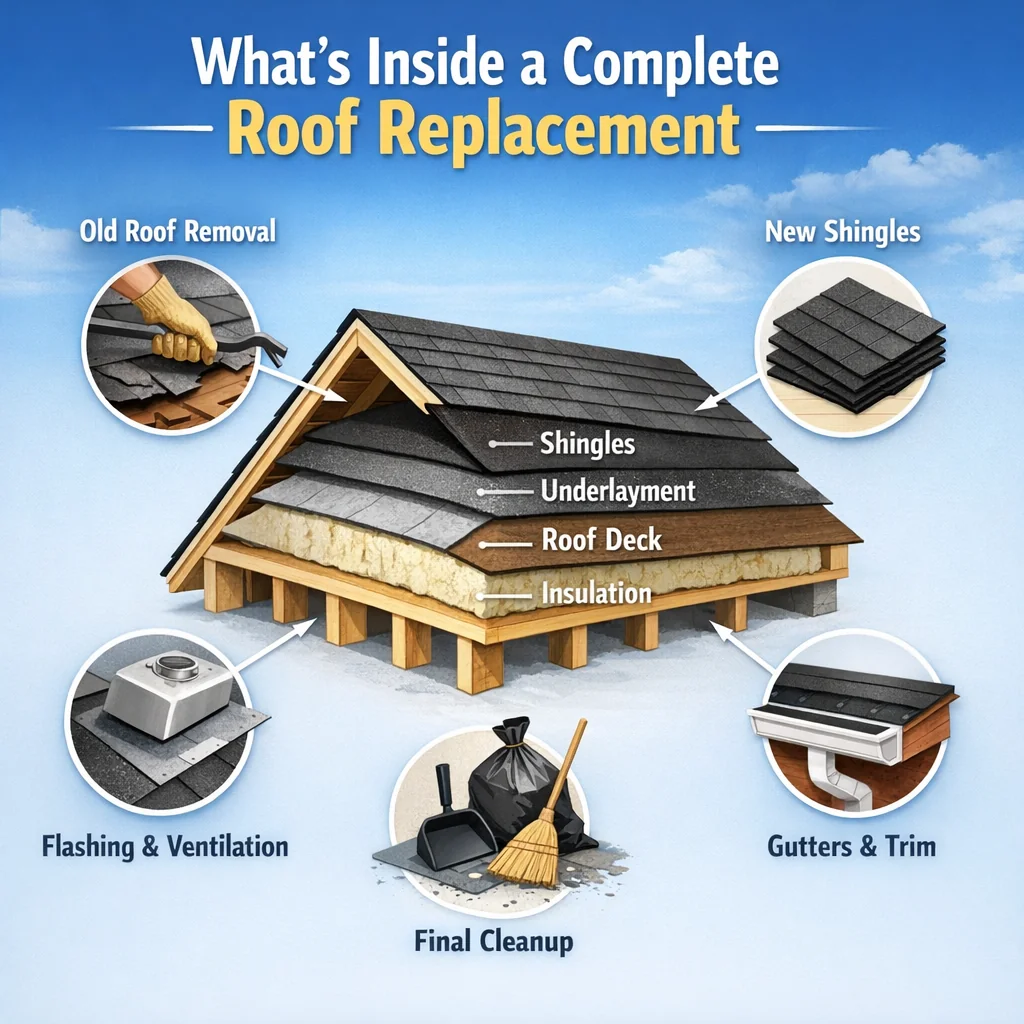
The word “replacement” suggests a straightforward swap, but a properly executed new roof is an assembly of interdependent components. When any one of them is undersized, skipped, or installed incorrectly, the performance of the entire system suffers, often in ways that are not visible until damage has already occurred.
Decking (sheathing): This is the structural layer that everything else attaches to. Before any new material goes on, the decking should be inspected for soft spots, rot, or deterioration. A contractor who skips this inspection is not just cutting a corner; they are potentially installing a premium roof over a compromised foundation.
Underlayment: This is the water-resistant barrier between the decking and the shingles. Synthetic underlayments offer better tear resistance and moisture protection than traditional felt. The grade of underlayment specified in a quote is one of the clearest indicators of whether a contractor is building a complete system or a minimal one.
Ice-and-water shield: A self-adhering membrane applied at vulnerable areas, typically eaves, valleys, and around penetrations. The coverage area specified matters. A quote that includes ice-and-water shield only at the eave edge is meaningfully different from one that extends coverage through valleys and around every pipe penetration.
Drip edge: Metal flashing installed along roof edges to direct water away from the fascia. It is a code requirement in most jurisdictions and a basic component of any complete installation. Its presence or absence in a quote scope is a reliable quality signal.
Flashing: The metal work around chimneys, skylights, dormers, and wall intersections. Flashing reuse is sometimes acceptable when the existing material is in good condition and is compatible with the new installation. When it is reused as a cost-cutting shortcut on aged or corroded material, it becomes the most likely point of future failure.
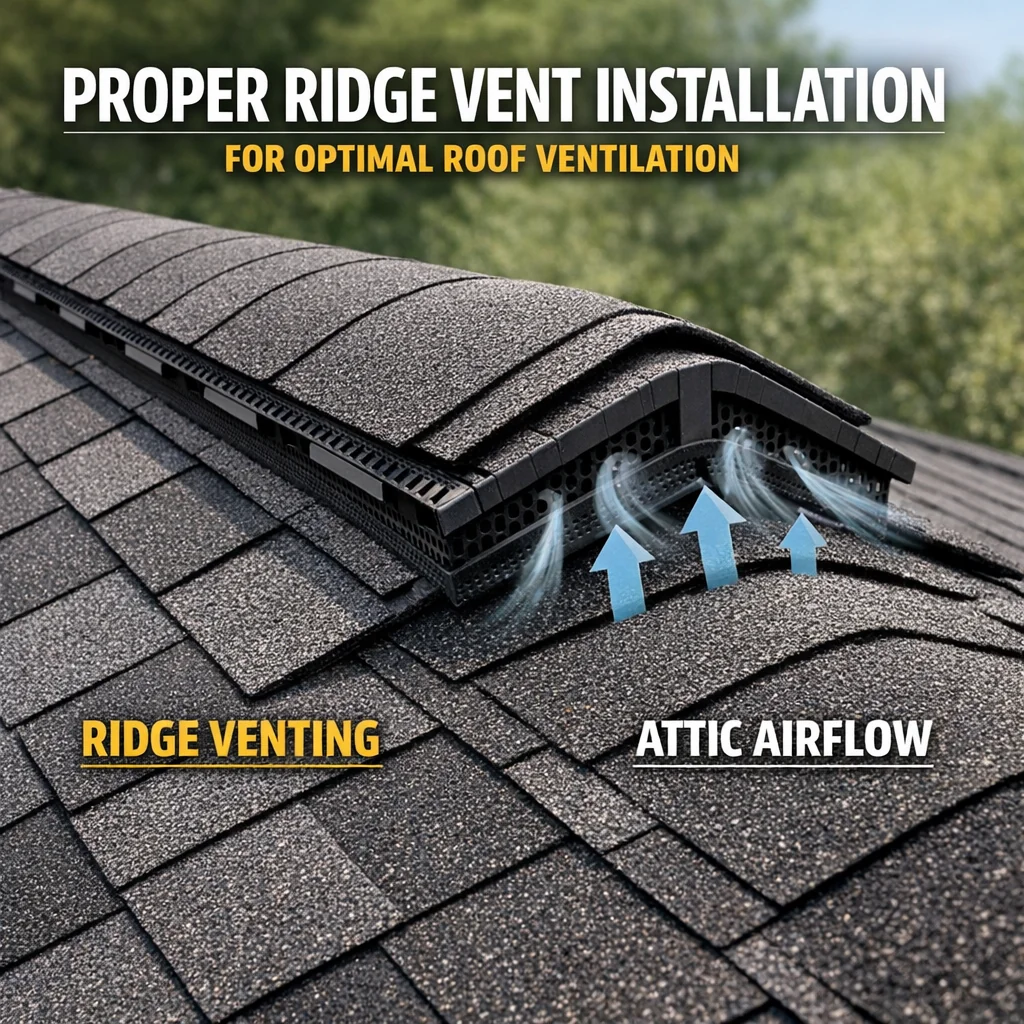
Ventilation: Intake and exhaust pathways that regulate temperature and moisture in the attic space. This component is discussed in depth below because its consequences are frequently underestimated.
Shingles, starter strips, and ridge caps: The visible surface layer. Manufacturer-approved starter strips and matching ridge caps are required for full warranty compliance on most premium shingle lines, including CertainTeed Landmark. Substituting generic alternatives can compromise the warranty even when the field shingle is correct.
One of the most common points of confusion homeowners face when gathering estimates is the assumption that identical shingle brands mean identical proposals. They do not.
When a contractor quotes CertainTeed Landmark shingles and another contractor quotes CertainTeed Landmark shingles, the shingle line is the same. Everything beneath and around it may differ entirely. Price differences between proposals frequently reflect scope differences, not quality differences in the shingle itself.
When reviewing multiple quotes for a new roof replacement, compare these line items directly rather than comparing bottom-line numbers. For a deeper look at how pricing varies across the region, our shingle roof replacement NC guide breaks down what typical costs include and what to watch for in a proposal:
| Scope Item | What to Look For | Why It Matters |
|---|---|---|
| Underlayment type and weight | Synthetic vs. felt; specific product named | Affects moisture resistance and warranty compliance |
| Ice-and-water shield coverage | Linear feet or coverage zones specified | Determines leak protection at vulnerable transitions |
| Drip edge included | Yes/No and material specified | Required for code compliance and edge water management |
| Starter strip type | Manufacturer-approved vs. cut shingles | Affects wind resistance at eaves and warranty validity |
| Ridge cap type | Manufacturer-matched hip and ridge product | Required for full warranty on most premium shingle lines |
| Pipe boot and penetration flashing | New vs. reused; material specified | Most common source of post-installation leaks |
| Decking replacement terms | Conditional rate per sheet or included | Turns the most common “surprise” cost into a pre-agreed variable |
| Ventilation assessment | Documented or not mentioned | If not documented, existing problems carry forward |
| Debris removal and cleanup | Included or itemized separately | Affects total project cost and job-site condition |
A quote that omits several of these items may carry a lower number but represent a fundamentally incomplete installation. The right comparison is scope-to-scope, not price-to-price.
Need a hand with this in Winston-Salem, Greensboro and the Triad? Call (336) 971-0464 or request a free estimate. Honest answers, no pressure.
Contractors sometimes offer to install new shingles over an existing layer as a faster, lower-disruption option. In some limited situations this may be discussed, but homeowners should understand the warranty implications before agreeing to it.
Most shingle manufacturers, including CertainTeed, require a full tear-off of existing roofing material as a condition of their product warranty. Installing over an existing layer without meeting that requirement means the manufacturer warranty on the new shingles may be void from the first day of installation. The homeowner pays for a decades-long warranty but receives no warranty protection at all.
Beyond the warranty issue, an overlay prevents inspection of the decking underneath. Rot, soft spots, and deteriorating sheathing remain hidden and continue to worsen. When the overlaid roof eventually needs replacement, the decking problems have compounded, and removal costs are higher because there are now two layers to strip instead of one.
The practical decision rule: before approving any installation approach, ask the contractor to show you the manufacturer’s installation requirements in writing. This is not an unreasonable request. A certified contractor will have this documentation readily available. If a full tear-off is required for warranty validity, that requirement is documented in the manufacturer’s specifications, not a matter of contractor opinion.
Of all the components in a roof system, ventilation is the one most likely to be assessed as a checkbox item rather than a substantive evaluation. This gap has real financial consequences.
Heat and moisture accumulate in an under-ventilated attic space during warm months. That heat radiates upward through the decking and degrades the adhesive strips on the underside of the shingles, the mechanism that holds shingle tabs sealed against wind. Over time, shingles begin to curl, buckle, or lose granules prematurely, not because the shingle was defective but because the environment beneath it was never properly managed.
This matters for warranty purposes because premature granule loss and curling caused by ventilation deficiencies are typically classified as installation-condition failures rather than product defects. That classification places the failure outside the scope of both the manufacturer warranty and the workmanship warranty in most cases. A homeowner with a premium shingle warranty and inadequate ventilation may find, a decade into the roof’s life, that neither document provides coverage for the problem they are experiencing.
A contractor performing a complete replacement evaluation should document:
If a contractor’s proposal does not include a written ventilation assessment, ask for one before signing. A ventilation deficiency discovered after installation is significantly more disruptive and costly to address than one corrected as part of the original project scope.
Hidden decking damage is the most frequently cited source of unexpected cost in a roof replacement. Shingles and underlayment must be removed before the full extent of decking deterioration becomes visible, which means the contractor cannot always give a firm number for decking replacement before work begins.
This is reasonable. What is not reasonable is receiving no guidance on this variable until the crew is already on the roof.
A competent contractor can provide a conditional estimate before the project starts. This approach specifies a per-sheet rate for any decking that requires replacement and sets a threshold based on the inspection findings once the old material is stripped. The homeowner knows the unit cost and the basis on which additional work will be authorized before a single shingle comes off.
This transforms decking replacement from an open-ended surprise into a documented, pre-negotiated variable. Ask for it in writing before the project begins.
The workmanship warranty and the manufacturer warranty protect different things and function differently in practice.
The manufacturer warranty covers product defects in the shingles themselves under normal conditions and proper installation. The workmanship warranty covers installation errors, and it is the document that applies when something goes wrong due to how the roof was installed rather than what it was made of.
Warranty length is one consideration. Enforceability is another. A long workmanship warranty from a contractor with no verifiable business history, no licensing documentation, and no insurance coverage provides limited practical protection. When evaluating a contractor’s workmanship warranty, consider:
At Smithrock Roofing, our roofing service is backed by a 5-year labor warranty alongside the CertainTeed limited lifetime manufacturer warranty. With more than 350 five-star reviews and more than 60 combined years of experience serving the NC Triad, including Winston-Salem, Greensboro, High Point, Kernersville, Clemmons, Rural Hall, and roofing in King, we stand behind every project with the kind of local accountability that a warranty document alone cannot replace.
A new roof replacement done right is a system built to last. Understanding what goes into that system, and what questions to ask before the work begins, is the most reliable way to make sure your investment performs the way it should.
Most residential roof replacements in the NC Triad are completed in one to two days, depending on the size and pitch of the roof, the materials being installed, and weather conditions. More complex rooflines or larger homes may require additional time. A reputable contractor will give you a realistic timeline before work begins and communicate clearly if anything changes during the project.
A manufacturer warranty covers defects in the roofing materials themselves, such as shingles that crack, curl, or fail prematurely under normal conditions. A workmanship warranty covers errors made during installation, such as improper nailing patterns, inadequate flashing, or poor ventilation setup. Both warranties matter, and understanding what each one covers helps you know who to contact if a problem develops after your roof is installed.
In many cases, homeowner’s insurance covers roof replacement when damage is caused by a covered peril, such as wind, hail, or fire. Age-related wear and gradual deterioration are generally not covered. If your roof has been damaged by a storm, documenting the damage thoroughly and working with a licensed local contractor who understands the claims process can make a significant difference in the outcome of your claim. Our roof replacement insurance claim guide walks through the six key steps to navigating that process effectively.
Several factors point toward full replacement rather than repairs, including the age of the existing roof, widespread granule loss on asphalt shingles, repeated leaking in multiple areas, visible sagging or structural compromise, and situations where more than a third of the roof surface is damaged. A qualified inspection can help clarify whether repairs will address the underlying issue or whether replacement is the more practical long-term solution.
When it comes to protecting one of the most important investments you will make in your home, the quality of the contractor matters as much as the quality of the materials. Smithrock Roofing has spent more than 60 combined years earning the trust of homeowners across Winston-Salem and Greensboro, and that local accountability shows up in every project we complete. Call us at (336) 971-0464 or Contact Smithrock Roofing to schedule your free estimate with a team that stands behind its work long after the last shingle is in place.

Smithrock Roofing © Copyright 2026 • All Rights Reserved • Privacy Policy • Maintained by Mongoose Digital Marketing