Hiring the wrong flat roof contractor usually does not reveal itself at signing. It reveals itself six months later, when water finds its way through a seam that was never properly heat-welded, or two years later, when a warranty claim gets denied because the installer was not certified for the system they put on your building. The decisions that protect you happen before installation begins, during the assessment phase, and at the point where you evaluate what a contractor actually knows versus what they simply offer.
This article walks through how flat roof systems actually work, what separates a reliable installation from one that will cost you later, and what questions to ask before any contractor gets on your roof.
The term “flat roof” is slightly misleading. Building codes and manufacturers define flat and low-slope roofs differently, and the actual slope of your roof, expressed as rise over run, determines which systems are approved for use on it. A system approved for a one-quarter-inch rise per twelve inches of run may not be appropriate for a true zero-slope application. This distinction matters because a contractor recommending a system without first confirming slope compatibility is guessing, not specifying.
Flat roofing is not a single product. It is an assembly: a structural deck, insulation, a membrane, and a drainage system that must work together. When one layer fails, the others compensate until they cannot. Understanding this assembly is the foundation of every good hiring decision. For a deeper look at what this process involves from start to finish, the Flat Roof Installation Contractor article walks through what a proper installation actually requires.
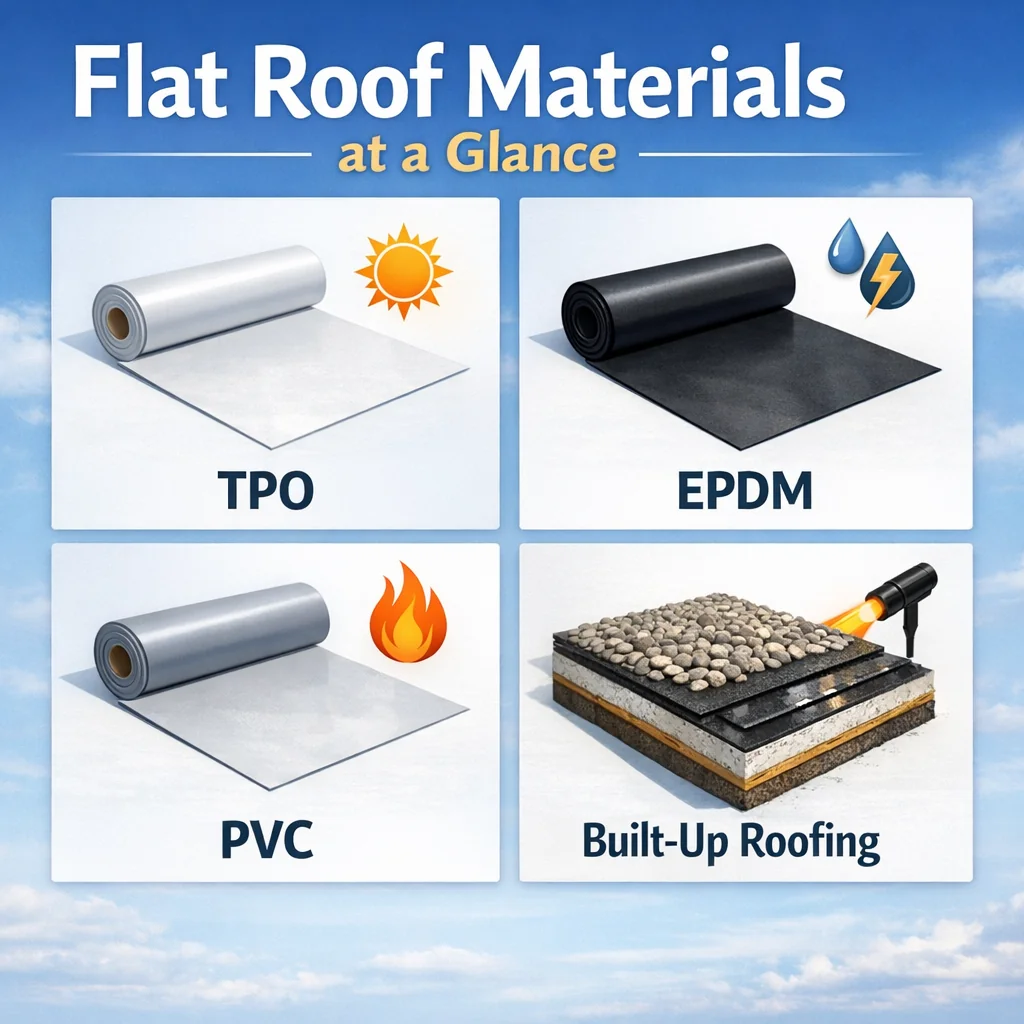
What you will notice in that breakdown is that every system has an installation-quality variable. TPO and PVC require heat-welded seams; if a contractor does not have the right equipment or training, the system’s performance advantage disappears regardless of what the product data sheet says. Modified bitumen applied by torch performs differently than the same product applied by cold adhesive, and the method often determines which warranty tier is available.
The material choice itself is frequently constrained before cost or preference enters the conversation. Your existing assembly, specifically what is already on the deck, how many layers are present, and whether moisture has been trapped in the insulation, can eliminate certain options outright. A built-up roof adds significant dead load; if the deck structure cannot support it, BUR is not viable regardless of other factors. Ask your contractor which materials your existing assembly actually supports, not just which materials they carry. That answer tells you whether the recommendation is driven by your building or by their inventory. Our roofing service is built around this kind of honest, assembly-first assessment rather than a product-first sales approach.
Multiple flat roof contractors will quote you a twenty-five or thirty-year warranty. That number is accurate in the same way that “up to” is accurate: it describes the ceiling under ideal conditions, not what you will automatically receive.
Manufacturer warranties on flat roofing systems are tiered. The maximum term is typically available only when a certified installer uses the correct system, the correct application method, minimum material thickness, and documented adherence to manufacturer specifications. The phrase “certified installer” is the mechanism that unlocks the higher warranty tier, but certification must be tied to the specific system being installed on your roof. A contractor certified for one manufacturer’s TPO product is not automatically certified for a different manufacturer’s system, even if both are TPO.
Warranties on flat roofing systems are voided more often than property owners realize. Common causes include:
That last point matters in practice. If a handyman patches a blister on your flat roof membrane, that repair can compromise your warranty coverage for the entire system. This is not a technicality buried in fine print; it is the manufacturer’s way of ensuring the assembly remains consistent with the tested installation.
Need a hand with this in Winston-Salem, Greensboro and the Triad? Call (336) 971-0464 or request a free estimate. Honest answers, no pressure.
Ponding water, defined as water that remains on a flat roof surface forty-eight hours after rain, is frequently treated as a drainage problem. It is actually a diagnostic signal.
Water ponds when the surface beneath it cannot direct it toward a drain or edge. That happens for several reasons, and only one of them is a clogged drain.
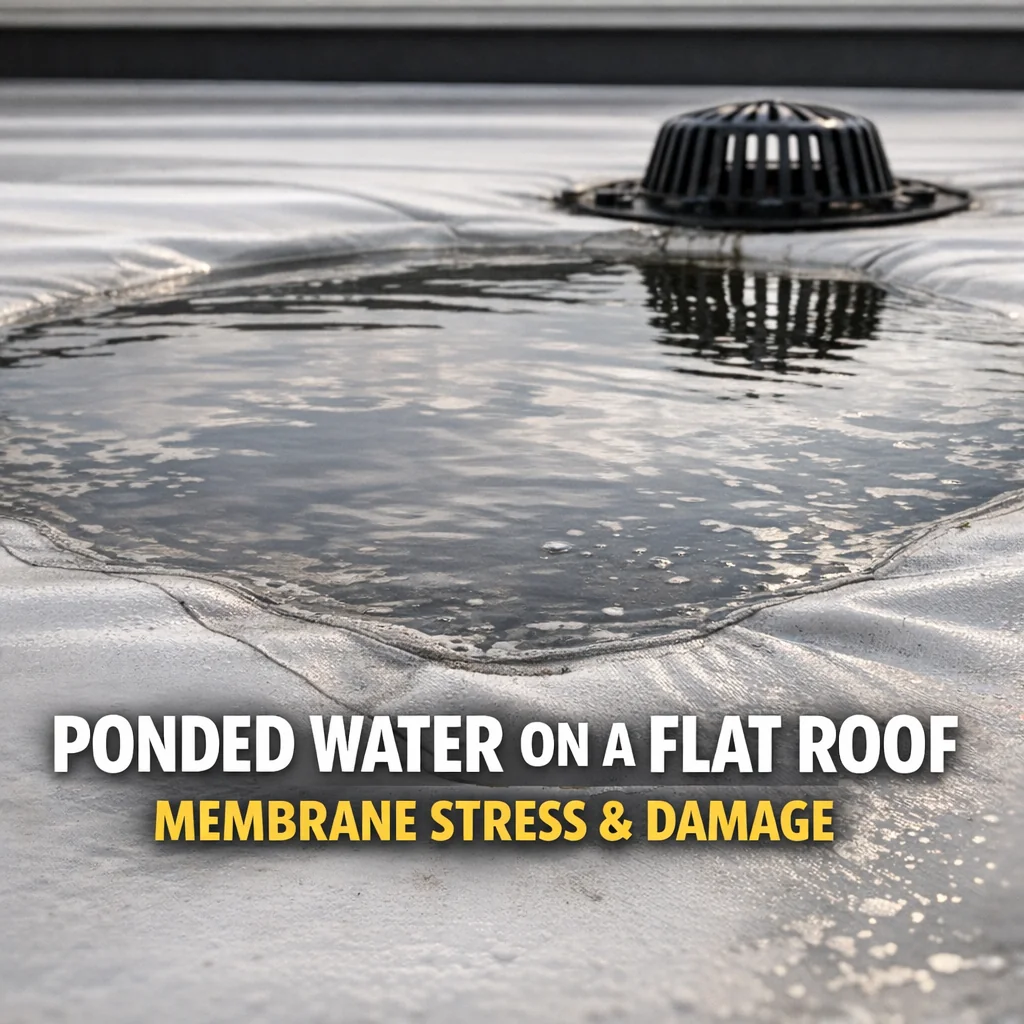
The more common causes are structural: the deck has deflected over time, the insulation has compressed or settled unevenly, or the original slope was insufficient for the drainage assembly. Ponding water adds dead load to the structure, accelerates membrane degradation, and, left unaddressed, creates the conditions for a catastrophic failure that starts well below the surface you can see.
When a contractor’s response to ponding water begins and ends at the membrane, ask whether they have assessed the deck, insulation, and drainage assembly. A surface patch on a membrane that sits over compromised insulation is not a repair. It is a delay. The article on Commercial Flat Roof Repair: Stop Leaks for Good goes further into how a proper repair process addresses the full assembly rather than the visible surface alone.
Replacing a flat roof without a proper pre-installation assessment is one of the most common ways a new system fails prematurely. The specific failure mode involves moisture: if existing insulation has absorbed water and the new system is installed over it, the trapped moisture has nowhere to go. It degrades the new insulation from beneath, causes adhesion failures in the membrane, and creates the conditions for mold growth inside the assembly, all before you see a single interior stain.
Moisture testing, sometimes done with a core sample or a non-destructive moisture scan, identifies wet insulation before it becomes a buried problem. This step is not optional if you want the system you are paying for to perform as designed.
A thorough pre-installation or pre-repair assessment by qualified flat roof contractors should document:
An overlay, which installs a new membrane over an existing one, is a legitimate option when the existing assembly is structurally sound and dry. It is not a shortcut. A contractor recommending an overlay without documenting the condition of the existing layers is not doing you a favor.
Smithrock Roofing works with homeowners and property owners across Winston-Salem, Greensboro, High Point, Kernersville, roofing in Clemmons, Rural Hall, King, and Mount Airy. With more than 350 five-star reviews and 60-plus combined years of experience, our team approaches every flat roof project the way we approach every exterior job: with a straight assessment of what is actually happening, an honest recommendation for what will fix it, and the certified craftsmanship to back the warranty that comes with the work.
If you have a flat roof that needs attention, the most useful first step is a proper assessment. That is where every good outcome starts.
The answer depends on what a proper assessment reveals. If moisture has reached the insulation or deck, if membrane failures are widespread, or if the system has reached the end of its design life, replacement is usually the more cost-effective path. If damage is isolated to a specific area and the surrounding assembly is dry and structurally sound, a targeted repair can extend the life of the system. A qualified flat roof contractor should be able to show you the evidence behind whichever recommendation they make.
All three are single-ply or built-up membrane systems used on low-slope and flat roofs, but they differ in material composition, installation method, and appropriate application. TPO and EPDM are single-ply membranes that are either mechanically fastened, adhered, or ballasted. Modified bitumen is a multi-layer system applied in sheets using heat welding or cold adhesive. The right choice depends on the building type, climate exposure, drainage design, and existing assembly conditions, not on which product is currently popular.
Service life varies by system type, installation quality, and how well the roof is maintained. A properly installed membrane system on a well-drained, correctly detailed assembly can perform for decades. Systems that were installed over wet insulation, have inadequately sealed penetrations, or lack regular maintenance tend to fail well before their rated lifespan. Annual inspections and prompt attention to minor issues are the most reliable way to get full life out of any flat roof system.
Flat roofs require attentive maintenance, but not necessarily more work, just different work. Because water does not shed as quickly, drains and scuppers must be kept clear of debris, and low points should be monitored for ponding. Seams, flashings, and penetrations are the most common failure points and should be inspected at least once a year and after significant weather events. Addressing small issues early is almost always less disruptive and less expensive than waiting until water has compromised the insulation or deck.
When a flat roof starts showing signs of trouble, the difference between a fix that holds and one that fails early usually comes down to who does the work and how thoroughly they assess the situation before touching a single membrane. Smithrock Roofing has spent decades earning the trust of property owners across Winston-Salem and Greensboro by doing exactly that, honest assessments, straightforward recommendations, and installations backed by real warranties. If your flat roof needs attention, call us at (336) 971-0464 or Contact Smithrock Roofing to schedule your assessment today.

Smithrock Roofing © Copyright 2026 • All Rights Reserved • Privacy Policy • Maintained by Mongoose Digital Marketing