
When a storm damages your roof and you file a homeowners insurance claim, the document that controls everything that follows is the insurance scope. It determines what gets repaired, what materials are approved, what quantities are covered, and ultimately what the carrier will pay. Misunderstanding how that document works, or accepting it without review, is where many homeowners run into problems.
This article explains what an insurance scope actually contains, how it gets built, where gaps commonly appear, and what your options are when the approved scope does not reflect the true cost of restoring your roof.
The insurance scope, often called a scope of loss or scope of work, is a formal document prepared on behalf of your insurance carrier after an adjuster inspects your property. According to United Policyholders, a scope of loss describes “the amount and type of damage that has been done to a structure, plus the quantity and quality of materials and the current cost of those materials and labor that will be needed to repair or rebuild that structure.”
The document typically includes:
What the scope is not: it is not a contractor bid. It is not a final payment amount. It is not necessarily complete when you first receive it. As callcupcake.com notes, pricing provided before the scope exists is provisional by definition, because no contractor can accurately price work the carrier has not yet defined or approved.
The scope is the carrier’s official position on what happened, what is covered, and what restoration should cost. Every downstream number in your claim flows from it.
Have a question about insurance scope? Send a message with the situation you are working through and the decision you need help with. Ask for a written explanation of possible next steps.
Most adjusters today prepare scopes using estimating software, with Xactimate being the most widely used platform in the U.S. market. United Policyholders and CIG Construction both note the same important point: “If a person using Xactimate software doesn’t input complete or accurate information about your property and/or current costs, the printout it produces will be inaccurate.”
That sentence contains the central mechanism behind most scope disputes, and it deserves more than a passing mention.
Xactimate does not independently assess your roof. It produces output based entirely on what the adjuster entered during their site visit. The adjuster inspects at a single point in time, before tear-off has occurred, which means they are limited to what is visible from the surface or from ground level.
If the adjuster does not record a specific component, that component cannot appear as an approved line item in the output. This is not always bad faith. It is a structural limitation of a single-point-in-time inspection before decking and underlayment are exposed. Starter strips, specific flashing types, drip edge, ice-and-water shield, and certain underlayment configurations are commonly absent from first-issue scopes because they were not individually entered during the inspection, not necessarily because the carrier made a deliberate decision to exclude them.
The document that results still looks authoritative. It is formatted, detailed, and numerical. That presentation can make it feel complete even when it is not.
The practical question when reviewing any scope is not just whether line items are present, but whether the inspection conditions that would have generated those line items ever existed. If the adjuster did not access a specific slope, or if the inspection occurred before tear-off revealed the underlayment condition, the relevant line items may be structurally absent rather than intentionally excluded. Our roof insurance claim guide covers this dynamic in detail and explains how to position your claim from the start.

Illustration, not a photograph of a completed client project.
Every competitor article on this topic describes the scope as something that gets issued and then either accepted or challenged. That framing misses how the process actually works.
The scope is a living document throughout the claim lifecycle. It can be supplemented when new information emerges. It can be disputed through an independent scope. It can expand when additional damage is discovered during tear-off. Understanding this matters because the decisions you make in the first days after receiving the initial scope affect your ability to access those later mechanisms.
When covered items are discovered after the initial scope is issued, particularly during tear-off when hidden conditions become visible, the appropriate process is to submit a supplement to the carrier. A supplement is a formal request to add approved line items to an existing scope based on documented findings. Callcupcake.com describes this as normal and not a sign that something went wrong: “hidden damage discovered during tear-off, code compliance requirements, or conditions that weren’t visible during the initial inspection can all create gaps between what’s approved and what’s required to properly restore the roof.”
An experienced contractor who works regularly with insurance claims will document findings during tear-off and communicate them to your carrier in a format the adjuster can act on. That documentation is the foundation of any supplement.
A complete scope should reflect any work required to bring the repaired or replaced roof into compliance with current local building codes. United Policyholders notes explicitly that “a complete scope of loss will specify the work that needs to be done to comply with the local building codes in the area.”
Code-related line items are frequently absent from first-issue scopes. Many policies include ordinance or law coverage for exactly this reason, but those coverage provisions do not activate automatically. Someone has to identify the required code upgrade, document it, and request that it be added. That responsibility typically falls to the contractor or a public adjuster, not the carrier. If no one flags it, the code item does not appear in the scope, and the work either gets absorbed by the contractor or simply does not get done to code.
If you believe the carrier’s scope undervalues your loss, an independent scope of loss is the most effective tool for comparison. However, not all documents that serve this purpose are equal, and the distinction matters.
United Policyholders notes that a scope of loss is “typically more detailed than an estimate.” CIG Construction makes the key operational point: “an independent scope of loss is more likely to be formatted similarly to the insurance company’s scope of loss, allowing for an apples-to-apples comparison of the work and costs.”
That format alignment is not a cosmetic detail. A contractor estimate formatted differently from the carrier’s Xactimate output creates a comparison problem. The carrier receives a document organized by its own line item categories on one side, and a contractor bid organized by trade or by roof section on the other. The line items do not map directly. The carrier can legitimately note that the documents are not comparable, and the dispute stalls.
| Document Type | Primary Purpose | Format | Weight in Dispute |
|---|---|---|---|
| Carrier scope of work | Define approved damage and authorized repairs | Xactimate or Symbility line-item format | Carrier’s official position |
| Contractor estimate | Price a specific job for a specific customer | Varies by contractor | Useful context, lower evidentiary weight |
| Independent scope of loss | Document the full loss for claim negotiation | Ideally matches carrier’s format and line items | Strongest counter-document when format-aligned |
An independent scope prepared by a public adjuster, an experienced construction estimator, or a contractor who understands the claims format carries more weight in a dispute because it speaks the same document language as the carrier’s scope. A standard contractor bid does not accomplish the same thing, even if the dollar figures are higher.
United Policyholders recommends hiring “a construction estimator, public adjuster, or experienced contractor” to prepare an independent scope. CIG Construction recommends asking any contractor you consider for this work whether they have previously prepared an independent scope, whether they are familiar with local construction costs, and whether they are willing to meet with the adjuster to address questions about the scope.
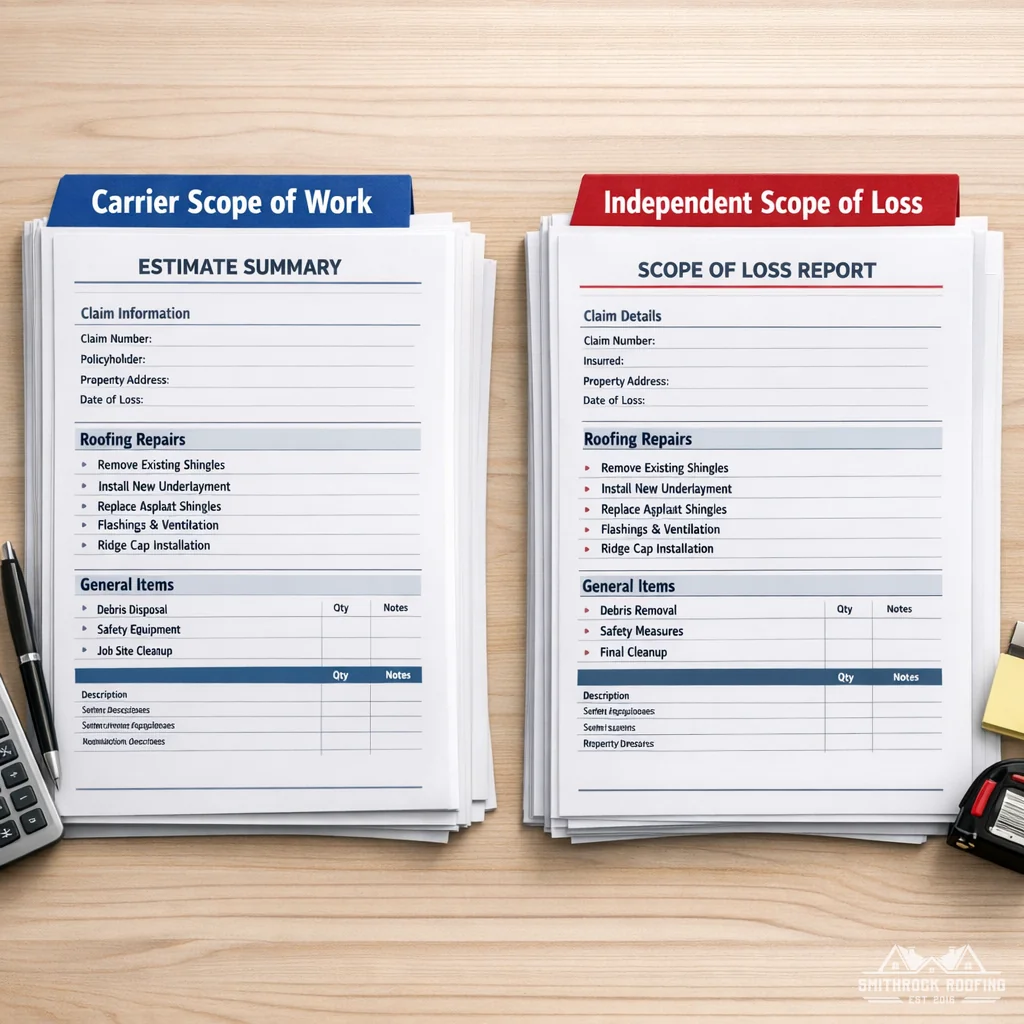
Illustration, not a photograph of a completed client project.
The term “lowballing” appears in most insurance scope discussions, but the mechanism behind it is rarely explained clearly.
Lowballing is not always an intentional act by the carrier. It is often the direct result of the input problem described earlier. An adjuster who conducts a surface inspection before tear-off, under time pressure, at a property with limited roof access, will capture a limited set of inputs. Those inputs produce a scope that is structurally incomplete, not because of deliberate underpayment, but because what was not entered cannot appear as a line item.
United Policyholders puts it plainly: “Unless you have the construction expertise needed to evaluate whether the scope of work/materials and the cost assigned to those items in the insurance company’s offer is accurate, you may not even realize you are being lowballed. It’s a classic example of, ‘You don’t know what you don’t know.'”
This is where a contractor experienced in insurance restoration work adds real value. Reading the carrier’s scope before work begins, identifying missing line items based on your actual roof system, and flagging those items before tear-off is documented is more straightforward than trying to recover missing items after work is complete. Supplements submitted with current documentation during active work are generally more productive than supplements submitted after the project closes.
When your carrier issues a scope, take time to review it before handing it directly to a contractor or setting it aside.
The scope identifies specific slopes or sections. If a section you believe was damaged is not listed, clarify that before work begins.
The scope will specify whether each area is approved for repair or full replacement. These are distinct approvals with different material and labor implications.
Common missing items in first-issue roofing scopes include:
If your existing roof system includes any of these components and they are absent from the scope, that is worth discussing with your contractor before work starts.
Scopes often note pre-existing conditions, normal wear, or items excluded by policy language. Understanding what is excluded prevents misaligned expectations about final payment.
At Smithrock Roofing, we review the carrier’s scope alongside homeowners across Winston-Salem, Greensboro, High Point, Kernersville, Clemmons, Rural Hall, King, and Mount Airy before any work begins. That review lets us identify missing line items, confirm that approved materials align with your existing roof system, and document findings during tear-off in a format that supports supplementation when additional covered damage is found.
Our approach is consultative. We explain what the scope includes, where gaps commonly appear, and what the documentation process looks like if a supplement is warranted. Our roofing service works within the insurance process rather than around it, keeping your project moving and your claim properly supported from inspection through final payment.
If you have received a scope and are not sure whether it reflects everything your roof requires, we are glad to take a look. Reach out to our team to schedule a review.
Work can begin before a scope is issued, but doing so creates significant risk. Without an approved scope, neither you nor the contractor knows which items the carrier has authorized, what materials are approved, or what quantities are covered. Repairs completed before scope issuance may be difficult to reconcile with the carrier’s later position on what was covered. In most cases, waiting for the scope, or at minimum understanding what the carrier has approved in writing, before authorizing full work protects your ability to use the supplementation process if additional damage is found during tear-off.
Document the discrepancy before work begins. Common examples include drip edge, starter strips, step flashing, pipe boot replacements, and ice-and-water shield. If those components are present on your roof but absent from the scope, that gap may be addressable through a supplement. A contractor familiar with the insurance claims process can review the scope alongside your actual roof system and identify items that may need to be formally requested before they can be included in the approved work.
No. A supplement is a formal request to add approved line items to an existing scope based on documented findings, typically damage or conditions that were not visible during the initial inspection. Supplements are a routine part of the insurance restoration process, particularly when tear-off reveals hidden damage or when code compliance requirements were not included in the first-issue scope. Submitting a supplement is not an adversarial action, it is the standard mechanism for updating the scope when new information becomes available. Disputes, by contrast, typically involve disagreement about whether specific damage is covered at all, and may involve independent scopes or appraisal processes.
Not necessarily. Many homeowners insurance policies include ordinance or law coverage that applies to code-related upgrades, but that coverage generally does not activate automatically. Someone must identify the specific code requirement, document it, and formally request that it be added to the scope. If no one flags a required code upgrade, it typically will not appear as an approved line item, which means the work either does not get done to code or the cost falls outside what the carrier has authorized. Reviewing your policy’s ordinance or law provision and confirming with your contractor whether any local code requirements apply to your roof replacement is worth doing before work begins.
The insurance scope is the document that controls your entire roofing claim, what gets repaired, what materials are authorized, and what the carrier will pay. Understanding what it includes, where first-issue scopes commonly fall short, and what your options are when coverage gaps appear is not a technical exercise reserved for contractors and adjusters. It is practical knowledge that directly affects the outcome of your claim.
The most important decisions in a roofing insurance claim happen before work begins: reviewing the scope carefully, identifying missing line items, confirming that approved materials match your existing roof system, and understanding the supplementation process before tear-off conceals the conditions that would support it. Treating the scope as a final verdict rather than a starting document is the most common mistake homeowners make, and it is the one that is hardest to correct after the fact.
If you have received a scope and have questions about what it covers, Smithrock Roofing serves homeowners throughout Winston-Salem, Greensboro, High Point, Kernersville, Clemmons, Rural Hall, King, and Mount Airy. Reach out in writing with your questions and we will take a look.

Smithrock Roofing © Copyright 2026 • All Rights Reserved • Privacy Policy • Maintained by Mongoose Digital Marketing