If you manage or own a commercial property in Winston-Salem, Greensboro, High Point, or anywhere across the NC Triad, you already know that a failing commercial roof does not politely wait for a convenient time to become a problem. It leaks during your busiest season, damages inventory, disrupts tenants, and forces decisions that need to be made quickly — often without enough information.
The question of commercial roofing repair cost comes up fast in those moments. And while most content you’ll find online is happy to hand you a price table and send you on your way, that approach skips past the most important part: understanding why repair costs vary so dramatically, and more importantly, how to make sure the repair you’re paying for actually solves the problem for good.
This guide is built around that gap. We’re going to cover the mechanics of accurate commercial roof diagnosis, the decision framework that separates a smart repair from a costly mistake, and the warranty considerations that most property managers never think about until it’s too late. By the end, you’ll have a clearer framework for evaluating your situation — and for evaluating the contractors who bid on it.
Most articles about commercial roofing repair costs are organized around repair categories: seam repairs, flashing repairs, drain repairs, penetration repairs. That structure feels logical, but it leads facility managers and building owners to the wrong conversation with contractors.
Here’s the problem: the repair label does not determine the cost. The diagnostic accuracy of the assessment before that repair is specified is what determines whether the cost is appropriate or whether you’re about to pay for a fix that won’t hold.
Commercial roofing systems — whether flat TPO, EPDM, modified bitumen, or built-up systems common across Triad-area industrial and retail buildings — behave differently from residential sloped roofs. Water does not fall straight down and exit cleanly. It migrates laterally, sometimes traveling significant distances through saturated insulation layers before it ever appears as a ceiling stain or visible interior damage.
The industry term for this distinction is primary failure point versus travel path. The primary failure point is where water first breaches the membrane system. The travel path is the route moisture takes once it’s inside the roof assembly. Interior damage almost always appears at the end of the travel path — not at the source.
A contractor who performs a visual inspection and scopes the repair around the visible symptom is not necessarily wrong to do so. But they may be leaving the actual breach point untouched. When that happens, the repair fails, the substrate continues to saturate further, and the next repair call happens sooner than it should.
Experienced commercial roofing contractors — and any inspector worth hiring — use core sampling at multiple points around the damage zone to map the true moisture boundary. This is not an upsell. It is the foundational step that makes everything else accurate.
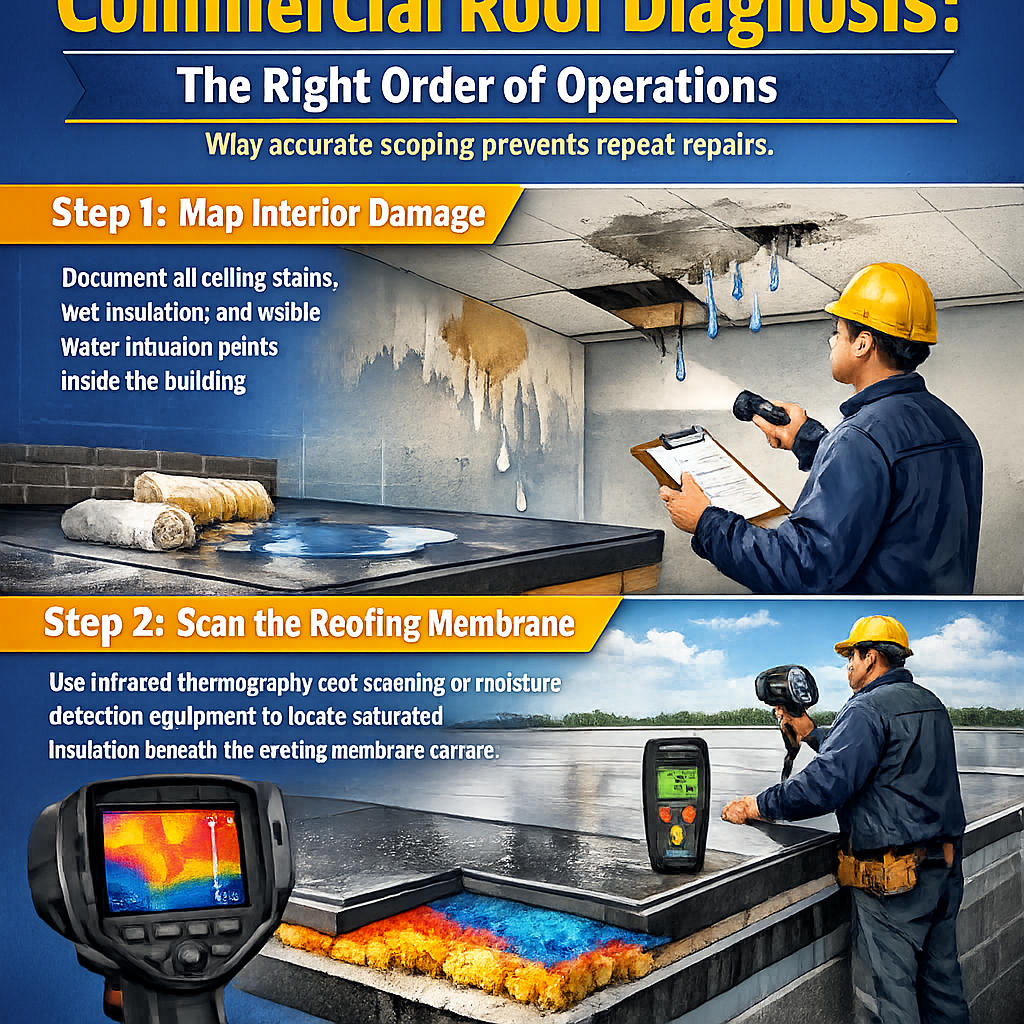
(https://www.nrca.net).”; item3_title=”Step 3: Core Sample the Boundary”; item3_body=”Pull cores at multiple points around the damage zone to identify the true moisture boundary — not just the visible symptom area.”; item4_title=”Step 4: Isolate the Primary Failure Point”; item4_body=”Trace moisture travel paths back to the actual breach in the membrane — which is often 15–40 feet from where interior damage appears.”; item5_title=”Step 5: Scope the Repair Accurately”; item5_body=”Define the repair area based on confirmed moisture boundaries, not visible damage alone, to ensure the fix holds long-term.”; footer=”Smithrock Roofing | smithrockroofing.com”]
There’s another layer here that most property managers don’t know to ask about: not all roof inspections are created equal.
A visual walk-through, an infrared thermographic scan, a nuclear moisture survey, and an electrical capacitance test are all legitimate inspection methods — but they produce fundamentally different pictures of the same roof. A visual inspection identifies surface symptoms. Infrared thermography detects subsurface moisture by identifying thermal anomalies in the roof surface, typically conducted in the evening as the roof radiates stored heat. Nuclear moisture surveys and capacitance testing go deeper into the insulation layers.
If you received a bid based on a visual inspection and another contractor performed infrared scanning before scoping their bid, those two bids are not comparable. They may be addressing different amounts of damage on the same roof — and neither contractor is necessarily being dishonest. They simply have different amounts of information.
When evaluating commercial roofing repair bids across Greensboro, Winston-Salem, or High Point properties, asking each contractor specifically how they conducted their inspection — and what technology they used — is one of the most useful questions you can ask. The answer tells you a great deal about the scope confidence behind the number they gave you. For a deeper look at what a thorough professional inspection should cover, the Ultimate Commercial Roof Inspection Checklist is a useful reference before you engage any contractor.
This is the piece that most online content about commercial roofing repair skips almost entirely, and it’s arguably the most consequential factor for building owners.
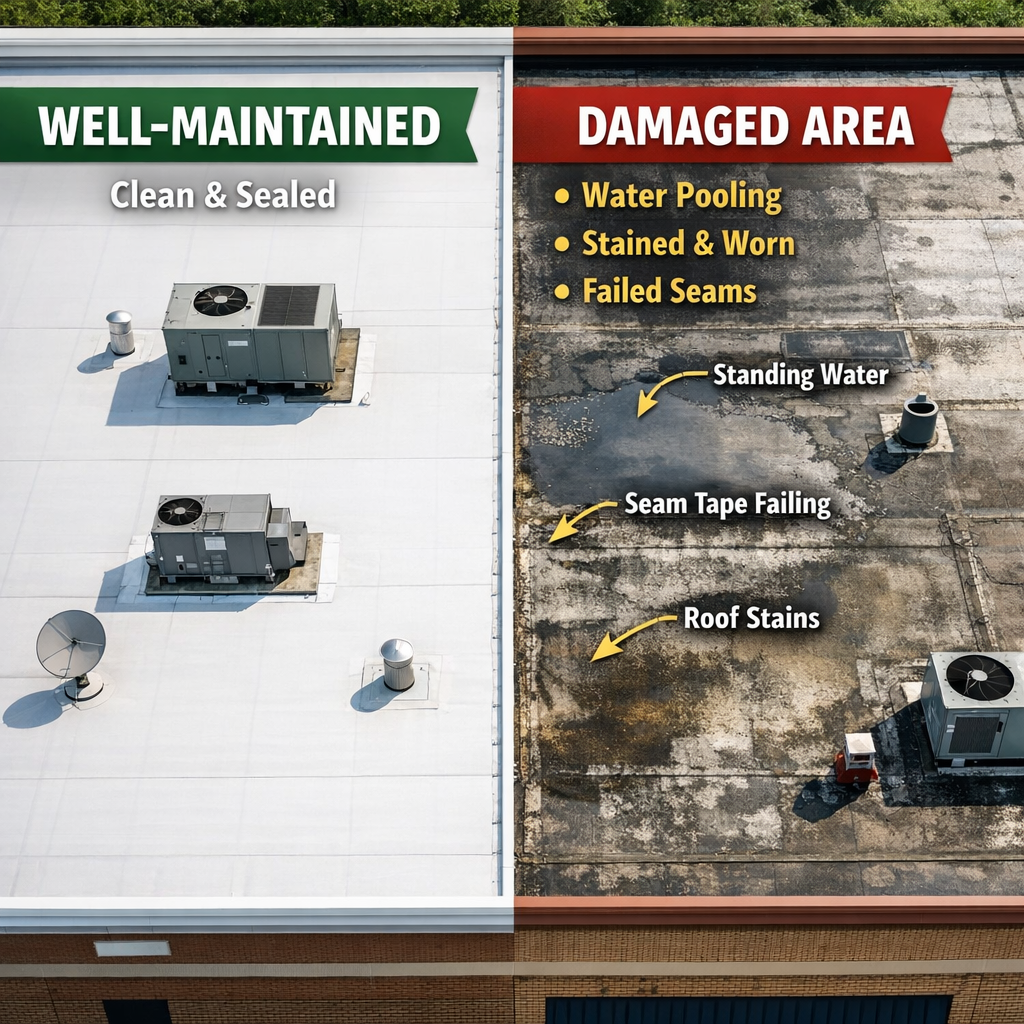
Water intrusion into a commercial roof assembly does not cause static damage. It causes progressive damage. The longer moisture sits in the insulation layer and around the structural deck, the more the remediation scope expands — and that expansion is not linear.
A standard commercial flat roof consists of several layers: the structural deck (typically steel, concrete, or wood), rigid insulation board, and the membrane on top. When water breaches the membrane and reaches the insulation board, the insulation begins absorbing moisture. Wet insulation:
At the point where the deck itself becomes compromised, the remediation calculus changes entirely. Deck repairs frequently trigger local code review requirements, and in some jurisdictions, detected structural deck damage requires third-party inspection and, in severe cases, can mandate a full system tear-off rather than a targeted repair. What began as a failed seam or cracked flashing can become a project several orders of magnitude larger — not because the repair was complicated, but because the damage was left to progress.
In the NC Triad’s climate, this risk is amplified. High Point, Kernersville, and surrounding communities experience humid summers with significant rainfall, followed by freeze-thaw cycles in winter. Water that has infiltrated a roof assembly in late summer can freeze and expand during a January cold snap, accelerating membrane and deck damage in ways that are not visible until spring — by which point the remediation scope has grown considerably.
The practical message for building owners is straightforward: small leaks are not maintenance items to defer. They are early-stage progressive failures that are far more affordable to correct when they’re caught early than when moisture has had months or seasons to travel and saturate. If you’re unsure whether what you’re seeing qualifies as an urgent issue, this article on ceiling leaks and how to find the real source walks through the diagnostic process in detail.
Here is where many building owners — and some contractors — get the decision wrong. The instinct is to repair as long as possible and delay replacement as long as possible. That instinct is not always wrong, but applying it without a structured framework leads to a pattern that experienced roofing consultants call “chasing the leak” — where ongoing repair spend accumulates over several years until it far exceeds what a planned replacement would have cost.
There is no universal answer to whether a repair or replacement is the smarter investment for a given commercial roof. But there are three variables that, evaluated together, give you a defensible framework for the decision:
1. Remaining serviceable life of the surrounding membrane
Even if a repair is technically feasible, performing it on a membrane that is near the end of its serviceable life creates a problem. The repaired area may hold, but the membrane surrounding it will continue to fail. You are essentially installing a new patch on a system that will require full replacement within a short window anyway — and the repair cost becomes a sunk expense with no life-cycle return.
2. Ratio of affected area to total roof area
The industry benchmark used by most experienced roofing consultants is the 25 to 30 percent threshold. When the total area requiring repair — including all moisture-affected insulation, not just surface membrane damage — represents more than roughly a quarter to a third of the total roof area, the life-cycle economics of repair versus replacement typically cross over in favor of replacement.
This threshold exists for a structural reason, not an arbitrary one. Piecemeal repairs on a failing membrane create distinct stress points. New membrane sections expand and contract differently than aged membrane sections. The seams between old and new material create differential movement, thermal bridging inconsistencies, and areas where future failure is statistically more likely. Each repair creates warranty dead zones where neither the old system’s warranty nor the new material’s warranty applies cleanly. Over time, a heavily patched roof becomes a patchwork of micro-vulnerabilities.
3. Deck condition
Membrane and insulation are replaceable components. The structural deck is not a component you want to replace as part of a roofing project — the cost and complexity escalate significantly when the deck is involved. A deck that is still sound creates a clean foundation for either repair or replacement. A deck showing corrosion, delamination, or deflection signals that any investment in the membrane above it carries elevated risk.
This is the section that most building owners only learn about the hard way — after a warranty claim is denied.
High-performance commercial roofing systems are typically sold with manufacturer warranties that cover not just the materials but the labor cost of repair if the system fails within the warranty period. These are called No Dollar Limit (NDL) warranties, and they represent significant financial protection for building owners.
The critical detail that most facility managers don’t know: an NDL warranty is not a blanket protection policy. It is a conditional agreement, and one of the primary conditions is that any repair performed on the warranted system must use manufacturer-approved materials and follow manufacturer-approved repair protocols.
This matters enormously in practice. If a seam opens on a TPO membrane that carries an NDL warranty, and a contractor repairs that seam using a sealant or repair tape that is not on the manufacturer’s approved materials list, the warranty may be partially or fully voided — not just in the area of the repair, but across the entire roof. The building owner, believing they authorized a cost-effective repair, has unknowingly exchanged their warranty coverage for a patch.
The concept of warranty-compliant repair scope should appear on every bid evaluation checklist for commercial properties. Before a repair is performed on any roof system that may still be under manufacturer warranty, the correct sequence is:
Some manufacturers require that warranty repairs be performed by their certified contractor network. Others require notification of any third-party repair. The specifics vary by manufacturer and warranty tier, but the principle is consistent: the manufacturer’s terms govern the repair, not the contractor’s preference.
At Smithrock Roofing, our CertainTeed PREMIER ShingleMark Master Certified status reflects exactly this kind of commitment to working within manufacturer systems — understanding that doing the job correctly means doing it in a way that protects the building owner’s coverage, not just completing the physical repair. You can review the specifics of our warranty coverage to understand exactly what protection we stand behind on every project.
One of the most common frustrations for facility managers and building owners is receiving two or three bids for the same commercial roof repair that are substantially different from each other. The instinct is to assume one contractor is overcharging or one is cutting corners. That instinct is not always wrong, but it frequently misses a more common explanation.
Commercial roofing repair pricing is not standardized. Unlike a commodity product with a fixed unit price, every commercial roof repair scope is constructed from a set of judgment calls: how much membrane is affected, how deep moisture has migrated into the insulation, whether the deck needs evaluation, what access equipment is required, what warranty conditions apply, and what the project timeline looks like given crew availability.
Two contractors performing visual-only inspections on the same roof can reasonably reach different conclusions about the scope — and both can be genuinely working from their best assessment. A third contractor who used infrared scanning will potentially scope a larger project than both, not because they’re padding the bid, but because they have more data.
The framework that protects building owners in this situation is the written scope of work document. Before evaluating any bids based on price, confirm that each bid is attached to a written scope that specifies:
When you have that level of scope detail from each contractor, you are positioned to compare bids meaningfully. Without it, you are comparing contractor confidence levels, not repair proposals.
While specific pricing is something that can only be determined through an on-site assessment of your individual building, the following factors consistently influence repair scope and complexity — and therefore influence cost — across commercial properties in Winston-Salem, Greensboro, High Point, and surrounding communities.
| Cost Factor | Why It Matters | What Increases Complexity |
|---|---|---|
| Roof Size and Affected Area | Larger membrane and insulation replacement area drives material and labor volume | Moisture migration well beyond the visible damage zone |
| Membrane Type | TPO, EPDM, modified bitumen, and built-up systems each have distinct repair requirements and material costs | Proprietary systems with limited contractor authorization |
| Insulation Condition | Wet or crushed insulation must be replaced, not just dried | Deep saturation extending to the structural deck |
| Deck Type and Condition | Steel decks corrode; concrete decks can delaminate; wood decks can rot | Any deck compromise triggers structural evaluation requirements |
| Roof Access | Rooftop equipment, HVAC units, skylights, and penetrations complicate access and add labor | Densely mechanically-equipped rooftops with limited clear walking area |
| Warranty Status | Active NDL warranties may require specific materials, contractors, and protocols | Non-authorized contractor restrictions or expired warranty documentation |
| Inspection Methodology | The depth of diagnostic technology used determines scope accuracy | Infrared or nuclear scans revealing saturation invisible to visual inspection |
| Local Climate Factors | Triad-area humidity and freeze-thaw cycles accelerate substrate damage | Repairs needed after winter freeze expansion of pre-existing moisture infiltration |
| Building Use and Occupancy | Occupied buildings may require phased work, after-hours scheduling, or containment measures | Food service, healthcare, or sensitive-inventory facilities with strict access controls |
| Contractor Backlog and Availability | Market conditions and seasonal demand affect scheduling and crew availability | Peak demand periods following storm events across the Triad |
Sophisticated building owners and asset managers think about commercial roofing not as a series of isolated repair events but as a component of long-term capital planning. This perspective shift changes how repair decisions are made — and it changes what information you should be asking your roofing contractor to provide.
A repair history log — documenting each repair event, the location on the roof, the scope of work performed, and the date — is one of the most valuable documents a building owner can maintain. Over time, this log reveals patterns: whether repairs are clustering in a specific zone (suggesting a systemic drainage or attachment failure), whether the frequency of repairs is accelerating (a signal that the membrane is approaching end of life), and whether the cumulative repair spend is approaching the threshold where capital replacement becomes the economically defensible choice.
Commercial property CFOs and asset managers routinely use repair history data to model capital reserve requirements and schedule system replacements during planned budget cycles rather than as emergency responses to failures. Roofing contractors who understand this approach — and who provide documentation that supports it rather than just completing the immediate repair — are genuinely more valuable partners for multi-property portfolios.
If you own or manage commercial property across the Triad, this is the kind of relationship to look for: a contractor who thinks about your building’s roofing system as an asset with a defined life cycle, not just a service call to respond to.
Given everything covered above, the contractor selection criteria for commercial roofing repair deserve more rigor than most building owners apply. Price matters, but it is not the first filter to apply — and treating it as the primary decision factor frequently produces the most expensive outcomes over time.
Manufacturer certification status. Verify that the contractor is authorized under the warranty system covering your existing roof. This is not a marketing credential — it is a functional requirement for warranty-compliant repairs.
Inspection methodology. Ask specifically what diagnostic tools they use and whether they perform core sampling to confirm moisture boundaries. A contractor who scopes repairs from a visual walk-through alone is working with less information than the scope requires.
Written scope of work. A reputable contractor should be willing and able to provide a detailed written scope before you sign anything. If a bid arrives without an accompanying scope document, ask for one before proceeding.
References on commercial work specifically. Commercial roofing is distinct from residential work in system complexity, diagnostic requirements, and warranty management. Verify that the contractor has a documented track record on commercial properties, not just residential re-roofing volume.
Insurance and licensing. Verify that the contractor is fully licensed and insured for commercial work in North Carolina. This is a baseline, not a differentiator — but it remains essential.
At Smithrock Roofing, we bring more than 60 combined years of experience to every project across the NC Triad — from small commercial retail buildings in Kernersville to larger industrial facilities in Winston-Salem and Greensboro. Our approach is built around accurate diagnosis first, honest scope communication second, and craftsmanship that’s backed by both our 5-year labor warranty and the manufacturer warranties we’re certified to support.
If your commercial roof needs attention, the right starting point is always an honest assessment — not a quick patch and a handshake. Contact our team to schedule a thorough inspection, and we’ll give you a clear picture of what your roof actually needs.
For additional guidance on commercial roof system types and maintenance standards, the National Roofing Contractors Association (NRCA) maintains a comprehensive resource library that facility managers and building owners will find useful.
As commercial roofing technology and inspection standards continue to evolve, building owners and facility managers in the NC Triad should consider these three specific steps heading into 2026:
1. Schedule a Proactive Infrared Thermal Scan
Infrared thermography has become one of the most reliable non-destructive diagnostic tools available for commercial flat and low-slope roofs. Rather than waiting for an interior leak to define your repair scope, scheduling a thermal scan during fall or spring — when temperature differentials are optimal — gives you a precise map of subsurface moisture before it migrates further into the assembly. Many building owners who use this approach discover they can target repairs far more efficiently than those relying on visual inspections alone.
2. Establish a Documented Preventive Maintenance Program
The NRCA and most major membrane manufacturers recommend semi-annual roof inspections as a minimum standard for commercial properties. Moving from reactive repairs to a documented maintenance schedule not only extends serviceable roof life but also protects manufacturer warranty coverage, which frequently requires evidence of regular maintenance activity. Ask your roofing contractor to provide written inspection reports that you can retain as part of your building’s maintenance file.
3. Review Your Roof Asset Documentation
If your commercial building lacks a current roof assembly record — documenting system type, installation date, previous repairs, and warranty status — 2026 is a practical time to establish one. This documentation directly informs repair scoping decisions, helps contractors avoid incompatible material selections, and provides critical information if your property is ever sold, refinanced, or subject to an insurance claim.
The primary variables are the type of roofing system installed, the extent and location of damage, whether the underlying insulation or decking has been compromised, and the accessibility of the affected area. A surface-level membrane puncture on an accessible flat roof is a significantly different scope than a repair requiring insulation removal and deck replacement. Accurate diagnostic work — including core sampling where appropriate — is the only reliable way to define that scope before work begins.
There is no single threshold, but several indicators suggest that replacement may be more practical than continued repair: repeated failures in the same area, widespread membrane deterioration, insulation that has lost significant thermal value due to moisture saturation, or a system that is approaching or past its expected service life. A qualified commercial roofing contractor should be able to present you with an honest comparison of repair versus replacement based on documented inspection findings, not general estimates.
It depends entirely on the warranty type, its current status, and whether previous work was performed by a certified contractor. Many manufacturer warranties contain specific requirements about who can perform repairs and what materials must be used to maintain coverage. Before authorizing any repair work, it is worth confirming with your contractor whether the proposed scope will preserve or potentially void any existing warranty. Contractors who hold manufacturer certifications are generally better positioned to navigate these requirements.
Most isolated commercial roof repairs — addressing a defined area of membrane damage, flashing failure, or localized moisture infiltration — can be completed within one to two days once materials are staged. Larger repairs involving insulation replacement or extensive deck work will require additional time. Weather windows are also a practical consideration for certain membrane systems that require specific temperature and moisture conditions for proper adhesion and cure. Your contractor should provide a realistic timeline as part of the written scope of work before the project begins.
When your commercial roof needs attention, working with a contractor who understands the specific demands of the NC Triad climate and has a documented history on commercial properties makes a meaningful difference in both the quality of the repair and the longevity of the result. Smithrock Roofing has spent decades earning the trust of building owners and facility managers across Winston-Salem and Greensboro, and we approach every project with the same commitment to honest diagnosis and durable craftsmanship. If you’re ready to get a clear picture of what your roof actually needs, Contact Smithrock Roofing to schedule a thorough inspection with our team.
Need a local pro? Learn more about our roofing services in Greensboro.
See also: Roofing Winston-Salem NC | What Homeowners Must Know

Smithrock Roofing © Copyright 2026 • All Rights Reserved • Privacy Policy • Maintained by Mongoose Digital Marketing