Financing for siding comes down to matching the right loan structure to your specific financial situation and the urgency of your project. This article breaks down how each financing pathway works, explains what competitors and lenders rarely tell you, and gives you a clear framework for making the decision that actually fits your home and your budget.
Replacing or repairing siding is one of the larger exterior investments a homeowner makes. It protects the structural integrity of your home, manages moisture, and directly affects curb appeal and resale value. Because the project scope is significant, most homeowners do not pay cash outright, and that is a reasonable choice. What matters is understanding what you are actually agreeing to before you sign anything.
The financing options most commonly offered to homeowners look straightforward on the surface: personal loans, home equity loans or HELOCs, contractor payment plans, and home improvement credit cards. The problem is that most guides treat these as interchangeable, presenting them side by side without helping you figure out which one fits your actual situation. The sections below fix that.
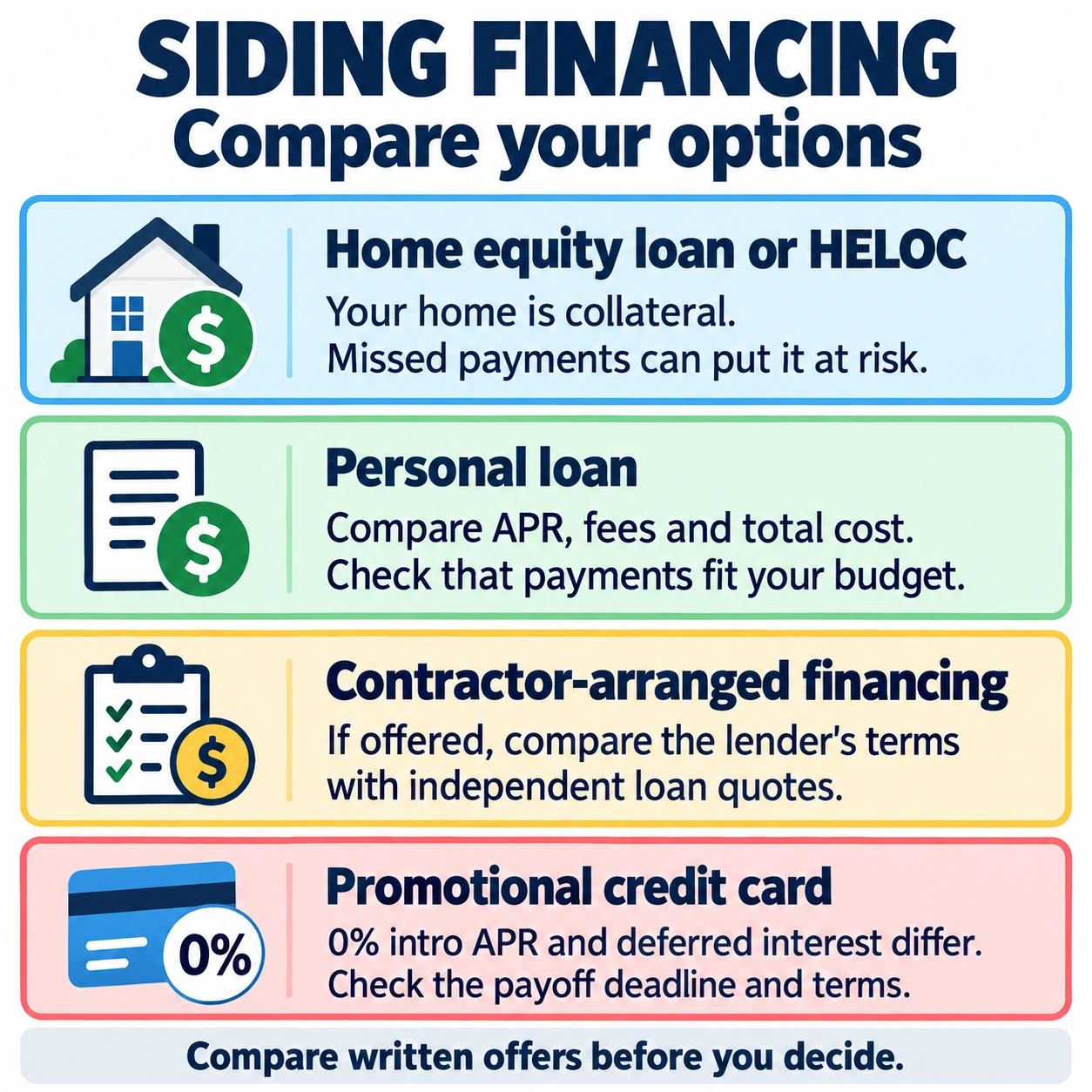
A personal loan is an unsecured installment loan, meaning you do not put your home or any other asset up as collateral. You borrow a fixed amount, agree to a fixed interest rate, and repay it in equal monthly installments over a set term.
Personal loans are the most flexible option for siding projects because they are not tied to your home’s equity and they fund quickly. Approval and funding can happen within 24 to 48 hours through many lenders, which matters a great deal when your siding is damaged and every week of delay risks further moisture intrusion.
The trade-off is that interest rates on personal loans are generally higher than home equity products, because there is no collateral backing the loan. Your credit score is the primary factor determining your rate.
What to know about credit score ranges:
| Credit Score Range | General Loan Access | Rate Sensitivity |
|---|---|---|
| 720 and above | Strong access, most competitive rates | Low sensitivity; small score changes have minimal rate impact |
| 670 to 719 | Good access, moderate rates | Moderate sensitivity |
| 640 to 669 | Approval likely, rates increase meaningfully | Higher sensitivity; improving score before applying can help |
| 580 to 639 | Approval possible but limited lender pool | High sensitivity; soft-pull pre-qualification is especially valuable here |
| Below 580 | Standard personal loans difficult; secured or co-signed options more realistic | Consider FHA Title I or other government-backed programs |
Soft-pull pre-qualification is available from many lenders and does not affect your credit score. If you are unsure where you stand, pre-qualifying with two or three lenders before applying formally gives you real rate data without any credit impact.
A home equity loan gives you a lump sum at a fixed rate, using your home as collateral. A HELOC (home equity line of credit) works more like a credit card against your equity, typically at a variable rate. Both generally offer lower interest rates than personal loans, and that rate advantage is the primary reason homeowners consider them.
The risks are real and worth stating plainly. Your home is collateral, meaning a default can lead to foreclosure. Variable-rate HELOCs are also sensitive to interest rate changes, so a plan that looks affordable today could shift if rates move.
The less-discussed risk is time. Home equity products typically take four to six weeks to close. For homeowners with cosmetic siding issues and no active damage, that timeline is manageable. For homeowners dealing with rotting siding, failed moisture barriers, or visible water infiltration, that six-week window is not a neutral waiting period. It is six weeks of unmitigated exposure that can expand the scope and cost of the project significantly. Mold remediation and sheathing repair are not typically included in the original siding loan scope, and they are not cheap. If you are weighing repair versus full replacement, the article on siding repair: fixing cracks, rot, and damage fast offers a useful breakdown of when partial repair is viable versus when a full replacement is the more cost-effective path.
The decision rule: home equity financing makes sense when the siding project is genuinely non-urgent and you have stable cash flow to service a loan backed by your home. If the siding is actively failing, the faster funding of a personal loan, even at a higher stated rate, may protect you from a far larger compounding problem.
Many siding contractors, including larger regional companies, offer financing through a preferred lending partner. This is convenient, and the rates can look competitive at first glance. But there is a structural issue that most homeowners do not consider.
When you finance through your contractor’s preferred lender, you are working within a closed referral relationship. You cannot easily compare that rate against the open market, because the contractor controls access to the financing channel. More importantly, you lose the ability to negotiate your project price and your loan rate as separate decisions.
The better approach: get pre-approved independently, through a bank, credit union, or lending marketplace, before you sign any contract. Once you have an independent rate in hand, you have a real benchmark. You can evaluate a contractor’s financing offer against it, and you can negotiate your project price as a separate conversation from your financing. The moment you accept a contractor’s financing plan without a benchmark, you have given up negotiating leverage you cannot get back.
Home improvement credit cards, particularly those with 0% promotional periods, are a viable option for smaller siding repairs or partial projects if you can pay off the full balance before the promotional period ends.
This is where the “same-as-cash” distinction matters, and it is widely misunderstood.
Need a hand with this in Winston-Salem, Greensboro and the Triad? Call (336) 971-0464 or request a free estimate. Honest answers, no pressure.
“Same-as-cash” and “0% APR” sound identical. They are legally and financially different products.
In a true 0% APR promotional loan, no interest accrues during the promotional period. If you pay off the balance in month six of a twelve-month promotion, you owe nothing extra.
In a deferred-interest or same-as-cash arrangement, interest accrues on the full original balance from the day funds are disbursed. That interest is waived only if you repay the entire balance before the deadline. If you pay off 95% of the balance by month twelve but miss the deadline on the remaining portion, you can be charged retroactive interest on the original full balance, not just what remains.
The effective annual percentage rate in a default scenario on these products is typically listed in the fine print and can be well above the rate you would pay on a fixed personal loan.
The practical rule: only choose a deferred-interest plan if you are confident you can pay the full balance at least 30 to 45 days before the deadline, giving yourself a buffer for payment processing and any unexpected cash flow disruption. If your income is variable or the project is large enough that payoff is uncertain, a fixed-rate installment loan gives you more predictable exposure, even if the stated rate is higher.
Rather than picking from a list, work through these questions in order:
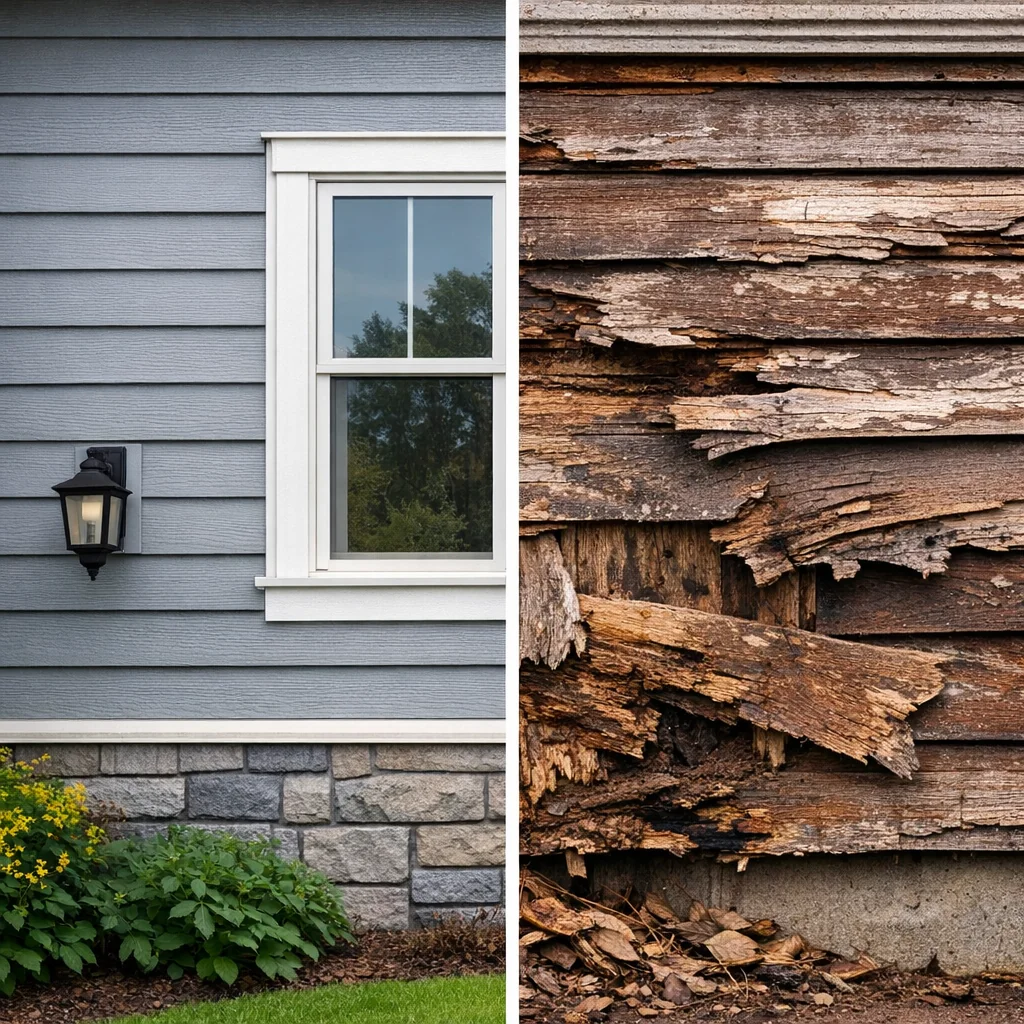
Step one: Is the damage urgent? Rotting panels, visible moisture intrusion, or a failed moisture barrier require fast action. Eliminate home equity products for their closing timeline and look at personal loans or contractor financing only if you have an independent rate to compare against.
Step two: What does your credit profile support? If your score is above 700 and you have significant equity, home equity products are worth evaluating for non-urgent projects. If your score is in the 580 to 640 range, focus on soft-pull pre-qualification across multiple lenders to find your best available rate before applying.
Step three: Do you have a payoff plan for promotional financing? If a 0% or same-as-cash offer is on the table, map out month-by-month whether you can realistically retire the full balance with a meaningful buffer before the deadline. If the answer is uncertain, a fixed-rate loan removes that risk.
Step four: Have you gotten an independent rate before talking to your contractor? If not, do that first. It costs nothing with a soft-pull pre-qualification, and it protects your negotiating position.
At Smithrock Roofing, we serve homeowners across Winston-Salem, Greensboro, High Point, Kernersville, Clemmons, Rural Hall, King, and Mount Airy. Our approach is consultative, not transactional. When we assess your siding, we give you an honest picture of what needs attention now versus what can wait, which directly affects which financing path makes the most sense for you. To learn more about what we offer, visit our siding service page for a full overview of materials, installation options, and what to expect from a professional exterior replacement. With more than 350 five-star reviews and over 60 combined years of exterior experience, we are here to help you make an informed decision, not just a fast one.
Yes, and the sequence matters. When you arrive at a contractor conversation already holding a pre-qualified rate from an independent lender, you are in a fundamentally stronger position than a homeowner who is hearing financing options for the first time at the estimate appointment. Knowing your baseline rate removes urgency from the financing conversation and lets you focus on the scope and quality of the work itself.
Deferred interest promotions typically apply retroactive interest to the original balance at a rate that is significantly higher than what a standard personal loan would have carried from the start. If you miss the payoff window by even a single billing cycle, the financial outcome can be considerably worse than if you had chosen a straightforward fixed-rate loan at the beginning. Before accepting any same-as-cash offer, map out a realistic month-by-month payoff schedule and build in a buffer.
Neither is universally better. Home equity products often carry lower interest rates and may offer tax advantages, but they require sufficient equity, involve closing timelines that can run several weeks, and put your home up as collateral. Personal loans close faster, carry no collateral risk, and are more accessible to homeowners with limited equity, though rates vary widely based on credit profile. The right answer depends on your equity position, credit score, the urgency of the project, and how long you realistically plan to stay in the home.
Most lenders do not restrict financing to full-replacement projects. Whether you are replacing a single damaged section or completing a whole-home installation, the financing structure works the same way. What matters to lenders is the total loan amount, your creditworthiness, and the repayment terms, not whether the project covers every exterior wall. That said, if a contractor’s assessment reveals that partial replacement now will likely lead to additional work within a short window, it is worth factoring that into your financing decision from the start.
Homeowners in Winston-Salem and Greensboro deserve straightforward guidance from a contractor who understands both the technical side of exterior work and the financial decisions that come with it. At Smithrock Roofing, that is exactly what we aim to provide, an honest assessment of your siding, a clear picture of what is urgent versus what can wait, and a conversation about financing that puts your interests first. If you are ready to talk through your options, call us at (336) 971-0464 or Contact Smithrock Roofing to schedule your free estimate.

Smithrock Roofing © Copyright 2026 • All Rights Reserved • Privacy Policy • Maintained by Mongoose Digital Marketing