
Rain gutter guards are covers or inserts that sit over or inside your gutters to keep debris out while allowing rainwater to flow through. This article explains how each major guard type works, where each one succeeds or falls short, and what to evaluate about your own home before choosing one.
A gutter guard’s job is straightforward: let water in, keep debris out. The challenge is that debris and water arrive together, and separating them reliably takes more thought than most product descriptions admit.
When leaves, pine needles, pollen, and seed pods land on your roof, every rainfall carries them into the gutters. Without protection, those gutters fill up, water backs up behind the clog, and you end up with overflow at the fascia, water against the foundation, or ice problems in cold stretches of weather. Guards reduce how much debris settles inside the gutter channel, which extends the time between cleanings and lowers the risk of those overflow events.
What guards do not do is make your gutters maintenance-free. Every contractor who has been doing this work for any length of time has seen homeowners disappointed by that promise. The fine organic material that pollen seasons produce, the sticky residue from certain tree buds, and the biofilm that develops on mesh surfaces over time will eventually require attention on any guard system. Understanding that upfront lets you choose a guard for the right reason: reduced maintenance, not eliminated maintenance.
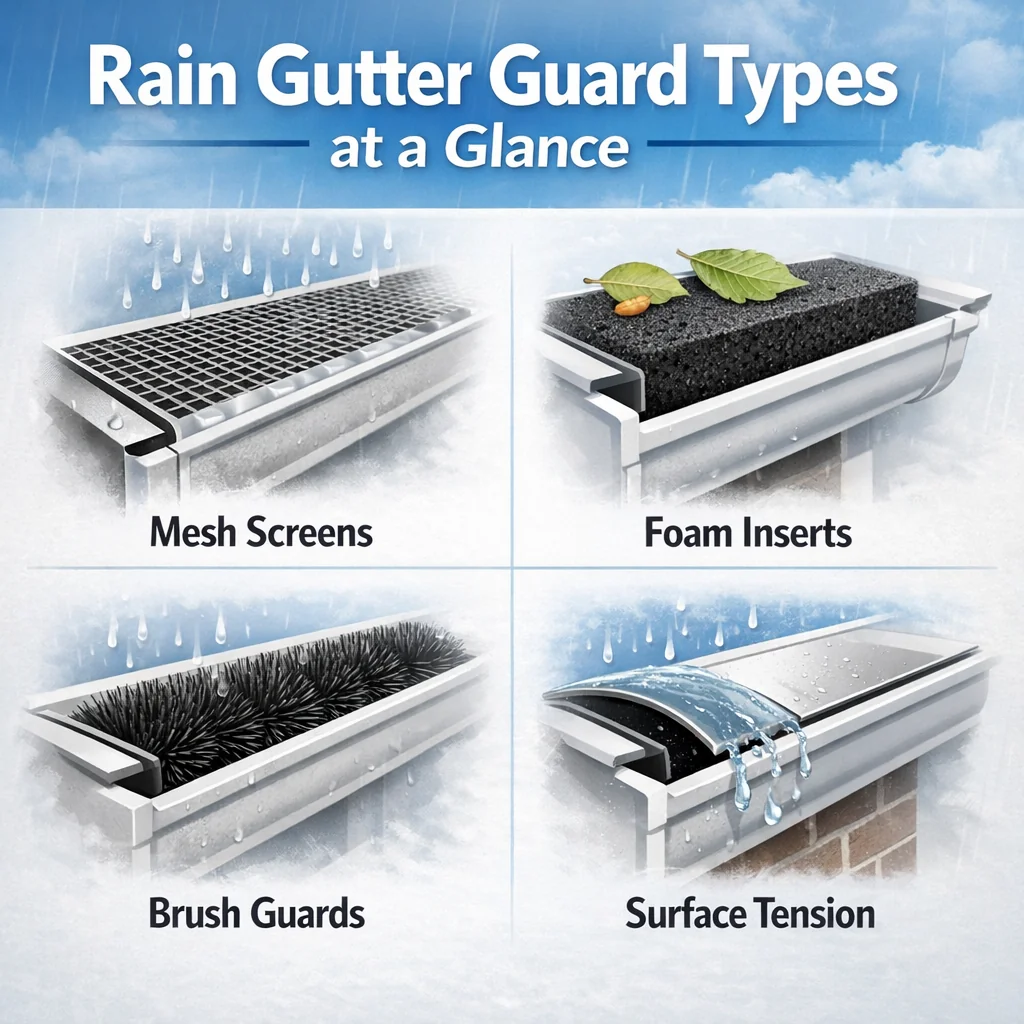
Guard designs fall into a few distinct categories, each built around a different method of separating water from debris.
These are the most common type. A perforated or woven panel sits over the open top of the gutter. Water passes through the holes; debris is supposed to blow off or slide off the surface.
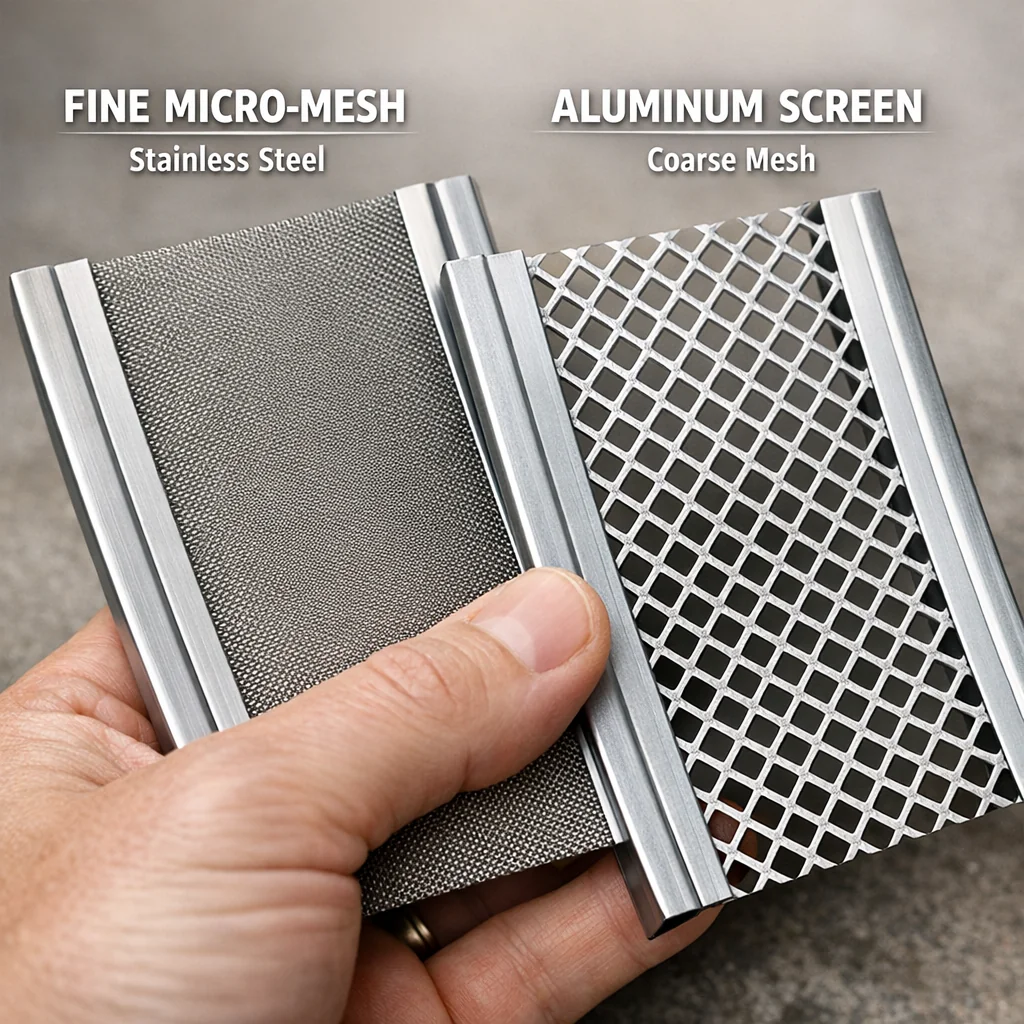
The defining variable is hole size. Coarser screens keep out large leaves but allow smaller material like shingle grit, pine needles, and seed pods to pass through. Micro-mesh guards use a very fine stainless steel or aluminum mesh, sometimes with openings finer than a millimeter, to block nearly all debris. The tradeoff is that finer mesh creates more surface tension resistance to water entry, which creates the overshoot problem described below.
These guards use a curved surface that water clings to as it flows off the roof edge. The water follows the curve and drops into the gutter while debris, theoretically, flies off the edge. They work reasonably well for large, dry leaves but struggle with pine needles and small debris that can ride the water film into the gutter anyway.
Foam inserts fill the gutter channel with a porous material; water filters through while debris sits on top. Brush inserts work similarly using bristles. Both are inexpensive and easy to install, but both also trap debris within the insert itself rather than keeping it out, which can create conditions for mold and plant growth inside the gutter.
Some systems replace the open gutter entirely with an enclosed channel that has a small water-entry slot. These typically perform well for large debris but share the overshoot problem with fine mesh during high-volume rainfall events.
Need a hand with this in Winston-Salem, Greensboro and the Triad? Call (336) 971-0464 or request a free estimate. Honest answers, no pressure.
There is a genuine contradiction in what you will read about micro-mesh guards. Some sources say fine mesh handles even heavy rain without issue. Others say tight mesh causes water to sheet right over the gutter during hard rainfall. Both statements can be true, and understanding why is the key to making a good decision.
The answer is that mesh performance depends on the relationship between three factors: roof pitch, rainfall intensity, and mesh fineness. Here is how those interact:
When rain falls on a steep roof, it accelerates as it travels down the surface and arrives at the gutter edge moving faster and with greater volume per second than the same rainfall on a low-pitch roof. At that arrival speed, water needs to pass through the mesh quickly. If the mesh is fine enough to create significant surface tension, meaning water has to slow down to pass through, some of that water will simply carry over the edge of the guard rather than entering the gutter.
On a lower-pitch roof, the same water arrives at the gutter edge moving more slowly and in a thinner sheet. A fine micro-mesh can accept it without the overshoot problem.
The practical decision rule: Before selecting a micro-mesh guard, consider your roof pitch. On roofs with a steep pitch, a slightly more open mesh, or a different guard style altogether, may move water more reliably than the finest mesh available. A contractor who measures your pitch and walks through your specific conditions is far more useful than a product review written for a generic home.
Most homeowners evaluate gutter guards by looking at the mesh itself. A detail that matters just as much is the angle at which that mesh is oriented relative to the gutter.
Guards where the screen lays flat and horizontal across the gutter opening are more vulnerable to debris bridging. When wet leaves and pollen land on a horizontal surface, they form a mat. That mat can cover enough of the mesh that water begins to sheet over it instead of passing through. In heavy pollen seasons, a horizontal screen can become effectively sealed within a single season without cleaning.
Guards where the screen sits at a more vertical or angled orientation shed debris more reliably. Debris that lands on a steeper surface is more likely to dry out and blow off, or slide when the next rainfall hits. This is a mechanical principle, surface angle affects whether debris bridges across holes or falls away from them, and it applies to evaluating any guard, not just one brand.
When comparing products, ask about screen orientation and look at how the guard sits once installed. A guard angled to match or approach the roof pitch tends to perform better in tree-heavy environments than one that lies flat. For a deeper look at how different guard designs compare in real-world conditions, the article Gutter Guards: More Trouble Than They’re Worth? walks through common performance pitfalls worth knowing before you buy.
Gutter guard selection is routinely treated as a standalone decision, but it is actually the middle step in a three-part system: gutter sizing, guard selection, and downspout capacity. Ignoring the third part can make your overflow problem worse after you have installed a guard.
Standard residential downspouts come in two common sizes. The smaller size, roughly two inches by three inches, is common on older homes. The larger size, roughly three inches by four inches, moves significantly more water per minute. When downspouts are undersized or partially obstructed, water backs up in the gutter during heavy rainfall.
Here is where the guard creates a new problem: a well-functioning gutter guard delivers clean, debris-free water to the gutter more efficiently than an unguarded gutter with partial clogs. That sounds like a benefit, and it is, unless the downspout cannot handle the increased flow. In that case, the guard effectively delivers water faster to a bottleneck, and water backs up behind the guard and overflows at the fascia.
Before investing in any gutter guard, have your downspout diameter checked. If you have smaller-diameter downspouts and they are backing up during moderate to heavy rain, upgrading those downspouts may solve the overflow problem you were hoping a guard would fix, and upgrading to a larger diameter is a straightforward improvement that often resolves chronic gutter overflow without a guard at all. Our gutters service covers full system evaluations, including downspout sizing, to make sure every component works together before a guard is ever selected.
Guard manufacturers offer several material combinations. The differences matter for long-term durability.
| Material | Common Use | Strength | Failure Mode |
|---|---|---|---|
| Stainless steel mesh | Micro-mesh guards | Resists rust, biofilm, and corrosion well | Higher initial investment; may dent under impact |
| Aluminum frame | Screen and micro-mesh guards | Lightweight, won’t rust | Can bend under debris load; fine mesh may clog with algae over time |
| Vinyl / PVC | Budget screens and inserts | Low cost, easy to cut | Can warp or become brittle; shorter service life in temperature extremes |
| Copper | Premium aesthetic option | Extremely durable, naturally antimicrobial | Highest cost; patinas over time (which some homeowners want, others don’t) |
| Galvanized steel | Heavy-duty screens | Strong and rigid | Susceptible to rust at cut edges and scratches over time |
Stainless steel mesh resists biofilm accumulation better than aluminum mesh because its surface is less porous. This matters in areas with heavy pollen seasons or overhanging trees, where organic film develops faster. Vinyl and PVC options are often fine for light-debris situations and short-term use, but they tend to be the first material to fail in systems that see real weather stress.
No matter which guard you choose, a few maintenance tasks remain non-negotiable.
Inspect annually, at minimum. Walk the perimeter of your home once a year and look at the guards from the ground. Sagging sections, visible debris matting, or standing water in the gutter channel after rain are signs that something needs attention.
Clear the top of the guard after heavy leaf fall. Most guards shed debris on their own, but a heavy leaf fall during a wet stretch can leave a layer sitting on top. A gentle rinse with a garden hose, never a pressure washer, which can damage mesh and displace guards, clears most of it quickly.
Watch for biofilm and pollen accumulation. After spring pollen season and again in fall, check whether a yellow-green film has developed on top of the mesh. This film can reduce water intake significantly. A soft brush and water handle it without damage.
Check downspout outlets seasonally. Even with guards in place, debris accumulates at downspout openings. A quick check to confirm water is exiting freely takes minutes and catches problems before they back up into the gutter.
Know when to call someone. If you notice water coming over the front edge of the gutter during normal rainfall, water staining on fascia boards, or any softness around the fascia when you press on it, those are signs that a professional should look at the full gutter system, not just the guard.
Pulling all of this together, the decision comes down to a short series of questions about your specific home rather than which product has the best marketing claim.
What is your roof pitch? Steeper pitch means faster sheet water, which narrows the range of mesh types that will perform reliably.
What trees are nearby? Large deciduous trees create a different debris profile than pine trees. Pine needles require finer mesh or more frequent cleaning regardless of guard type. Overhanging trees of any kind accelerate biofilm development.
What size are your current downspouts? If they back up now, a guard upgrade will not fix that. Address downspout sizing first.
How often are you willing to do minimal maintenance? Even the best guard requires a seasonal inspection. If you want complete hands-off operation, no product on the market guarantees that, and any contractor who tells you otherwise is not being straight with you.
Is the guard compatible with your gutter profile? K-style and half-round gutters require different guard designs. Confirm compatibility before purchasing.
At Smithrock Roofing, we serve homeowners across Winston-Salem, Greensboro, High Point, Kernersville, Clemmons, Rural Hall, King, Mount Airy, and the surrounding NC Triad. When our team looks at your gutters, we evaluate the full system, gutters, guards, downspouts, and how they connect to the overall condition of your roofline. That complete picture is what a single-product review or a product listing page cannot give you. With more than 350 five-star reviews and 60-plus combined years of experience, we can walk you through what your home actually needs, no pressure, just honest advice.
No. Every gutter guard type on the market still requires periodic inspection and some level of maintenance. Fine debris, shingle grit, and organic material like pollen and biofilm will accumulate on or near any guard surface over time. What a quality guard does is reduce how often cleaning is needed and make the job safer when it is needed, it does not eliminate the task altogether.
Pine needles are one of the more challenging debris types for gutter guards because their thin, narrow shape allows them to slip through coarser mesh openings and lay flat across finer ones. Guards still offer value in pine-heavy environments by reducing the volume of debris that enters the gutter channel, but they typically require more frequent inspection than homes surrounded only by deciduous trees. A finer mesh grade is generally the better starting point in those situations. The article Gutter Guards vs Leaf Guards: Which Is Right for You? breaks down how different guard types handle specific debris profiles in more detail.
Not universally. K-style gutters and half-round gutters have different dimensions and edge profiles, and many guards are designed specifically for one or the other. Before purchasing any guard product, confirm that it is rated for your existing gutter style and width. Installing an incompatible guard can create gaps, reduce performance, and in some cases void both the guard and gutter warranty.
If your gutters are pulling away from the fascia, show visible rust or corrosion along the seams, sag noticeably between hangers, or have fascia boards that feel soft when pressed, those are signs the underlying system needs attention before a guard is added. Installing a guard on a compromised gutter does not fix the structural issue, it can actually make it harder to identify and address later.
Protecting your home from water damage starts with a gutter system that actually works, and getting there means evaluating guards, gutters, and downspouts together rather than treating any one piece as a standalone fix. Smithrock Roofing has been helping homeowners in Winston-Salem, Greensboro, and throughout the NC Triad make those decisions with confidence, backed by more than 350 five-star reviews and over 60 combined years of hands-on experience. If you’re ready for an honest assessment of what your home needs, give us a call at (336) 971-0464 or Contact Smithrock Roofing to schedule your free estimate today.

Smithrock Roofing © Copyright 2026 • All Rights Reserved • Privacy Policy • Maintained by Mongoose Digital Marketing