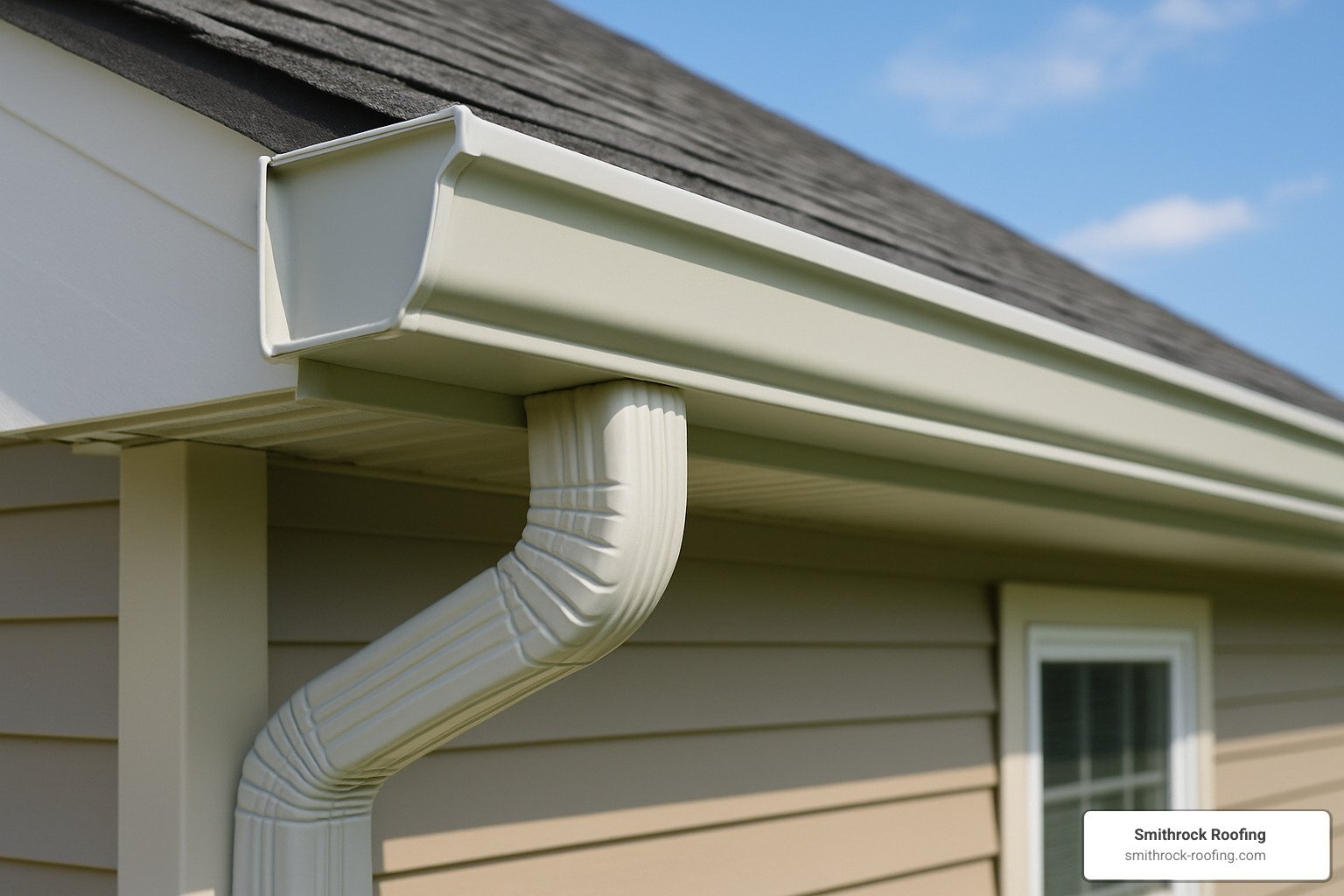
Gutters Clemmons NC: What Your Home Really Needs

Why Clemmons Homes Need More From Their Gutters Than Most Contractors Will Tell You

If you’ve ever watched water pour over the edge of your gutters during a summer storm — or worse, noticed it pooling against your foundation — you already know that a gutter system that looks fine isn’t always one that’s working. What most homeowners in Clemmons don’t realize is that the gutter advice circulating online was written for a generic American home in a generic American climate. Your home isn’t generic, and neither is the environment it sits in.

Clemmons, NC sits in the western Piedmont Triad — a geography that creates specific demands on exterior drainage systems that most gutter contractors simply don’t address. Between the area’s clay-heavy soils, a dense local tree canopy loaded with debris-producing species, and a rainfall pattern that regularly delivers intense volume in short windows, gutters here have to work harder than the national average. When they’re sized, sloped, and installed correctly, they protect your fascia, foundation, and landscaping for decades. When they’re not, the damage often starts quietly and compounds quickly.

This guide is meant to give you the honest, technical picture — the kind of assessment a genuinely experienced installer makes before a single bracket goes up. We’ll cover what Clemmons’ specific environment demands from a gutter system, how professional installation actually works from the ground up, what separates useful gutter protection from gutter guard marketing, and why the downspout side of the equation matters just as much as the trough itself.


What Clemmons’ Local Environment Actually Demands From a Gutter System

The Piedmont Rainfall Problem Most Contractors Ignore

Clemmons doesn’t experience rainfall the way a coastal community does. The western Piedmont sits in a zone where tropical moisture systems moving in from the Gulf regularly stall over the region, producing what meteorologists call high-volume, short-duration rainfall events. In plain terms: a lot of water, falling very fast.

The practical consequence for your gutter system is that standard 4-inch K-style gutters — the most commonly installed size across the country — can be chronically undersized for this rainfall profile. A 4-inch gutter has a drainage capacity adequate for moderate, sustained rain. It is not well-suited to the kind of intense convective storms the Triad experiences through late spring, summer, and especially late August through October when Gulf-born systems push through the Carolinas.

This is why experienced Piedmont installers routinely specify 5-inch K-style or 6-inch half-round gutters for Clemmons homes, particularly on roof sections with larger drainage areas or steeper pitches. The upsized gutter doesn’t just handle more water — it handles sudden surge volume without overflowing at the miters and end caps, which is where overflow damage typically concentrates.

If a contractor quotes you 4-inch gutters without first calculating the drainage area of each roof section and comparing it against regional rainfall intensity data, that’s a signal worth paying attention to.

The Tree Canopy Problem: Clemmons’ Specific Debris Load

The tree species within 30 feet of your roofline determine more about your gutter maintenance schedule — and your gutter guard choices — than almost any other factor. Clemmons’ residential neighborhoods are heavily canopied, and several of the most common species create debris profiles that defeat the gutter protection systems most frequently marketed to homeowners.

Here’s what you’re likely dealing with:

  • Loblolly and Virginia Pines — Produce pine needles year-round, with heavy shedding in late spring. Pine needles are thin enough to penetrate most screen and wide-mesh guard systems, and they mat together when wet, forming dense plugs that block water flow entirely.
  • Sweetgum — One of the most common street and yard trees in Forsyth County. Sweetgum balls (the spiny seed pods) are large and irregular. They create bridging failures on reverse-curve gutter guard systems by spanning the curve opening without falling through, then accumulating behind a dam of additional debris.
  • Willow Oak — The dominant street tree in many Clemmons neighborhoods. Willow Oaks shed catkins in spring and small, narrow leaves through fall. Catkins and helicopter seeds are among the most problematic debris types for foam insert guards, where they work into the material, germinate, and cause root-based blockages.
  • Tulip Poplar — Common in older wooded lots. Large leaves that break down slowly and create heavy wet-mat blockages in any open-trough system.

Understanding your specific tree canopy isn’t a landscaping concern — it’s an engineering input that should directly inform how your gutter protection is specified. For a deeper look at how different guard systems stack up against these debris types, the article Gutter Guards vs Leaf Guards: Which Is Right for You? breaks down the key differences and performance trade-offs worth understanding before you buy.

Clemmons Tree Debris vs. Gutter Guard Types

Clay Soil and Foundation Drainage: Why Gutter Failures Cost More Here

Forsyth County’s soils are predominantly clay-based. Clay soil does not absorb water the way sandy or loamy soils do — it sheds and channels it. When gutters overflow or downspouts deposit water too close to the foundation, that water doesn’t percolate away. It runs along the surface, finds the path of least resistance, and often ends up against the foundation wall or beneath a crawl space.

The combination of clay soil and the Piedmont’s high-intensity rainfall events makes proper gutter-to-drainage integration more consequential here than in many other regions. This isn’t a reason to panic — it’s a reason to be specific about how your system is designed and installed.


The Pre-Installation Assessment That Separates Experts From Order-Takers

Why Fascia Condition Is the First Question, Not an Afterthought

Here is something most gutter contractors won’t tell you until they’re already on your ladder: the most common reason new gutters fail prematurely has nothing to do with the gutter itself. It’s the fascia board it’s attached to.

Fascia boards run horizontally along the lower edge of your roofline. They’re the mounting surface for every gutter hanger and bracket. When fascia is compromised by moisture intrusion, wood rot, or insect damage — problems that are extremely common in the humid NC Piedmont climate — any gutter attached to it is working on borrowed time. A rotted fascia board can’t hold hanger tension. Over one to two seasons, gutters installed over failing fascia will sag, pull away from the roofline, and direct water exactly where you don’t want it.

A professional pre-installation assessment should always include:

  • Probing fascia boards along the entire roofline for soft spots, spongy areas, or paint failure that indicates moisture intrusion beneath the surface
  • Checking rafter tail integrity at the eave — rot that appears on fascia often extends inward to the rafter tails behind it
  • Identifying previous gutter hanger locations where spike-and-ferrule systems have left oversized holes that have been allowing water infiltration for years
  • Assessing existing soffit condition directly behind the fascia, where ventilation blockage and moisture damage frequently co-occur

If fascia repair or replacement is needed, it should happen before gutters are installed — not as an afterthought after the first hanger pulls out. A contractor who skips this inspection isn’t cutting corners; they’re setting you up for a callback and a frustrating conversation about why your new gutters already need attention.

Slope Engineering: The Measurement Most People Never Think to Ask About

Gutters don’t drain by gravity alone — they drain because they’re installed at a calculated slope. The industry standard is a 1/4-inch drop per every 10 linear feet of gutter run, directed toward the downspout outlet.

This sounds like a small number, and it is. But it matters enormously. Too little slope and water sits in the trough, accelerating oxidation, creating mosquito habitat, and leaving sediment deposits that gradually reduce flow capacity. Too much slope and the far end of the gutter sits visibly below the roofline, creating an aesthetic problem and a point where wind-driven rain can bypass the trough entirely.

On longer runs — common on the ranch-style and split-level homes throughout Clemmons — slope must be calculated from the midpoint outward to two downspout locations, rather than running the full length to a single outlet. A single long slope concentrates too much volume at one point and typically results in overflow during high-intensity events.

This is foundational installation knowledge. Its absence on a contractor’s website or during a consultation is a reasonable indicator of how their crew approaches the work.

Seamless K-style gutters and downspouts on a Clemmons NC home surrounded by mature Forsyth County trees


Seamless Gutters: What That Term Actually Means in the Field

On-Site Roll Forming and Why It Matters

The term “seamless gutters” appears on virtually every gutter contractor’s website in the Triad. Very few explain what it means or why it matters.

Seamless gutters are formed from a continuous coil of aluminum that is fed through a roll-forming machine — typically mounted in the contractor’s truck — and shaped into the gutter profile on-site. The gutter is cut to the exact length needed for each run of your home. This means the only seam connections in the system occur at corners and at downspout outlets, rather than every 10 to 12 feet as with sectional gutters.

Why does this matter practically?

Seams are the primary failure point in any gutter system. Sectional gutters, which are assembled from pre-cut lengths joined with slip connectors and sealant, introduce a joint at every connection. Each joint is a potential leak, and each one is subject to thermal expansion and contraction stress through Clemmons’ seasonal temperature swings — from summer highs in the upper 90s to hard freezes in January and February. Over years of cycling, sealant in sectional systems dries, cracks, and fails.

Seamless gutters eliminate the vast majority of these failure points. The material forms a single continuous channel per run, and the only sealant required is at the end caps and outlet connections — locations that are minimal in number and easy to inspect.

Aluminum Gauge: The Specification Contractors Rarely Mention

Not all seamless aluminum gutters are equal. The thickness of the aluminum — measured in gauge — has a direct effect on how the gutter performs over time. Common gauges used in residential installation are .027 and .032 inches.

The difference is real:

Specification.027 Gauge Aluminum.032 Gauge Aluminum
Dent resistanceModerate — susceptible to ladder contact and falling debrisSignificantly higher — resists casual impact
Weight capacityAdequate for typical debris and water loadBetter suited to heavy debris accumulation and ice load
Longevity expectation15–20 years with regular maintenance20–30+ years with regular maintenance
Thermal stabilityStandard performance across seasonsSlightly better dimensional stability in freeze-thaw cycles
Best applicationHomes with low debris load and minimal ice exposureRecommended for Clemmons homes under heavy tree canopy or in low-sun winter exposure

When you’re comparing gutter proposals, asking which gauge aluminum is being used is one of the most informed questions you can put to a contractor. It’s a specification detail that separates a premium installation from a minimum-viable one, and it’s rarely volunteered unprompted.


Gutter Guards: A Decision Framework for Clemmons Homeowners

The Five Guard Categories and Their Real-World Performance

The gutter protection market is crowded and loud. Most of what homeowners encounter is marketing, not engineering. Here is a straightforward breakdown of the five primary guard categories and how each performs against the specific conditions Clemmons properties face.

Guard TypeHow It WorksEffective AgainstFails AgainstClemmons Verdict
Screen / MeshHorizontal screen over trough openingLarge leavesPine needles, small seeds, catkinsPartial — reduces cleaning but doesn’t eliminate it
Micro-MeshFine stainless steel mesh over aluminum frameMost debris typesVery fine tree pollen, certain seed typesBest general performer for mixed canopy
Reverse Curve (Helmet)Water clings to curved surface; debris falls offLarge leaves in low-debris environmentsSweetgum balls, heavy debris mix, high rainfall volumeNot recommended for most Clemmons lots
Foam InsertPorous foam fills trough; water flows throughModerate leaf debrisCatkins, seeds — germinate inside foamNot recommended under Willow Oak or pine canopy
Brush InsertCylindrical brush fills troughCoarse debrisFine needles, seeds accumulate in bristlesNot recommended for Clemmons’ fine debris loads

The Honest Position on Gutter Guards

No gutter guard eliminates maintenance permanently. Any contractor or product that makes this claim is overpromising. What a well-matched guard system does is extend the interval between cleanings and reduce the severity of each cleaning event.

The most universally capable guard system for Clemmons’ mixed debris environment — pine needles, catkins, sweetgum balls, and fine leaf litter — is a stainless steel micro-mesh system mounted on an aluminum frame that matches the gutter width. The key variables to evaluate are:

  • Mesh opening size — smaller openings filter more debris but can reduce flow capacity during intense rainfall; the right balance depends on your specific debris load
  • Frame rigidity — a flexible frame will bow under debris accumulation, creating low points where water pools rather than flows to the outlet
  • Mounting method — systems that insert under the first row of shingles require careful installation to avoid disturbing the roofing system’s integrity

Even with a high-quality micro-mesh system installed, plan on at least one inspection per year, with attention to any sections directly below heavy-canopy trees.


Downspout Engineering: The Part of the System That Does the Real Work

Why the Downspout Side Is Where Water Damage Decisions Are Made

A gutter trough that collects water perfectly is only as effective as the downspout system that removes it from your roofline and carries it away from your home. This is the part of the gutter system that most contractors — and most homeowners — underinvest in conceptually.

There are several engineering factors that a thorough downspout specification should address:

Sizing relative to drainage area. The standard 2×3-inch downspout is appropriate for smaller roof sections. Larger roof areas, valley concentrations, and low-pitch rooflines require 3×4-inch downspouts to handle the volume generated during peak rainfall events. Undersized downspouts back up, forcing water over the front edge of the gutter trough — negating everything the gutter itself was designed to do.

Placement relative to foundation grade. Downspout terminus location should be selected based on the grade — the slope of the ground — at each discharge point. The goal is always to direct water away from the foundation, not parallel to it. On lots with minimal grade change, downspout extensions and splash blocks are a minimum requirement; on flatter lots, underground drainage connections may be warranted.

Underground drainage integration. On Clemmons properties where yard slope is minimal or where hardscape (driveways, patios, walkways) interrupts natural drainage paths, downspouts can be connected to underground drain lines that carry water to a remote discharge point — a pop-up emitter set into a lawn area well away from the structure, or a connection to the property’s existing drainage infrastructure. For a full breakdown of how this process works and what it costs, the article Bury Your Downspouts: Keep Your Foundation Dry and Your Yard Tidy covers the options in detail. This is a system-level solution that addresses what surface-only downspout extensions cannot.

Strap and bracket spacing. Downspouts need to be secured to the wall at regular intervals — typically every six feet — to prevent wind flex, which stresses the outlet connection at the gutter base and the elbow connections at grade level. Loose downspouts are a cosmetic problem until they become a leak problem.

The broader point is this: gutters and downspouts are a system. Specifying one without thinking through the other is how new installations end up with water damage that the homeowner assumed was solved.


Hanger Systems and Spacing: The Structural Foundation of Every Installation

Hidden Hangers vs. Spike-and-Ferrule: Why the Difference Matters

The method by which a gutter is attached to the fascia affects how long it stays in place, how cleanly it looks, and how well it performs under Clemmons’ periodic ice and debris load.

Spike-and-ferrule systems — the older method — drive a long spike through the front of the gutter, through a cylindrical ferrule inside the trough, and into the fascia. Over time, thermal expansion and contraction work these spikes loose, creating gaps between the gutter back and the fascia where water infiltrates and accelerates wood decay.

Hidden hanger systems — the current professional standard — use a bracket that clips inside the gutter trough and fastens to the fascia with a screw. The bracket is concealed, the fastener is a screw rather than a spike (dramatically more pull-out resistance), and the connection point is protected inside the trough rather than exposed on the front face.

Hanger spacing matters as well. Standard residential installation calls for hangers every 24 inches. On runs with heavy debris load potential, extended ice exposure, or roof sections where valley concentration dumps high water volume into a single gutter section, spacing of 18 inches provides meaningfully better structural support against sagging.

This is the kind of specification detail that separates an installation built to last from one built to pass a visual inspection. Ask about it — any experienced contractor should be able to speak to their hanger type and spacing without hesitation.


Working With a Contractor You Can Actually Trust

Choosing a gutter contractor in Clemmons shouldn’t feel like a gamble. The details covered in this guide — fascia assessment, slope calculation, aluminum gauge, debris-matched guard selection, downspout engineering, and hanger system specification — are the baseline of what a qualified installer thinks about before the job begins.

At Smithrock Roofing, we bring over 60 combined years of exterior contracting experience to every project in the NC Triad, including the Clemmons homes and neighborhoods we’ve served for years. Our A+ BBB rating and more than 312 five-star reviews reflect a straightforward commitment: do the assessment correctly, use quality materials, install them properly, and communicate clearly from the first conversation to the last walkthrough.

We’re fully licensed and insured, and we back our gutter work with the same professionalism that earned us CertainTeed PREMIER ShingleMaster certification on the roofing side. Gutters are part of your home’s complete exterior drainage system — and we treat them that way. You can learn more about our gutter services or explore what our customers have to say on our reviews page.

If you’re ready to have a real conversation about what your Clemmons home’s gutter system actually needs, we’re here. No pressure, no oversimplifying, just honest answers from people who’ve been doing this long enough to know the difference.

Contact Smithrock Roofing for a free gutter assessment and estimate. We serve Clemmons, Winston-Salem, Kernersville, High Point, Greensboro, Rural Hall, King, and surrounding communities throughout the NC Triad.


For authoritative rainfall data for the Forsyth County area, the NOAA National Centers for Environmental Information maintains regional precipitation records and storm event databases. For information on local tree species common to Forsyth County, the NC Forest Service provides species identification and management resources relevant to homeowners.

Strategic Recommendations for 2026

As you plan ahead for your Clemmons home’s exterior drainage, three specific steps will set you up for fewer surprises and better long-term performance:

1. Schedule a Post-Winter Fascia and Soffit Inspection
The freeze-thaw cycles that move through Forsyth County each winter put quiet stress on the wood behind your gutters. Before spring rains arrive in full force, have a qualified contractor physically inspect the fascia board condition, not just the gutters hanging in front of it. Catching soft or compromised wood early prevents a simple gutter job from becoming a full fascia replacement project mid-season.

2. Use NOAA’s Storm Events Database to Audit Your System Against Local Rainfall History
The NOAA National Centers for Environmental Information makes regional precipitation records publicly accessible. Pull the 10-year rainfall data for Forsyth County and compare peak hourly rainfall events against your current gutter sizing. If your system was installed more than a decade ago, it may have been sized to a standard that no longer reflects actual storm intensity in the area.

3. Request a Debris Load Assessment Tied to Your Specific Tree Canopy
Generic gutter guard recommendations ignore the single most important variable: what is actually falling onto your roof. In 2026, ask any contractor you interview to walk your property, identify the dominant tree species overhead, and match their guard recommendation to that debris profile — not to a one-size-fits-all product catalog.


Frequently Asked Questions

How do I know if my gutters are the right size for my Clemmons home?

The right gutter size depends on your roof’s square footage, the slope of each drainage plane, and the peak rainfall intensity typical for Forsyth County. A five-inch K-style gutter handles most standard residential applications, but homes with steep roofs, large drainage areas, or exposure to heavy canopy debris often require six-inch systems. If you’re seeing overflow during moderate rain — not just severe storms — that’s a reliable sign your current sizing is undersized for your specific conditions.

What type of gutter guard works best in Clemmons, NC?

There is no single best gutter guard for every Clemmons home because performance depends on what’s falling from the trees above yours. Micro-mesh guards perform well against the fine debris and seed pods from sweetgum and Bradford pear trees common in Forsyth County neighborhoods, while reverse-curve and screen styles are better matched to properties with larger leaf loads. A proper guard recommendation starts with identifying your canopy species first.

How often should gutters be cleaned and inspected in Forsyth County?

Most homes in the Clemmons and greater Forsyth County area benefit from at least two cleanings per year — once in late spring after seed and pollen season, and again in late fall after deciduous trees have fully dropped. Homes with heavy oak, pine, or sweetgum coverage may need an additional mid-season clearing. An annual inspection by a qualified contractor should also evaluate hanger spacing, slope consistency, and downspout flow — not just debris removal.

What should I ask a gutter contractor before hiring them in Clemmons?

Ask whether they will assess your fascia board condition before installation, how they calculate gutter slope and downspout sizing, what gauge aluminum they use, and whether their guard recommendation is based on your specific tree canopy. A contractor who can answer those questions with specifics — rather than a general product pitch — is one who understands that gutters are a drainage engineering problem, not just a material installation job.


Conclusion

Your home’s gutter system is one of the few components that works hardest during the moments you’re least likely to be watching it — during a heavy NC Triad rainstorm at midnight, quietly directing thousands of gallons away from your foundation. Getting that system right requires more than showing up with a ladder and a price. It requires the kind of assessment, material knowledge, and installation discipline that Smithrock Roofing has been applying to homes across Clemmons and Winston-Salem for years. If you’re ready to work with a team that treats your exterior drainage as the system it actually is, we’d be glad to start with an honest conversation.

Get a Free Estimate

Share:

Categories

Follow us

You can find us on Facebook, Instagram, and Google.
Smithrock Roofing LLC logo featuring stylized rooftops with chimneys and arched windows
Smithrock Roofing proudly services the cities of Winston-Salem, King, Clemmons, Lewisville, Pilot Mountain, East Bend, Mt. Airy, Kernersville, Siloam, Danbury, High Point, Trinity, Pfafftown, Tobaccoville, Greensboro, Walnut Cove, Belews Creek, Rural Hall, Pinnacle, Bethania, Advance, Wallburg, Horneytown, Union Cross, and Midway, NC.

Newsletter

Sign up to receive important tips, special offers, and discounts.

Smithrock Roofing © Copyright 2026 • All Rights Reserved • Privacy Policy • Maintained by Mongoose Digital Marketing