Gutters High Point NC | Expert Sizing & Installation

Why High Point Homes Need a Different Gutter Strategy

Most gutter content you’ll find online reads the same way: a quick list of services, a few star ratings, and a call to action. What you rarely find is an honest, technically grounded explanation of why your gutters matter, how they should be sized for your specific home, and what makes High Point’s environment harder on gutters than a generic installer from out of town might realize.

That matters, because gutters aren’t just a finishing detail on your roofline. They are the primary drainage system protecting your foundation, your fascia, your siding, and the structural integrity of your entire home. Get them wrong — wrong size, wrong material, wrong placement, or wrong maintenance schedule — and the consequences show up in places that are expensive to fix: cracked foundations, rotting wood, flooded crawl spaces, and damaged landscaping.

At Smithrock Roofing, we’ve spent decades working on homes across the NC Triad, and High Point has its own set of conditions that demand a more thoughtful approach. This guide explains what those conditions are, how they should influence your gutter decisions, and what separates a properly specified installation from one that just looks good on day one.


The High Point Environment: Why Generic Gutter Advice Falls Short

Piedmont Triad Rainfall and What It Means for Gutter Sizing

High Point sits in the Piedmont Triad, a region that receives roughly 45 to 50 inches of rainfall annually. That number alone doesn’t tell the full story. The more important figure for gutter performance is peak rainfall intensity — how much rain falls in a short period during a single storm event.

The NC Piedmont regularly sees convective summer storms capable of producing 2 to 3 inches of rain per hour. That kind of intensity places enormous hydraulic demand on a gutter system, and standard 5-inch K-style gutters — the most common size sold across the country — can be genuinely undersized for many High Point homes when those conditions hit.

Proper gutter sizing isn’t guesswork. Professional contractors use a calculation that combines three variables:

  • Rainfall intensity (inches per hour) for the local region
  • Effective drainage area of the roof — meaning the total square footage of roof plane that drains to a given gutter run
  • Roof pitch — steeper pitches increase the effective drainage area, because water accelerates off a steep slope faster than a shallow one

When you run those numbers for a High Point home with a 7:12 or steeper pitch, a large unbroken roof plane, or a gutter run exceeding 40 feet without an intermediate downspout, a 5-inch gutter often cannot move water fast enough during peak storm events. The result is overflow — which looks like a minor annoyance but is actually water dumping directly against your foundation and saturating the soil at your home’s most vulnerable point.

A 6-inch K-style gutter has roughly 40% greater water-carrying capacity than a 5-inch. For many High Point properties, especially those built between the 1970s and 1990s with the wide roof planes common in ranch and split-level construction, that upgrade isn’t optional — it’s the correct engineering decision.

High Point’s Tree Canopy: A Non-Standard Debris Load

Walk through almost any established High Point neighborhood and you’ll notice the tree canopy. Guilford County’s urban forest is dense and diverse, and the specific species common to this area create a debris load pattern that a generic “clean your gutters twice a year” recommendation simply doesn’t account for.

Here’s what’s actually falling into your gutters throughout the year:

Tree SpeciesDebris TypeDrop PatternWhy It’s Problematic
Loblolly & Virginia PineNeedlesYear-round, continuousNeedles are narrow enough to pass through most gutter guard mesh and accumulate in downspout elbows
SweetgumSpiky seed ballsOctober through FebruaryDon’t decompose quickly; create hard physical blockages that standard cleaning can miss
Willow OakVery small, narrow leavesFall, concentratedWet leaves mat together into impermeable layers that resist vacuum cleaning methods
General DeciduousLarge leavesOctober–DecemberStandard blockage; well-addressed by most cleaning approaches
All speciesPollenMarch–May, heavyDeposits a gummy, adhesive film inside gutters that binds other debris to gutter walls

The practical takeaway from this is important: a twice-yearly cleaning schedule is insufficient for most High Point properties with mature tree coverage. Pine needles are falling in July. Sweetgum balls are dropping in January. And every spring, the Triad’s notoriously heavy pollen season coats the interior of your gutters with a sticky residue that turns any subsequent debris into a near-permanent blockage.

A realistic cleaning schedule for a tree-surrounded High Point home typically involves three cleaning visits per year — once in late spring after pollen season, once in late summer, and once in late fall after leaf drop completes. Homes adjacent to pine trees should consider a fourth visit or invest in a gutter guard system specifically evaluated for needle infiltration.

High Point's Gutter Debris Calendar

Clay Soil, Crawl Spaces, and Foundation Risk

This is where the conversation about gutters shifts from roof maintenance to structural protection — and it’s something most contractors in this market never bring up.

High Point and the surrounding Piedmont region sit on Cecil and Pacolet clay loam soils. These are expansive clay-bearing soils with a specific behavior pattern: they shrink and crack during dry periods, and they swell when saturated with water. That wet-dry cycling creates soil movement directly adjacent to your home’s foundation.

When gutters overflow, are improperly graded, or discharge downspouts too close to the structure, the result isn’t just wet mulch. It’s repeated, prolonged saturation of the soil that surrounds your foundation walls. Clay holds that moisture for an extended period rather than draining it away. Over time, the expansion and contraction of that soil puts lateral pressure on foundation walls, causes differential settling, and contributes to the door frame misalignment, drywall cracks, and uneven floors that are common complaints in High Point’s pre-1990 housing stock.

The second compounding factor is crawl space construction. A large percentage of homes in High Point — particularly those built in the 1950s through 1980s — sit on crawl space foundations rather than slabs. That matters because:

  • Water that saturates soil adjacent to a crawl space foundation migrates inward
  • Elevated moisture in a crawl space accelerates wood rot in floor joists and girders
  • High crawl space humidity raises indoor humidity levels, strains HVAC systems, and creates conditions favorable to mold growth
  • In many cases, gutter dysfunction is the original source of what homeowners experience as a “musty smell” or an HVAC efficiency problem

Properly functioning gutters — sized correctly, graded at the right slope, equipped with downspouts discharged a minimum of 4 to 6 feet from the foundation, and maintained on a realistic schedule — are a direct investment in your crawl space and foundation health. That’s not a sales argument. That’s building science.


Gutter Materials and Systems: What the Options Actually Mean for Your Home

Seamless vs. Sectional Gutters: The Real Distinction

You’ll hear “seamless gutters” marketed almost universally by gutter contractors in this area, and the pitch is usually simple: fewer seams means fewer leaks. That’s true as far as it goes, but it addresses only one of four primary ways gutters fail. A complete understanding of gutter failure modes gives you a clearer picture of what to look for and what to ask about.

The four primary gutter failure modes:

  1. Seam failure — Leaking at joints in sectional systems. Seamless gutters eliminate most of this risk along the run, though end caps and mitered corners still involve sealed joints.

  2. Improper slope — Gutters must pitch toward downspouts at approximately 1/4 inch of drop per 10 feet of run. Gutters installed level or with inconsistent slope allow water to sit and eventually overflow or freeze in place.

  3. Inadequate hanger spacing — Gutters are only as stable as their attachment. Hangers spaced too far apart allow gutters to sag under debris or ice load, breaking slope and pulling away from the fascia. In High Point’s climate, hangers should be placed no more than 24 to 30 inches apart, with tighter spacing in areas subject to debris accumulation.

  4. Undersized downspout outlets — A correctly sized gutter paired with an undersized downspout creates a bottleneck. Standard guidance calls for one downspout per 30 to 40 linear feet of gutter, but that ratio tightens when roof pitch is steep or the drainage area is large. Homes with wide, low-slope rooflines discharging onto a single 2×3 inch downspout are a common source of overflow problems.

Seamless gutters, fabricated on-site to the exact length of your roofline, are the correct choice for most High Point homes. But the quality of a seamless installation is entirely determined by how well those other three factors are addressed. A seamless gutter installed with poor slope and inadequate hangers will fail just as reliably as a sectional gutter with a failing seam.

Material Selection: Aluminum, Galvanized Steel, and Copper

The material landscape for residential gutters is fairly straightforward, with each option carrying genuine trade-offs rather than a single clear winner for every situation.

Aluminum is the most common residential gutter material for good reason. It doesn’t rust, holds paint well, is available in continuous seamless lengths, and performs reliably across High Point’s full range of seasonal conditions. For most homes, correctly installed aluminum gutters are the practical right answer.

Galvanized steel offers greater structural rigidity, which can be an advantage on very long runs or under heavy debris loads. The trade-off is susceptibility to rust over time, particularly at cut ends and seams. In High Point’s humidity, the lifespan of galvanized gutters is shorter than in drier climates, and they require more maintenance attention to perform well.

Copper is a premium architectural material, used primarily on historic homes, custom construction, or situations where visual character is a priority. Copper develops a distinctive patina over time and has an exceptionally long service life. It is not a cost-efficient choice for standard residential installation but is worth understanding if you’re working on a High Point home with historical significance or specific aesthetic requirements.

Gutter Guards: Matching the Product to the Environment

Gutter guard marketing tends toward sweeping claims — lifetime warranties, zero maintenance, complete blockage prevention. The reality is more nuanced, and High Point’s specific debris profile makes guard selection more consequential than it is in markets with simpler tree canopies.

The three main operating mechanisms for gutter guards:

Surface tension (reverse curve) systems work by directing water over a curved surface into the gutter while debris is supposed to fall off the edge. These perform reasonably well with large leaves but struggle with pine needles and small debris, which cling to the curved surface and eventually infiltrate. Not the strongest option for High Point homes with significant pine coverage.

Micro-mesh systems use a very fine stainless steel mesh over a gutter frame, filtering debris while allowing water through. These are the most effective guards for High Point’s debris profile — the mesh is fine enough to block pine needles and sweetgum seed fragments, and the stainless construction holds up against the Triad’s heavy pollen loads without degrading. Quality varies significantly by manufacturer; the mesh gauge and frame construction determine whether the guard performs as described. For a deeper look at how different products compare in real Triad conditions, the article The Homeowner’s Guide to Gutter Guard Installation in the Triad: Stop Cleaning Gutters for Good walks through the key evaluation criteria worth reviewing before you buy.

Screen and foam inserts are lower-cost options that provide moderate protection against large leaves. They are ineffective against pine needles and can trap debris within the guard material itself, requiring cleaning that can be more difficult than cleaning an open gutter. These are rarely the right long-term choice for High Point properties.

One important caveat regardless of guard type: no guard system eliminates maintenance entirely. Even the best micro-mesh guards require periodic inspection and cleaning, particularly after pollen season and following the sweetgum seed ball drop in late fall and winter. A guard that reduces cleaning from four visits to two visits per year is delivering real value — a guard that eliminates cleaning entirely is not a realistic expectation in this environment.


Fascia Assessment: The Step Most Installers Skip

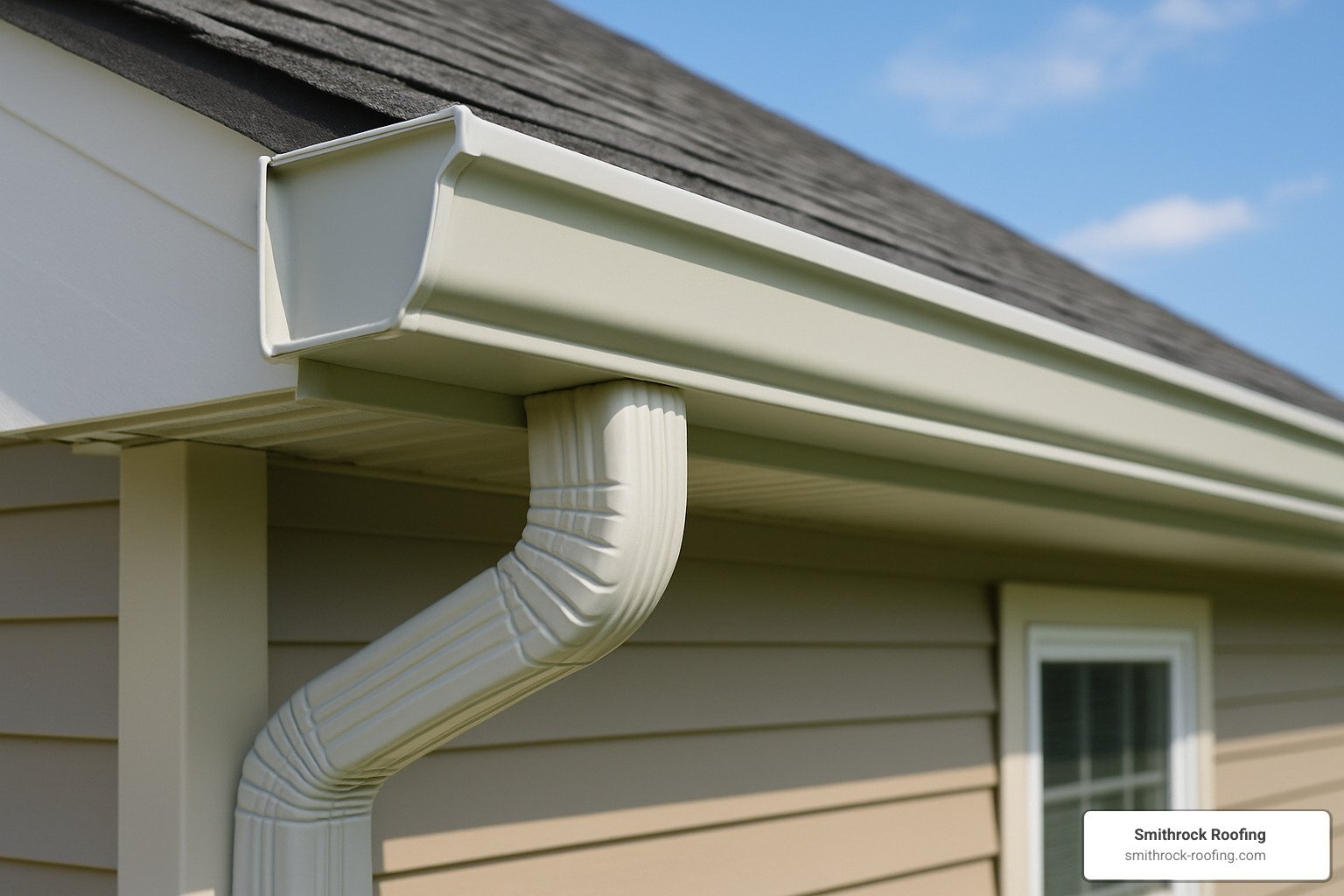
Close-up of gutters on a High Point, NC home showing fascia board condition, hanger hardware, and comparison of healthy vs. d

Before any gutter installation or replacement, the condition of your fascia boards deserves careful attention. Fascia is the horizontal trim board that runs along the lower edge of your roofline — it’s also the surface your gutters attach to. Every hanger, spike, or screw holding your gutters in place is anchored into that wood.

High Point’s housing inventory includes a substantial number of homes built between 1950 and 1990. Many of those homes have original wood fascia boards that have been exposed to decades of moisture cycling. When gutters fail — whether from improper slope, overflowing debris, or age — they typically fail in a way that directs water directly onto the fascia behind them. That moisture penetrates behind the gutter lip, and because it’s hidden from view, it often goes undetected for years.

The consequences of installing new gutters over deteriorated fascia are straightforward: the new gutters fail at the attachment points as the compromised wood loses its grip on the fasteners. The result is a gutter that pulls away from the roofline — not because of the gutter itself, but because of what it was attached to.

Any legitimate gutter installation should begin with a fascia assessment. At a minimum, the installer should probe the fascia along the installation path, checking for soft spots, delamination, and signs of rot. Where fascia boards are compromised, they need to be repaired or replaced before the new gutter system goes up. This is not an upsell — it’s the foundational condition that determines whether the installation will hold.


What a Properly Installed Gutter System Looks Like: Key Specifications

When you’re evaluating any gutter installation proposal, these are the technical specifications that separate a correctly engineered system from one that simply looks good on the day it goes in:

  • Gutter size: 6-inch K-style for roof drainage areas over 1,000 square feet, steep pitches above 6:12, or long unbroken gutter runs. 5-inch appropriate for smaller drainage areas with moderate pitch.
  • Slope: 1/4 inch of pitch per 10 linear feet toward the nearest downspout, consistent across the full run.
  • Hanger spacing: 24 to 30 inches maximum in normal conditions; 18 to 24 inches in areas with heavy debris loads or ice risk.
  • Downspout sizing: 3×4 inch rectangular or 4-inch round for most High Point residential applications. 2×3 inch acceptable only on very short, low-load runs.
  • Downspout frequency: One downspout per 30 to 40 linear feet of gutter under standard conditions; more frequent placement required for steep pitches or large drainage areas.
  • Downspout discharge: Minimum 4 to 6 feet from foundation, directed away from the structure and downhill. Extensions or underground drainage recommended where grade allows water to pool near the home.
  • Fascia condition: Confirmed sound before installation. Compromised boards replaced prior to hanger placement.
  • End caps and miters: Sealed with gutter sealant rated for outdoor use; joints at inside and outside corners inspected and confirmed watertight.

These aren’t aspirational standards. They’re the baseline for an installation that will perform through High Point’s storm seasons and protect your home over the long term. If a proposal you’re reviewing doesn’t address these items — or if an installer can’t speak to them when asked — that’s meaningful information.


How Long Should Gutters Last in High Point’s Climate?

Industry averages often cite 20 to 30 years for aluminum gutters, but that number assumes installation quality and maintenance schedule that many homes don’t receive. In High Point’s specific conditions, the realistic lifespan varies considerably based on a few factors:

Factors that extend gutter life in High Point:
– Correct initial sizing and slope (prevents standing water and freeze-thaw damage)
– Consistent cleaning schedule matched to the local debris calendar
– Gutter guard systems that reduce organic debris accumulation
– Prompt attention to minor issues — loose hangers, failing sealant at joints — before they compound
– Fascia in sound condition providing solid hanger attachment throughout the system’s life

Factors that shorten gutter life in High Point:
– Standing water from flat or incorrectly sloped gutters (accelerates corrosion and freeze-thaw damage in winter)
– Organic debris that holds moisture against the gutter floor year-round
– Ice accumulation from gutters that are not properly draining before freezing temperatures arrive
– Heavy tree coverage without adequate cleaning frequency
– Improper original sizing that causes gutters to work at their hydraulic limit during every significant storm

A well-installed, properly maintained aluminum gutter system on a High Point home should realistically provide 20 to 25 years of service life. Systems that are undersized, under-maintained, or installed over compromised fascia often require partial or full replacement within 10 to 15 years — not because gutters are inherently fragile, but because the conditions they were operating in were working against them from the start.


Signs Your Gutters Are Failing: What to Look for From the Ground

Homeowners don’t need to climb a ladder to identify most early warning signs of gutter problems. A careful ground-level inspection after a heavy rain event reveals a great deal:

  • Water spilling over the front lip of gutters during rain — indicates blockage, improper slope, or undersized gutters for your roof’s drainage load
  • Water emerging at gutter seams or end caps — sealant failure; typically repairable if caught early
  • Gutters visibly pulling away from the roofline — hanger failure, often related to fascia deterioration behind the gutter
  • Visible sagging or low spots in the gutter run — slope has been lost, water is pooling in that section
  • Staining or erosion in soil directly below the gutter line — overflow has been occurring for an extended period
  • Paint peeling on fascia boards visible beneath the gutter lip — water is getting behind the gutter and contacting the wood
  • Rust streaking on painted gutters — most common at end caps and joints; indicates sealant failure and water intrusion
  • Downspouts that don’t drain during rain, or drain very slowly — blockage in the downspout itself, often at the elbow connecting the gutter outlet to the vertical run

Any of these signs warrants a professional inspection before the issue progresses. What starts as a loose hanger or a failing joint is manageable. Left unaddressed through several seasons of High Point’s rainfall, those small issues tend to become fascia replacement, foundation drainage corrections, or crawl space remediation — all of which are far more involved than the original repair would have been.

Strategic Recommendations for 2026

As High Point homeowners evaluate their gutter systems heading into 2026, three priorities stand out as particularly worthwhile investments of time and attention:

1. Schedule a Post-Winter Professional Inspection
Winter precipitation, ice accumulation, and freeze-thaw cycles put measurable stress on hangers, joints, and sealant. Before spring rainfall arrives in full force, having a licensed contractor walk your roofline and drainage system gives you an accurate picture of what survived the season intact and what needs attention before the heavier rain months begin. This is especially relevant for homes with older aluminum systems or those installed over wood fascia that has not been inspected in several years.

2. Evaluate Gutter Protection Compatibility With Your Specific Roof Profile
The gutter guard market has expanded considerably, and product quality varies widely. Rather than purchasing a retail solution based on general reviews, ask a local contractor to assess your roof pitch, tree canopy exposure, and current gutter sizing before recommending a guard style. What performs well on a low-slope roof with minimal overhead tree cover may perform poorly on a steeper pitch surrounded by the mature hardwoods common across High Point neighborhoods. A site-specific recommendation will serve you far better than a one-size-fits-all product. Smithrock’s gutter guard solutions for High Point homes are evaluated exactly this way — starting with your roof’s specific conditions rather than a catalog recommendation.

3. Address Fascia Condition Before It Dictates the Replacement Timeline
If your gutters are otherwise functional but your fascia boards are showing signs of softness, rot, or paint failure, addressing the fascia now — rather than waiting until the gutter system fails entirely — preserves your options. Replacing fascia proactively allows new gutters to be mounted on sound material, extending the service life of the entire installation and avoiding the compounding expense of emergency replacements during active rain seasons.


Frequently Asked Questions

How often should gutters be cleaned in High Point, NC?

Most homes in High Point benefit from gutter cleaning at least twice per year — once in late spring after tree pollination and seed release has peaked, and again in late fall after deciduous trees have fully dropped their leaves. Homes situated beneath mature oaks, sweet gums, or pine trees may need cleaning three or four times annually due to the volume of debris those species deposit. The Piedmont Triad’s consistent rainfall makes keeping gutters clear particularly important, as even partial blockages can cause overflow during the region’s more intense storm events.

What size gutters are appropriate for most High Point homes?

The majority of residential installations in High Point use five-inch K-style gutters, which handle the drainage load generated by typical roof sections adequately. Homes with steeper pitches, larger roof surface areas, or valley configurations that concentrate runoff into a single section may require six-inch gutters on those high-volume runs. Downspout sizing matters equally — a properly sized gutter paired with an undersized or poorly placed downspout will still overflow during heavy rain. A contractor familiar with local rainfall intensity patterns can assess your specific roof geometry and recommend sizing accordingly.

Is it worth installing gutter guards on a home in the Piedmont Triad?

For many homeowners in the High Point area, gutter guards offer a practical reduction in maintenance frequency, particularly where significant tree coverage makes seasonal cleaning a recurring need. However, guards are not a permanent solution that eliminates all maintenance — debris can still accumulate on top of certain guard styles, and periodic inspection remains necessary. The value of a gutter guard system depends heavily on the product quality, correct installation, and compatibility with your roof type. A professional assessment helps determine whether the investment makes sense for your specific property.

What causes gutters to pull away from the house, and can it be repaired?

Gutters separate from the roofline for two primary reasons: hanger failure and fascia deterioration. Hangers can loosen over time due to normal thermal expansion and contraction, or because they were spaced too far apart during the original installation. In many cases, re-securing or adding hangers resolves the problem. However, if the fascia board behind the gutter has softened due to prolonged moisture exposure, hangers have nothing structurally sound to grip — and the fascia must be replaced before the gutter can be properly remounted. A contractor can determine which condition applies during an inspection, and in most cases early intervention keeps the repair straightforward.


Conclusion

Gutters are a small but consequential part of what keeps a home protected in a climate like High Point’s — and getting them right from installation through ongoing maintenance is exactly the kind of detail that Smithrock Roofing, proudly serving Winston-Salem, Greensboro, High Point, and Kernersville, brings to every project. Whether you’re dealing with a failing section on an older home in High Point or planning a full replacement in the greater Greensboro area, the team at Smithrock brings local knowledge and honest guidance to every assessment. If you’re ready to have your gutters evaluated by someone who understands what Piedmont Triad weather actually demands of a drainage system, Get a Free Estimate and let us take a look.

Share:

Categories

Follow us

You can find us on Facebook, Instagram, and Google.
Smithrock Roofing LLC logo featuring stylized rooftops with chimneys and arched windows
Smithrock Roofing proudly services the cities of Winston-Salem, King, Clemmons, Lewisville, Pilot Mountain, East Bend, Mt. Airy, Kernersville, Siloam, Danbury, High Point, Trinity, Pfafftown, Tobaccoville, Greensboro, Walnut Cove, Belews Creek, Rural Hall, Pinnacle, Bethania, Advance, Wallburg, Horneytown, Union Cross, and Midway, NC.

Newsletter

Sign up to receive important tips, special offers, and discounts.

Smithrock Roofing © Copyright 2026 • All Rights Reserved • Privacy Policy • Maintained by Mongoose Digital Marketing