Gutters Kernersville NC: What Homeowners Must Know

Why Kernersville Homeowners Need to Think Differently About Gutters

Most homeowners don’t think much about their gutters until something goes wrong — a waterfall cascading off a clogged eave, a water stain creeping across a ceiling, or a soft spot in the fascia board that wasn’t there last spring. By that point, a manageable maintenance issue has often turned into a repair project.

But here in Kernersville, gutters carry more responsibility than they do in many other parts of the country. The combination of heavy Piedmont tree canopy, intense summer thunderstorms, and red clay soil creates a drainage environment where even a slightly underperforming gutter system can cause damage that goes well beyond a soggy yard. Understanding why that’s true — and what a properly designed gutter system actually looks like — is the difference between protecting your home and just hanging some aluminum on the roofline.

This guide covers what you need to know about gutters in Kernersville, NC: the local factors that shape every installation decision, how to choose the right system for your specific roof, what separates a quality installation from a shortcut job, and how to think about gutter guards given the specific trees in this area.


What Makes Kernersville Different: Red Clay, Heavy Canopy, and Summer Storms

Before talking about gutters themselves, it helps to understand the environment they’re working in. Kernersville sits in the Piedmont region of North Carolina, and that geography creates three specific challenges that directly affect how your gutter system should be designed and maintained.

The Red Clay Problem

Forsyth and Guilford county homeowners are well acquainted with Piedmont red clay. It’s dense, sticky, and — once saturated — nearly impermeable to water. This matters enormously for gutter performance.

In regions with sandy or loamy soil, water that drips off an overflowing gutter gets absorbed into the ground relatively quickly. In Kernersville, that same overflow pools, runs along the surface, and migrates toward the nearest low point — which is often a foundation wall, a crawl space vent, or a basement window well.

Crawl space homes are extremely common throughout Kernersville and the surrounding communities. When a gutter system allows water to consistently shed near the foundation — even in small amounts — that water has nowhere productive to go in red clay soil. It sits against the foundation, it works into crawl space vapor barriers, and over time it accelerates wood rot, mold growth, and structural settlement.

This is why gutter sizing, slope, and downspout placement aren’t just aesthetic or general-maintenance considerations here. They’re directly connected to foundation and crawl space health in a way that’s more consequential than in many other markets.

Intense Convective Rainfall

The NC Triad receives roughly 42–46 inches of rainfall annually, but the pattern of that rainfall matters as much as the total. From May through August, the Piedmont experiences frequent convective thunderstorms — fast-moving, high-intensity events where rainfall can exceed two inches per hour at peak. This is not a gentle, steady rain that a modestly sized gutter can handle. These are short, heavy bursts that demand immediate drainage capacity.

A gutter system that looks perfectly adequate on a calm fall day can be completely overwhelmed during a July afternoon storm. If you’ve ever watched sheets of water pour over the front edge of your gutters during a summer storm while water runs down your siding, that’s not just a clog — it may be a sizing problem.

The Tree Canopy Factor

Kernersville’s established neighborhoods are lined with mature hardwoods and conifers. Oak, sweet gum, pine, and tulip poplar are all common. Each of these trees sheds debris on different seasonal timelines, which means gutters in this area face a near-continuous cycle of organic material — oak leaves in fall, pine needles through winter, oak catkins and pollen masses in spring, and sweet gum balls almost year-round.

This isn’t something a single annual cleaning adequately addresses. It’s a year-round system management challenge, and it has direct implications for whether gutter guards make sense for your property and, if so, which type.


Choosing the Right Gutter Size: The Decision Framework Explained

One of the most common gaps in gutter information is the question of size. Nearly every contractor in the area offers both 5-inch and 6-inch K-style gutters, but very few explain the actual logic behind choosing between them. Here’s how that decision works.

Understanding Roof Drainage Area

Gutter sizing is an engineering exercise, not a preference. The fundamental question is: how much water does your roof shed onto this gutter run during a peak rainfall event?

That calculation involves three variables:

  1. The horizontal plane area of the roof section draining to a particular gutter run — measured in square feet
  2. A pitch correction factor — steeper roofs shed water faster, effectively increasing the hydraulic load
  3. Local rainfall intensity — in the Piedmont, peak intensity figures for storm drainage calculations typically fall in the 2–4 inch per hour range depending on storm frequency assumptions

When you multiply roof area by the pitch factor and cross-reference against local rainfall intensity, you get a required flow rate. You then match that flow rate to a gutter profile that can handle it.

The 5″ vs. 6″ Breakdown

Factor5″ K-Style Gutter6″ K-Style Gutter
Typical max roof drainage area (moderate rainfall)Up to ~5,500 sq. ft.Up to ~7,960 sq. ft.
Best suited forSmaller homes, lower-pitch roofs, shorter gutter runsLarger homes, steeper roofs, longer runs
Downspout size typically paired with2×3″ or 3×4″ downspouts3×4″ downspouts standard
Weight of debris loadLower debris retentionSlightly more capacity for debris before overflow
Visibility from streetSlightly less prominentMore visible profile on the roofline

The pitch correction is where many homeowners are surprised. A roof with a 4:12 pitch (relatively shallow) has a pitch factor close to 1.0 — meaning the horizontal area and the effective drainage area are essentially the same. But a roof with a 9:12 or 10:12 pitch — common on many two-story Colonial and Craftsman homes in Kernersville — carries a pitch factor of roughly 1.3 or higher. That means a 2,000 square foot footprint on a steep roof behaves hydraulically more like a 2,600 square foot flat roof when it comes to gutter load.

This is one of the most common reasons homeowners on steeper-pitched homes continue to experience overflow even after cleaning their gutters. The gutters may simply be undersized for the actual drainage demand.

Downspout Placement Is Just as Important as Width

The width of the gutter is only half the equation. A 6-inch gutter that fills up faster than it can drain is no better than a 5-inch one that overflows. The general guideline is one downspout for every 30 to 40 linear feet of gutter run, and the downspout placement should be calculated to ensure the flow isn’t bottlenecked at a single exit point on a long run.

In Kernersville’s red clay environment, where the downspout terminates matters enormously. Discharging water six inches from a foundation wall — even through a properly sized, fully functional gutter — can still cause the same foundation and crawl space problems as a clogged gutter if the water has nowhere to disperse. Extensions, splash blocks, and in some cases underground drainage routing are part of a complete system, not optional add-ons.


5


Installation Quality: The Details That Determine How Long Your Gutters Last

A gutter can be the correct size and still fail within a few years if it’s installed improperly. These are the installation quality factors that matter most — and that you should ask any contractor about before work begins.

Slope: Getting the Angle Right

Gutters are not installed level. They’re hung at a deliberate slope so water moves toward the downspout rather than sitting stagnant. The industry standard is a drop of approximately one-quarter inch for every 10 linear feet of gutter run.

When slope is too shallow, water stands in the gutter after rain stops. Standing water accelerates corrosion in aluminum gutters, creates an environment for mosquito breeding, and adds weight load that stresses the hanger system. When slope is too steep, the visual line of the gutter becomes noticeably uneven from the street, and water can rush to the downspout end faster than it drains — causing localized overflow during heavy rain.

On long gutter runs (more than 40 feet), a slight crown in the center — sloping toward downspouts at both ends — is often the correct approach to maintain both aesthetics and hydraulic function.

Hangers and Fasteners

Hidden hanger systems with screws, rather than traditional spike-and-ferrule fasteners, are the current standard for good reason. Spikes are driven through the gutter face into the fascia, and over time — through thermal expansion, contraction, and the weight of debris and ice — they pull loose. Once a spike loosens, that section of gutter begins to sag, disrupting slope and creating pooling.

Hidden hangers wrap around the inside of the gutter and fasten with screws that hold far more securely over time. Hanger spacing should be no more than 24 inches on standard installations — closer in areas exposed to heavy debris load or potential ice accumulation, which is relevant in Kernersville during winter weather events.

Fascia Board Condition: The Step No One Talks About

Here is something that separates a thorough installation from a quick one: before any gutter goes up, the condition of the fascia board behind it should be assessed.

Fascia boards are the horizontal boards running along the lower edge of the roofline where gutters attach. When they’re sound, they provide a stable, solid mounting surface. When they’re soft from rot or moisture infiltration — which is extremely common in homes where older gutters have been leaking or pulling away from the roofline — they cannot hold hangers securely regardless of fastener quality. For a deeper look at what this repair involves, the article on fascia and soffit repair covers the process in detail.

Installing new gutters on compromised fascia is one of the most common reasons a new installation fails within two or three years. The hangers slowly pull out of the soft wood, the gutter sags, slope is lost, and the whole cycle repeats. Any contractor recommending new gutters should walk the fascia condition with you before the quote is finalized.

Thermal Expansion Allowances

Aluminum expands and contracts with temperature. North Carolina’s temperature range — from single-digit wind chills in winter to 95°F summer heat — creates a significant thermal movement cycle across a long gutter run. Joints and end caps need appropriate sealant allowances for this movement. Seamless gutters, which are fabricated on-site to the exact length of each run with no mid-span seams, handle this better than sectional systems because there are far fewer joints where sealant can fail over time.


Gutter Guards in Kernersville: Why the Tree Canopy Changes the Equation

Gutter guards are worth discussing seriously, because the answer is not simply “yes, get them” or “no, skip them.” It depends heavily on what’s growing in your yard — and in Kernersville, that matters more than most places.

The Three Debris Problems Specific to This Area

Sweet gum balls are one of the most problematic debris types for gutter guards. These spiky, roughly spherical seed pods are roughly 1 to 2 inches in diameter. The good news is that most micro-mesh guards with small enough openings will keep them out of the gutter channel. The better news is that their size means they typically roll off roof surfaces before reaching the gutter. The problem arises with screen-style insert guards, where sweet gum balls can lodge in the mesh openings and become extremely difficult to remove without lifting the entire guard section.

Pine needles are the nemesis of reverse-curve (surface tension) guards. These guards work by curving water around a nose and into the gutter channel while debris is supposed to fall away. Pine needles, however, are long and narrow enough to stand vertically along the curved nose and wick water inward — defeating the surface tension mechanism entirely. In neighborhoods with significant pine canopy, reverse-curve guards frequently underperform and may redirect water outward over the gutter rather than into it.

Oak catkins and pollen masses (the stringy, worm-like tassels that oaks shed in spring) are fine enough to penetrate lower-quality micro-mesh products. Quality micro-mesh guards that perform well in heavy oak canopy environments typically need mesh openings of 30 microns or finer. Products rated at 50 microns — which are widely marketed — allow oak catkin material through, which then mats and compacts at the bottom of the gutter channel and is actually harder to clean than loose leaves.

How to Match Guard Type to Your Property

Tree Type on PropertyBest Guard OptionGuards to Avoid
Heavy pine coverageMicro-mesh (fine grade)Reverse-curve / surface tension
Heavy oak coverageMicro-mesh (30 micron or finer)Low-grade micro-mesh (50+ micron)
Sweet gum treesMicro-mesh or solid coverScreen-style insert guards
Mixed hardwood canopyFine micro-meshScreen insert, reverse-curve
Minimal tree coverageGuards may be optionalN/A

No gutter guard eliminates maintenance entirely. What a quality guard does is reduce cleaning frequency — from two or three times per year to perhaps once every year or two — and prevent the fast, heavy clogs that cause overflow during storms. For homeowners with mature trees close to the roofline, that reduction in maintenance is genuinely worthwhile. For a home on a relatively open lot, the value proposition is more modest.


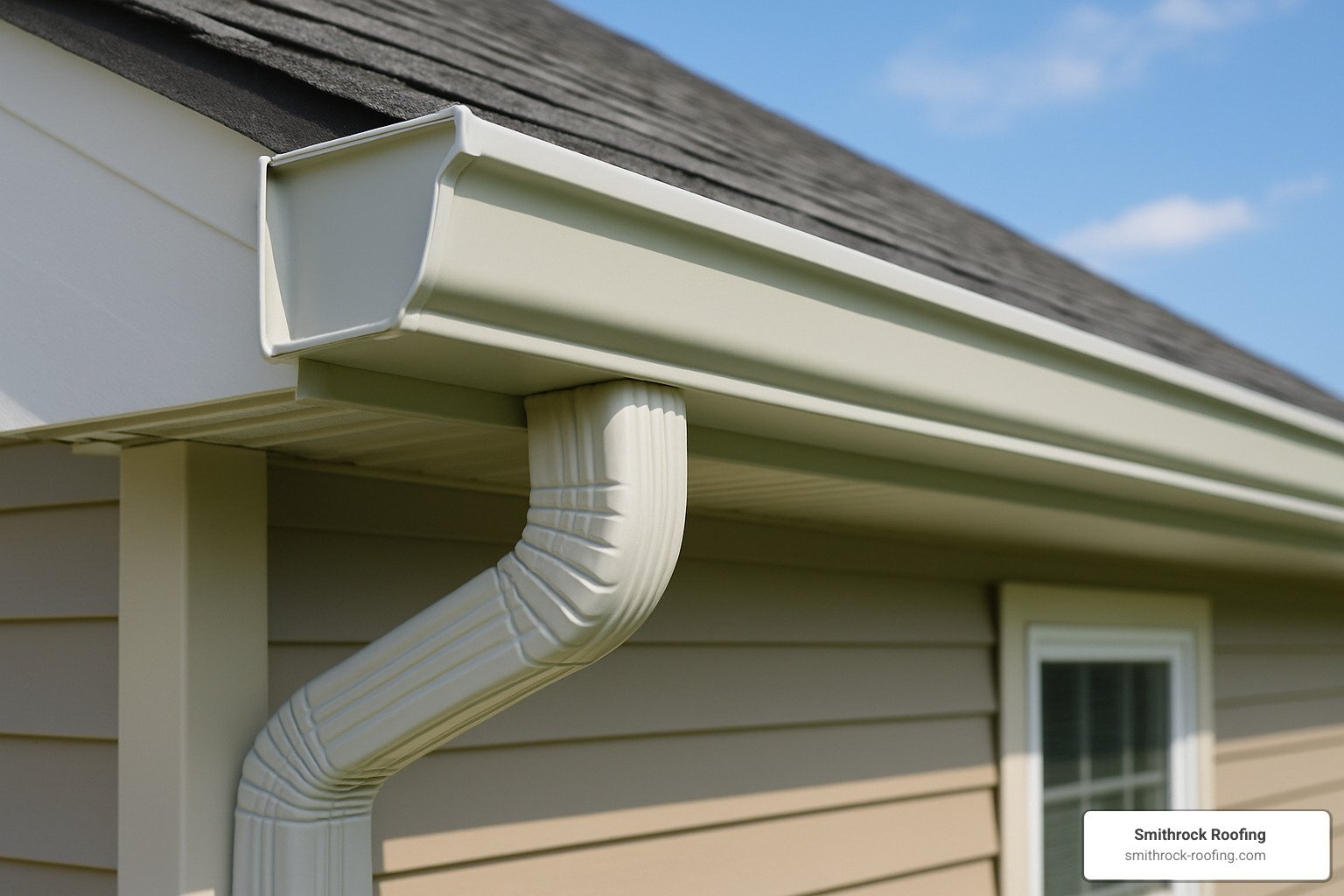
A close-up photograph of a newly installed seamless aluminum gutter on a Kernersville-area home, showing clean roofing fascia boards (the flat wooden trim boards running along the roof edge), properly spaced hidden hangers, and a downspout extension directing water away from the foundation onto a splash block. A mature oak tree should be visible in the background, providing context for the debris management discussion.


Seamless vs. Sectional Gutters: Why It’s Not Just a Marketing Distinction

You’ll hear the term “seamless gutters” from nearly every contractor, but the practical reasons it matters are worth understanding rather than just taking on faith.

Sectional gutters are assembled from pre-cut lengths — typically 10-foot sections — joined together with connectors and sealed with caulk or butyl sealant. Every joint is a potential leak point, and as sealants age and as the gutter system expands and contracts through seasonal temperature swings, joints are where failures begin.

Seamless gutters are fabricated on-site using a portable roll-forming machine that shapes a continuous length of aluminum coil stock to the exact dimension needed for each run. The only joints in a seamless system are at corners and downspout outlets — dramatically fewer failure points than a sectional system.

For a home in Kernersville with a mature tree canopy and a crawl space foundation sitting on red clay, this distinction is particularly meaningful. Fewer joints mean fewer places for water to escape at the roofline and run down behind the gutter, where it contacts the fascia and soffit and begins the wood rot cycle.

The aluminum gauge matters too. Standard residential gutters are typically fabricated from .027-gauge aluminum stock. Contractors cutting corners sometimes use lighter stock; quality installations use .027 or heavier. Thicker material holds its shape better under debris load and resists denting from falling branches — another relevant consideration given the tree canopy common to Kernersville neighborhoods.


What a Complete Gutter System Evaluation Should Include

If you’re having your gutters assessed — whether for repair, replacement, or as part of a larger exterior project — here’s what a thorough evaluation should cover:

  • Gutter sizing review relative to roof drainage area and pitch, not just visual inspection for damage
  • Slope measurement along each run to confirm proper pitch toward downspouts
  • Hanger condition and spacing — loose hangers, missing hangers, and spike systems that have pulled free
  • Fascia board integrity at all gutter attachment points
  • Sealant condition at all joints, end caps, and inside miters (for sectional systems)
  • Downspout condition and capacity including outlet connections and extensions at ground level
  • Discharge point assessment — where water terminates relative to foundation walls and grade
  • Soffit condition directly above the gutter line for evidence of overflow splash or moisture intrusion
  • Debris load and guard performance if guards are currently installed

A gutter system that scores well across all of these categories is one that’s genuinely protecting your home. A system with multiple marginal issues — even if it’s not visibly failing — is one that’s managing water less effectively than it should be, and in Kernersville’s red clay environment, that margin matters.


Serving Kernersville and the NC Triad

Smithrock Roofing serves homeowners throughout Kernersville, Winston-Salem, Greensboro, High Point, Clemmons, Rural Hall, King, and the surrounding NC Triad communities. Our team has 60-plus combined years of exterior contracting experience, and we hold an A+ BBB rating backed by more than 312 five-star reviews from homeowners across this region.

We understand the specific conditions that Kernersville homes face — the red clay drainage challenges, the tree canopy debris cycles, the summer storm intensity — because we work here every week. When we evaluate a gutter system, we’re not running through a generic checklist. We’re looking at your specific roof, your soil, your tree canopy, and how your current system is handling all of it.

If you’ve been watching water overflow your gutters during storms, noticed soft spots in your fascia, or simply haven’t had your gutter system professionally evaluated in several years, we’re happy to take a look. Reach out to schedule an assessment — no pressure, just straight answers about what your home needs.

Strategic Recommendations for 2026

If you’re planning ahead for your home’s exterior maintenance in the coming year, here are three specific steps worth prioritizing:

1. Schedule a post-winter gutter inspection before spring storm season. Kernersville’s winters bring freeze-thaw cycles that stress sealants, hangers, and fascia connections. Getting a professional eye on your system in late February or March — before the heavy spring rainfall arrives — gives you time to address any damage before it affects water management during the season when it matters most.

2. Evaluate whether your current system is sized for your actual roof. Many older Kernersville homes were built with 4-inch or undersized 5-inch gutter profiles that were adequate for their original roof configurations but may be mismatched after re-roofing with heavier architectural shingles or after surrounding tree canopy has changed drainage patterns. A capacity assessment in 2026 is particularly relevant if you’ve had a new roof installed in the last three to five years.

3. Have your downspout discharge points assessed relative to current grade. Soil settles over time, and discharge extensions that were directing water away from your foundation adequately five years ago may no longer be doing so effectively — especially in Kernersville’s red clay soil, which shifts with moisture saturation. A quick assessment of where your water is actually terminating can prevent foundation-adjacent moisture problems before they develop.


Frequently Asked Questions

How often should gutters be cleaned in the Kernersville area?

Most Kernersville homes benefit from gutter cleaning at least twice per year — once in late fall after deciduous trees have dropped their leaves, and once in late spring after tree pollen and seed pod season has passed. Homes with significant tree canopy overhead, particularly properties with oak, pine, or sweet gum trees, may need cleaning three or four times annually to prevent debris buildup that leads to overflow and standing water in the gutter channel. The local climate’s combination of heavy tree coverage and intense summer storms makes regular cleaning a genuine maintenance necessity rather than optional upkeep.

What’s the difference between sectional and seamless gutters, and which is better for my home?

Sectional gutters are assembled from shorter lengths of material joined at intervals, which creates seams that require sealant and are prone to leaking as that sealant ages. Seamless gutters are roll-formed from a continuous piece of aluminum on-site and cut to the exact length of each run, eliminating all mid-span joints. For Kernersville homes, seamless aluminum gutters are the more reliable long-term choice because there are fewer points where failure can develop — particularly relevant given the volume and intensity of summer storms this region receives. Seams in sectional systems tend to fail progressively, and a leaking seam over a fascia board is a leading cause of wood rot in this climate.

Do gutter guards actually work, and are they worth it for homes in Kernersville?

Gutter guards vary widely in quality and effectiveness, and the honest answer is that performance depends heavily on the specific product, the installation method, and the type of debris your property generates. In Kernersville, where pine needles, oak tassels, and sweet gum balls are common, guards that perform adequately in other regions sometimes struggle because the debris types are fine enough to pass through mesh or accumulate on top in ways that restrict flow. A well-installed micromesh guard from a reputable manufacturer can meaningfully reduce cleaning frequency for many homeowners, but no guard currently on the market eliminates the need for periodic inspection entirely. Any contractor who tells you a guard system is completely maintenance-free deserves some skepticism.

How can I tell if my gutters are causing damage to my fascia or foundation?

Several signs suggest your gutter system is transferring water where it shouldn’t go. At the fascia level, look for paint that’s peeling or bubbling along the top edge of the board directly behind the gutter, soft or spongy wood when you press against the fascia, or visible staining that tracks down from the gutter attachment points. At the foundation level, watch for soil that’s consistently saturated or eroded at the base of your downspouts, efflorescence (white mineral deposits) on foundation walls, or moisture in a basement or crawl space that correlates with rainfall events. In Kernersville’s red clay environment, foundation-adjacent moisture is a persistent risk because the soil holds water rather than draining it freely, making downspout discharge management particularly important.


The Right Team for Kernersville Gutters

Smithrock Roofing proudly serving Winston-Salem, Greensboro, High Point, Kernersville and the surrounding Triad communities brings more than 60 combined years of exterior contracting experience to every gutter assessment, installation, and repair — and that local knowledge makes a real difference when red clay soils, dense tree canopy, and intense summer storms are part of the equation. Whether you’re in Kernersville or a neighboring community like Clemmons or Rural Hall, our team can evaluate your specific situation and give you straight answers about what your home actually needs. Get a Free Estimate and let’s take a look together.

Share:

Categories

Follow us

You can find us on Facebook, Instagram, and Google.
Smithrock Roofing LLC logo featuring stylized rooftops with chimneys and arched windows
Smithrock Roofing proudly services the cities of Winston-Salem, King, Clemmons, Lewisville, Pilot Mountain, East Bend, Mt. Airy, Kernersville, Siloam, Danbury, High Point, Trinity, Pfafftown, Tobaccoville, Greensboro, Walnut Cove, Belews Creek, Rural Hall, Pinnacle, Bethania, Advance, Wallburg, Horneytown, Union Cross, and Midway, NC.

Newsletter

Sign up to receive important tips, special offers, and discounts.

Smithrock Roofing © Copyright 2026 • All Rights Reserved • Privacy Policy • Maintained by Mongoose Digital Marketing