
Old roofs are one of the most common concerns we hear from homeowners across the NC Triad. The honest answer to “how old is too old?” is that age is only part of the picture. What matters more is a roof’s actual condition, the material it is made from, how it was installed, and what has happened to it over the years. This article explains how to read those factors together, what risks genuinely old or deteriorating roofs carry, and what makes a replacement project on an older home more complex than it first appears.
Most guides lead with a number, typically 20 years for asphalt shingles. That number is a reasonable starting point, but it is not a decision rule on its own.
A roof installed 12 years ago on a house with poor attic ventilation, no maintenance, and a pattern of storm damage may be functionally older than a 25-year-old roof that has been consistently maintained and sits on a well-constructed home. The reverse is also true. A well-installed roof on a protected structure, inspected regularly and repaired promptly, can remain serviceable well past what a simple age chart would suggest.
The factors that determine a roof’s functional age include:
An experienced roofer does not lead a roof assessment with “how old is it?” They lead with what the decking, flashing, and shingle integrity actually look like. Our roofing service includes this kind of thorough, condition-first evaluation so homeowners get an accurate picture rather than a number pulled from a general guide.
Have a roofing question about your home? Send a message with your town, your current roof material and the repair or material question you want to resolve. Mention this article about old roofs and ask for a written explanation of possible next steps. You can also review Roofing.
| Material | General Lifespan Range | Key Aging Factors |
|---|---|---|
| Asphalt shingles | 15 to 30 years | UV exposure, granule loss, moisture cycling |
| Wood shake | 20 to 40 years | Rot, insect damage, moisture retention |
| Metal roofing | 40 to 70 years | Coating integrity, fastener corrosion |
| Clay tile | 50+ years, potentially much longer | Low moisture content resists efflorescence; concrete tile requires periodic retreatment |
| Slate | 75 to 150+ years | Structural support requirements, flashing longevity |
The lifespan ranges above assume reasonable maintenance and proper installation. A clay tile roof fired to approximately 1% moisture content, for example, resists the salt migration and surface degradation that causes concrete tile to require repainting over time. The material composition makes a meaningful difference in how a roof ages, not just how long it lasts on paper.
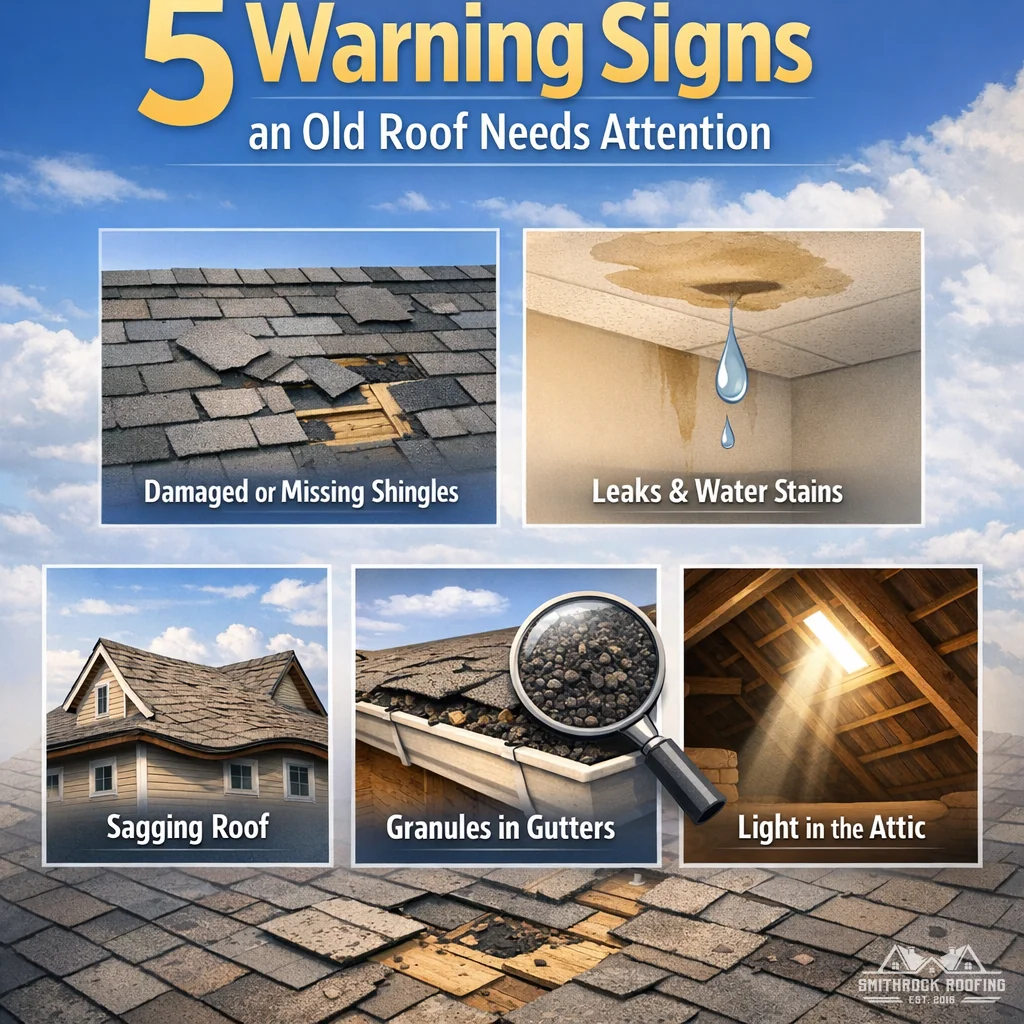
Illustration, not a photograph of a completed client project.
Each of these signs is a symptom, not a diagnosis. Granule loss from UV degradation follows a slower, more predictable pattern than granule loss from physical damage. Curling caused by manufacturing defects in older shingles looks almost identical to curling caused by poor attic ventilation. An inspection that names the symptom without identifying the root cause gives a homeowner an incomplete picture.
This is the part most guides mention once and move past. For homes that are several decades old, it deserves a real explanation.
Before asphalt shingles became the standard, wood shingles were a common and affordable roofing material. As asphalt shingles gained popularity, many roofers shingled directly over the existing wood layer rather than removing it. When that asphalt layer eventually wore out, the same thing happened again. On genuinely old homes, it is not uncommon to find three or even four complete roofing systems stacked on the original 1×6 or 1×8 wood decking.
This creates a specific inspection problem. A standard visual assessment of an old layered roof cannot tell you what the decking beneath all those layers actually looks like. The most structurally important layer is the one least visible. If the original wood decking has gaps wider than 1/4 inch across significant portions of the roof, it must be re-decked before new shingles can be properly installed. That is a manufacturer requirement, not an optional upgrade.
What this means practically: on an old home with multiple roofing layers, a replacement project scope cannot be fully confirmed until the tear-off is complete and the decking is exposed. For a detailed look at how to weigh these options, the article Old Roofing: Tear-Off or Recover? Make the Right Call covers the decision framework in depth. Any quote for a roof on a genuinely old house should be understood as a starting point, pending what the decking reveals.
The chimney is another area where old houses consistently present complications. Even well-installed flashing will eventually fail if the mortar between the bricks has deteriorated. A chimney that is no longer in use can often be taken down below the roofline to eliminate it as a leak source entirely. One that must remain requires careful attention to both the flashing and the underlying masonry condition.
Old roofs are more likely to leak, and leaks create a risk that most homeowners do not immediately connect to their roof: fire.
The risk is not about water volume. It is about water path. A small, slow leak that travels along a rafter toward a ceiling junction box or a recessed lighting fixture is more dangerous than a larger leak that falls visibly into an open space. Water reaching electrical components inside a wall or ceiling cavity can cause a short circuit, and combustible materials nearby, including wood framing, wire insulation, or the paper layer on drywall, can ignite.
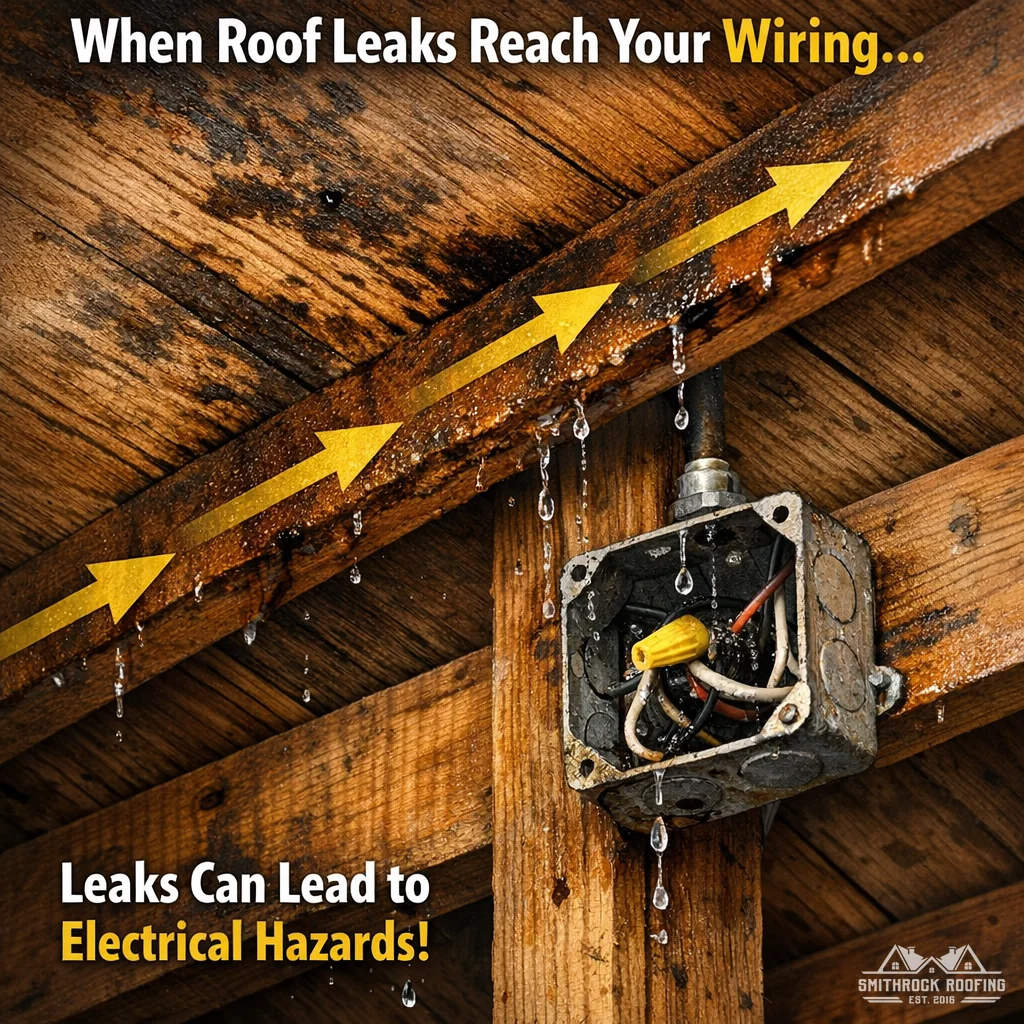
Illustration, not a photograph of a completed client project.
Before a known leak on an older home is simply patched and monitored, the interior path of that leak should be traced from its entry point to where it terminates. If the leak path runs near electrical components, including recessed lighting, junction boxes, or HVAC wiring routed through ceiling cavities, the electrical system should be assessed before the situation is treated as minor.
Insurance carriers treat roof age as a risk factor, and their policies reflect that. For many homeowners, coverage terms shift meaningfully once a roof passes a certain age threshold.
The reason is straightforward from the insurer’s perspective: an older roof is statistically more likely to be damaged in a storm or weather event, and more likely to have pre-existing deterioration that complicates a claim. Some policies apply actual cash value calculation rather than replacement cost value once a roof reaches a certain age, which means a claim payout is reduced to account for depreciation. Others require inspections before renewing coverage on a home with an older roof.
Understanding where your roof sits in its actual lifespan, not just its calendar age, puts you in a much better position when coverage questions arise. A documented inspection from a qualified roofer gives you evidence that your roof’s condition is being actively managed, which is a meaningful difference when a claim is reviewed.
The practical lesson across all of this is to assess condition before defaulting to age. A sequenced approach looks like this:
That is the evaluation logic a knowledgeable roofer applies. It is more useful than any age threshold on its own, and it leads to better decisions for your home and your budget.
Yes. Visible surface condition from the ground tells you very little about what is happening at the decking level, in the flashing joints, or along the path a slow leak travels before it becomes visible inside the home. Granule loss, early moisture intrusion into wood decking, and deteriorating mortar around chimney masonry are all things that look acceptable from the curb and reveal themselves only on closer inspection. Age past 20 years is a reason to inspect, not a reason to assume a problem exists, but it is also not a reason to assume everything is fine.
It depends entirely on where the water is going, not how much water is moving. A small, slow leak that travels along a rafter toward a ceiling junction box, recessed light, or any wiring routed through the ceiling cavity is not a situation suited to monitoring. Water reaching electrical components inside a wall or ceiling creates a fire risk that is not visible and does not announce itself before it becomes serious. Before any leak on an older home is treated as minor, the interior path of that water needs to be traced. If the path runs near electrical components, that should be assessed by a qualified person before the situation is left alone.
That approach avoids the inspection problem rather than solving it. The most important layer, the original wood decking, remains completely hidden when new material is layered over existing material. If that decking has gaps wider than a quarter inch across significant areas, it does not meet the substrate requirement for proper shingle installation. Adding another layer on top of a compromised deck means the new roof is also starting from a compromised foundation. For older homes with multiple existing layers, a tear-off that exposes the decking is the only way to know what the project actually requires.
Many insurance carriers apply stricter terms once a roof reaches a certain age threshold, commonly in the range of 15 to 20 years for asphalt shingles. This can mean a shift from replacement cost value to actual cash value on a claim, which reduces a payout to account for depreciation, or it can mean inspection requirements before a policy renews. The most useful thing a homeowner can do is understand where their roof actually sits in its condition-based lifespan, not just its calendar age, and have that condition documented through a qualified inspection. Documented evidence that a roof is being actively maintained and monitored is a meaningful difference when a claim is reviewed or a renewal is questioned.
The question “how old is too old?” has a real answer, but it is not a single number. It is the answer you get when age, material type, installation quality, maintenance history, exposure conditions, and actual current condition are all read together. A 22-year-old asphalt roof on a poorly ventilated home that has never been inspected and a 22-year-old asphalt roof on a well-maintained home with a documented repair history are not the same situation, even though they share a number.
For homeowners across Winston-Salem, Greensboro, High Point, and the rest of the NC Triad, the condition-first approach matters more than a calendar threshold. The same is true for anyone living in an older home where the question of what is actually under that surface layer has never been answered.
If your roof is past the mid-point of its expected material lifespan, showing any of the warning signs covered here, or sitting on a house old enough to have accumulated multiple roofing layers, a qualified assessment is the next logical step, not because age guarantees failure, but because condition determines everything, and condition has to be looked at to be known.

Smithrock Roofing © Copyright 2026 • All Rights Reserved • Privacy Policy • Maintained by Mongoose Digital Marketing