
A roof inspection report sitting on a closing table looks authoritative. It has photos, findings, and a remaining-lifespan estimate. What it does not always tell you is how the inspector accessed the roof, why certain findings matter more than others for your specific situation, or when you should bring in a second opinion from a roofing specialist. Those gaps are where transactions go sideways, and they are what this guide is designed to close.
Whether you are buying a home in Winston-Salem, preparing to list in Greensboro, or managing an aging roof in High Point or Kernersville, understanding how to read and act on a roof inspection report is as important as the inspection itself.
A thorough inspection evaluates the roof from two directions: the exterior surface and the attic underside. Neither alone tells the complete story.
On the exterior, the inspector works through every visible surface, connection point, and drainage component. The focus areas that most experienced inspectors prioritize are not the broad fields of shingles. As mdhi.com notes, fields of shingle rarely fail first. Leaks almost always originate at the details: the flashing around chimneys, the transitions at walls, the valleys where two roof planes meet, and the penetrations for plumbing vents and HVAC stacks. (mdhi.com)
In the attic, the inspector looks at the structural framing, the underside of the sheathing, ventilation balance, and any staining that indicates moisture has moved through the roof. This is where, as nextdayinspect.com puts it, the inspector gains a direct view of “signs of moisture intrusion that are not visible from the exterior.” (nextdayinspect.com) Staining on the sheathing can confirm an active leak path even when the shingles above look serviceable from the ground. For a deeper look at how attic evidence connects to exterior roof findings, our Roof and Attic Inspection Guide for NC Homeowners walks through the relationship between both inspection layers.
Most buyers receive their report without registering one sentence buried near the beginning: the method used to access the roof.
Inspectors evaluate roofs by the safest method available given the conditions. That may mean walking the roof fully, inspecting from a ladder at the eaves, or relying on binoculars combined with the attic underside when the roof is steep, wet, or otherwise unsafe. The report states which method was used. (mdhi.com)
This matters because the method directly affects what the inspector could and could not observe. A report from a fully walked inspection allows the inspector to check flashing details up close, feel for soft spots, identify nail pops at mid-field, and assess granule loss patterns across every elevation. A binocular observation, combined with attic evidence, can confirm active moisture intrusion but cannot reliably detect lifted shingles in the middle of a field, deteriorating sealant at penetrations, or flashing that has separated slightly at a wall transition.
If your report states the roof was not walked, and the roof age or condition is a material concern in the transaction, you have a reasonable basis to request a specialist follow-up before closing.
Have a roofing question about your home? Send a message with your town, your current roof material and the repair or material question you want to resolve. Mention this article about real estate roof inspection and ask for a written explanation of possible next steps. You can also review Roofing.
Not every finding in a roof inspection report carries the same weight. A flat checklist of fifty inspection points, with a missing chimney cap sitting alongside evidence of prior water damage in the same undifferentiated list, does not give a buyer or seller meaningful guidance on what to do next.
The three findings that most consistently shift negotiating leverage are remaining service life, active leaks, and ventilation deficiencies. (mdhi.com) Here is why each one matters, and how to think about it.
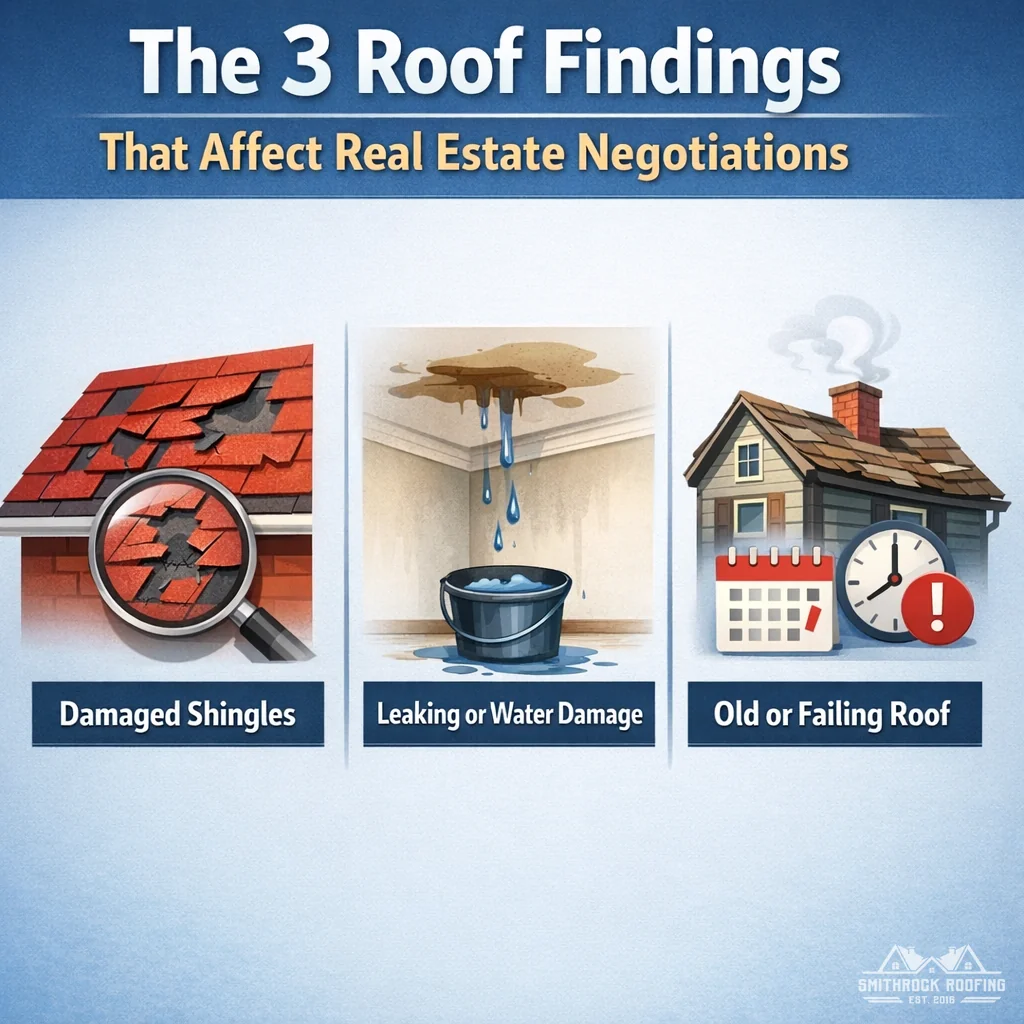
Illustration, not a photograph of a completed client project.
When an inspector estimates that a roof has a certain number of years of service life remaining, they are drawing on the material type, installation quality, visible wear, and the conditions the roof has been exposed to. The estimate is a budgeting tool, not a guarantee. (mdhi.com)
For a buyer, that number does two things. First, it establishes a planning horizon for a major capital expense. Second, it creates a basis for negotiation if the remaining life is short enough that replacement is a near-term certainty rather than a distant possibility.
What buyers often do not realize is how wide the margin of uncertainty around that estimate can be. A roof that “has seven to ten years remaining” might need replacement in five if the ventilation is poor, the attic runs hot, or significant wear accumulates. The same roof, well maintained and properly ventilated, might extend further. When an inspector gives you a remaining-life figure, ask what factors would pull that timeline shorter.
Active leaks are the highest-risk finding in any real estate context. Unlike a worn shingle or a deteriorating seal, an active leak represents ongoing damage whose full extent is often not yet known. Water that has been moving through a roof system for even one season can compromise sheathing, insulation, framing members, and interior finishes in ways that are invisible at inspection time.
The attic is where this finding is most reliably documented. Staining on the sheathing, discoloration at rafter tails, and soft areas around penetrations are the evidence that tells the real story, as mdhi.com describes it. (mdhi.com) When the exterior looks adequate but the attic shows staining, the staining is the more reliable data point.
For a buyer, an active leak is not simply a repair item to negotiate. It is a signal to understand the full moisture path before closing, because the repair cost of the roof entry point may be modest while the downstream damage is not. Understanding how to identify and address the true source of water intrusion is covered in detail in our article on roof leak repair contractors.
Ventilation is the finding that most buyers underestimate. Poor attic ventilation shortens roof life and drives up cooling costs, yet it is relatively inexpensive to correct. (mdhi.com) That combination makes it strong negotiating leverage: the cost to the seller to address it is low, but the long-term impact on the buyer’s roof life and energy costs is real.
Proper ventilation requires a balanced system with intake at the soffits and exhaust at or near the ridge. When that balance is off, heat and moisture build up in the attic space, accelerating the breakdown of shingles from the underside and creating conditions favorable to mold and sheathing damage.
A generalist home inspector certified through InterNACHI or ASHI is qualified to assess a roof as part of a standard pre-purchase inspection. The report will identify obvious defects, document the method used, and give a remaining-life estimate. For a straightforward transaction on a standard shingle roof, that level of assessment is appropriate. (nextdayinspect.com)
A certified roofing contractor brings a different level of technical depth. As welteroofing.com observes, home inspectors “are not roofing experts and often base their observations and conclusions on flawed information.” (welteroofing.com) This is not an argument against home inspectors; it is an argument for understanding what each professional is equipped to do.
A roofing specialist becomes appropriate in these situations:

Illustration, not a photograph of a completed client project.
The table below organizes inspection findings into three categories based on their practical significance for the transaction.
| Finding | Category | What to Do |
|---|---|---|
| Active leak with attic staining | Walk-away signal or repair-before-close | Require documented repair and re-inspection before closing |
| Short remaining service life (near-term replacement likely) | Negotiating leverage | Request a seller credit or price adjustment based on replacement planning |
| Ventilation deficiency | Negotiating leverage | Low correction cost; request repair or credit |
| Flashing failure at chimney, wall, or valley | Repair-before-close or credit | Determine if active moisture intrusion is present; escalate to specialist if so |
| Missing chimney cap | Maintenance item | Buyer absorbs; minor repair |
| Granule loss consistent with age | Supporting data for remaining-life estimate | Context for life estimate, not standalone leverage |
| Nail pops or lifted shingles | Maintenance item | Monitor; not insurance-claim eligible but address before next storm season |
| Gutter damage or improper slope | Maintenance item | Buyer absorbs unless drainage is compromising the foundation |
The goal of this framework is to help buyers and sellers move past the flat checklist and distinguish between findings that justify a renegotiation, findings that are buyer-absorbs maintenance items, and findings that represent enough unknown risk to pause the transaction until more information is available.
A pre-listing roof inspection gives sellers a significant advantage: it eliminates the surprise finding that derails a transaction in the final week before closing. When a seller already knows the roof’s condition and has documentation in hand, they control the narrative around it.
Sellers who have had a specialist roofing inspection conducted prior to listing can use that report to counter inflated repair claims from a buyer’s inspector, demonstrate that the property has been responsibly maintained, and reduce the likelihood of last-minute renegotiations over roof condition. (welteroofing.com)
For listing agents in Winston-Salem, Greensboro, High Point, Kernersville, roofing in Clemmons, Rural Hall, King, and Mount Airy, working with a roofing contractor who understands transaction timelines matters. The inspection needs to fit the closing schedule, and the documentation needs to be detailed enough to hold up to scrutiny.
Smithrock Roofing serves homeowners and agents across the NC Triad. When a transaction depends on a credible, detailed assessment of a roof’s condition, our roofing service provides the kind of documentation that agents and buyers can rely on.
A standard home inspection covers the entire property, with the roof evaluated as one component among many. A dedicated roof inspection focuses exclusively on the roofing system, including the exterior surface, all flashing and penetration details, gutters and drainage, and the attic underside. The depth of documentation in a dedicated inspection is typically greater, and when a certified roofing contractor conducts it, the findings carry more technical specificity than a generalist report. For most standard transactions, a generalist home inspection is the appropriate starting point. A dedicated roofing assessment becomes appropriate when the generalist has flagged something significant, when the material type is complex, or when an insurance claim requires a higher evidentiary standard.
It means the inspector evaluated the roof by a method other than physically walking the surface, most commonly from a ladder at the eaves or through binoculars combined with attic observation. Inspectors use the safest method available given the conditions, and the report states which method was used. The practical consequence is that certain findings, such as lifted shingles in the middle of a field, deteriorating sealant at penetrations, or flashing that has separated slightly at a wall transition, are more difficult to detect without close physical access. If the roof’s age or condition is a material concern in your transaction and the report states it was not walked, you have a reasonable basis to request a specialist follow-up before closing.
Not always, but it is always worth investigating. Staining on the underside of the sheathing can indicate either an active leak path or a historic one that has since been resolved. The distinction matters significantly: an active leak represents ongoing damage with unknown downstream consequences, while historic staining may simply document a repair that was made years ago. An inspector will typically note whether the staining appears fresh or older based on its color, texture, and whether associated materials show signs of ongoing moisture. When the report is ambiguous on this point, requesting clarification from the inspector or escalating to a specialist is the appropriate next step before closing.
A pre-listing roof inspection gives a seller meaningful control over how the roof’s condition enters the transaction. When a seller already has documented findings in hand, they are in a position to address issues proactively, counter inflated repair claims from a buyer’s inspector, and reduce the likelihood of last-minute renegotiations in the final days before closing. The inspection also signals to buyers that the property has been responsibly maintained. Having credible documentation prepared before the first offer arrives is a practical advantage for sellers across the NC Triad rather than a formality.
A roof inspection report is not the end of the conversation. It is the beginning of a more informed one. The buyers and sellers who navigate roof findings most effectively are the ones who understand what the report actually covers, what it cannot observe given the access method used, and which findings carry enough financial or structural weight to change how the transaction proceeds.
The three findings that consistently shift negotiations, remaining service life, active leaks, and ventilation deficiencies, are worth more attention than any checklist of maintenance items. The attic evidence is worth more scrutiny than the exterior surface alone. And the method used to access the roof is worth reading before accepting any finding at face value.
Whether you are buying, selling, or simply trying to understand the condition of a roof before a decision point arrives, a credible and detailed assessment from a qualified roofing professional is what gives every other conversation a reliable foundation.

Smithrock Roofing © Copyright 2026 • All Rights Reserved • Privacy Policy • Maintained by Mongoose Digital Marketing