A roof leak rarely announces itself at the right moment or in the right place. You notice a water stain on a bedroom ceiling after a rainstorm, or a drip appears near a light fixture, and your first instinct is to look directly above it for the problem. That instinct is understandable, but it is usually misleading. Water moves. It follows rafters, travels along insulation batts, and migrates laterally across roof decking before finding a low point and dropping. By the time a leak becomes visible inside your home, the actual entry point may be several feet away, sometimes in an entirely different roof zone.
That single fact shapes everything about how a skilled roof leak contractor approaches diagnosis, and it is the clearest way to separate a thorough professional from someone who will seal the area above your stain and call the job done. This guide is designed to give you the framework to understand what good leak repair actually looks like, what questions to ask, and what the answers should sound like, so that when you hire someone to work on your home, you can evaluate their approach with confidence.
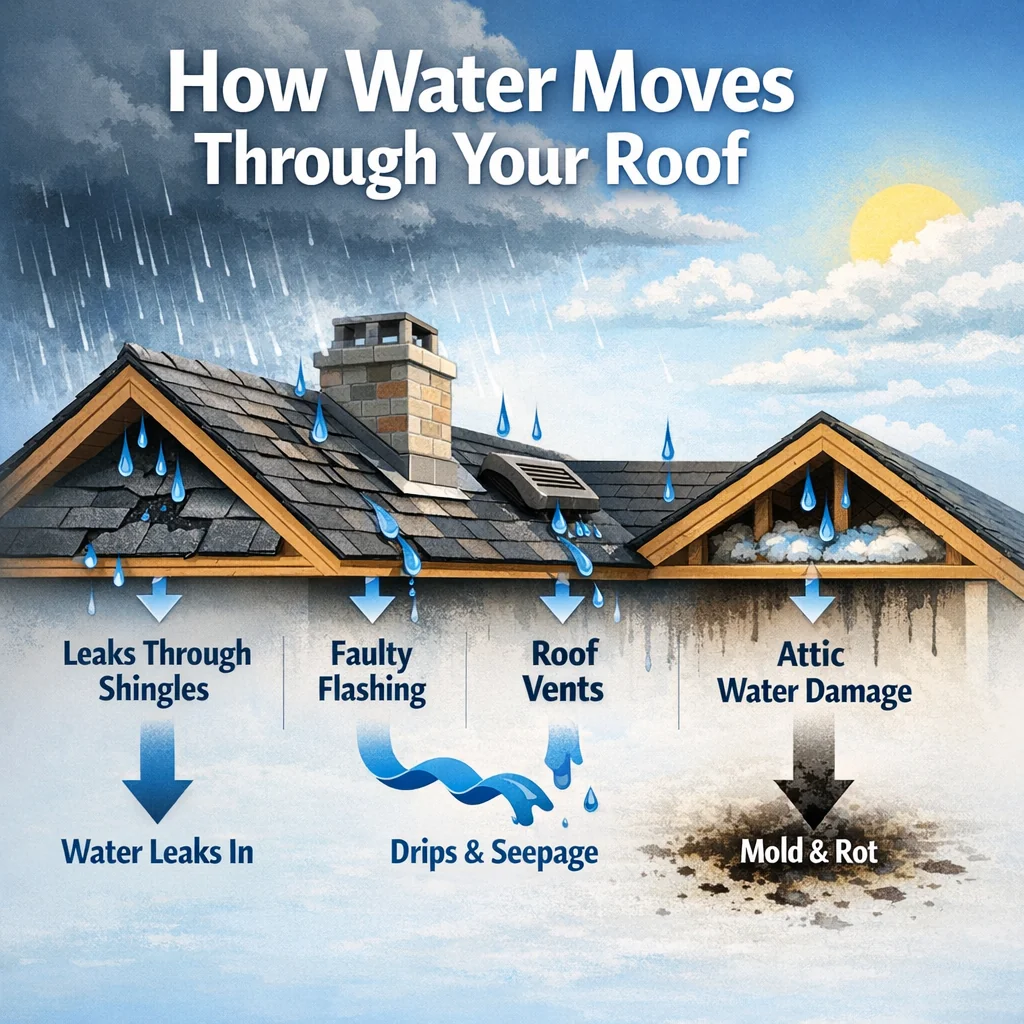
When water enters your roof system, it does not behave the way most people imagine. It follows the path of least resistance. That path is almost always downhill and lateral, running along the top surface of the roof decking, wicking into insulation, or traveling down a rafter before finally accumulating at a low point and dripping.
This means a ceiling stain in the middle of a room might trace back to a failed valley several feet up the slope. A wet spot near an interior wall might originate at a chimney flashing on the opposite side of the roof peak. A drip near a ceiling light fixture could be traveling from a compromised vent boot located well away from the fixture’s position.
Any contractor who walks through your front door, looks at the ceiling stain, and immediately climbs to the roof section directly above it without a systematic diagnostic process is starting in the wrong place. Proper leak detection works backward from visible interior damage, tracing the likely water migration paths before identifying candidate entry points on the roof surface.
At Smithrock Roofing, our process starts with understanding where the water ended up, then building a logical map of how it got there. That means examining framing, decking condition, and insulation in addition to the exterior roof surface, because the full story of the leak rarely lives in one place.
Roof systems are layered. Shingles sit over underlayment, which sits over decking, which is supported by rafters or trusses. Water can enter at any penetration, seam, or transition point, chimney bases, pipe boots, dormer flashings, valley intersections, and ridge caps are all common culprits. Once it passes the shingle layer, it travels under the underlayment and along the decking before reaching the interior.
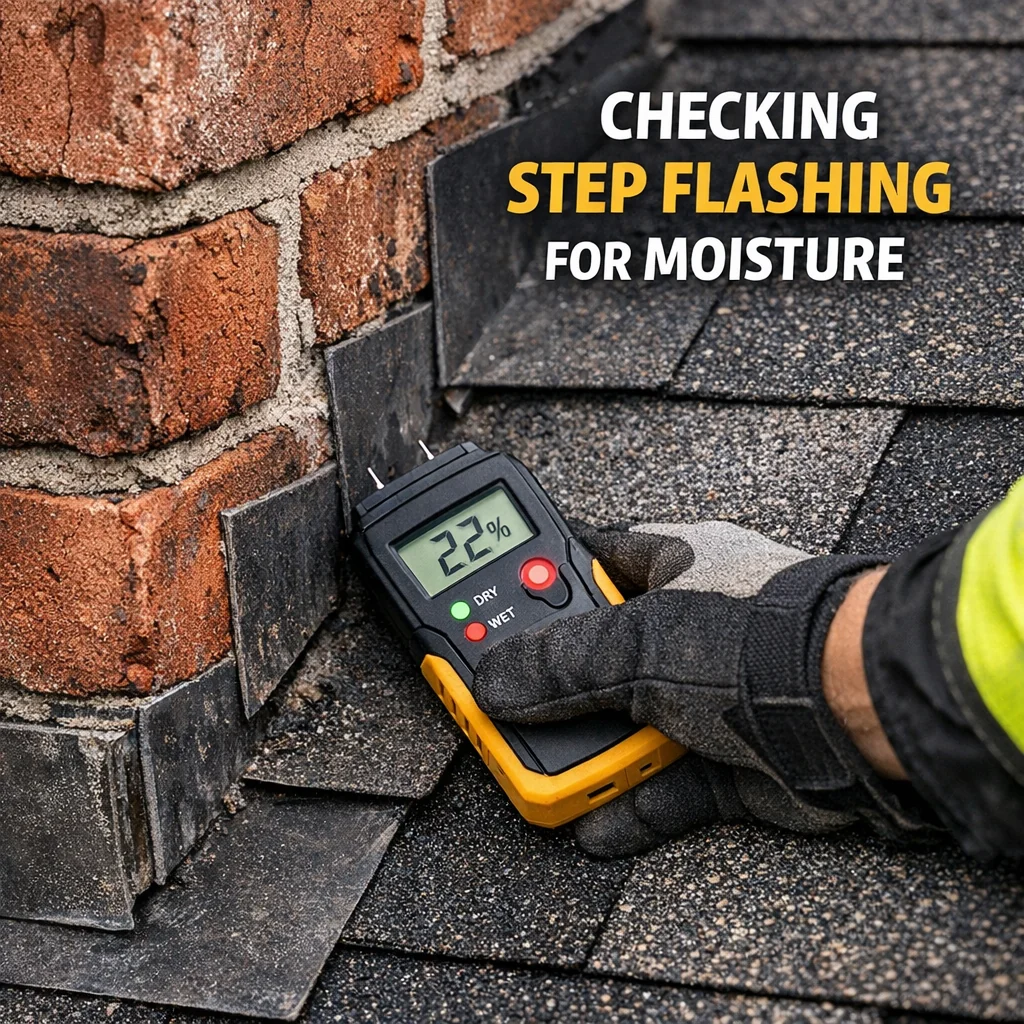
The diagnostic implication is significant. A contractor’s first job is not to find the wet spot on the roof; it is to understand the geometry of where the water could have entered given the visible pattern of interior damage, then inspect those candidate zones methodically. Infrared moisture scanning can reveal wet decking and insulation that is not yet visible to the eye, allowing a contractor to trace the migration path before confirming the entry point.
This is precisely why an experience-based, methodical approach matters more than a quick visual scan. Our team brings over 60 combined years of exterior contracting experience to every diagnosis, which means we have seen the same misleading ceiling stain patterns enough times to know where to look first.
Every roofing company will tell you they fix the root cause, not just the symptom. That language has become so common it no longer carries meaning on its own. What actually separates a localized permanent repair from a temporary patch is a question of underlying conditions, and it requires an honest diagnostic conclusion, not a marketing promise. If you want a deeper look at this distinction, our article on how to patch your roof without falling for a contractor walks through the warning signs in detail.
Not every localized repair is a short-term fix. Some roof problems are genuinely isolated. A deteriorated pipe boot, for example, fails because the rubber collar degrades with age and UV exposure. The surrounding shingles may be in excellent condition. Replacing that boot with a quality new unit, sealed and integrated properly with the existing shingles, is a complete and lasting solution, not a compromise. The same applies to a single section of failed step flashing at a dormer, or a small area of cracked caulk at a skylight curb where the skylight frame and surrounding deck are otherwise sound.
In these cases, a localized repair is the correct, permanent answer. A contractor who recommends a full roof replacement in these situations is not serving your interests.
The calculus changes when the damage is not isolated. If moisture meter readings show wet decking that extends well beyond the visible damage zone, a localized repair will not stop new leak points from developing nearby as that wet wood continues to deteriorate. If step flashing has failed along an entire dormer run rather than at a single joint, resealing one section leaves the adjacent sections ready to fail at the next rain event. If the underlayment beneath a section of shingles has lost its integrity across a broader area, visible as cracking, brittleness, or delamination during an inspection, replacing only the shingles above it addresses the surface but not the layer that does the actual waterproofing work.
The diagnostic findings that distinguish these two scenarios include:
A contractor who can walk you through these findings and explain what they mean for your specific repair is giving you a real diagnosis. A contractor who says “we don’t do patches” without explaining what they found and why the repair will last is offering you a slogan, not expertise.
At Smithrock Roofing, we explain our findings before we recommend anything. Our approach is consultative, you understand what we found and why we’re recommending what we are, so you can make an informed decision about your own home.
Need a hand with this in Winston-Salem, Greensboro and the Triad? Call (336) 971-0464 or request a free estimate. Honest answers, no pressure.
When you research roofing companies, you will encounter certifications from several major manufacturers, CertainTeed, GAF, Owens Corning, and others. These are frequently presented side-by-side as equivalent markers of quality. They are not equivalent, and understanding the difference helps you use them as genuine decision criteria rather than visual reassurance.
Each manufacturer runs an independent certification program with its own training requirements, inspection standards, and warranty implications. The most significant practical difference is what the certification unlocks for you as a homeowner.
| Certification | What It Requires of the Contractor | What It Unlocks for the Homeowner |
|---|---|---|
| CertainTeed PREMIER ShingleMaster | Documented installation training, insurance verification, proven track record, ongoing compliance review | Access to SureStart PLUS extended warranty coverage; labor warranty pass-through unavailable to non-certified contractors |
| GAF Master Elite | Less than 3% of contractors qualify; requires licensing, insurance, strong reputation review, and commitment to ongoing training | Golden Pledge warranty (50-year coverage) with labor included; standard GAF warranty not available from non-certified contractors |
| Owens Corning Preferred Contractor | Insurance and licensing verification; manufacturer training completion | System Protection Limited Warranty with enhanced terms versus non-preferred contractor installations |
| General Licensing Only | Varies by state; minimum legal requirement to operate | Standard manufacturer material warranty only; no labor warranty pass-through |
The practical takeaway: a contractor’s certification matters because it determines what warranty protection you receive on the labor, not just the materials. Material warranties cover shingle defects. Labor warranties cover the installation workmanship, the sealing, the flashing integration, the underlayment installation. Those are the failure points that produce leaks.
Smithrock Roofing holds CertainTeed PREMIER ShingleMaster certification, which means our roofing service qualifies for enhanced warranty coverage that non-certified contractors cannot offer. That certification is current, it was earned through documented training and compliance review, and it carries real obligations, to the manufacturer and to you. You can also review the full details of our coverage on our warranty page.
A question worth asking any contractor: “Is your certification current, and what warranty does it allow you to offer on labor?” If they cannot answer that question specifically, the certification badge on their website may not be doing the work you think it is.
Active water intrusion can create secondary damage quickly. Knowing what to do in the period between discovering a leak and having a professional on site can meaningfully reduce that damage.
A genuine roofing emergency involves active, uncontrolled water entry with potential for immediate structural or safety consequences: a large section of decking exposed by storm damage, water contacting electrical systems, or a ceiling showing signs of imminent structural failure. These situations warrant immediate contact and temporary tarping to stop water entry while permanent repairs are arranged.
A visible ceiling stain from a past rain event is urgent but not an emergency in the same sense. The damage has occurred; the priority is accurate diagnosis and a scheduled repair, not a panicked call at midnight. Knowing the difference helps you get the right response without unnecessary escalation.
Our team serves homeowners across Winston-Salem, Greensboro, High Point, Kernersville, roofing in Clemmons, Rural Hall, King, and Mount Airy, and we’re available to help you assess the severity of what you’re dealing with so you know exactly what level of response your situation calls for.
Choosing the right contractor for a leak repair is a decision worth taking seriously, because the quality of the diagnosis determines the quality of the repair. Here is a practical framework for evaluating your options.
“Where do you think the water is entering, and how did you determine that?”
A contractor who can explain the migration path, entry point, how water traveled, why it appeared where it did, is demonstrating real diagnostic reasoning. A contractor who points to the ceiling stain and says “probably up here somewhere” is guessing.
“What condition is the surrounding decking in, and how do you know?”
The answer should reference some form of moisture assessment beyond a visual scan. If they have not checked the decking condition beyond the obvious damage zone, they have not completed the diagnosis.
“Is your manufacturer certification current, and what warranty does it allow you to extend on labor?”
This question separates certified contractors from contractors who once held a certification. A current, active certification has specific warranty implications. A lapsed one does not.
“What would tell you that a localized repair won’t hold long-term?”
A contractor who can articulate the specific diagnostic findings that would push them from a localized repair to a broader recommendation is someone who is thinking about your roof’s long-term health, not just today’s invoice.
Smithrock Roofing has built its reputation across the NC Triad on exactly this kind of honest, educate-first approach. With more than 350 five-star reviews, an A+ BBB rating, and over 60 combined years of experience, we have earned the trust of homeowners who want straight answers and work that lasts. When you call us, you get a real assessment, not a sales pitch.
The answer depends on what the diagnostic process reveals, specifically, the condition of the underlying decking, the extent of any saturated insulation, and how much of the surrounding roofing material has been compromised. A localized repair is appropriate when damage is genuinely contained. When moisture has migrated broadly, when decking integrity is weakened across a larger area, or when the roof system is near the end of its serviceable life, a more comprehensive solution is usually the more cost-effective long-term path. A contractor who completes a thorough inspection should be able to explain clearly which situation you are facing and why.
Water rarely travels straight down. Once moisture penetrates the roof system, it follows the path of least resistance, running along rafters, pooling in low points in the decking, and eventually appearing on your ceiling at a location that can be several feet away from the true entry point. This is why experienced contractors trace the water migration path rather than working backward from the stain alone. Diagnosing from the stain without identifying the actual entry point is one of the most common reasons leak repairs fail to hold.
Protect your interior first. Move furniture and belongings away from the affected area, place containers to catch dripping water, and use plastic sheeting or towels to limit further damage to flooring and walls. If water is pooling near any electrical fixtures or panel boxes, treat that as an urgent safety issue. Document everything with photos before cleanup begins, this is useful both for your contractor’s diagnosis and for any insurance conversations. Then contact a qualified roofing contractor as soon as possible, since ongoing moisture intrusion can escalate quickly once it has a path in.
It depends on the contractor and the scope of the work performed. Manufacturers of roofing materials offer product warranties, but labor warranties are issued by the contractor and vary significantly depending on their certification status and business practices. Contractors who hold current manufacturer certifications are typically authorized to extend longer labor warranties than contractors whose certifications have lapsed or who are not certified at all. Before any work begins, ask specifically what the labor warranty covers, how long it runs, and what conditions would void it.
When a roof leak appears, the difference between a repair that holds and one that fails often comes down to who you trusted with the diagnosis. Smithrock Roofing has served homeowners across Winston-Salem, Greensboro, High Point, and Kernersville with the kind of honest, experienced workmanship that more than 350 five-star reviews reflect, and whether you are in Greensboro dealing with an aging flat roof or in Winston-Salem facing storm damage, our team brings the same thorough approach every time. If you are ready for a straight answer and a repair done right, call us at (336) 971-0464 or Contact Smithrock Roofing to schedule your free estimate today.

Smithrock Roofing © Copyright 2026 • All Rights Reserved • Privacy Policy • Maintained by Mongoose Digital Marketing