When homeowners in the Winston-Salem, Greensboro, and High Point area start researching roofing options, rubber shingles tend to generate a lot of questions, and a lot of confusion. The marketing language sounds great: “50-year lifespan,” “Class 4 hail resistance,” “made from recycled tires.” But the details that actually determine whether this product is right for your home, your neighborhood, and your climate? Those tend to get buried or skipped entirely.
This guide is written to fix that. We’re going to walk through what rubber shingles are actually made of, how they perform in real-world conditions, what the warranty fine print means for you, and how to approach your insurance carrier before you commit to anything. If you’ve been reading the same surface-level rundowns and still have nagging questions, you’re in the right place.
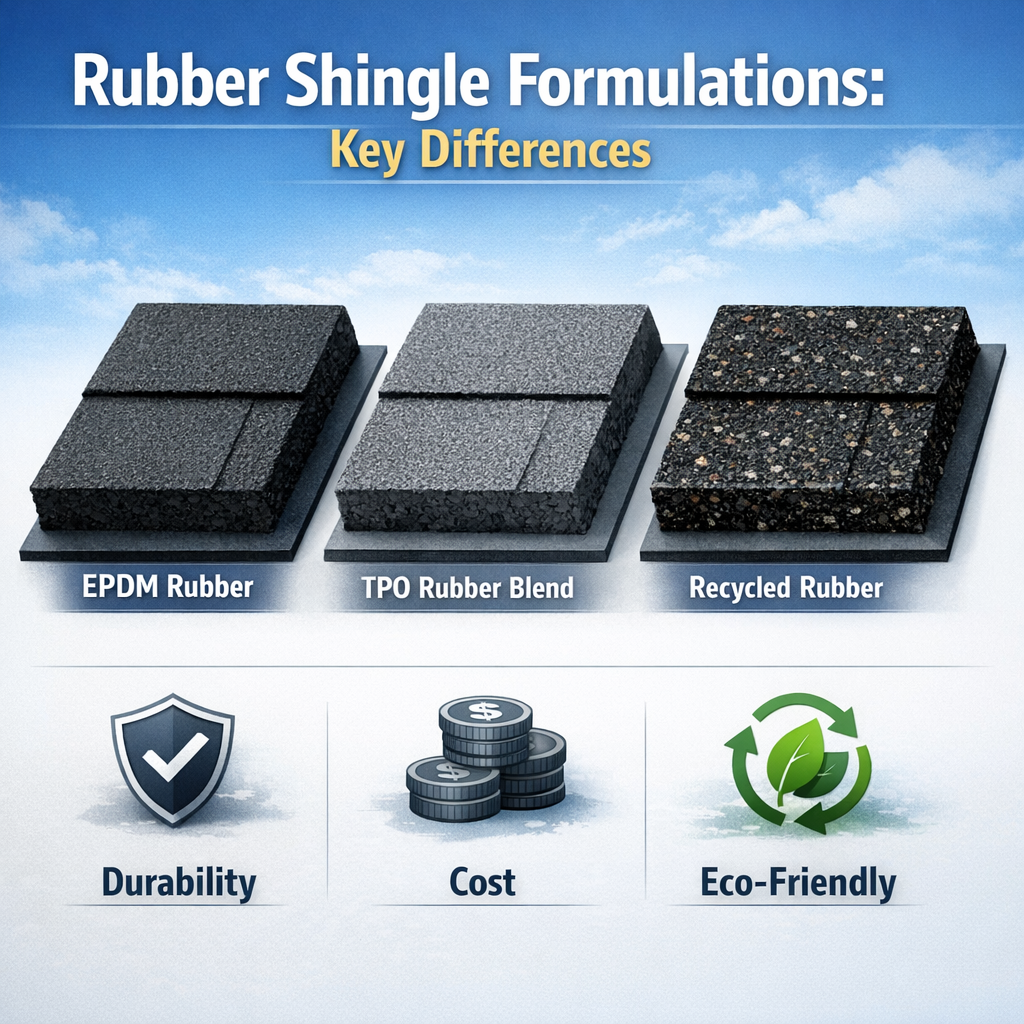
The term “rubber shingle” covers more ground than most people realize. There are two fundamentally different product formulations on the market, and treating them as interchangeable is one of the most common mistakes buyers make.
The most widely marketed rubber shingles are made primarily from post-consumer scrap tires ground into crumb rubber, typically combined with polymer binders and sometimes slate dust or cellulose fiber to improve dimensional stability. Manufacturers in this category often advertise 70% to 95% recycled content, a genuinely appealing number for environmentally conscious homeowners.
What the marketing rarely explains is that recycled tire rubber contains legacy chemical compounds including zinc, polynuclear aromatic hydrocarbons (PAHs)and processing oils. Reputable manufacturers use proprietary processing methods to neutralize or encapsulate these compounds before the material ever becomes a roofing product. But the degree of treatment varies between manufacturers, and not every rubber shingle on the market carries third-party verification of its chemical safety profile.
If environmental health is a priority for your household, look specifically for products that have undergone independent leachate testing or carry certifications such as GREENGUARD. The presence of “recycled content” alone is not sufficient evidence of chemical neutrality.
EPDM stands for ethylene propylene diene monomer, a synthetic rubber compound that has been used in flat and low-slope commercial roofing membranes for decades. Some premium rubber shingle manufacturers use virgin EPDM rather than recycled crumb rubber, producing a product with a more consistent molecular structure, tighter dimensional tolerances, and a known UV degradation profile.
EPDM-based shingles typically have lower thermal expansion variability, which matters considerably for the fastening system (more on that below). They also tend to carry more straightforward chemical credentials. The trade-off is that virgin EPDM products sacrifice the recycled-content story that many buyers find appealing.
Understanding which formulation you’re evaluating, and asking manufacturers directly for third-party testing documentation, puts you in a far better position than comparing marketing claims alone.
Need a hand with this in Winston-Salem, Greensboro and the NC Triad? Call (336) 971-0464 or request a free estimate. Honest answers, no pressure.
Nearly every rubber shingle product on the market leads with its UL 2218 Class 4 impact resistance rating, and that credential is genuinely meaningful. Class 4 is the highest rating available under this standard, achieved by withstanding a 2-inch steel ball dropped from 20 feet without cracking, splitting, or fracturing.
For homeowners in the NC Triad, where spring and summer storms regularly bring hail and high winds, that’s a real advantage over standard three-tab or even many architectural asphalt shingles. If you’ve dealt with storm damage before, our article on hail damage roof repair breaks down what inspectors look for that homeowners typically miss.
But here’s what the product listings and buyer guides consistently leave out: UL 2218 testing is conducted on flat, horizontal samples under controlled laboratory conditions. It does not replicate the mechanical stress patterns of a steep-slope installation, the effects of thermal cycling over multiple seasons, or the fatigue behavior of a product that has been in service for 15 or 20 years. In other words, it measures how a fresh, flat shingle responds to a standardized impact, not how your actual roof will perform over the decades you’re planning to live there.
This isn’t an argument against choosing rubber shingles. It’s an argument for understanding that Class 4 is a baseline quality indicator, not a performance ceiling. The product’s real-world durability depends heavily on installation quality, substrate condition, climate factors, and attic system performance.
One more technical point that gets glossed over: fire resistance ratings for rubber shingles are assembly ratingsnot product ratings. Under UL 790, the fire resistance of a roofing system is evaluated based on the complete assembly, shingle, underlayment, and deck working together. A rubber shingle product might carry a Class A fire rating as part of a specific approved assembly, but that rating is only valid when the correct underlayment is installed beneath it.
If an installer substitutes a different underlayment, even a nominally comparable one, the Class A designation may no longer apply. This is not a theoretical concern. It’s a real installation variable that homeowners rarely think to ask about, and it matters both for code compliance and for insurance purposes.
When reviewing any rubber shingle product, ask the manufacturer for the specific approved assembly documentation and confirm that your installer is familiar with those requirements.
Of all the technical details surrounding rubber shingle installation, the fastening system is the one most likely to determine whether your roof performs as advertised over a 40-plus-year service life, and it’s the one most homeowners never hear about.
Rubber expands and contracts at a meaningfully different rate than the wood decking beneath it. On a hot NC summer day, a roof surface can reach temperatures well above ambient air temperature. In the winter, that same surface contracts. This cycle repeats thousands of times over the life of the roof. If the fasteners holding each shingle in place don’t accommodate that movement, either because they’re too tight, too loose, or the wrong type, the shingle is working against itself every time the temperature changes.
Experienced rubber shingle installers use what the trade sometimes calls a “float fastening” approach: ring-shank nails or specified screws driven to a precise torque tolerance that allows the shingle to move slightly without lateral shift. Overtightening compresses the shingle body and creates stress fractures at the fastener point. Undertightening allows the shingle to migrate, which compromises the weather seal at the overlap.
This is not something a general roofing crew encounters on a typical asphalt shingle job. It’s a technique specific to rubber and polymer roofing products, which is one reason that manufacturer certifications for installers exist, and one reason those certifications actually matter rather than being just a marketing checkbox.
Homes built before roughly 1970 frequently have spaced board sheathing rather than continuous plywood or OSB decking. Spaced sheathing was standard practice for decades and works perfectly well under traditional materials designed for it.
Under rubber shingles, it introduces a complication. The gaps between boards create differential flex points across the deck surface. When the roof moves under thermal load or wind pressure, the shingle spans those gaps and is asked to flex in ways a solid-deck installation would never require. Over time, this can stress the fastening system and the shingle body at the gap locations.
This doesn’t automatically disqualify rubber shingles for older homes. It does mean that a thorough deck assessment is an essential step before any product is selected, and that a contractor who skips that assessment isn’t giving you the full picture.
The NC Triad sits in a climate zone that presents a genuinely varied set of roofing challenges across the calendar year: hot, humid summers with UV intensity and storm activity; winters with occasional ice events and freeze-thaw cycling; and a shoulder season that can swing significantly within a single week.
This matters for rubber shingle selection because not all products within this category perform identically across that range.
Prolonged UV exposure is the primary accelerant of surface degradation in rubber roofing products. The Triad’s summer sun, combined with roof surface temperatures that can climb well above air temperature, creates conditions where the quality of UV-stabilizing compounds in the shingle formulation becomes a meaningful differentiator between products. Cheaper formulations may show surface oxidation, color fade, or surface checking earlier than their rated lifespan would suggest.
When comparing products, look for published UV resistance test data specific to the formulation you’re evaluating, not just the general claim of UV resistance.
While the Triad doesn’t see the sustained winter conditions of mountain regions, ice events and freeze-thaw cycles do occur, sometimes in the same week. Rubber shingles are generally well-suited to these conditions compared to more brittle materials, but the interaction between frozen rubber, ice damming at the eave, and the underlayment beneath is a system-level consideration.
A proper ice-and-water shield installation at the eaves and in valley areas is standard practice in this region regardless of shingle type. With rubber shingles, confirming that the underlayment selection is compatible with the manufacturer’s approved assembly (back to the fire rating discussion above) is an important verification step.
Homes in higher-humidity microclimates, particularly those surrounded by tree cover with limited air circulation, can experience accelerated fastener corrosion if the wrong nail material is specified. Rubber shingle manufacturers typically specify stainless steel or hot-dipped galvanized fasteners for this reason. Using standard electro-galvanized nails in a humid environment creates a slow-moving failure mode: the fastener corrodes while the shingle surface looks fine, and the blow-off risk accumulates invisibly over years.
This is the kind of detail that separates an experienced installer from one who simply knows how to put shingles on a roof.
A 50-year warranty sounds like a complete answer to the durability question. In practice, rubber shingle warranties are conditional documents, and the conditions matter. Smithrock Roofing’s warranty page outlines how we approach workmanship guarantees and what homeowners should expect from any contractor they hire.
The following table outlines the most common warranty conditions found in rubber shingle manufacturer documentation and what each one means for you as a homeowner:
| Warranty Condition | What It Actually Means |
|---|---|
| Certified installer requirement | The warranty is void if installed by a contractor not certified by the manufacturer. Always verify certification before signing a contract. |
| Fastener specification compliance | Specific nail type, gauge, and penetration depth are required. Deviation, even minor, can void coverage. |
| Underlayment compatibility | Only manufacturer-approved underlayment combinations qualify. Installer substitutions, however minor, may disqualify the warranty. |
| Inspection schedule requirements | Some warranties require periodic professional inspections (often every 5 to 10 years) to maintain coverage. Missed inspections can void terms. |
| Ventilation requirements | Adequate attic ventilation (typically meeting IRC minimums of 1:150 or 1:300 net-free area ratios) is often a stated condition. An unventilated attic can void the warranty regardless of product quality. |
| Transferability terms | Some warranties transfer to a new homeowner with a fee and notification requirement. Others do not transfer. This affects resale value calculations. |
| Geographic exclusions | Certain products carry exclusions for specific climate conditions or environmental exposures not relevant to the Triad but worth confirming. |
| Prorated vs. non-prorated coverage | Some warranties offer full replacement value for the first portion of the term, then shift to prorated coverage. Read which portion applies at what year. |
The honest takeaway here is that a 50-year warranty is not the same as a 50-year guarantee of free replacement. It’s a conditional document with specific compliance requirements. Meeting those requirements starts at installation, which is why certified craftsmanship isn’t just a selling point, it’s the mechanism by which your warranty coverage stays intact.
The insurance angle on rubber shingles is one of the most actionable, and most poorly explained, aspects of this product category. Here’s how to approach it correctly.
Insurance carriers in storm-active states recognize that Class 4 impact-resistant roofing reduces the frequency and severity of hail-related claims. As a result, many carriers offer premium discounts for homes with qualifying roofs. In some states, Texas, Colorado, and Oklahoma among them, these discounts are mandated by law. North Carolina’s discount structure varies by carrier and is not mandated, meaning the benefit depends entirely on your specific insurer’s policies.
This distinction is important: the discount is not automatic because you installed a rubber shingle. It’s activated by a specific combination of factors.
Before committing to any rubber shingle product, take these steps with your insurance carrier:
1. Ask whether they maintain an approved product list for Class 4 discounts.
Major carriers often maintain lists of specific approved products, not just any product claiming Class 4 certification. Your chosen rubber shingle brand and product line may need to appear on that list for the discount to apply.
2. Ask what documentation they require from the installer.
Many carriers require a formal roof certification document, not just a receipt or invoice, to activate the discount. Confirm this requirement before installation so your contractor knows to provide it.
3. Ask what percentage discount applies to your policy.
Discounts typically apply to the wind and hail portion of your homeowner’s premium, not the total premium. Understand what that means in concrete terms for your specific policy before factoring it into your decision.
4. Ask whether the discount is subject to re-inspection requirements.
Some carriers reserve the right to re-inspect the roof periodically to confirm the qualifying product is still in acceptable condition. Know this going in.
5. Get all of this in writing.
Verbal confirmations from insurance representatives don’t bind coverage decisions. Request email confirmation or a written policy endorsement for any discount commitment.
Over a 40 to 50-year roof lifespan, a sustained insurance discount compounds into a meaningful financial offset against the higher upfront investment of rubber shingles. But that offset only materializes if you’ve done this groundwork before the shingles go on.
This is a detail that rarely appears in rubber shingle buyer guides, but it’s highly relevant in established neighborhoods where HOA covenants and historic district designations are common.
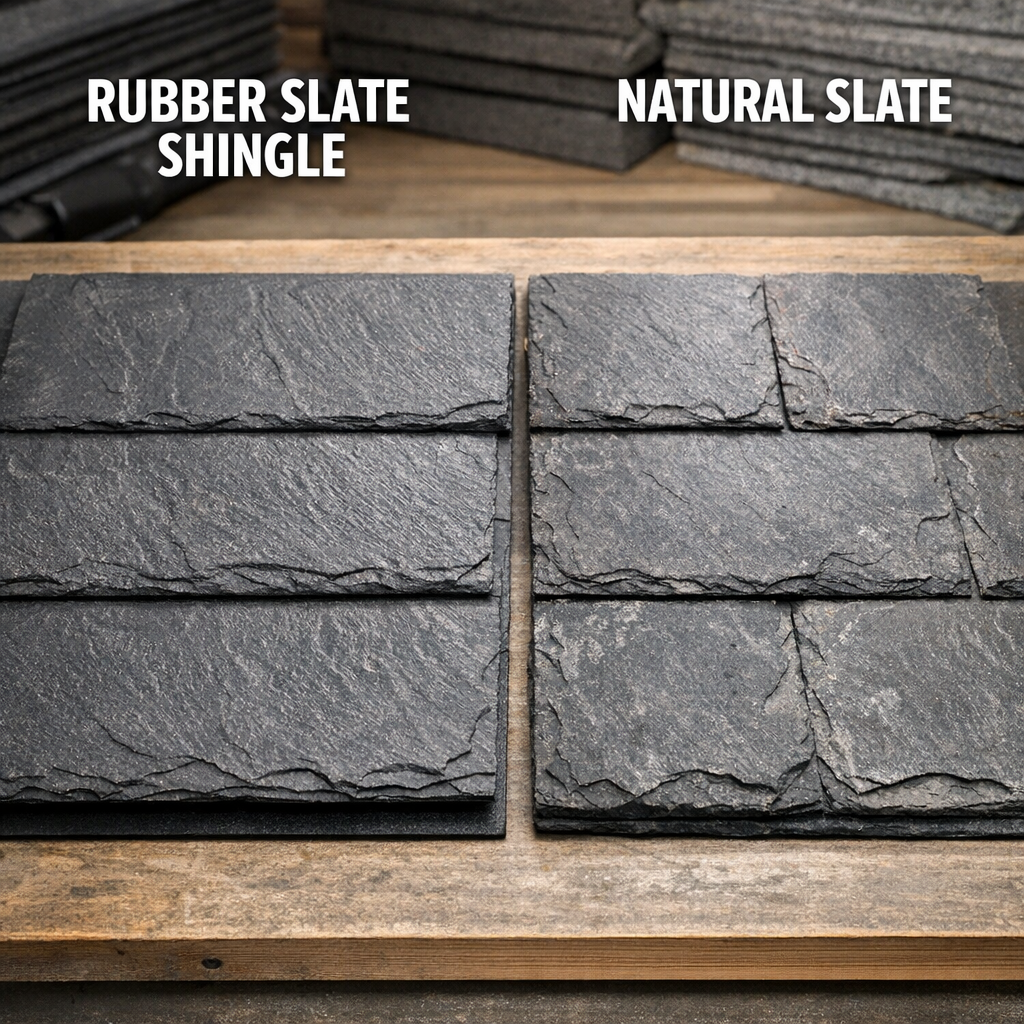
Rubber shingles are designed to visually mimic slate or cedar shake. In many applications, the resemblance is convincing. But HOA architectural standards and municipal historic preservation guidelines often specify materials by category, not just by appearance. A covenant that requires “natural slate” does not permit synthetic slate, regardless of how similar the visual result may be.
Before purchasing rubber shingles for a home subject to any external design review, obtain written approval from the relevant authority, your HOA board or your local historic preservation commission, with the specific product name and manufacturer documentation provided for review. A verbal assurance that it “looks fine” is not binding approval.
Earlier in this guide, we mentioned that rubber shingle longevity claims assume certain system-level conditions. It’s worth being direct about what those conditions are, because meeting them is not automatic, it requires deliberate decisions at every stage of the project.
Proper attic ventilation serves two functions on any roof: it regulates temperature differentials that accelerate shingle aging, and it manages moisture that can degrade the deck beneath. Most rubber shingle warranties explicitly reference IRC ventilation minimums, typically 1 square foot of net-free ventilation area per 150 square feet of attic floor space (or 1:300 with a vapor barrier).
An attic that runs significantly hotter than it should because ventilation is inadequate will age any roofing product faster than its rated lifespan. It can also void your warranty. If your home has never had its attic ventilation assessed, that assessment should happen before any new roof goes on, regardless of material. Our article on roof vent installation costs explains what drives pricing and why the right ventilation setup matters for long-term performance.
No roofing product performs above the quality of the deck it sits on. Soft spots, delaminating plywood, rot at the eaves, or structurally compromised sheathing will telegraph problems upward through even the best shingle. A proper installation begins with a full deck inspection and remediation of any deficiencies before the new material is applied.
As discussed in the fire rating section, the underlayment is not an afterthought. It’s a functional part of the roofing assembly that contributes to fire performance, moisture management, and the valid application of manufacturer warranty terms. Selecting the right underlayment for your specific rubber shingle product, climate zone, and local code requirements is a decision your contractor should make with intention, not convenience.
With 60-plus combined years of exterior contracting experience, the team at Smithrock Roofing has seen what happens when roofing decisions are made on marketing claims rather than technical understanding. The homeowners who end up most satisfied, and whose roofs perform the way they expected, are the ones who asked the right questions before the project started.
If you’re evaluating rubber shingles for your home in Winston-Salem, Greensboro, High Point, Kernersville, Clemmons, Rural Hall, King, or anywhere in the NC Triad, we’re happy to talk through the specifics: what your deck looks like, what your insurance carrier requires, what your HOA allows, and which product formulation makes sense for your home’s situation. That’s the kind of conversation we actually enjoy having.
No pressure. No shortcuts. Just honest answers from people who know roofing.
For further reading on roofing material standards, the Insurance Institute for Business & Home Safety (IBHS) publishes independent research on impact-resistant roofing performance. For fire rating assembly documentation, the Underwriters Laboratories product certification database allows you to look up specific approved assemblies by product name.
The local climate presents a specific combination of conditions, humid summers, occasional ice events in winter, and an active hail season, that rubber shingles handle reasonably well when the right product is selected. Impact resistance is a genuine advantage in this region. However, local HOA requirements vary significantly across different communities, so confirming product approval with your neighborhood association before purchasing is always a necessary first step.
Many rubber shingle products achieve a UL 2218 Class 4 impact rating, which is the highest classification available under that standard. In third-party testing, Class 4 products demonstrate measurably better resistance to impact damage than standard three-tab or architectural asphalt shingles. That said, no roofing material is completely immune to damage from severe hail, and the performance of any product depends heavily on proper installation over a sound deck.
A legitimate fire rating means the specific product, installed in a specific assembly configuration with specified underlayment, has been tested by a recognized third-party laboratory and listed in their certification database. The most reliable verification method is looking up the product by name in the Underwriters Laboratories Product iQ database before your project begins. If a product is described as having a fire rating but cannot be found in an active listing, that claim warrants serious scrutiny.
At minimum, ask whether the contractor has installed the specific product being proposed before, which underlayment they intend to use and why, how they plan to handle the existing deck if problems are found, and what documentation they’ll provide for warranty registration. A contractor who can answer those questions with specifics, not generalities, has done this work before. One who defaults to vague assurances about quality and experience without substantive answers is worth approaching carefully.
Rubber shingle roofing is a legitimate, high-performing option for the right home and the right situation, but getting there requires honest guidance from people who understand the product, the local codes, and the realities of installation in this region. The team at Smithrock Roofing has built its reputation in Winston-Salem and Greensboro by giving homeowners exactly that: straightforward answers, thorough assessments, and work that holds up long after the crew has left. If you’re ready to talk through whether rubber shingles make sense for your home, Contact Smithrock Roofing and let’s start with an honest conversation.
Need a local pro? Learn more about our roofing services in Kernersville.
See also: Tin Roofing Contractors: What NC Homeowners Must Know
See also: Roofing Winston-Salem NC | What Homeowners Must Know
See also: High Point NC Roofing: What Homeowners Must Know
See also: Commercial Roofing Repair Cost: What You Must Know

Smithrock Roofing © Copyright 2026 • All Rights Reserved • Privacy Policy • Maintained by Mongoose Digital Marketing