Hiring a tin roofing contractor sounds simple enough until you realize that most homeowners, and, honestly, some contractors, are not entirely sure what “tin roofing” means anymore. The term has stuck around for over a century, but the material it describes has changed completely. If you are a homeowner in Winston-Salem, Greensboro, High Point, or anywhere across the NC Triad thinking about a metal roof, understanding what you are actually buying, and who is actually qualified to install it, will save you from an expensive mistake.
This guide is not a sales brochure. It is the honest, detailed explanation that most roofing websites will not give you because it requires acknowledging complexity instead of glossing over it. We will cover what “tin roofing” really means today, how metal roofs actually fail, what separates a qualified installation from a time bomb, and the questions you should be asking any contractor before you sign anything.
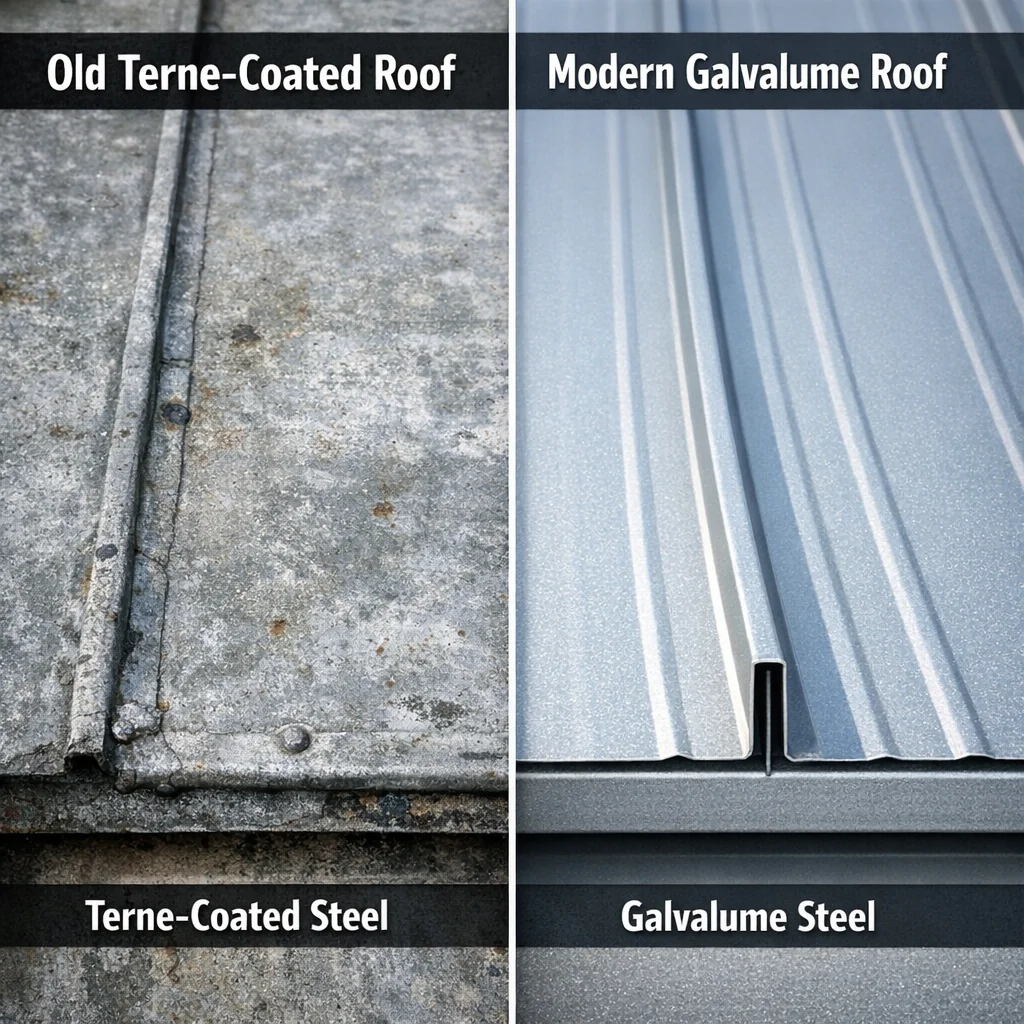
For most of the 19th and early 20th centuries, metal roofing in America meant one thing: terne-coated steel. Terne was an alloy of lead and tin applied to a steel base sheet, giving it excellent corrosion resistance and a distinctive matte gray appearance. You can still find original terne roofs on older homes and historic buildings throughout the Piedmont region, churches, farmhouses, and commercial buildings that have stood for well over a hundred years.
The problem with terne metal is the lead. Environmental regulations tightened significantly through the 1980s and into the 1990s, making lead-tin terne largely unavailable for new residential installation. By the time most of today’s roofing contractors entered the trade, true terne roofing had already become a specialty product reserved for historic restoration work, not standard residential builds.
So when a homeowner today calls around asking for “tin roofing contractors,” they are usually asking for one of these modern materials:
None of these is tin in any meaningful sense. But “tin roof” persists in everyday language the same way “Kleenex” persists for facial tissue. Understanding the distinction matters not because of terminology, but because each material has different performance characteristics, different installation requirements, and different long-term maintenance needs.
If you own an older home in a historic district, a traditional neighborhood, or a rural property with an original terne roof still in place, you face a different challenge than a homeowner doing a straightforward replacement. Sourcing terne-compatible material for a repair requires specialty suppliers. Matching the profile and appearance of an original standing seam terne roof requires a contractor with specific historic restoration experience, not just general metal roofing experience.
If you are not sure whether your existing roof is original terne or a later replacement, a qualified inspector or experienced metal roofing contractor can identify it during a site visit. Original terne typically shows a consistent matte gray patina, hand-soldered seams, and specific pan dimensions that differ from modern roll-formed panels.
Need a hand with this in Winston-Salem, Greensboro and the NC Triad? Call (336) 971-0464 or request a free estimate. Honest answers, no pressure.
The most useful thing any roofing contractor can do for you is explain how things go wrong, not just promise you they will not. Here are the actual failure modes that separate a 50-year metal roof from one that starts causing problems in under a decade.
Metal expands when it heats up and contracts when it cools down. That is not a minor detail, it is the central engineering challenge of every metal roof installation. Steel expands and contracts roughly one inch for every 100 linear feet of panel for every 100 degrees Fahrenheit of temperature change. In the NC Triad, where summer roof surface temperatures can push well above 150°F and winter nights can drop near or below freezing, the temperature swing across a single roof over the course of a year is significant.
This is precisely why standing seam metal roofing was engineered the way it was. The raised seam profile is not aesthetic, it exists to accommodate movement. Concealed clip systems allow panels to float independently on the substrate, expanding and contracting without pulling against fasteners or distorting the panel surface. The system works because it is designed with movement in mind.
A screw-down or exposed fastener metal panel system handles this differently. Each fastener is a fixed point, and as the panel moves thermally, the metal works back and forth against the fastener. Quality exposed fastener panels use oversized, slotted holes or neoprene-washered screws that compress and release, but even those systems have a finite cycle life. Over years of thermal cycling, fasteners can back out, and the holes they leave behind become leak points.
This is the most common cause of premature metal roof failure on residential buildings. A contractor who installs a clip-based standing seam system using fixed fasteners, or who uses exposed fastener panels on long panel runs without accounting for movement, is building in a problem. It will not show up immediately. It will show up five or eight years later, when the thermal fatigue has accumulated enough cycles to compromise the seal.
Questions to ask any contractor about thermal movement:
A contractor who cannot answer these questions clearly has not thought carefully about the installation they are proposing. For a deeper look at how installation decisions affect long-term outcomes, the article How to Install Metal Roofing: Avoid Costly Mistakes covers the most common errors and how to identify them before they become your problem.
Different metals have different electrochemical potentials. When two dissimilar metals make direct contact in the presence of moisture, the less noble metal corrodes faster than it would on its own. This is galvanic corrosion, and it is a real concern on metal roofs because the roofing system involves multiple metal components, panels, fasteners, flashings, drip edges, and hardware.
Common problem combinations:
A qualified contractor specifies compatible materials throughout the system. Fasteners should be stainless steel or manufacturer-matched for the panel material. Flashings should be the same metal as the panels, or a chemically compatible alternative. Any area where runoff from a copper element (including copper-based algae treatments) contacts a steel or aluminum panel is a potential corrosion accelerator.
This seems granular, but it is exactly the kind of detail that separates an experienced metal roofing contractor from someone who installs metal panels a few times a year between shingle jobs.
Modern metal roofing panels, particularly painted Galvalume products, arrive from the factory with a baked-on Kynar 500 or Hylar 5000 PVDF coating. These are exceptional coatings, fade-resistant, UV-stable, and highly durable under normal conditions. They are also unforgiving of improper handling and surface contamination during installation.
Field-cut panels produce metal shavings. If those shavings are not immediately swept clear and the panel wiped clean, they begin to rust on the surface, leaving stain trails and creating micro-abrasion points in the coating. Any field modification, trimming, drilling, notching, should be done with appropriate tools (shears or nibblers, not grinders) and the cut edge should be treated with a color-matched touch-up coating to prevent bare metal exposure.
A contractor whose crew is using angle grinders to cut metal panels and leaving the job site covered in metal shavings is not taking care of your roof system.
Our area does not see the most extreme winter cold, but hard freezes are a real part of the winter pattern, particularly in elevated terrain and areas farther from urban centers. Low-slope metal roofing applications, anything under about 3:12 pitch, require specific underlayment selections to manage ice and water infiltration risk.
Metal panels are smooth and shed snow quickly, which is generally a benefit. But if snow and ice cycle repeatedly at the eave edge, ice dams can form underneath the panel at the low point. Self-adhering ice and water shield underlayment at eaves and valleys is the correct mitigation, and a contractor who is applying standard synthetic felt on a low-slope metal application is taking a shortcut that the first significant ice event will expose.
Every contractor claims to be qualified. Here is how to verify it independently.
When a roofing contractor says they are “manufacturer certified,” that phrase can mean anything from a one-day product training to a rigorous multi-year certification process with regular audits. The difference matters.
For painted metal panels, Kynar 500 applicator certification indicates that a contractor has been vetted to properly handle, store, and install panels with PVDF coatings, a meaningful credential. For systems like standing seam, some manufacturers offer installer training programs that teach the specific clip systems, seam tools, and quality checkpoints for their panels.
Ask specifically: Which manufacturer’s certification do you hold, what did the certification process involve, and what ongoing requirements does it have? A credential that requires renewal and auditing is more meaningful than one that was issued once and never revisited.
At Smithrock Roofing, our CertainTeed PREMIER ShingleMaster certification reflects that kind of ongoing commitment to verified quality, not just a one-time acknowledgment.
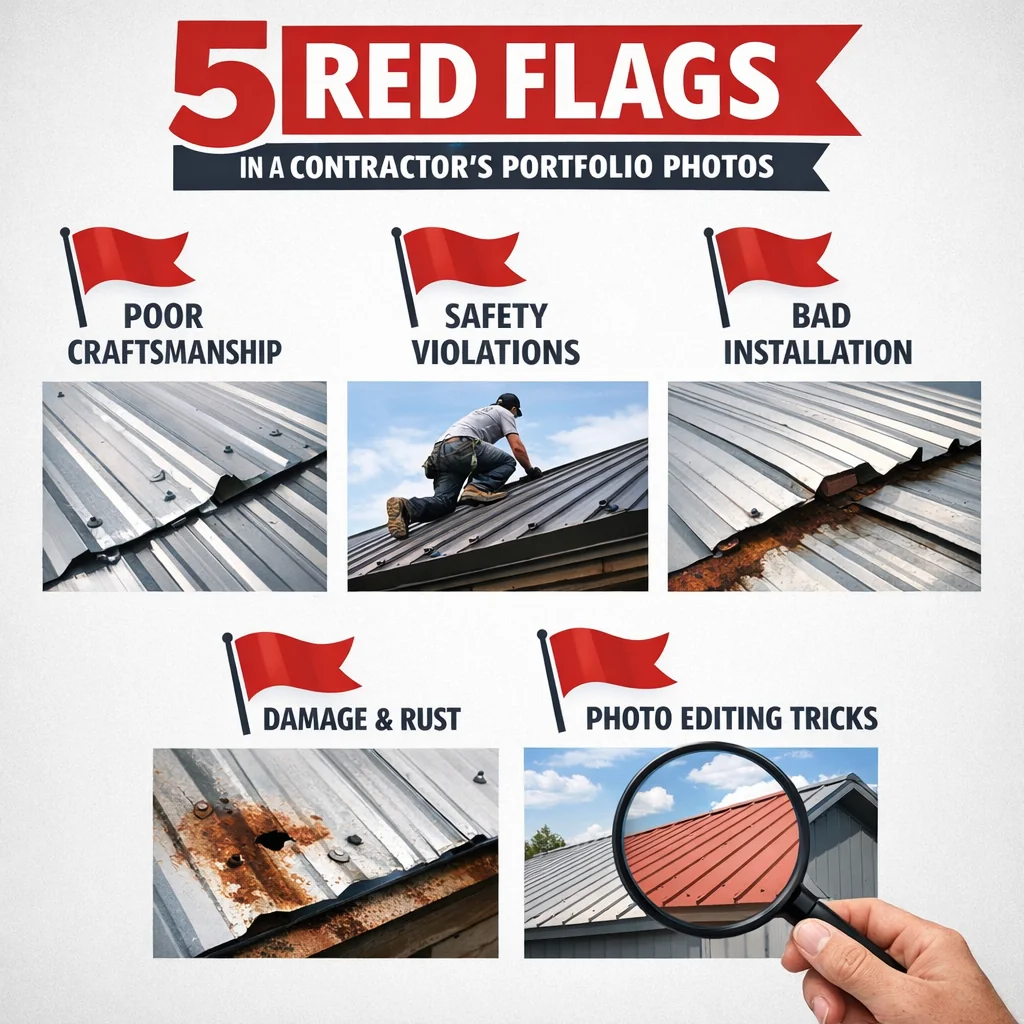
Project photos are the most revealing window into a contractor’s actual workmanship, if you know what to look for.
A complete metal roof warranty has two distinct parts, and you should never accept only one of them as “full coverage.”
| Warranty Type | What It Covers | What It Does Not Cover | Issued By |
|---|---|---|---|
| Manufacturer Material Warranty | Panel coating performance, corrosion resistance, paint adhesion | Installation errors, flashing failures, fastener back-out | The panel manufacturer |
| Contractor Workmanship Warranty | Labor quality, installation errors, leak points from improper installation | Material defects, storm damage beyond normal weather events | The installing contractor |
| What a Gap Looks Like | If your contractor goes out of business, the manufacturer warranty survives, but installation defects are not covered | If you only have a workmanship warranty, material failures may not be covered | Both documents are necessary |
At Smithrock Roofing, we back our work with a 5-year labor warranty alongside the manufacturer’s limited lifetime material warranty. You can review the full details of our coverage on our Warranty page. That combination means you have coverage for both dimensions of the system, not just one.
A significant number of roofing companies in the NC Triad, and across the country, operate primarily as sales organizations. They land the job, collect the deposit, and hand the actual installation to a subcontracted crew. That crew may be skilled and reputable, or they may be whoever was available that week.
This is not automatically disqualifying. Some legitimate roofing operations use trusted subcontractors they have worked with for years and stand behind fully. But you deserve to know whether the company you are signing a contract with is the company that will be on your roof.
Ask directly: Will your own employees be performing this installation, or will it be subcontracted? If subcontracted, can I meet the crew lead and review their credentials?
A company that cannot or will not answer this question clearly is giving you your answer.
General liability insurance protects your property if the contractor damages it. Workers’ compensation insurance protects you, the homeowner, if a worker is injured on your property and their employer does not carry proper coverage. Without workers’ comp, an injured worker may have legal grounds to make a claim against your homeowner’s insurance, or against you directly.
Before any contractor starts work on your roof, request certificates of insurance for both. Verify that both are current, not expired, and that coverage limits are adequate for a residential roofing project.
Metal roofing performs well in our area, but the installation details need to reflect local conditions.
Synthetic underlayment is the correct choice beneath a metal roof in our climate. Traditional felt can trap moisture vapor in the high-humidity months, and moisture vapor trapped between a metal panel and a wet felt underlayment creates a slow-burn condensation problem. High-quality synthetic underlayment is vapor-permeable enough to let the assembly breathe while still providing the required water-resistant barrier.
In areas with a history of ice accumulation, the northern edges of our service area near King and the Stokes County line, self-adhering membrane at eaves and valleys adds an important secondary line of defense.
In the NC Triad’s climate, panel color selection has a real impact on attic thermal performance. Lighter, reflective colors reduce solar heat gain during the long, hot summers. Darker colors absorb more heat, which is largely irrelevant for the mild winters but does create additional attic cooling load through the summer months.
Energy efficiency claims for metal roofing, the commonly cited figures about cooling cost reduction, apply most accurately to lightly colored or reflectively coated panels in high solar-gain climates. That description fits our area in summer. A dark charcoal metal panel in the same climate delivers much of the durability benefit but without the thermal performance benefit. Neither choice is wrong, but the claim deserves honest context.
Parts of the NC Triad, particularly the more rural areas of Forsyth, Stokes, and Davidson Counties, have open terrain exposure that increases effective wind load on roofing systems. Standing seam metal with properly specified concealed clips performs exceptionally well under wind uplift because there are no exposed fastener penetrations for wind-driven water to enter. Clip spacing and panel gauge should be specified with local wind exposure in mind, not defaulted to minimum code requirements across every project.
A contractor who genuinely knows metal roofing will do more than give you a quick measurement and a proposal number. They will:
At Smithrock Roofing, we have more than 60 combined years of experience across our team, and our consultative approach means we are explaining the work as we scope it, not just handing you a number and hoping you sign. We serve homeowners across Winston-SalemGreensboro, High Point, Kernersville, Clemmons, Rural Hall, King, and the surrounding communities, and we take the same care on a smaller residential project as we do on a larger commercial scope.
If you have questions about whether a metal roof is right for your home, or you want an honest second opinion on a proposal you have already received, we are glad to help, no pressure, no sales tactics, just straight answers from people who have been doing this for a long time.
See also: Old Ridge Roofing: What Homeowners Must Know
A properly installed metal roof, whether standing seam, exposed fastener, or a stone-coated steel system, generally outlasts asphalt shingles by a significant margin. Where a standard asphalt shingle roof may require replacement every 20 to 30 years depending on installation quality and climate exposure, a metal roof installed with the correct gauge, coating, and fastener specification is routinely documented to perform well beyond 40 to 50 years. The key variable is installation quality. A metal roof that is improperly detailed at the flashing, ridge, or penetration points will fail long before its material potential.
A standing seam system uses concealed clips that attach to the roof deck and allow the panel to float over the clip as it expands and contracts with temperature changes. No fastener penetrates the panel face. An exposed fastener system drives screws directly through the panel face into the deck or purlin below. Exposed fastener systems are typically faster to install and carry a lower upfront investment, but they require more ongoing attention to the fastener locations, specifically the neoprene washers that seal each penetration, over the life of the roof. Standing seam systems generally carry stronger long-term performance credentials for residential applications, particularly in high-wind or high-rainfall environments.
Yes, and this is an area where many installations fall short. Standard felt underlayments can trap moisture against a metal panel and accelerate corrosion at the panel’s underside, particularly on steel systems. Self-adhering rubberized membranes or high-temperature synthetic underlayments are more commonly specified for metal applications, and the right choice depends on the panel type, roof pitch, and climate exposure. A qualified metal roofing contractor will specify the underlayment as part of the system, not as an afterthought or a cost-cutting variable.
In many cases, yes, favorably. Metal roofing systems are frequently recognized by homeowner’s insurance carriers as impact-resistant and fire-resistant materials, which can influence premium calculations. The specific outcome depends on your carrier, your policy structure, and the rating assigned to the metal panel system you install. It is worth contacting your insurance provider before your project is finalized so you understand how the material selection may affect your coverage terms. Some carriers also require documentation of the installed system’s impact resistance rating, so retain your manufacturer’s product data sheet after installation.
Choosing the right tin roofing contractor is not simply about finding the lowest proposal, it is about finding a team that understands the system they are installing, communicates clearly before the work begins, and stands behind the result after it is done. Smithrock Roofing brings more than 60 combined years of experience to every project across Winston-Salem and Greensboro, and we approach each scope, residential or commercial, simple or complex, with the same level of care and transparency. If you are ready to get honest answers and a straightforward assessment of your roof, we would be glad to hear from you: Get a Free Estimate.

Smithrock Roofing © Copyright 2026 • All Rights Reserved • Privacy Policy • Maintained by Mongoose Digital Marketing