Replacing a roof is one of the largest home improvement decisions you will make. It is also one of the least understood, not because homeowners aren’t smart, but because the roofing industry has done a poor job of explaining what actually happens between the moment a contractor drives away and the moment your new roof is expected to last 30 years.
Most of the advice available online focuses on how to avoid getting scammed. That is useful, but it sets the bar too low. Knowing how to spot a bad contractor is not the same as knowing how to choose an excellent one, evaluate a proposal with confidence, or protect yourself if something goes wrong two years after installation.
This guide goes further. As a roofing company with 60-plus combined years of field experience serving Winston-Salem, Greensboro, High Point, Kernersville, Clemmons, Rural Hall, King, and the surrounding NC Triad, we have seen every version of how a roof replacement can go right, and wrong. What follows is the honest, field-informed breakdown that most contractors, frankly, would rather you not have.
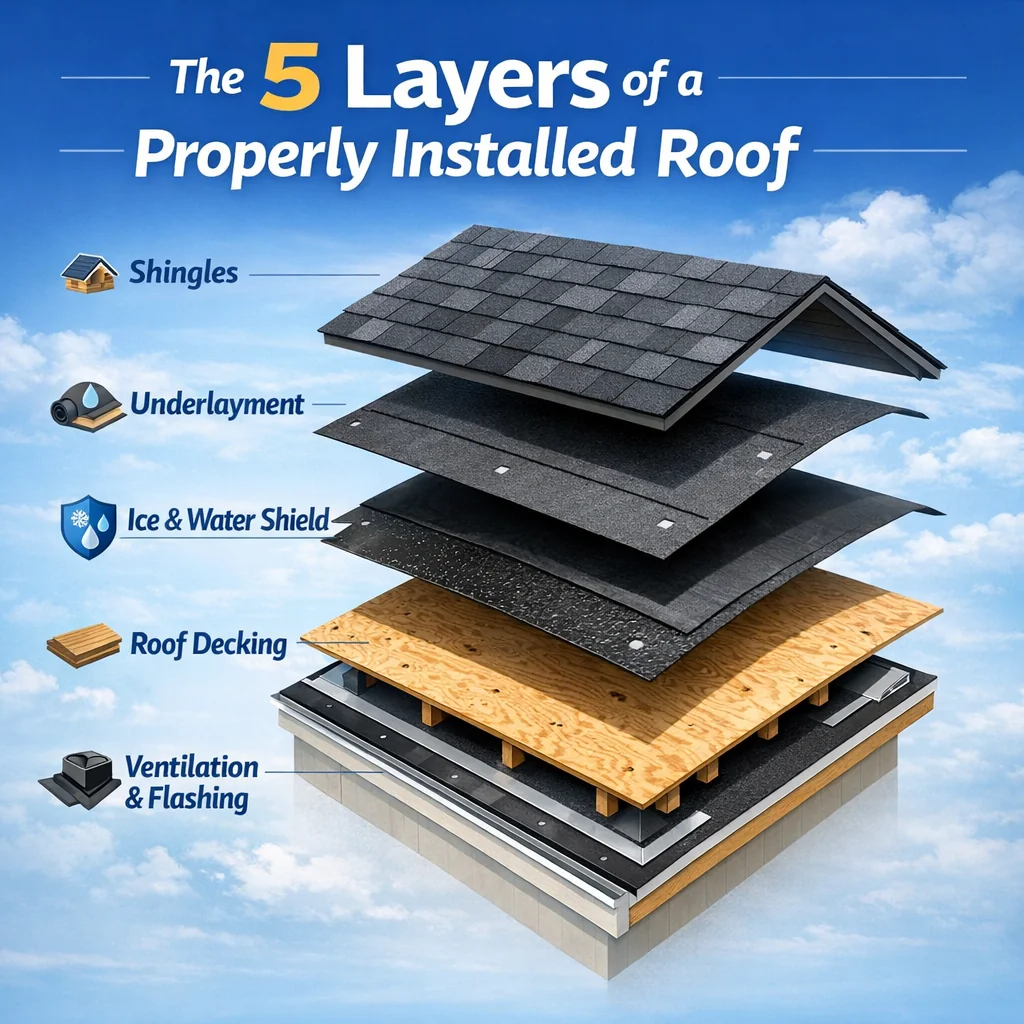
The single biggest misconception homeowners carry into a roof replacement is that the shingles are the roof. They are not. The shingles are the outermost surface of a layered system, and every layer beneath them determines whether those shingles perform as warranted, or fail years ahead of schedule.
Here is what a properly installed roof replacement actually involves, from the deck up:
The deck is the structural sheathing, typically OSB or plywood, that everything else attaches to. When a tear-off crew removes old shingles, they expose the deck for the first time in potentially decades. What they find at that moment matters enormously.
Localized decking rot, caused by a single chronic leak at a pipe boot or flashing failure, is common and patchable. Systemic delamination, where the OSB has absorbed moisture broadly and lost its structural integrity, requires full or partial re-decking before a new roof can go on.
The problem is that many roofing proposals treat decking replacement as a vague open-ended charge. This is one of the most common sources of sticker shock homeowners experience mid-project. A legitimate contractor will write decking replacement into the contract at a defined per-sheet rate so you know exactly what you are agreeing to if damaged sections are found.
Equally important: when fasteners are driven into compromised decking, the shingles above them will not hold during high winds. Neither the manufacturer nor the contractor will typically cover blow-off failures caused by poor decking, because the underlying condition falls outside the scope of the warranty. In our area, where summer storms can bring sustained winds that stress even well-anchored roofing systems, this is not a theoretical concern.
Underlayment is the water-resistant barrier installed over the decking before shingles go down. It is the last line of defense against water infiltration if a shingle is damaged, lifted, or missing. Not all underlayments are equal.
Felt paper (15 lb or 30 lb) is the traditional option and still widely used. Synthetic underlayments offer superior tear resistance, better slip resistance for installers working on steep-slope roofs, and improved moisture management. Some premium synthetic products also serve as temporary weather barriers if a project is interrupted mid-installation by rain, which, given NC Triad weather patterns, is worth taking seriously.
Any contractor who does not specify underlayment type in their proposal is leaving a performance variable unresolved. Ask for it in writing.
Flashing is the metal that seals every point where the roof surface meets a vertical planechimneys, skylights, pipe penetrations, dormers, and roof valleys. It is also the element most likely to fail first on any roof system, and the element that receives the least attention from homeowners comparing bids.
There are two practices in the field. The first is replacing all flashing as part of every roof replacement. The second is reusing existing flashing where it “looks fine.” The second approach is a cost-cutting measure that creates measurable risk. Metal flashing that has been on a roof for 15 or 20 years has experienced hundreds of thermal expansion and contraction cycles. Its seals have aged. Its fasteners have corroded. Visually intact flashing can still be functionally compromised.
Post-replacement leaks at chimneys and around skylights are among the most common callback issues in roofing. In the vast majority of those cases, the leak originates at reused flashing, not at the new shingles. Our detailed article on roof repair around chimney explains exactly how these failures develop and what a proper repair looks like.
Ask your contractor directly: does your proposal include full flashing replacement, or do you reuse existing flashing? The answer tells you a great deal about their standards.
This is where things get genuinely technical, and genuinely important.
Most homeowners think of ventilation as a comfort feature. It is not. It is a warranty-critical system component.
Every major shingle manufacturer publishes explicit ventilation ratio requirements as a condition of their warranty coverage. These requirements specify the minimum net free area of ventilation, typically expressed as a ratio of ventilated area to attic floor area, that must be in place at the time of installation. The commonly required standards are 1:150 (one square foot of ventilation per 150 square feet of attic floor) or 1:300 depending on vapor barrier conditions.
If your attic ventilation does not meet these specifications when new shingles are installed, the warranty can be voided, not at some point in the future if a problem arises, but retroactively, from the day of installation.
A qualified roof replacement contractor should conduct a ventilation audit before any material is ordered. This means measuring net free area of existing intake and exhaust ventilation, checking for blocked soffit vents (a common issue in older NC Triad homes), and verifying that air can flow continuously from eave to ridge without obstruction.
In homes with inadequate ventilation, the corrective measures are not complicated, additional ridge venting, soffit vent clearing, or power ventilation in specific cases, but they need to be identified and addressed before installation, not discovered during a warranty claim years later.
Need a hand with this in Winston-Salem, Greensboro and the NC Triad? Call (336) 971-0464 or request a free estimate. Honest answers, no pressure.
“Get everything in writing” is advice that sounds helpful but means very little if you do not know what to look for in the document itself. A standard roofing contract can be one of the most ambiguous agreements a homeowner signs, and that ambiguity rarely works in the homeowner’s favor.
Here is a breakdown of what a complete, homeowner-protective contract should specify:
| Contract Element | What to Look For | Red Flag Language |
|---|---|---|
| Decking replacement | Defined per-sheet rate; maximum estimated quantity | “Additional charges as needed” with no rate specified |
| Underlayment specification | Product name and grade listed explicitly | “Standard underlayment” with no product detail |
| Flashing scope | States whether flashing is replaced or reused; materials specified | No mention of flashing at all |
| Ventilation assessment | Confirms pre-installation audit is included | No reference to ventilation |
| Tear-off method | Full tear-off to deck confirmed; disposal responsibility stated | “Overlay acceptable where permitted” |
| Nail type and pattern | Fastener specification for shingle type and wind zone | No fastener specification listed |
| Cleanup protocol | Magnetic sweeping, daily debris removal, final inspection | “Job site left clean” with no specifics |
| Permit responsibility | States who pulls the permit and who is responsible for inspection | Silent on permitting |
| Warranty terms | Both labor warranty duration and manufacturer warranty registration are stated | “Backed by manufacturer warranty” with no enrollment detail |
| Subcontractor disclosure | Identifies whether work is performed by employees or subcontractors | No mention of who will actually be on site |
That last item deserves more attention than it typically receives.
A large portion of roofing companies, including some nationally recognized names, use subcontractor labor exclusively. The crew that arrives at your home may have no employment relationship with the company you signed a contract with. Their training, workmanship standards, and accountability structures may differ significantly from what the contracting company represents in its marketing.
This is not inherently a disqualifying practice, but it is information homeowners deserve to have. When you ask a contractor whether the crew performing your roof replacement is employed directly by their company or is a subcontracted crew, a trustworthy contractor will answer that question directly and explain what oversight and quality control mechanisms are in place. Hesitation or deflection is informative in itself.
Manufacturer certification programs are useful reference points, but they require interpretation to be meaningful.
Programs like the CertainTeed ShingleMaster certification system tier contractors based on a combination of factors, volume of product installed, insurance requirements, and workmanship inspections. The highest tiers, such as CertainTeed’s PREMIER ShingleMark Master Certified designation, represent contractors who have met both administrative and workmanship standards at a verified level, including independent inspection of actual installation work.
What many homeowners do not realize is that lower-tier certifications within these programs may reflect primarily administrative compliance, insurance minimums met, paperwork submitted, rather than verified installation quality. A contractor can hold a manufacturer certification while having never had a single roof inspected by anyone other than themselves.
The right questions to ask any certified contractor are:
At Smithrock Roofing, our CertainTeed PREMIER ShingleMark Master Certified status is the company’s highest tier designation and reflects both verified workmanship standards and the extended warranty coverage that comes with it, which is a meaningful distinction for homeowners comparing proposals. You can review the full details of what our warranty covers and how it is structured.
Credentials matter. But ask what they actually required to earn, not just whether they exist.
The NC Triad experiences enough severe weather, hail events, tropical remnants pushing through the Piedmont, derecho-style wind events, that storm-chasing contractors are a seasonal reality here. After significant weather, you may receive door-to-door visits from contractors offering free inspections before you have even had a chance to assess your own property.
Some of these contractors are legitimate and local. Many are not.
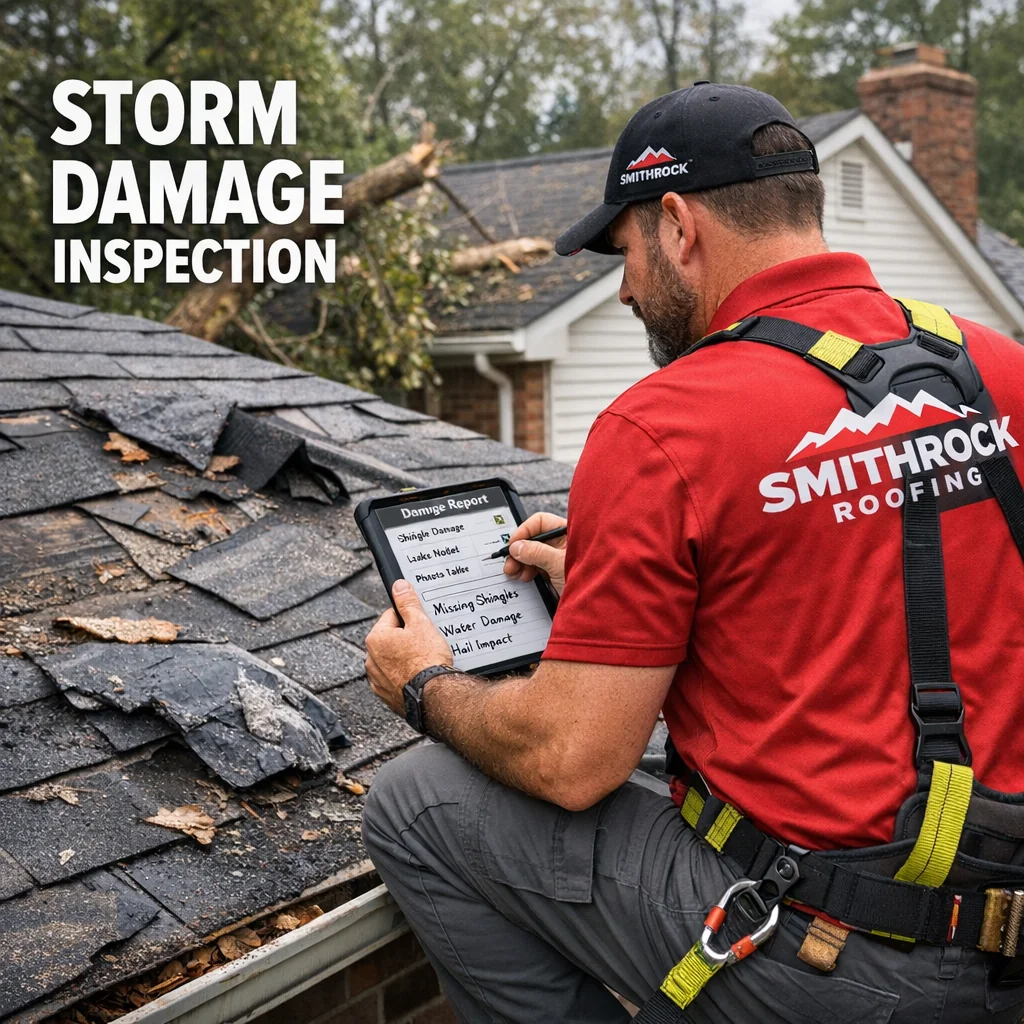
Here is what separates a trustworthy post-storm contractor from one who is working against your interests:
If a contractor shows up uninvited, pushes for a same-day decision, and frames the conversation around your insurance claim rather than the condition of your roof, trust that instinct telling you to slow down. Our article on storm damage roof repair covers exactly what NC Triad homeowners should expect from a legitimate post-storm assessment process.
Most homeowners understand that installing new shingles over existing ones (called an overlay or re-roof) is generally a compromise compared to a full tear-off to the deck. What fewer homeowners understand is that the quality of the tear-off itself is a significant variable.
A professional tear-off includes:
These details are not glamorous, but they are the difference between a job that is done and a job that is done correctly. Ask your contractor to walk you through their tear-off process before work begins. If they cannot describe it in specific terms, that is informative.
Every roofing product has a minimum slope requirement specified in the manufacturer’s installation manual. Standard three-tab and architectural shingles are generally rated for slopes of 4:12 (four inches of vertical rise per 12 inches of horizontal run) and above. Low-slope applications, typically anything below 2:12, require entirely different product systems, including modified bitumen or TPO membranes.
Where homeowners run into trouble is in the middle range: slopes between 2:12 and 4:12. Some shingle products can be installed in this range with enhanced underlayment systems and modified fastening patterns. Others cannot be, regardless of how they are installed.
A contractor who installs an architectural shingle on a slope below its rated minimum, without written disclosure to the homeowner and explicit note in the contract, has created a warranty void condition before the project is complete. Water that collects in shallow valleys or at low-slope transitions can work under shingles in ways that are impossible on steeper pitches, and the installation manual language will relieve the manufacturer of responsibility.
This matters particularly on homes with complex rooflines, dormers, additions, attached structures, which are common in older housing stock. Each roof plane may have a different slope, and the material and underlayment specifications should account for each of them.
The difference between a contractor with deep field experience and one with polished marketing is most visible in the conversations that happen before a contract is signed.
An experienced contractor will raise the ventilation question before you do. They will explain their decking inspection protocol without being asked. They will distinguish between their workmanship warranty and the manufacturer’s material warranty, and they will tell you how both are registered and what voids each one. They will answer the subcontractor question directly.
At Smithrock Roofing, our approach to every roof replacement in the NC Triad starts with a consultative assessment, not a sales pitch. We look at the whole system: deck condition, ventilation ratios, flashing integrity, drainage design, and product compatibility for your specific roof geometry. We back every installation with a 5-year labor warranty and the extended coverage available through our CertainTeed PREMIER ShingleMark Master Certified status.
Sixty-plus combined years of experience means we have seen how shortcuts play out, in callbacks, in warranty disputes, in leaks that appear three years after a “completed” job. We have built our reputation across Winston-Salem, Greensboro, High Point, Kernersville, Clemmons, Rural Hall, King, and the surrounding communities by doing work we are not embarrassed to put our name on, and by treating every homeowner’s project as if it were our own home.
That is the standard a roof replacement contractor should be held to. Now you have the knowledge to hold them to it.
The honest answer depends on several factors that only a thorough on-site inspection can confirm: the age of your current system, the extent of granule loss on existing shingles, whether the roof deck shows signs of rot or delamination, and how many layers of roofing are already installed. A single area of damaged shingles may be repairable, but widespread granule loss, sagging sections, or recurring leaks in multiple locations typically indicate that a full replacement is the more sound long-term investment. Our article on roof repair vs. replacement walks through the specific criteria that determine which path makes sense for your situation. An experienced contractor will show you what they find and explain the reasoning, not just hand you a replacement quote by default.
A manufacturer’s material warranty covers defects in the shingles and roofing products themselves, issues that originate in how the product was made. A workmanship warranty covers the quality of the installation: improper nailing patterns, flashing errors, underlayment placement, and other contractor-controlled variables. These are two separate documents with two separate sets of conditions. Some manufacturer warranties, like the CertainTeed PREMIER ShingleMark, are only available through certified contractors and offer significantly longer coverage than standard warranties. Always ask for both documents in writing and confirm how each one is registered.
Some do, some do not, and yes, it matters. When a general roofing contractor subcontracts the physical installation to a separate crew, your workmanship warranty is issued by the contractor you hired, but the work is performed by people who may not share the same training standards or quality controls. This creates a gap in accountability that is difficult to resolve if problems emerge. Before signing a contract, ask directly whether the crew performing your installation is employed by the company or hired as subcontractors, and ask what oversight the contractor provides on-site during the job.
For most single-family homes in Winston-Salem, Greensboro, High Point, and surrounding communities, a full roof replacement can typically be completed in one to two days once materials are staged and weather conditions are suitable. Larger homes, complex rooflines with multiple slopes or dormers, or situations requiring significant deck repair may extend the timeline. Weather in our area can also affect scheduling. A reliable contractor will give you a realistic project window upfront and communicate proactively if conditions change.
Choosing the right roof replacement contractor in the NC Triad is ultimately about finding a team that treats your home with the same care and accountability they would bring to their own, and Smithrock Roofing has built that reputation across Winston-Salem, Greensboro, and the surrounding communities one project at a time. Whether you are dealing with an aging system or evaluating storm damage, our team brings certified expertise, honest assessments, and work we are proud to put our name on. When you are ready to take the next step, we are here to help, Get a Free Estimate and let us show you what a consultative, no-pressure roofing experience looks like.
Need a local pro? Learn more about our roofing services in Clemmons.

Smithrock Roofing © Copyright 2026 • All Rights Reserved • Privacy Policy • Maintained by Mongoose Digital Marketing