
Wind damage to roof shingles is one of the most common and most misread problems a homeowner will face. It ranges from a handful of missing shingles after a strong storm to subtler, slower-developing failures that go unnoticed until water finds its way inside. Understanding how wind actually breaks down a roof, and what that looks like at each stage, puts you in a far better position to protect your home, document a claim accurately, and make smart decisions about repair.
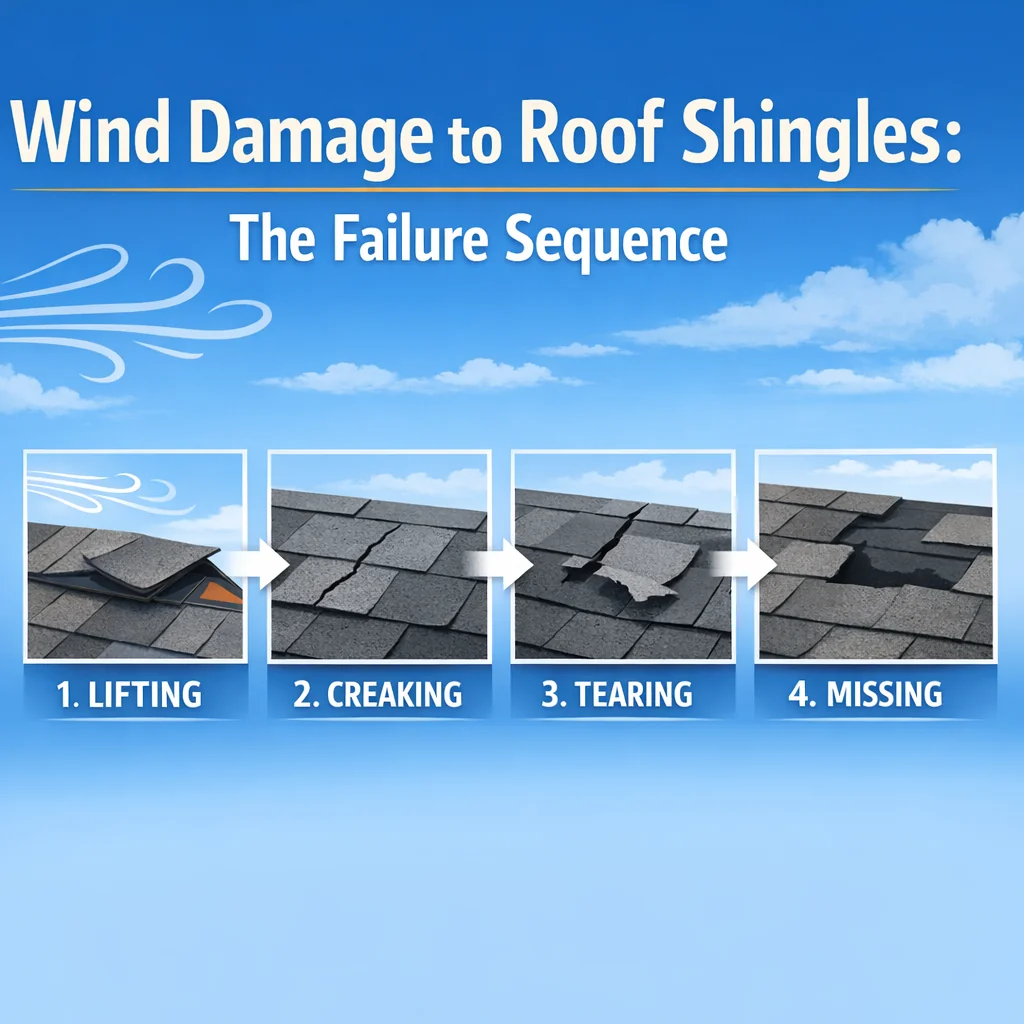
Wind does not simply rip shingles off a roof in one sudden motion. The process is more gradual, and it often begins long before any shingle goes missing.
Every asphalt shingle is held down by two things: roofing nails and a self-sealing adhesive strip along the underside. In normal conditions, that seal strip bonds to the shingle below it and keeps the tab lying flat. As a roof ages, thermal cycling, repeated expansion and contraction through hot summers and cold winters, gradually weakens that bond. The older the roof, the more compromised the seal strips are likely to be.
When wind speeds increase, air pressure builds beneath the shingle edge. If the seal strip is intact, the shingle resists. If the strip is partially failed, the shingle begins to flutter. That flutter creates a stress crease near the top of the shingle, right at the point where it pivots against the nail line. Over repeated wind events, that crease deepens. Eventually the shingle either tears at the crease or lifts off entirely.
This means that in many cases, the roof shows damage in two stages: creased but still-present shingles (early stage) and missing shingles (late stage). Skipping past that first stage is where documentation gaps and missed claims originate. For a closer look at how these early warning signs progress, the article Wind Damage Shingles: When to Act Before It Gets Worse walks through the key thresholds homeowners should understand.
Wind pressure is not evenly distributed across a roof surface. The edges, ridges, hips, and corners experience significantly higher uplift forces than the field (center) of the roof. The windward slope, the face directly exposed to the storm’s approach, takes the most direct force. These are the areas where shingles fail first and most often.
This directional pattern is one of the most useful diagnostic tools available. When significant damage appears primarily on one slope or concentrated along the edges of the windward side, that is consistent with wind as the cause. When damage appears in roughly equal amounts across all roof faces with no directional logic, wind becomes a less likely primary cause, and other explanations deserve consideration.
One of the most important things an experienced roofer does during a post-storm inspection is distinguish genuine wind damage from conditions that mimic it. Several other causes of loss can produce shingles that are missing, creased, or displaced.
The following markers help sort through the possibilities:
| Observed Pattern | More Likely Explanation |
|---|---|
| Damage concentrated on windward slope and edges | Wind damage consistent with the storm |
| Damage distributed uniformly across all roof faces | Hail, manufacturing defect, or general wear |
| Creases at the mid-shingle area on fully sealed shingles | Manufacturing defect more likely than wind |
| Partial vertical tears without associated creasing | Possible manual or man-made damage |
| Damage inconsistent with what occurred to neighboring roofs, trees, or shutters | Wind narrative may not hold; further investigation warranted |
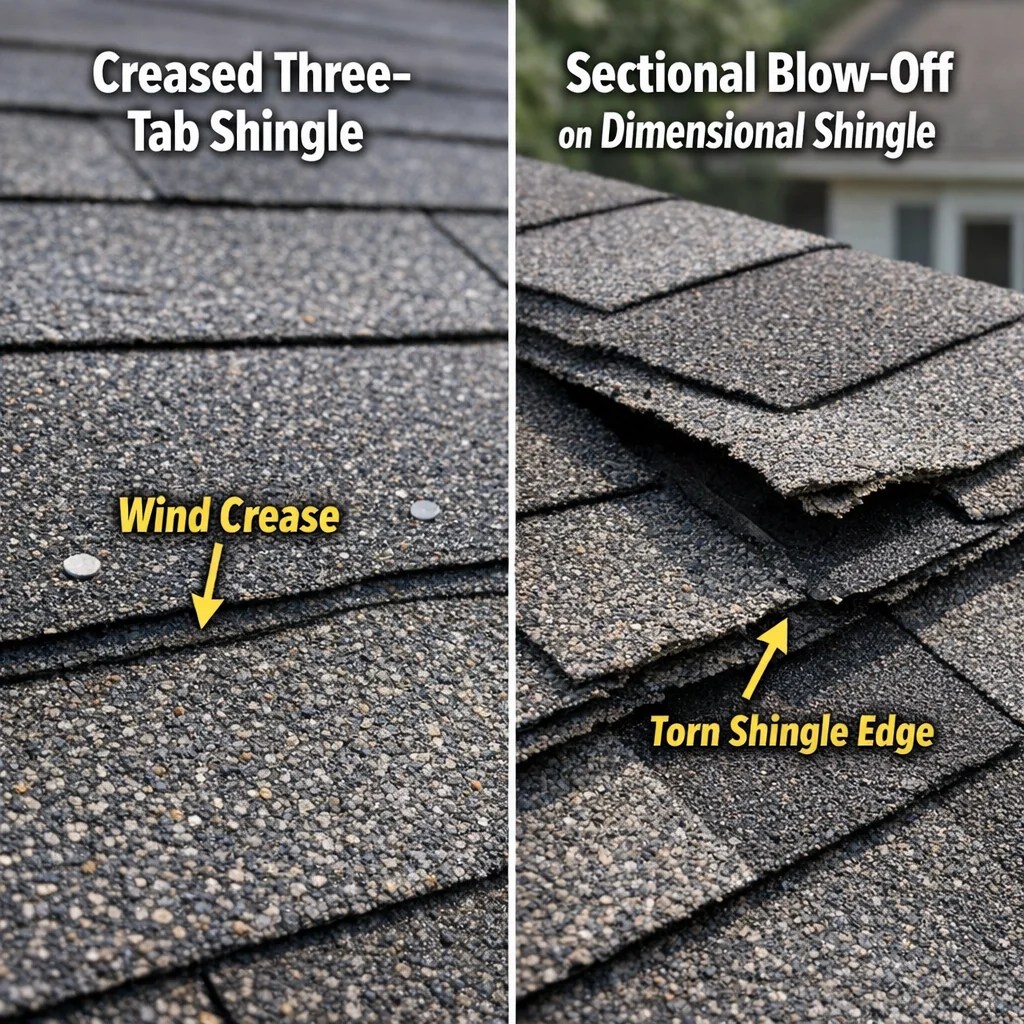
| Sectional blow-off of multiple shingles together | Dimensional shingles, wind likely; or possible vertical racking installation defect |
| Individual creases on dimensional (laminated) shingles | Warrants closer inspection; less typical of wind on this shingle type |
This is not about disputing a claim, it is about accurate diagnosis. Misidentifying a manufacturing defect as wind damage, or vice versa, leads to the wrong repair approach and can complicate the claims process unnecessarily.
Three-tab shingles and dimensional (laminated) shingles fail differently under wind, and that matters for both inspection and documentation.
Three-tab shingles are thinner and more flexible. They are more prone to developing the individual stress crease described above, and damage tends to appear as single missing tabs or creased individual shingles.
Dimensional shingles are thicker and stiffer. Rather than creasing, they tend to fail in sections, with multiple shingles lifting or detaching together. If you have dimensional shingles and you are seeing individual creases rather than sectional losses, that is a pattern worth discussing with your roofer, because it may indicate something other than wind loading as the primary cause. Our roofing service covers the full range of shingle types and storm-related repairs, so the right solution can be matched to what your roof actually needs.
Need a hand with this in Winston-Salem, Greensboro and the Triad? Call (336) 971-0464 or request a free estimate. Honest answers, no pressure.
Homeowners are often told to inspect their roof from the ground after a storm, and that is a reasonable first step. But it is worth being clear about what ground-level inspection can and cannot reveal.
Visible from the ground:
– Missing shingles or large bare patches
– Shingles visibly curled, lifted, or displaced
– Sections of ridge cap missing
– Obvious debris impact damage
Requires physical roof access:
– Wind-creased shingles (the stress line is a subtle dark mark, not visible at a distance)
– Partially unsealed shingles that are still in place but no longer bonded
– Damaged or lifted flashing at valleys, chimneys, or pipe boots
– Granule loss patterns that indicate seal strip exposure
This distinction matters practically. A roof that looks intact from the driveway may still have wind-creased shingles across a significant portion of the windward slope. Those shingles are structurally compromised and will fail progressively, but they will not trigger the same immediate alarm as a missing section.
Many homeowners are advised to pull NOAA weather records for the date of a storm, and that is good advice. The key is understanding how to use that data beyond simply logging it.
NOAA reports document wind speed and, critically, wind direction during a storm event. Once you have that information, compare the recorded wind direction to the location of damage on your roof. If the heaviest damage is on the face of the roof that was directly exposed to the documented wind direction, that correlation supports wind as the cause. If the damage pattern does not align with the wind direction record, that is worth noting and discussing with your adjuster.
This approach turns documentation from a passive record into an active tool, and it is exactly the kind of reasoning a qualified roofing contractor can walk through with you during the inspection process. The Storm Damage Roof Repair: NC Triad Homeowner Guide covers how to build that documentation from start to finish, including how to organize weather records alongside your inspection findings.
Smithrock Roofing has served homeowners across Winston-Salem, Greensboro, High Point, Kernersville, roofing in Clemmons, Rural Hall, King, Mount Airy, and the surrounding NC Triad for decades. With more than 350 five-star Google reviews, 60-plus combined years of experience, and CertainTeed PREMIER ShingleMaster certification, our team brings the knowledge and the honesty to give you a straight answer about what your roof actually needs after a storm.
Missing shingles are the most visible sign of wind damage, but they are not the only one. Wind-creased shingles, lifted seal strips, and granule loss patterns can all indicate that wind has compromised your roof even when every shingle appears to still be in place. A physical inspection by a qualified roofing contractor is the only reliable way to identify these less obvious forms of damage.
Wind speed is one factor, but it is not the whole picture. The direction the wind was traveling, the age and condition of your shingles, the slope and orientation of your roof, and whether any previous damage had weakened the seal strips all influence how your roof responds to a given storm. Two roofs in the same neighborhood can experience meaningfully different outcomes from the same event.
The sooner the better. Wind-creased shingles and partially unsealed tabs continue to deteriorate after a storm, and what starts as a compromised seal can develop into an active leak over the following weeks. Getting an inspection promptly also ensures that your documentation of the damage is tied closely to the storm event, which matters during the insurance claims process.
Most standard homeowner’s insurance policies do cover wind damage, but coverage depends on your specific policy terms, your deductible, and how the damage is documented. Correlating the damage pattern on your roof with NOAA wind direction data from the storm date strengthens the case that wind was the cause. A reputable roofing contractor can help you document the damage accurately before you file your claim.
When a storm rolls through Winston-Salem or Greensboro, the damage it leaves behind is not always obvious from the ground, and the details that get missed are often the ones that lead to leaks, premature shingle failure, and costly repairs down the road. Smithrock Roofing’s team brings decades of experience, CertainTeed PREMIER ShingleMaster certification, and a straightforward approach to every inspection, so you get an honest assessment of what your roof actually needs rather than what sounds like a sale. Call us at (336) 971-0464 or Contact Smithrock Roofing to schedule your post-storm inspection today.
See also: roofing services in Winston-Salem

Smithrock Roofing © Copyright 2026 • All Rights Reserved • Privacy Policy • Maintained by Mongoose Digital Marketing