
Why gutter guards are bad is a phrase that many homeowners only search for after they’ve spent thousands of dollars on a system that failed to live up to the glossy marketing brochures. The gutter protection industry is a multi-billion dollar market built almost entirely on a single, powerful psychological hook: the promise that you will never have to climb a ladder again. For many, especially as they age or as their schedules become more packed, this is an irresistible proposition. However, the fundamental physics of water, gravity, and organic decomposition often stand in direct opposition to the design of these products.
Instead of eliminating problems, they frequently create new ones that are harder and more expensive to fix. The reality is that gutters are designed to be open channels. When you close that channel with a screen, a mesh, or a hood, you are introducing a filter. And as any engineer will tell you, every filter eventually clogs. The question isn’t if it will clog, but when and how much damage it will cause before you notice.
The Main Reasons Gutter Guards Fail:
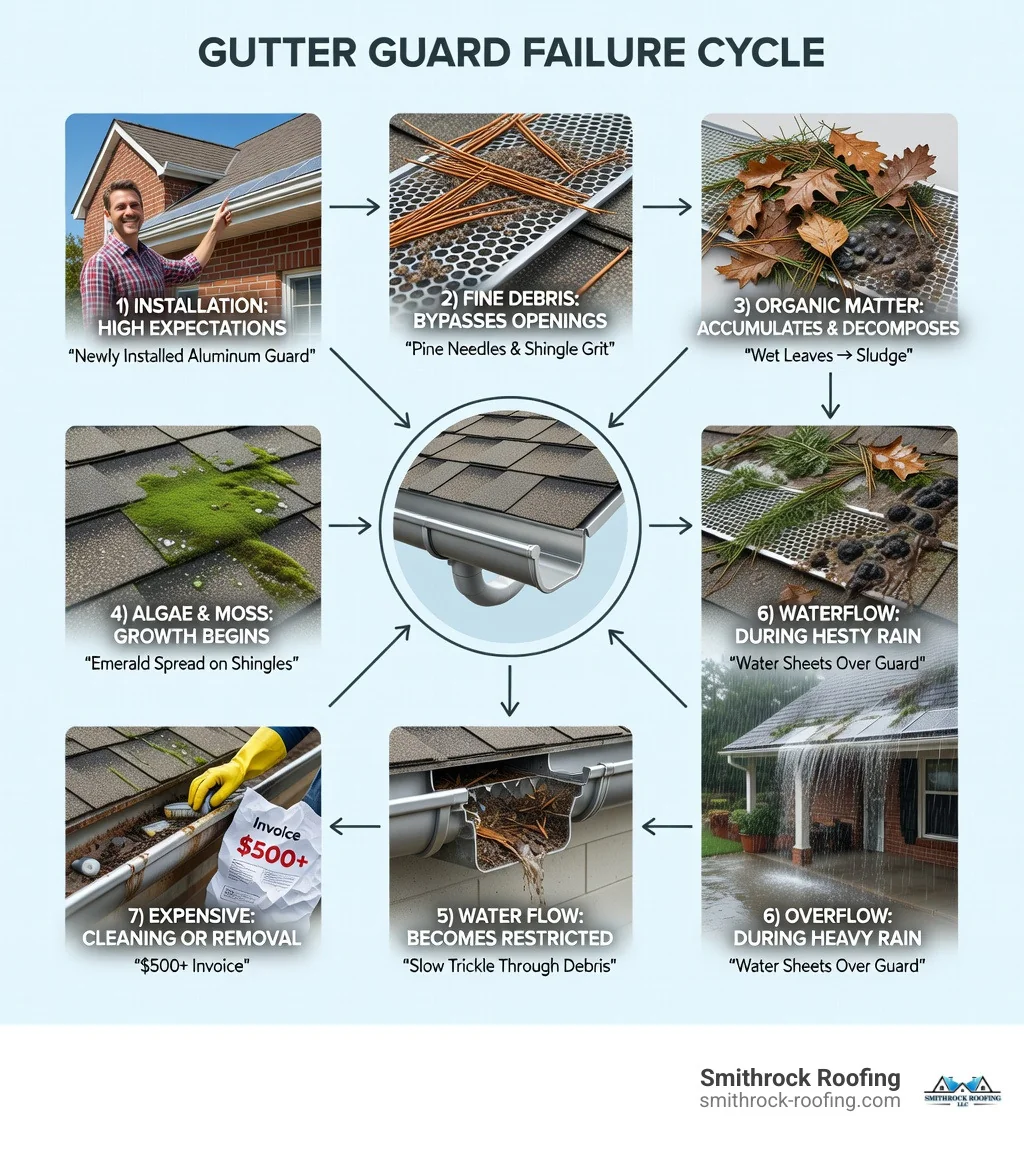
Many homeowners invest in gutter guards, expecting to never climb a ladder again. The reality? You’ll still need regular maintenance, but now it’s harder to perform. Cleaning debris on top of guards is often more difficult than cleaning gutters themselves because the debris becomes matted into the mesh. And when fine particles do slip through the holes, they create a sludge that’s nearly impossible to remove without dismantling the entire system. Before you spend thousands on a system that might create more problems than it solves, let’s examine exactly why gutter guards often disappoint homeowners who trusted the hype.
Why gutter guards are bad terms you need:
We’ve all seen the commercials. A smiling homeowner stands safely on the ground while their neighbor teeters on a ladder, pulling handfuls of muck out of an open gutter. The pitch is enticing: buy our product, and you’ll never have to clean your gutters again. Unfortunately, in our experience across North Carolina, from Winston-Salem to Greensborothis is rarely the reality. The idea of “maintenance-free” gutters is a myth. While a guard might stop a large oak leaf from entering the trough, it doesn’t stop the smaller, more insidious debris. Over time, these particles accumulate, creating a mess that is actually more difficult to manage than it would be in an open system.

The biggest culprit in the failure of these systems is fine debris. If you live in an area with pine trees or heavy pollen, you know that nature doesn’t just drop big leaves. It drops a variety of microscopic and thin materials that are perfectly designed to defeat gutter guards:
When these particles bypass the guard, they create a hidden blockage. Because you can’t see into the gutter, you won’t know there’s a problem until water starts backing up into your eaves or overflowing onto your foundation. For more on how to spot these issues, check out our Gutter Repair Winston Salem Guide. You can also learn more about why these promises fall short in our post on Busted: 5 Common Gutter Guard Myths.
When a standard gutter gets dirty, you scoop it out with a simple tool or your hands. When a guarded gutter gets dirty, the job becomes a complex engineering project. Many professional cleaning companies actually charge a “guard surcharge” because the work is so much more intensive. You often have to unscrew or unclip the guards to reach the sludge underneath. If you have a “reverse curve” or “helmet” style system, you might not be able to clean it at all without specialized high-pressure tools. This obscured visibility is a major reason why gutter guards are bad for long-term home health. If you find yourself in this predicament, you might need to search for Gutter Repair Near Me to find a professional who can safely dismantle the system to clear the blockage. Furthermore, the act of removing and reinstalling these guards repeatedly can strip the screw holes in your gutters, leading to loose components that rattle in the wind.
Need a hand with this in Winston-Salem, Greensboro and the NC Triad? Call (336) 971-0464 or request a free estimate. Honest answers, no pressure.
Even homeowners who accept that guards need occasional maintenance often make costly errors in the process. If you’ve got a guarded system, here are the mistakes we see most frequently on service calls throughout the Triad area, and what to do instead.
The bottom line is that cleaning gutters with guards is a more involved, more time-consuming job than cleaning open gutters. It requires the right tools, the knowledge of how your specific guard type attaches, and the patience to address the interior trough, not just the visible surface on top.
One of the most alarming things we see at Smithrock Roofing is how gutter guards can actually damage the very roof they are supposed to protect. A gutter system is designed to work with your roof, not against it. When you introduce a third-party product that interferes with that relationship, the structural integrity of your home is at risk. This is particularly true in our area, where varied weather puts constant stress on roofing materials. From the scorching heat of summer to the sudden ice storms of winter, your roof needs to expand, contract, and breathe. Gutter guards often prevent this natural process.
This is one of the most important questions a homeowner can ask before purchasing any gutter guard system — and unfortunately, it’s one most salespeople avoid answering directly. The short answer is: yes, certain installation methods can and do void your roof warranty, and the consequences can be financially devastating.
Many popular gutter guard products require the installer to slide the edge of the guard under your first or second row of shingles. This is a massive red flag. Most shingle manufacturers, such as GAF or CertainTeed, have strict guidelines about “disturbing” shingles after they’ve been installed. According to the Asphalt Roofing Manufacturers Association (ARMA)the proper installation and layering of roofing materials are vital to the system’s overall performance and longevity.
Here’s specifically how gutter guard installation can trigger a warranty void:
Before choosing any add-on, it’s wise to consult a professional Gutter Installation Service that understands the delicate balance of your roof’s ecosystem. If you’re unsure whether a guard system was installed in a way that compromised your warranty, have a certified roofing contractor inspect the shingle edge before a problem develops — not after a leak forces your hand.
Gutters are attached to your fascia boards using hangers or spikes. These boards are strong, but they have a specific weight limit. A standard gutter is designed to carry water, which is heavy (about 8.3 pounds per gallon), but that water is meant to be moving. However, when you add the weight of the guard itself, plus the weight of wet debris trapped on top, plus a layer of North Carolina snow or ice, you are asking for trouble.
The added weight can cause the gutters to sag or pull away from the house entirely. This doesn’t just damage the gutters; it can rip the fascia board right off the rafters. This leads to a domino effect of repairs involving the Cost of New Fascia, Soffit, and Guttering. Proper Gutter and Downspout Installation is about more than just catching rain; it’s about weight distribution and structural safety. When a gutter pulls away, it creates a gap where water can run down the side of your home, leading to siding rot, window frame damage, and eventually foundation issues. In some extreme cases, we have seen entire gutter runs collapse under the weight of ice-laden guards, causing damage to landscaping and vehicles parked below.
When homeowners research gutter guards, they often find enthusiastic manufacturer websites and mixed consumer reviews. What’s rarely explained upfront is that the problems with gutter guards tend to fall into predictable categories — and every major guard type has at least one serious weakness.
No guard type is immune to the fundamental problem: debris accumulates wherever water slows down, and guards slow water down. The only question is where the accumulation happens — on top, inside, or at the downspout — and how difficult it is to address when it does.
Physics doesn’t care about marketing brochures. Gutter guards are designed to work in “ideal” conditions, a light, vertical rain with no wind and a perfectly clean surface. But in the real world, weather is messy. In our area, we get heavy summer downpours and winter ice storms, both of which reveal the fundamental flaws in guard design. When the weather gets extreme, the very device meant to protect your home often becomes the primary cause of its damage.
During a typical North Carolina winter, we experience frequent freeze-thaw cycles. Gutter guards, especially the metal screen or solid hood types, are “first to freeze.” Because they sit on top of the gutter, they are exposed to the cold air from both above and below, unlike the bottom of the gutter which is somewhat insulated by the house.
When snow on your roof melts due to heat loss from the attic and hits a frozen gutter guard, it can’t enter the gutter. Instead, it freezes on top, creating a solid sheet of ice. This leads to:
If your system has already suffered from winter damage, you may be looking at the Gutter Replacement Cost Per Foot sooner than you expected. For a deeper dive into these issues, read our Expert Gutter Installation Guide.
Have you ever seen water shoot right over a gutter during a thunderstorm? This is known as the “waterfall effect,” and it’s a common complaint with reverse-curve or solid-hood guards. These systems rely on the physical principle of surface tension to pull water into a small slot. This phenomenon occurs because water molecules are more attracted to each other than to the air, causing the liquid to behave as if its surface were covered with a stretched elastic membrane.
However, if the guard is dirty (which they always are due to pollen and dust), the water loses its grip and shoots straight past the gutter. This water then falls directly against your foundation, leading to basement leaks and soil erosion. The velocity of water during a heavy North Carolina downpour, which can often exceed several inches per hour according to data from the National Weather Serviceoften exceeds the capacity of these systems to redirect it. In these cases, you might need to invest in an expensive Downspout Drain Pipe system just to move the water that your gutters failed to catch. You can find more details on these performance gaps in What Is the Downside of Gutter Guards? The Complete Homeowner’s Guide. The waterfall effect is particularly damaging because it concentrates the force of the rain into a single line along your foundation, which can quickly wash away mulch and topsoil.
One of the most unpleasant reasons why gutter guards are bad is that they create a “protected” environment for pests.
Furthermore, the decomposing organic matter trapped under a guard fosters mold and mildew growth. This can eventually spread to your siding or roof deck, compromising the air quality near your home’s entry points. If you’re dealing with drainage issues caused by these blockages, you might consider Burying Gutter Downspout lines to keep water away from the house, but that doesn’t solve the problem at the roofline.
So, if gutter guards aren’t the answer, what is? At Smithrock Roofing, we believe in a “back to basics” approach that actually works for homeowners in Winston-Salem and Greensboro:
If you are curious about the investment required for these systems, you can check the Cost to Install Gutter Guards Per Foot, but remember to weigh that against the long-term maintenance costs we’ve discussed. Often, the most sustainable path is a high-quality gutter system maintained by regular, professional care.
Yes — and there are several, depending on your home, your local tree canopy, and the type of guard you install. The most consistent downside is that guards do not eliminate maintenance; they change the nature of it, usually making it more difficult and more expensive. Open gutters are easy to scoop clean. Guarded gutters require removing panels, scrubbing mesh, and clearing sludge from a trough you can’t easily see into. Beyond maintenance, the structural risks are real: weight loading on your fascia, ice dam formation in winter, and the potential to void your roof warranty if shingles are disturbed during installation. The “waterfall effect” during heavy rain is another frequently reported downside — water overshoots the guard entirely and pours directly against your foundation rather than being channeled away from it. For most homeowners in the NC Triad, the combination of these downsides outweighs the convenience of reduced leaf cleanup.
No. Almost no manufacturer will guarantee that you will never have to clean your gutters. Most warranties only cover the gutter itself from “clogging,” not the guard. You will still need to clear debris off the top and occasionally flush out the fine silt that accumulates inside. If you ignore them, the buildup will eventually render the system useless.
Yes, and this is one of the more serious risks associated with poorly installed guards. If a guard is installed by sliding its flange under your shingles, it can disrupt the shingle’s natural drainage path and break the factory-applied sealant strip. Over time, this creates a channel where water is wicked upward through capillary action rather than shed downward — a process that slowly saturates your underlayment and roof deck without any visible sign of a leak until significant damage has already occurred. Additionally, frozen guards in winter contribute directly to ice dam formation, which forces meltwater back under the shingles and can lead to interior ceiling leaks, damaged drywall, and compromised insulation. Any guard installation that physically contacts or modifies your shingles carries this risk, which is why having a certified roofing contractor evaluate the work before and after installation is so important.
Most are not. Pine needles are notorious for “spearing” through mesh or sliding into the slots of reverse-curve systems. Small seeds like those from maple trees can also get trapped in the mesh and begin to grow, turning your gutters into a planter. Once the roots take hold, the guard usually has to be replaced.
Independent consumer testing consistently finds that no gutter guard product performs as advertised in all conditions. Reviewers frequently note that micro-mesh guards — often the highest rated category in controlled tests — still require regular cleaning in real-world environments, particularly in areas with heavy pollen or pine tree coverage like much of the NC Triad. Solid-hood and reverse-curve systems consistently receive criticism for the waterfall effect during high-volume rain events. Consumer feedback also highlights poor long-term value: the installed cost of a premium guard system is substantial, and once homeowners factor in ongoing maintenance, the financial case for guards weakens significantly. The general consensus from independent sources mirrors what we observe in the field — no guard is truly maintenance-free, and the best system for any home depends heavily on local conditions, roof pitch, and tree coverage rather than brand reputation alone.
In dry climates or during drought periods, gutter guards can actually increase fire risk. Dry leaves and pine needles that sit on top of the guards are highly flammable. If an ember from a nearby fire or a firework lands on this dry bed of debris, it can ignite right next to your roofline and fascia, potentially spreading the fire into your attic much faster than if the debris were tucked inside a damp gutter.
Many homeowners find that bulky “helmet” style guards are unsightly. They create a thick, visible line along the roof edge that can clash with the home’s architecture. While some low-profile mesh systems are less visible, they still change the clean lines of your roof and can become stained with algae and pollen over time, making them look dingy and unmaintained.
At the end of the day, your gutters have one job: to move water away from your home as quickly and efficiently as possible. In our experience serving the Winston-Salem and Greensboro areas, gutter guards often hinder this process more than they help. From voiding roof warranties to creating dangerous ice dams and providing homes for pests, the risks frequently outweigh the convenience. The marketing promise of “never cleaning your gutters again” is a powerful one, but it rarely holds up to the reality of North Carolina’s weather and diverse tree life.
Before you commit to a “maintenance-free” system, we invite you to think about the long-term health of your home. Sometimes, the simplest solution, a well-installed, open gutter system and a regular cleaning schedule, is the best one. This approach ensures that water is always flowing, your roof warranty remains intact, and your foundation stays dry. It also allows for regular inspections that can catch small problems before they become five-figure disasters.
If you’re struggling with your current gutters or considering a new installation, don’t go it alone. Whether you need a Gutter Guard Installation that is done correctly and safely, or you’re looking to replace an old, failing system with high-quality seamless gutters, Smithrock Roofing is here to help. We pride ourselves on honest advice and high-quality craftsmanship. Contact us today to discuss your home’s needs and find a solution that actually works for your specific property and budget.
Need a local pro? Learn more about our gutter installation and repair in Winston-Salem.
Gutter guards are considered bad investments because they often fail to eliminate maintenance, can void roof warranties, add dangerous weight to gutters, fail during heavy rain, create ice dams, have a poor return on investment, and hide gutter problems, making them harder and more expensive to fix.
Yes, installing gutter guards can void your roof warranty if the installation method involves nailing into or lifting shingles, which often violates manufacturer terms.
No, gutter guards do not prevent the need for cleaning gutters; fine debris like pine needles, shingle grit, and moss spores can still slip through or accumulate on top, requiring cleaning.
Gutter guards fail during heavy rain because water can overshoot the guard due to surface tension issues or debris blockages, defeating the purpose of having gutters.
The hidden problems include still requiring cleaning, potentially voiding roof warranties, adding dangerous weight, failing in heavy rain, creating ice dams, having a poor return on investment, and hiding gutter problems.

Smithrock Roofing © Copyright 2026 • All Rights Reserved • Privacy Policy • Maintained by Mongoose Digital Marketing